

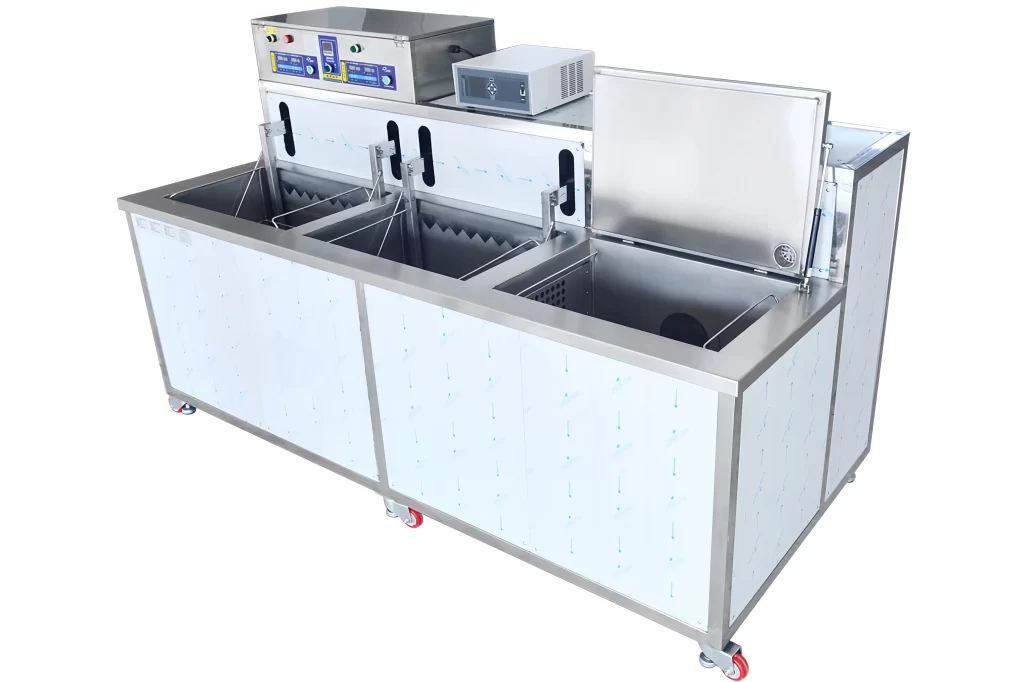
Ultrasonic cleaning is often seen as a low-risk surface preparation method because it removes contamination without mechanical scrubbing. In practice, the same cavitation field that removes grease, chips, and films can also attack the base metal if the process is not correctly matched to the part. The two visible defects that cause the most confusion are etching and pitting. Etching is a broad surface change, usually dulling or roughening of large areas. Pitting is localized material loss that appears as craters, dots, or small cavities. Both can reduce dimensional accuracy, harm fatigue life, create corrosion initiation points, and cause coating adhesion failures.
What Etching and Pitting Look Like
Etching generally appears as a uniform or patchy loss of surface brightness. On aluminum, it may look chalky or white; on brass and copper, it may appear as a dull stain; on steel, it may show as a change in shade or loss of machined tool marks. The damage is often spread across the surface and follows the areas where the cleaning chemistry has the greatest contact.
Pitting is different. The surface may still look bright between the defects, but there are discrete depressions. In early cavitation damage, pits may be small and shallow. In more advanced attack, they become deeper, undercut, or clustered. Cavitation erosion under controlled laboratory conditions is evaluated by a vibratory test method, as described in ASTM G32 [1]. That type of standardized inspection helps separate erosive mechanical damage from chemical etching.
Because etching and pitting can occur at the same time, the correction is not always a single parameter. The first step is to determine whether the driver is primarily cavitation energy, chemistry, residual contaminant, or a combination.
Why Cavitation Can Attack the Base Material
Ultrasonic cleaning works by creating alternating compression and rarefaction waves in the liquid. During the rarefaction phase, dissolved gas and vapor form bubbles. During the compression phase, those bubbles collapse violently. The collapse produces microjets and shock waves that dislodge contamination.
The same mechanical action can remove substrate material. Large, energetic bubble collapse creates repeated impact on the surface. After enough cycles, fatigue-like damage appears. The intensity is not uniform across the tank. Parts placed directly above a transducer radiating face or in a high-energy standing-wave zone receive stronger cavitation than parts in quieter areas.
Frequency is one of the strongest controls. Lower ultrasonic frequencies, including 20 kHz and 28 kHz, generally create larger bubbles and more aggressive implosions. Higher frequencies, including 40 kHz and 80 kHz, create smaller bubbles and lower surface impact. For a part that is already clean, higher energy is not better; it simply increases the risk of surface attack.
Cavitation intensity determines whether a process cleans or erodes. <Процесс ультразвуковой очистки: пошаговое техническое руководство> covers how transducer placement, generator tuning, and tank configuration change the cavitation field delivered to the part surface.
Process and Chemistry Causes
Most etching and pitting defects in production ultrasonic cleaning come from a small group of process variables.
Power density and amplitude. The electrical power delivered to the transducers is converted into mechanical energy in the liquid. When power density is too high for a delicate substrate, cavitation becomes erosive instead of cleaning. This is especially true when powerful 20 kHz or 28 kHz systems are used for long cycles on soft metals or thin sections.
Exposure time. Ultrasonic cleaning does not automatically stop when the surface is clean. If parts remain in an energized tank after the contamination is gone, the cavitation field continues to hammer the base metal. The cleanest visual result can still have damaged edges, threads, and polished surfaces.
Detergent pH and chemistry. Alkaline cleaners are effective on oils and greases but chemically attack aluminum, magnesium, zinc, and some copper alloys. Acidic cleaners remove oxides and scale but can etch steel, copper, and brass if concentration or time is excessive. Choosing a cleaner is not just about soil removal; it is also about compatibility with the substrate. Immersion corrosion testing of a candidate alloy and detergent combination can be screened using a method such as ASTM G31 [2].
Temperature. Elevated tank temperature accelerates both cleaning and chemical attack. Hot alkaline baths are more aggressive on active metals. If the heater band is too hot or the tank is not stirred properly, local temperature differences can cause non-uniform etching.
Residual chlorides and salts. Pitting on stainless steel is often traced to chloride-containing process water, fingerprints, or salt residues. When cavitation breaks the passive film, chloride ions can initiate localized attack. This is why final rinse quality and drying time matter.
Galvanic coupling. A part in contact with a dissimilar metal basket, fixturing pin, or another part can experience galvanic corrosion. The damage appears as pitting, staining, or local film formation at the contact point.
The table below summarizes the most common field symptoms and the first parameter to check.
| cURL Too many subrequests by single Worker invocation. To configure this limit, refer to https://developers.cloudflare.com/workers/wrangler/configuration/#limits | cURL Too many subrequests by single Worker invocation. To configure this limit, refer to https://developers.cloudflare.com/workers/wrangler/configuration/#limits | cURL Too many subrequests by single Worker invocation. To configure this limit, refer to https://developers.cloudflare.com/workers/wrangler/configuration/#limits |
|---|---|---|
| cURL Too many subrequests by single Worker invocation. To configure this limit, refer to https://developers.cloudflare.com/workers/wrangler/configuration/#limits | cURL Too many subrequests by single Worker invocation. To configure this limit, refer to https://developers.cloudflare.com/workers/wrangler/configuration/#limits | cURL Too many subrequests by single Worker invocation. To configure this limit, refer to https://developers.cloudflare.com/workers/wrangler/configuration/#limits |
| cURL Too many subrequests by single Worker invocation. To configure this limit, refer to https://developers.cloudflare.com/workers/wrangler/configuration/#limits | cURL Too many subrequests by single Worker invocation. To configure this limit, refer to https://developers.cloudflare.com/workers/wrangler/configuration/#limits | cURL Too many subrequests by single Worker invocation. To configure this limit, refer to https://developers.cloudflare.com/workers/wrangler/configuration/#limits |
| cURL Too many subrequests by single Worker invocation. To configure this limit, refer to https://developers.cloudflare.com/workers/wrangler/configuration/#limits | cURL Too many subrequests by single Worker invocation. To configure this limit, refer to https://developers.cloudflare.com/workers/wrangler/configuration/#limits | cURL Too many subrequests by single Worker invocation. To configure this limit, refer to https://developers.cloudflare.com/workers/wrangler/configuration/#limits |
| cURL Too many subrequests by single Worker invocation. To configure this limit, refer to https://developers.cloudflare.com/workers/wrangler/configuration/#limits | cURL Too many subrequests by single Worker invocation. To configure this limit, refer to https://developers.cloudflare.com/workers/wrangler/configuration/#limits | cURL Too many subrequests by single Worker invocation. To configure this limit, refer to https://developers.cloudflare.com/workers/wrangler/configuration/#limits |
| cURL Too many subrequests by single Worker invocation. To configure this limit, refer to https://developers.cloudflare.com/workers/wrangler/configuration/#limits | cURL Too many subrequests by single Worker invocation. To configure this limit, refer to https://developers.cloudflare.com/workers/wrangler/configuration/#limits | cURL Too many subrequests by single Worker invocation. To configure this limit, refer to https://developers.cloudflare.com/workers/wrangler/configuration/#limits |
Material-Specific Risk Factors
cURL Too many subrequests by single Worker invocation. To configure this limit, refer to https://developers.cloudflare.com/workers/wrangler/configuration/#limits
cURL Too many subrequests by single Worker invocation. To configure this limit, refer to https://developers.cloudflare.com/workers/wrangler/configuration/#limits
cURL Too many subrequests by single Worker invocation. To configure this limit, refer to https://developers.cloudflare.com/workers/wrangler/configuration/#limits
cURL Too many subrequests by single Worker invocation. To configure this limit, refer to https://developers.cloudflare.com/workers/wrangler/configuration/#limitsПромышленные ультразвуковые очистители против традиционных методов очисткиcURL Too many subrequests by single Worker invocation. To configure this limit, refer to https://developers.cloudflare.com/workers/wrangler/configuration/#limits
Prevention Controls for Production
cURL Too many subrequests by single Worker invocation. To configure this limit, refer to https://developers.cloudflare.com/workers/wrangler/configuration/#limits
cURL Too many subrequests by single Worker invocation. To configure this limit, refer to https://developers.cloudflare.com/workers/wrangler/configuration/#limits cURL Too many subrequests by single Worker invocation. To configure this limit, refer to https://developers.cloudflare.com/workers/wrangler/configuration/#limits
cURL Too many subrequests by single Worker invocation. To configure this limit, refer to https://developers.cloudflare.com/workers/wrangler/configuration/#limits cURL Too many subrequests by single Worker invocation. To configure this limit, refer to https://developers.cloudflare.com/workers/wrangler/configuration/#limits
cURL Too many subrequests by single Worker invocation. To configure this limit, refer to https://developers.cloudflare.com/workers/wrangler/configuration/#limits cURL Too many subrequests by single Worker invocation. To configure this limit, refer to https://developers.cloudflare.com/workers/wrangler/configuration/#limits
cURL Too many subrequests by single Worker invocation. To configure this limit, refer to https://developers.cloudflare.com/workers/wrangler/configuration/#limits cURL Too many subrequests by single Worker invocation. To configure this limit, refer to https://developers.cloudflare.com/workers/wrangler/configuration/#limits
cURL Too many subrequests by single Worker invocation. To configure this limit, refer to https://developers.cloudflare.com/workers/wrangler/configuration/#limits cURL Too many subrequests by single Worker invocation. To configure this limit, refer to https://developers.cloudflare.com/workers/wrangler/configuration/#limits
cURL Too many subrequests by single Worker invocation. To configure this limit, refer to https://developers.cloudflare.com/workers/wrangler/configuration/#limits cURL Too many subrequests by single Worker invocation. To configure this limit, refer to https://developers.cloudflare.com/workers/wrangler/configuration/#limits
cURL Too many subrequests by single Worker invocation. To configure this limit, refer to https://developers.cloudflare.com/workers/wrangler/configuration/#limits cURL Too many subrequests by single Worker invocation. To configure this limit, refer to https://developers.cloudflare.com/workers/wrangler/configuration/#limits
cURL Too many subrequests by single Worker invocation. To configure this limit, refer to https://developers.cloudflare.com/workers/wrangler/configuration/#limits cURL Too many subrequests by single Worker invocation. To configure this limit, refer to https://developers.cloudflare.com/workers/wrangler/configuration/#limits
cURL Too many subrequests by single Worker invocation. To configure this limit, refer to https://developers.cloudflare.com/workers/wrangler/configuration/#limitsВыбор правильной системы ультразвуковой очистки для промышленного успехаcURL Too many subrequests by single Worker invocation. To configure this limit, refer to https://developers.cloudflare.com/workers/wrangler/configuration/#limits
cURL Too many subrequests by single Worker invocation. To configure this limit, refer to https://developers.cloudflare.com/workers/wrangler/configuration/#limits
Process Support and Next Steps
cURL Too many subrequests by single Worker invocation. To configure this limit, refer to https://developers.cloudflare.com/workers/wrangler/configuration/#limits
cURL Too many subrequests by single Worker invocation. To configure this limit, refer to https://developers.cloudflare.com/workers/wrangler/configuration/#limits
Часто задаваемые вопросы
How can I tell etching from pitting?
Etching tends to affect a large area and makes the surface appear dull, chalky, or uniformly roughened. Pitting appears as discrete depressions, craters, or dots. Magnification helps: broad surface loss is more likely chemical, while localized mechanical cavities or corrosion pits point to cavitation intensity, residue, or galvanic attack.
Does higher ultrasonic power clean faster?
Not necessarily. Higher power can speed up heavy contamination removal, but beyond a certain level it begins to erode the substrate. The safer approach is to use the lowest power that achieves the required cleanliness within the production cycle time.
Can aluminum be cleaned in an ultrasonic tank without pitting?
Yes. Aluminum can be cleaned safely when the detergent is compatible, pH is controlled, temperature is moderate, frequency is high enough for the geometry, and the exposure time is limited. An immediate rinse after cleaning is also important.
Will increasing frequency prevent all pitting?
No. Higher frequency reduces cavitation intensity and lowers mechanical pitting tendency, but chemical attack, chloride residue, galvanic coupling, or excessive time can still cause defects. Frequency should be managed alongside chemistry, temperature, rinse, and fixturing.
Ссылки
[1] ASTM International, ASTM G32-16: Standard Test Method for Cavitation Erosion Using Vibratory Apparatus, ASTM International, West Conshohocken, PA, 2016.
[2] ASTM International, ASTM G31-72(2004): Standard Guide for Laboratory Immersion Corrosion Testing of Metals, ASTM International, West Conshohocken, PA, 2004.
[3] ASM International, ASM Handbook Volume 5: Surface Engineering, ASM International, Materials Park, OH, 1994.
[4] International Organization for Standardization, ISO 16232:2018: Road Vehicles — Cleanliness of Components and Systems, ISO, Geneva, Switzerland, 2018.
Если вас интересует, ознакомьтесь с этими связанными статьями:
Системы восстановления растворителей: раскрытие возможностей для снижения затрат в промышленности
Как обеспечить идеальное сцепление покрытия без водяных пятен или пятен?
Объяснение ультразвукового оборудования для очистки: Полное руководство
 Russian
 English
 German
 Spanish
 French
 Portuguese