

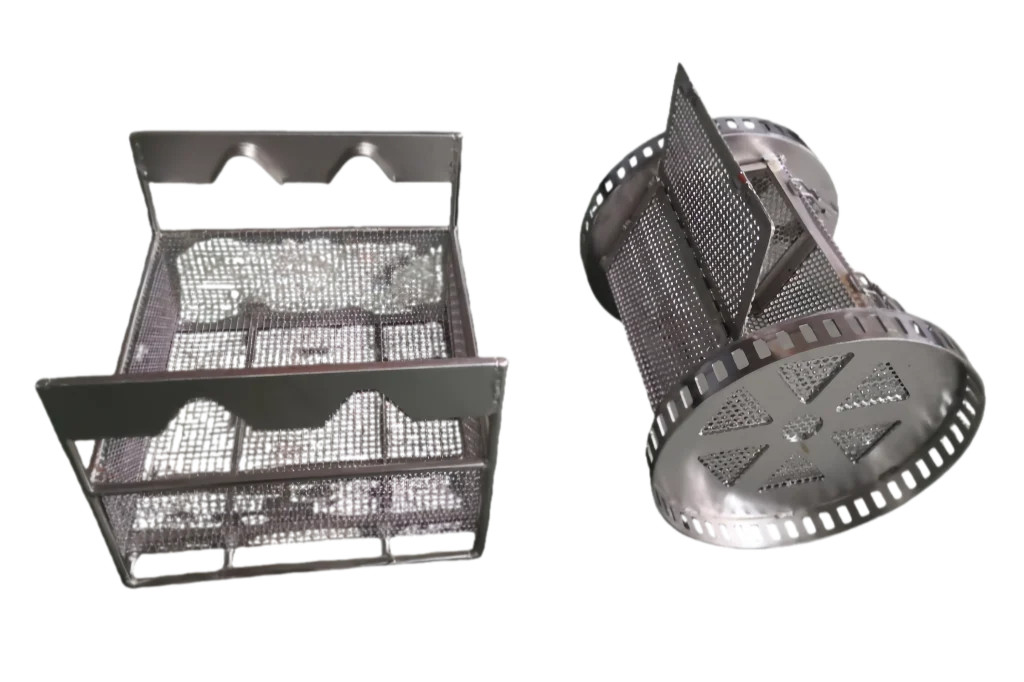
When a batch of machined parts exits a CNC cell, the cleaning step that follows isn't a commodity rinse—it's a process gate that decides whether downstream coating, assembly, or inspection will succeed. Most shops discover this when blind holes trap chips that destroy tolerance in a plasma coating chamber, or when left-over stamping oil contaminates a vacuum furnace. A stationary basket in an ultrasonic tank cleans well for simple geometries, but complex parts demand a different mechanism. Rotary basket ultrasonic cleaners automate the 360° exposure that blind holes, undercuts, and internal threads need, protecting part surfaces while delivering repeatable cleanliness across high-mix, high-volume batches. For manufacturing environments whose part variety and throughput have outpaced manual or static-tank cleaning, the rotary basket approach is worth a close look—not because it spins, but because it forces the cleaning fluid through the exact geometry that static immersion leaves untouched.
What Happens Inside a Rotary Basket Ultrasonic Cleaner
In a conventional ultrasonic tank, cavitation bubbles collapse near submerged surfaces, but the energy reaches only the face that faces the transducer—or the floor of the tank. A part tilted inside a static basket gets uneven exposure; blind holes may remain full of fluid but starved of fresh cavitation. A rotary basket changes this by continuously rotating the load through the ultrasonic field. The basket turns slowly, typically 2–5 rpm, so every part surface spends equal time oriented toward the transducer array, and centrifugal motion pushes solvent or aqueous solution through internal cavities.
The mechanism is simple, but the engineering gets specific. For heavy loads—we routinely design rotary basket systems for 500 kg to 2000 kg—the basket must not only carry the weight but also transmit ultrasonic energy without dampening. In our work at GTKCLEAN, we reinforce basket frames and pair them with high-torque drives and side-mounted transducers to ensure that the entire load sees consistent sound intensity regardless of rotation angle. A mismatch here produces "shadows" on the part, and shadow zones mean unclean surfaces that only show up in a coating adhesion test weeks later.
Basket Design: Circular vs. Square, and the Blind-Hole Problem
Not every batch cleaner needs a round basket. Square baskets are simpler and work well for flat, plate-like parts that shouldn't contact each other, especially when fixtures can separate pieces. But parts with deep blind holes, recesses, or intricate internal geometries—automotive valve bodies, bearing housings, silicone mold components—require a circular basket that rotates and tumbles the parts gently. The tumbling action continuously reorients each piece, exposing different faces to the ultrasonic field and letting gravity assist fluid exchange inside cavities.
The basket material matters just as much as its shape. Stainless steel 304 or 316 is standard for water-based and mild solvent cleaning; PTFE or PP is selected when aggressive chemicals are involved or when workpieces scratch easily. We have seen projects where a poorly chosen plastic basket absorbed up to 30% of the ultrasonic energy, measured as a drop in cavitation intensity at the part surface, simply because the material dulled the transmission. The basket is not a container—it's part of the acoustic path.
For batch processing, basket perforation pattern directly controls fluid exchange. Too little open area starves the center of the load; too much weakens the basket structure. We size perforations based on the smallest part dimension to prevent parts from wedging, while keeping open area above 40% for most applications. The difference between a basket that "works" and one that delivers zero-residue cleaning is often just the hole pattern and the wall thickness.
Process Integration: From Single Tank to Multi-Stage Automation
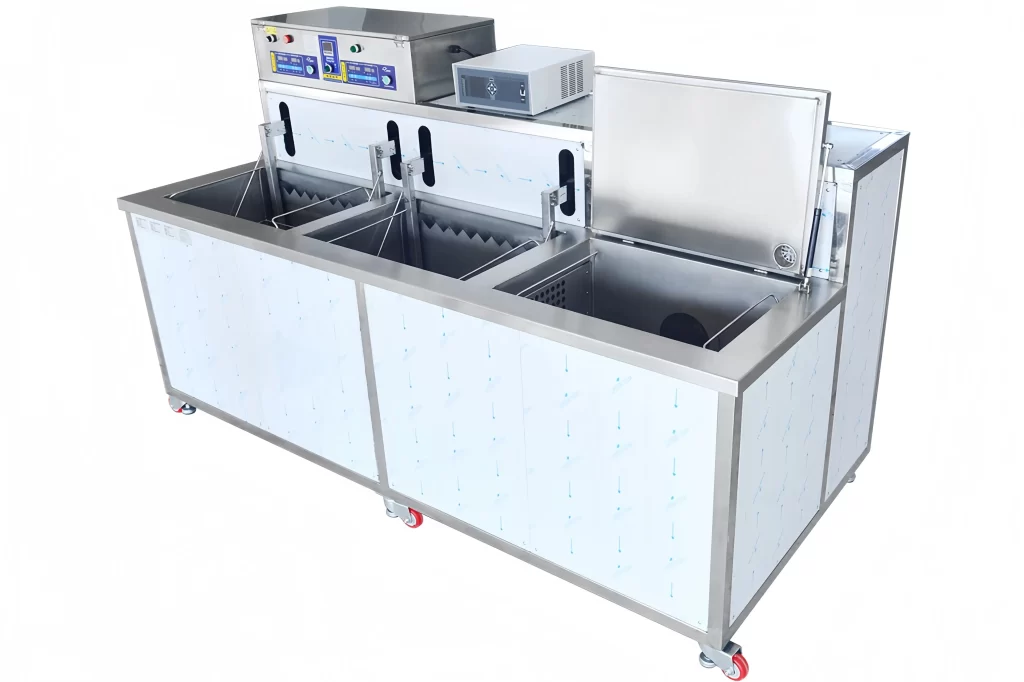
A rotary basket ultrasonic cleaner rarely stands alone. It's typically one station in a multi-tank line: ultrasonic degreasing → rinse → passivation or rust prevention → drying. The basket transfers between tanks via hoist or robotic arm, and the rotation mechanism moves with the basket or operates only in the ultrasonic tank, depending on the system architecture. The cleaning cycle per tank runs 5–8 minutes for most industrial parts, though we adjust dwell time by contaminant load and cleanliness spec.
When we design a multi-tank system for a customer, we integrate the rotary basket's rotation control with the PLC so that rotation pauses or reverses at specific points to drain pockets of retained fluid before transfer. This sounds minor, but in one case with a supplier of hydraulic manifold blocks, cross-contamination between rinse and drying tanks was traced to a single cavity that held 3 ml of dirty solution—eliminated by programming a brief reverse rotation before basket lift. These details don't appear in equipment brochures, but they separate a cleaning line that consistently meets a 0.1 mg residue spec from one that doesn't.
| Тип загрязнителя | Static Basket Result | Rotary Basket Result |
|---|---|---|
| Blind-hole chips | Incomplete removal, re-deposition risk | Mechanical + cavitation action clears >98% |
| Mold release agent | Surface-only cleaning | Penetrates undercuts, no residue |
| Stamping oil film | Uniform removal on flat faces | Even removal throughout complex geometry |
| Pre-coating particles | Varied; re-wash often needed | Consistent; one-pass meets spec |
When a Rotary Basket Justifies Its Cost
Not every batch needs rotation. If your parts are simple plates, rods, or symmetrical components with no internal features, a static ultrasonic tank with optimized transducer placement may deliver equal cleanliness at lower capital cost. But if more than 20% of your part mix includes blind holes deeper than 2× diameter, threaded features, or recesses where chips pack, the rotary basket becomes the faster path to zero defects. A static system can eventually clean those geometries with longer soak times and manual reorientation, but cycle time balloons and labor creeps in.
The economic break-even often comes from the downstream savings. A coating line that rejects 3% of parts due to residue-related adhesion failures may cut that to near zero with a rotary basket system. In our experience with automotive component suppliers, the ROI on a multi-tank rotary basket line, running two shifts, frequently falls under 18 months when factoring reduced rework, lower inspection headcount, and fewer coating scrap events. That's not a sales claim—it's the math we walk through with engineering teams during system specification.
For parts large enough that a single fixture carries the entire load—engine cylinder heads, gearbox housings—a rotary basket may not be the right solution; a stationary fixture with a part-specific transducer layout often performs better. That's why the application assessment starts with the part geometry, not the equipment catalog.
Choosing the Right Rotary Basket System
Five factors determine whether a rotary basket ultrasonic cleaner will meet your throughput and cleanliness targets: load mass and distribution, basket perforation and material, transducer frequency and placement, drying method, and automation level. We've found that many first-time buyers focus on ultrasonic power and tank volume while overlooking basket engineering, which then limits the system. If the basket flexes under load, the rotation becomes uneven and alarms trip or bearings wear prematurely—a problem we address with structural analysis at the design stage.
Frequency matters differently for batch processes than for single-part cleaning. In a rotating batch, the field must penetrate not only the basket wall but also the mass of parts between the wall and the center. Lower frequencies (20–28 kHz) provide stronger cavitation and reach the center of a dense load better; higher frequencies (40–80 kHz) deliver finer cleaning for delicate surfaces but lose penetration in thick cross-sections. We often combine multiple frequencies across tanks: a 28 kHz degrease tank followed by 40 kHz rinse for final particle removal.
The drying stage after cleaning is equally part of the batch equation. Hot air drying is economical but can leave water spots in blind holes if the basket doesn't tilt to drain. Vacuum drying addresses this by boiling residual moisture at low temperature, which we specify for components headed into vacuum coating or soldering. The basket rotation speed during drying steps also affects outcome—too fast and parts shift; too slow and pooled water remains. We typically reduce rotation speed to 1 rpm during hot air drying and use pulsed rotation during vacuum drying.
Common Questions About Rotary Basket Ultrasonic Cleaners
In practical terms, what makes a rotary basket system deliver cleaner blind holes than a static tank with the same ultrasonic power?
The rotation does three things simultaneously: it continuously changes the angle of attack for cavitation bubbles so that no internal surface remains shadowed; it tumbles parts so that trapped chips and fluid pockets drain mechanically; and it moves fresh solution through cavities instead of relying on diffusion. In a static tank, the fluid inside a blind hole may cavitate but the contaminant stays suspended until the basket is pulled, then re-deposits. Rotation flushes that loop.
How do you prevent part damage during rotation and tumbling?
cURL Too many subrequests by single Worker invocation. To configure this limit, refer to https://developers.cloudflare.com/workers/wrangler/configuration/#limits
Is it possible to run multiple part families in the same rotary basket without cross-contamination?
cURL Too many subrequests by single Worker invocation. To configure this limit, refer to https://developers.cloudflare.com/workers/wrangler/configuration/#limits
What should I plan for maintenance and consumables with a rotary basket system?
cURL Too many subrequests by single Worker invocation. To configure this limit, refer to https://developers.cloudflare.com/workers/wrangler/configuration/#limits
cURL Too many subrequests by single Worker invocation. To configure this limit, refer to https://developers.cloudflare.com/workers/wrangler/configuration/#limits
Если вас интересует, ознакомьтесь с этими связанными статьями:
Мойка деталей на водной основе: Техническое руководство для производителя
Оптимизация промышленной очистки для снижения затрат на растворы
 Russian
  English
  German
  Spanish
  French
  Portuguese