
Selecting ultrasonic cleaning systems for medical devices is a decision that directly impacts cleaning validation, production throughput, and regulatory compliance. After two decades of engineering automated cleaning solutions for a wide range of industries, I have seen that the most reliable path to consistent, validated cleanliness lies in multi-tank automated configurations with precisely controlled ultrasonic frequency, ultrapure water rinsing, and hot air or vacuum drying. This article examines the hardware features, validation requirements, and supplier evaluation criteria that determine whether a system will meet the demands of medical device manufacturing in daily production, not just in a specification document.
Medical Device Cleanliness Standards Demand Validated Ultrasonic Cleaning
Manufacturers of surgical instruments, implants, and diagnostic components operate under standards that leave little room for cleaning variability. ISO 13485 requires documented process control, while guidelines such as AAMI TIR30 and FDA expectations for cleaning validation push for repeatable, measurable results. The challenge is not simply removing visible contaminants. Particle counts in the single-micron range, low bioburden levels, and the absence of process residues like cutting fluids or polishing compounds all come into play.
Ultrasonic cavitation reaches threads, blind holes, and internal lumens that spray or manual cleaning cannot touch, which is why it has become the backbone of medical device cleaning. However, cavitation alone does not guarantee a validated process. Without tight control over frequency, power density, chemistry, and rinsing—and without automation to eliminate operator variability—batch consistency drifts. I have observed programs where manual ultrasonic stations produced acceptable results during initial validation but failed routine monitoring six months later, simply because small operator differences added up.
Ultrasonic Cleaning Systems for Medical Devices Must Meet Rigorous Requirements
Medical device cleaning lines are not generic industrial washers. They demand specific engineering choices that affect both part safety and process repeatability.
Tank and wetted material compatibility. Tanks and piping are typically fabricated from 316L stainless steel rather than standard 304 because the lower carbon content and molybdenum addition improve corrosion resistance, especially when chloride-containing cleaners are used for passivation or bioburden control. Material selection matters for another reason: any metal ion release into the cleaning bath can compromise biocompatibility testing later.
Frequency selection and power calibration. Low-frequency ultrasonics near 20–25 kHz provide aggressive cavitation suitable for robust instruments and heavy machining residues. Higher frequencies in the 40–80 kHz range produce gentler, more uniform cleaning that preserves delicate surfaces, including those with passivation layers or thin coatings. The power density must be calibrated to the tank volume and part load; underpowering leaves contamination behind, while overpowering risks surface pitting. In systems we design, the ultrasonic generator output is mapped to the actual liquid load to maintain consistent cavitation intensity across production runs.
Rinse water quality. Tap or even reverse osmosis water can leave dissolved solids on device surfaces—a direct conflict with cleanliness specifications for implantable or blood-contact devices. Medical-grade configurations integrate a deionized (DI) water loop that maintains rinse water conductivity at or below 0.06 µS/cm, eliminating water spots and ionic contamination. GTKCLEAN’s pre‑PVD parts ultrasonic cleaner platform, for example, pairs ultrapure water rinsing with air knife and hot air drying to meet high‑reliability coating and medical device requirements within a single automated line.
| Параметр | Standard Industrial Washer | Medical-Grade Configuration |
|---|---|---|
| cURL Too many subrequests by single Worker invocation. To configure this limit, refer to https://developers.cloudflare.com/workers/wrangler/configuration/#limits | cURL Too many subrequests by single Worker invocation. To configure this limit, refer to https://developers.cloudflare.com/workers/wrangler/configuration/#limits | 316L stainless steel |
| Rinse water | RO or softened water | Ultrapure DI water (≤0.06 µS/cm) |
| Drying method | Горячий воздух | Hot air + vacuum or air knife |
| Control system | Basic PLC or manual | Siemens/Mitsubishi PLC with recipe management |
| Фильтрация | Single-pass | Multi-stage recirculation |
| Validation support | Нет | IQ/OQ/PQ documentation package |
Automated Ultrasonic Cleaning Systems for Medical Devices Deliver Repeatable Validation
Single-tank manual ultrasonic benches serve well for small-batch work and contamination testing, but production-scale medical device cleaning moves quickly toward multi-station automation. The reason is straightforward: validation requires that every part experience the same thermal, chemical, and mechanical conditions. An operator transferring baskets between tanks introduces timing variation, cross-contamination risks, and inconsistent agitation—exactly the kind of sources a validation engineer cannot accept.
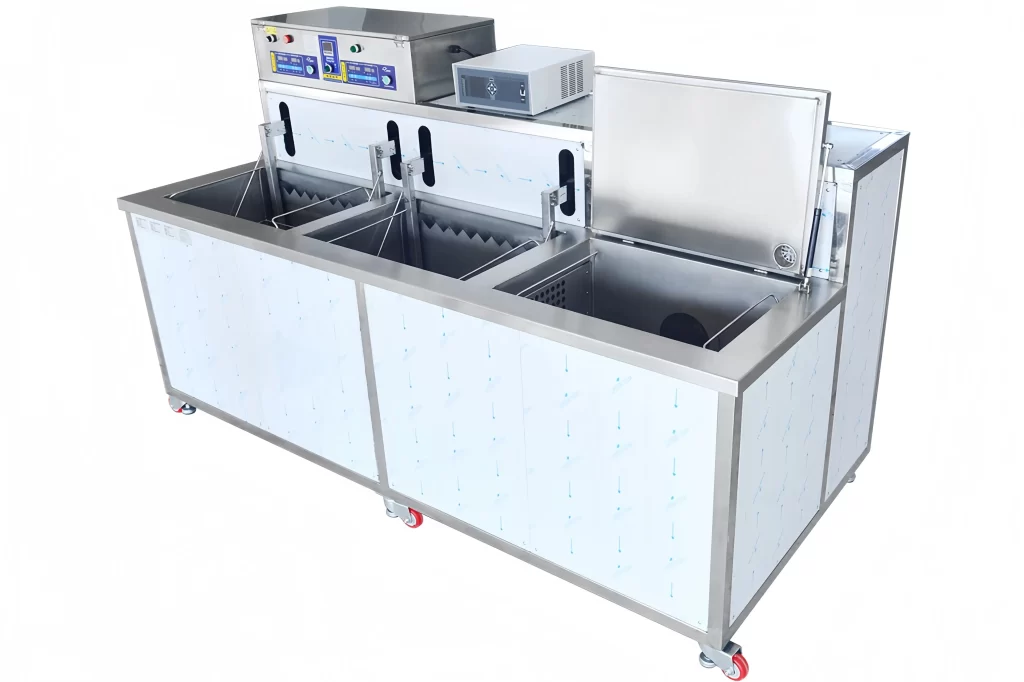
A typical automated line for medical components includes an ultrasonic wash station, multiple DI water rinse stages, and a drying module, all sequenced by a robotic or linear transfer system. Each station runs to a pre‑set recipe that governs temperature, ultrasonics on/off, and cycle time, and the PLC logs these parameters for every batch. This log becomes the objective evidence that the cleaning process was delivered as designed—a key requirement for ISO 13485 audits.
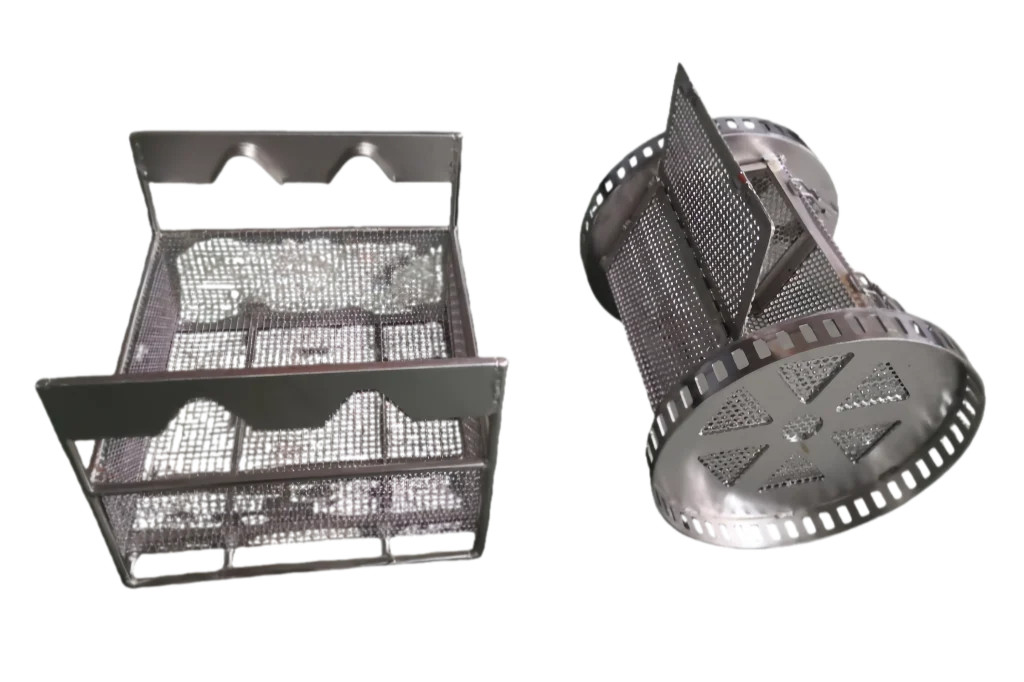
Drying is often undervalued in system specification. Residual moisture inside a lumen or under a retaining ring can host biological growth or react with sterilization gases. Vacuum drying, combined with hot air, removes water from tight internal volumes where passive evaporation fails. If your medical device parts involve blind holes or complex internal features, the cleaning basket design and drying method must be carefully matched to the part geometry. We review part prints regularly and can confirm the appropriate configuration—send your drawings to [email protected].
Validation and Documentation Processes Are Essential for Regulatory Compliance
A cleaning machine is only part of the picture. Regulatory bodies expect evidence that the cleaned device consistently meets its predefined cleanliness acceptance criteria. Installation Qualification (IQ), Operational Qualification (OQ), and Performance Qualification (PQ) form the core framework, and the cleaning system must support these activities with accessible process data, cycle reports, and alarm logs.
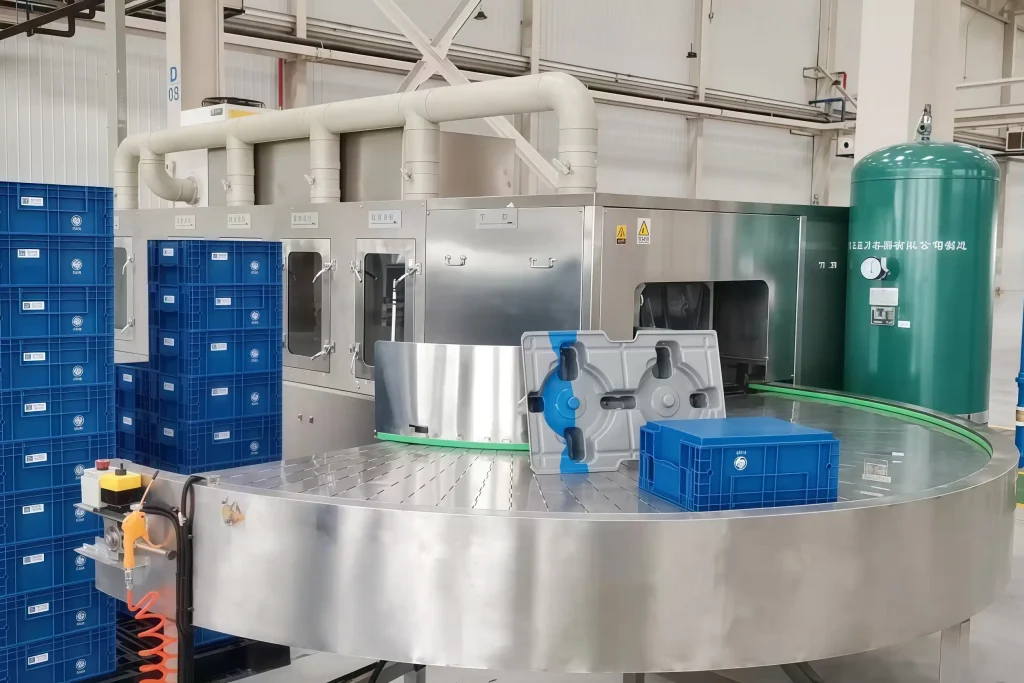
When evaluating ultrasonic cleaning systems, the ability to export time‑stamped records of temperature, ultrasonic power, rinse water resistivity, and cycle completion is not optional; it is operational necessity. A machine that cleans well but cannot demonstrate that it cleaned well on a specific Tuesday morning creates a quality system gap. The supplier’s willingness to provide validation-documentation packages and on-site calibration support often separates equipment that gets through an audit smoothly from equipment that does not.
Cleaning process validation must also account for worst‑case loading conditions: maximum number of parts per basket, parts in multiple orientations, and heavily contaminated devices. These studies are best performed in cooperation with the equipment manufacturer, who can adjust cycle parameters based on real-world test results.
Supplier Capabilities Determine Long-Term Cleaning Process Reliability
A well-designed cleaning system can perform for over a decade in a production environment, which makes supplier selection a long-term decision. Several factors deserve careful attention.
Engineering depth. The supplier should demonstrate the ability to customize tank sizes, basket layouts, and automation sequences around specific part families, not just offer a standard catalog line. In medical device manufacturing, part geometries change frequently, and a cleaning line must be reconfigurable without a full replacement.
Regulatory awareness. A supplier that has worked with medical device companies understands what an auditor expects to see in a cleaning process file—from microbial control measures to change-management documentation.
After-sales infrastructure. On‑site installation, operator training, and ongoing technical support are critical. Medical device production lines carry a high cost of downtime; a supplier with regional service capability and remote troubleshooting access minimizes that risk. GTKCLEAN operates in more than 20 countries with engineering teams that support installation, training, and remote process upgrades, which has proven essential for manufacturers expanding operations to new sites.
cURL Too many subrequests by single Worker invocation. To configure this limit, refer to https://developers.cloudflare.com/workers/wrangler/configuration/#limits
Common Questions About Ultrasonic Cleaning for Medical Devices
cURL Too many subrequests by single Worker invocation. To configure this limit, refer to https://developers.cloudflare.com/workers/wrangler/configuration/#limits
cURL Too many subrequests by single Worker invocation. To configure this limit, refer to https://developers.cloudflare.com/workers/wrangler/configuration/#limits
cURL Too many subrequests by single Worker invocation. To configure this limit, refer to https://developers.cloudflare.com/workers/wrangler/configuration/#limits
cURL Too many subrequests by single Worker invocation. To configure this limit, refer to https://developers.cloudflare.com/workers/wrangler/configuration/#limits
cURL Too many subrequests by single Worker invocation. To configure this limit, refer to https://developers.cloudflare.com/workers/wrangler/configuration/#limits
cURL Too many subrequests by single Worker invocation. To configure this limit, refer to https://developers.cloudflare.com/workers/wrangler/configuration/#limits
cURL Too many subrequests by single Worker invocation. To configure this limit, refer to https://developers.cloudflare.com/workers/wrangler/configuration/#limits
cURL Too many subrequests by single Worker invocation. To configure this limit, refer to https://developers.cloudflare.com/workers/wrangler/configuration/#limits
cURL Too many subrequests by single Worker invocation. To configure this limit, refer to https://developers.cloudflare.com/workers/wrangler/configuration/#limits
cURL Too many subrequests by single Worker invocation. To configure this limit, refer to https://developers.cloudflare.com/workers/wrangler/configuration/#limits
Если вас интересует, ознакомьтесь с этими связанными статьями:
Проектирование промышленных корзин для уборки: оптимизация производительности и долговечности
Ультразвуковые системы очистки: точность, эффективность и промышленные применения
Внедрение систем восстановления растворителей: Руководство по эффективности завода
Руководство для менеджера завода: интеграция автоматизированных линий очистки
 Russian
  English
  German
  Spanish
  French
  Portuguese