

Getting CNC machined parts completely clean before coating, plating, or assembly is a step that cannot be skipped without consequences. A single embedded chip or a film of cutting oil can cause coating delamination, a failed pressure test, or a rejected batch. Ultrasonic cleaning systems solve this by delivering consistent, repeatable results across thousands of parts, but the process itself is more than dropping a basket into a tank. The right system setup and sequence directly determine whether you get a reject or a reliable surface.
What Makes CNC Machined Part Cleaning Difficult
CNC machining leaves multiple contaminant layers on a workpiece: water-soluble and straight-oil cutting fluids, fine metallic chips packed into threads and blind holes, and sometimes a thin film of oxidation or rust preventive oil. Manual solvent wiping or spray rinsing rarely reaches internal cavities, and on complex geometries with cross-drilled holes, contamination is simply pushed deeper. Ultrasonic cavitation removes these contaminants by generating microscopic vacuum bubbles that implode on the surface, scrubbing even inside recess a brush cannot reach. However, the sonication alone is not enough. Without a properly engineered sequence of wash, rinse, and dry, recontamination happens before the part leaves the line.
Matching the System to the Part
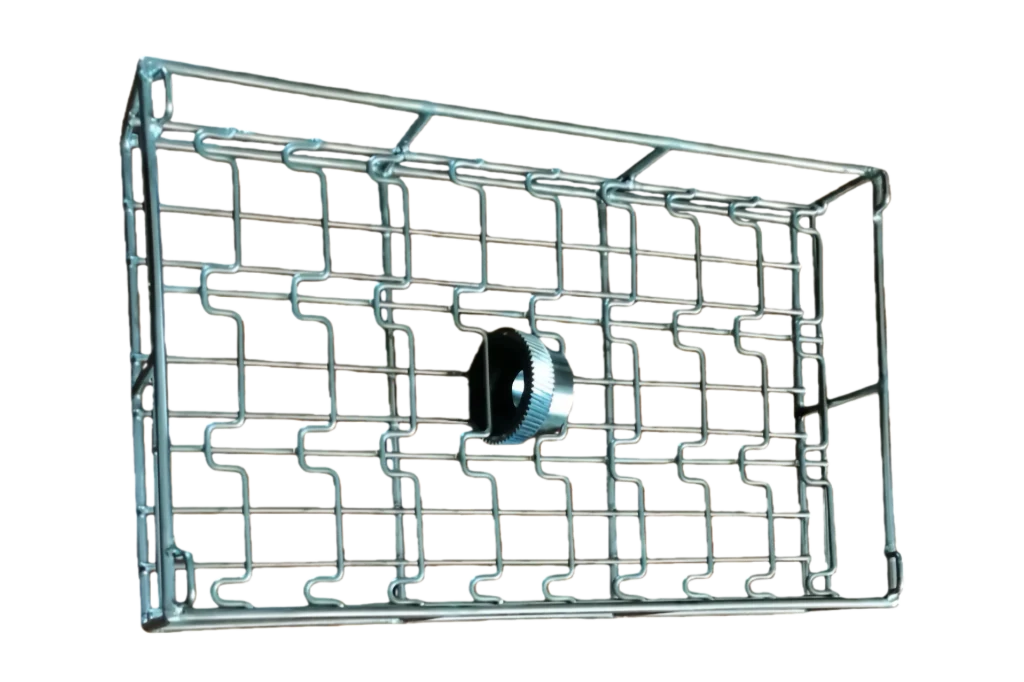
Selecting the right ultrasonic cleaning system starts with the part itself. Material, geometry, size, and the required cleanliness level determine frequency, tank configuration, and handling method. For aluminum components, 28 kHz or 40 kHz frequencies are commonly used to avoid surface etching while still removing oils. Steel parts tolerate lower frequencies like 20 kHz for heavier contamination. The basket design is equally critical. Parts must be oriented so that cavitation reaches every cavity, and the basket must prevent part-to-part contact scratches. We have seen programs where a rotary basket eliminated a 15% rework rate on parts with deep blind holes because it continuously changes the part orientation, exposing trapped air pockets to the cleaning action. For heavy or large machined housings, a square basket in a multi-tank system with robotic transfer often makes more sense.
The Core Cleaning Sequence
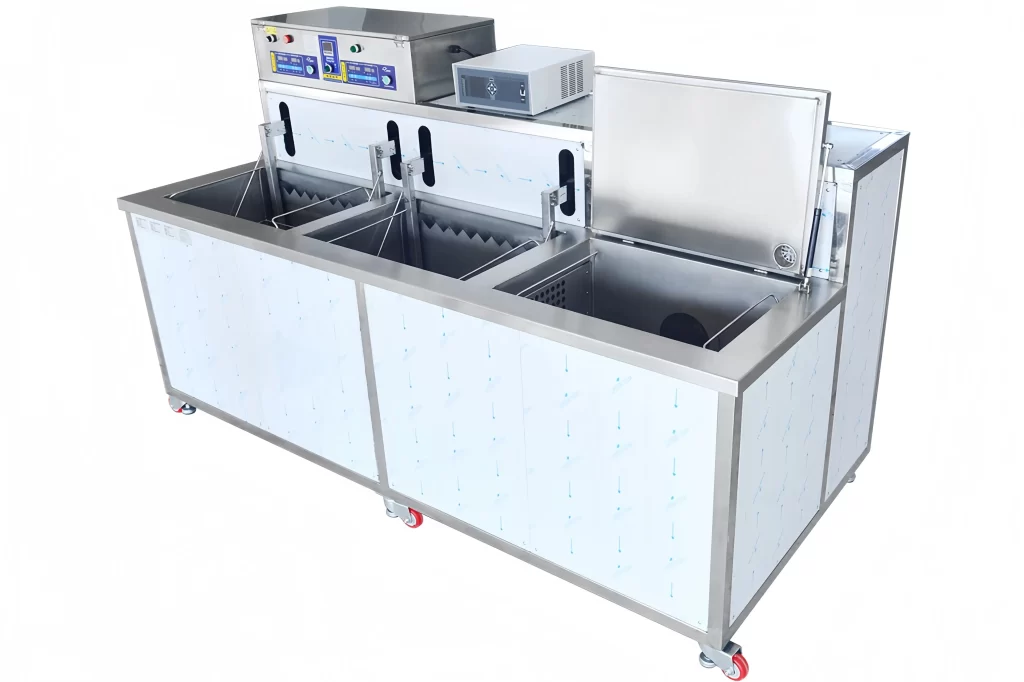
A production-grade ultrasonic cleaning line for CNC parts almost always uses multiple stages. A typical four tank sequence works like this:
- Pre-wash: High-pressure spray or immersion with recirculated cleaning solution to remove bulk chips and heavy oil before the ultrasonic tanks.
- Ultrasonic degreasing: Heated water-based detergent at 45–65 °C with immersion ultrasonic. This tank removes the remaining cutting fluid films and fine particles. We typically design this stage with overflow weirs and bag filtration to keep the solution clean for an entire shift.
- Rinse: At least two counterflow rinses, the final one using deionized (DI) water with conductivity control below 0.06 μS/cm. This step removes detergent residues that would otherwise form water spots during drying.
- Сушка: Air knife blow-off followed by a hot air recirculation zone, or vacuum drying for complex parts where water remains trapped.
Each stage's dwell time is programmable; for precision parts, 5 to 6 minutes per tank is a common starting point.
Why Drying Determines Final Cleanliness
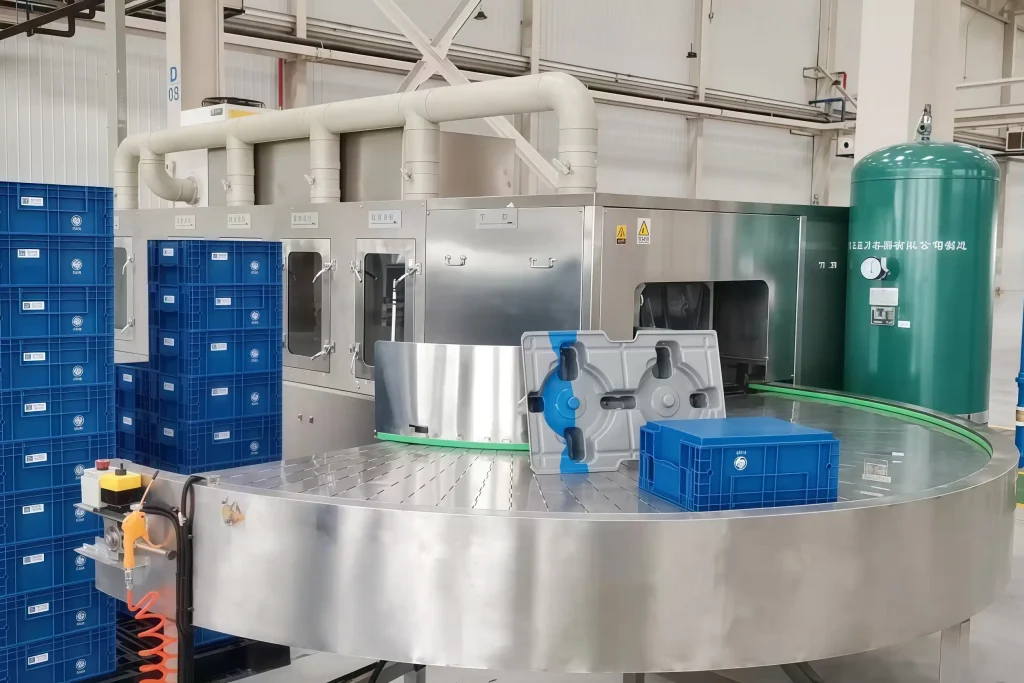
Drying is not just about removing visible moisture. If the final rinse leaves behind even a thin DI water film that air-dries slowly, dissolved solids in the ambient air can deposit and create sub micron residues. This is especially critical before PVD or CVD coating, where any stain disrupts film adhesion. For simple plate-type parts, a high-velocity air knife combined with an 80 °C hot air tunnel is sufficient. For parts with intersecting bores or blind holes, vacuum drying is far more reliable because it lowers the boiling point of water at room temperature, literally boiling it out of the pores. If your production line includes an inline washer, confirm that the drying section length and temperature profile are validated for your heaviest, most complex part geometry, not just an average sample.
Automating for Consistency
When production volumes exceed a few hundred parts per hour, manual basket transfer between tanks becomes a bottleneck and a contamination risk. Automated systems, whether robotically loaded multi-tank lines or inline conveyor designs, lock in the cleaning recipe and remove operator variability. On a recent line we configured for a manufacturer producing aluminum die-cast housings, switching from manual semi-automated tanks to a fully automatic inline system reduced cleaning cycle time by 30% and cut rejections for surface residues to under 0.2%. Key enablers were the integrated oil skimmer, automatic solution dosing, and the PLC-controlled recipe that adjusts basket speed and immersion time per part variant.
If your program involves parts with deep tight bores or pre-coating specifications, it is worth confirming the drying method and rinse water quality early in the equipment selection phase. What works in a benchtop trial often does not scale to production throughput.
Common Questions About Ultrasonic Cleaning of CNC Machined Parts
Can a single-tank ultrasonic cleaner handle CNC machined parts adequately?
A single tank can clean simple, low-volume parts if the operator manually wipes off heavy chips before loading and changes the water frequently. But for production environments, single-tank cleaning lacks the separate rinse and dry stages needed to prevent redeposition of contaminants. Parts cleaned in a single tank almost always carry a thin detergent film that later attracts dust or interferes with coating adhesion. For any part moving to plating or coating, a minimum of wash, rinse, and dry stages is required.
What is the safest frequency for aluminum parts?
Frequencies between 28 kHz and 40 kHz give good cleaning action without surface erosion on most aluminum alloys. 20 kHz creates more aggressive cavitation and can pit softer alloys, especially if the part remains stationary over a transducer. If the part has polished surfaces or thin walls, start with 40 kHz and increase power gradually while inspecting for surface change.
How do I prevent flash rust on steel parts after aqueous cleaning?
Flash rust appears within minutes on bare steel after aqueous cleaning if no corrosion inhibitor is used. The simplest approach is adding a rust inhibitor to the final rinse tank. A more robust method, which we often implement, is a post-rinse dip in a water-displacing rust preventive before drying. This also protects parts during storage between cleaning and assembly.
When should I consider solvent ultrasonic cleaning instead of water-based cleaning?
Solvent systems, such as hydrocarbon or modified alcohol cleaners under vacuum, make sense when parts are deeply recessed and water becomes trapped, or when drying must be completely residue-free without heat. They also work well for parts containing dissimilar metals that would cause galvanic corrosion in water. The trade-off is higher initial equipment cost and the need for a solvent recovery system to keep operating cost manageable. If your production line already manages solvent degreasing, solvent ultrasonic is often a direct upgrade.
If your part mix includes both simple and complex geometries, the cleaning system needs to be validated against the worst-case part. Share your part drawings and cleanliness specification with us at [email protected] or call +86 17768507147, and we can review whether a multi-stage ultrasonic system or a vacuum solvent approach will meet your throughput and quality targets.
Если вас интересует, ознакомьтесь с этими связанными статьями:
Обновление до автоматизированных ультразвуковых систем очистки для повышения эффективности
Что такое ультразвуковая волна?
Внедрение систем восстановления растворителей: Руководство по эффективности завода
 Russian
  English
  German
  Spanish
  French
  Portuguese