

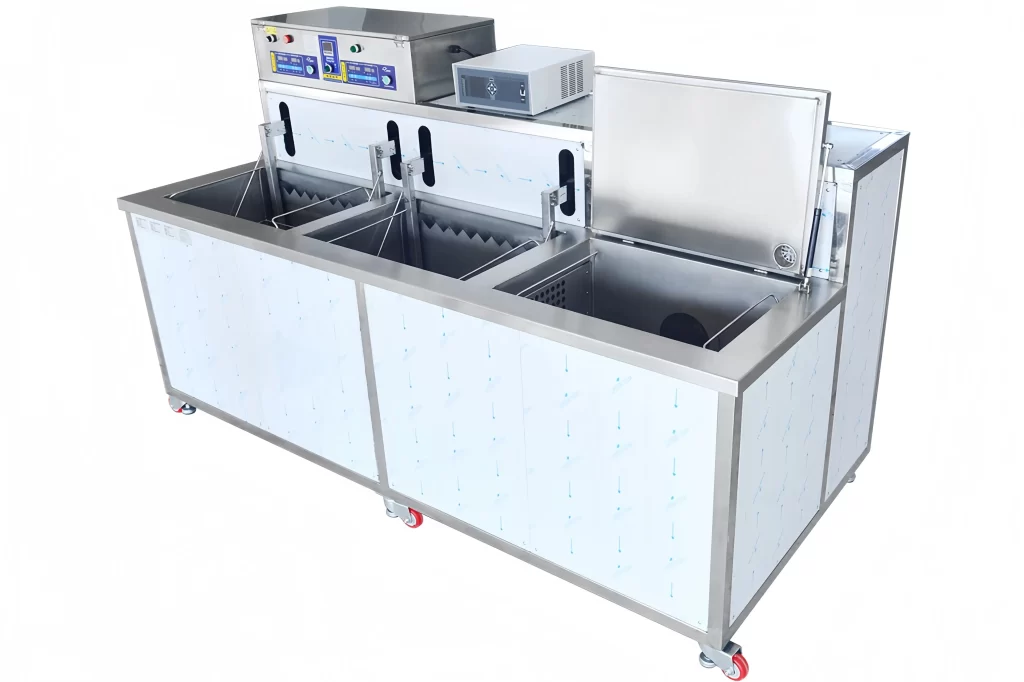
A diesel engine’s SCR catalyst doesn’t fail overnight. Pressure drop climbs gradually, fuel consumption inches up, and NOx compliance monitors start flagging excursions you can’t explain with urea dosing adjustments. By the time the catalyst is pulled for inspection, the honeycomb channels are caked with a dense mixture of ammonium bisulfate, sulfur compounds, and fly ash that a water rinse alone won’t touch. Chemical cleaning can dissolve some of it, but it risks leaching active components from the washcoat. Ultrasonic regeneration gives you a third path: targeted cavitation that strips deposits from the substrate surface without the corrosion risk of aggressive chemistry. After twenty years engineering automated cleaning systems for industrial components, I’ve seen how the same physics that cleans blind holes in aerospace parts can restore an SCR catalyst to within 5% of its original NOx conversion efficiency—provided the system is designed specifically for the substrate dimensions and contamination profile.
The Ultrasonic Regeneration Process for SCR Catalysts
Ultrasonic cleaning works through cavitation: high-frequency sound waves create microscopic bubbles in a liquid medium that collapse asymmetrically near a solid surface, generating local pressures exceeding 10,000 psi and microjet velocities over 400 km/h. When you submerge a plugged catalyst element in a tank with the right transducer arrangement, those collapsing bubbles act like millions of tiny scrubbers reaching into every channel, dislodging hardened deposits from the washcoat surface without mechanical abrasion. The process begins with a low-pressure water flush to remove loose debris, followed by immersion in a heated cleaning solution, typically a mild alkaline detergent, to soften ammonium bisulfate. Ultrasonic energy is then applied in cycles, with frequency and power density matched to the substrate material: higher frequencies near 40 kHz work well for thin-walled cordierite substrates, while lower frequencies around 20 kHz deliver the energy needed for vandium-based catalysts with heavier plugging.
Multi-tank systems add a critical rinse stage after ultrasonic treatment. We’ve found that a single-tank configuration often leaves dissolved solids trapped in the catalyst channels, which dry into a residue that re-deposits sulfates. A dedicated DI water rinse tank with overflow weirs removes these solubilized contaminants before the catalyst moves to drying. For large elements, hot air drying at 80–120°C follows, with air knife blowers to clear residual moisture from the channels. The entire cycle for a 150 mm × 150 mm × 1200 mm element runs approximately 25–30 minutes, including loading and transfer—a throughput that supports a turnaround of 12 to 16 elements per shift with a single multi-tank line.
Engineering the Ultrasonic System: Frequency, Basket, and Drying
Getting cavitation energy deep into a ceramic honeycomb is not simply a matter of turning up the power. The acoustic impedance mismatch between the liquid and the substrate causes reflection losses, and the channel geometry itself creates standing wave patterns that can over-clean the inlet face while leaving the outlet face untouched. Generator power alone is a poor predictor of results. I’ve walked clients through regeneration trials where a 3 kW system at 28 kHz with a centre-focused transducer array outperformed a 6 kW generic cleaner because the former compensated for the catalyst’s length-to-diameter ratio. The right starting point for most 300 cpsi cordierite SCR elements is 28 kHz, 10–15 W/litre power density in the tank, with transducers arranged to produce a diagonal standing wave that sweeps across the full element cross-section rather than forming a stationary node in the centre.
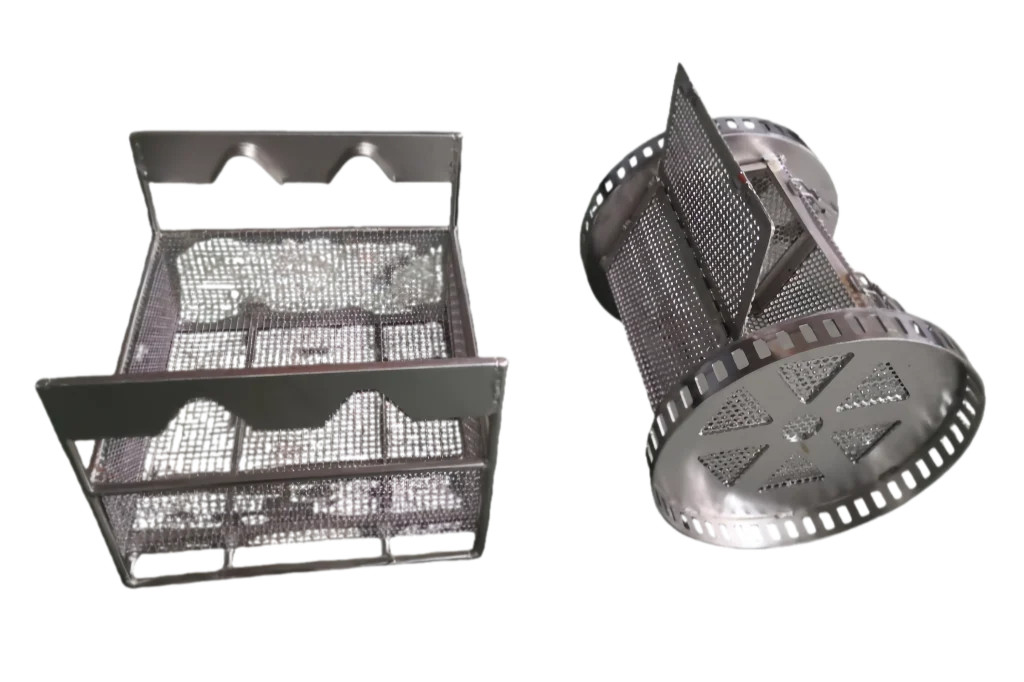
Basket design is just as critical, and it’s where the difference between a modified parts washer and a purpose-built regeneration system becomes obvious. An SCR element removed from a marine exhaust gas economiser can weigh over 60 kg. If the basket allows it to shift during agitation, the corners of the ceramic block will rub against the metal frame, causing edge chipping. We use stainless steel baskets with pressure-point foam inserts and a clamping plate that holds the element firmly against a reference surface aligned to the transducer plane. For honeycomb substrates with wall thicknesses below 0.2 mm, even minor vibration can initiate microcracks that grow under subsequent thermal cycling, so the basket must dampen rather than transmit vibration. The same basket then carries the element through the rinse and drying stations, eliminating manual handling between steps.
Drying is the often-overlooked step that determines whether the catalyst is ready for immediate reinstallation or must sit for hours. Residual moisture left in the channels reacts with residual sulfur to form a thin sulfuric acid film that etches the washcoat over time. A combination of high-velocity air knives and controlled hot air drying at a peak temperature of 120°C—never above the catalyst’s calcination temperature—removes moisture from the channel walls without thermal shock. We’ve retrofitted several systems with vacuum-assisted drying modules for elements over 300 mm in diameter, where the channel length makes convective drying alone too slow. The added capital cost pays back quickly when the fleet can reduce catalyst exchange turnaround by four hours.
Adapting Regeneration Systems for Different SCR Applications
A stationary lean-burn gas engine running on landfill gas produces a very different contaminant cocktail than a marine two-stroke engine burning heavy fuel oil. The regeneration system’s tank configuration, chemistry, and post-cleaning passivation steps must be tuned accordingly. Landfill gas engines generate silica-based deposits that are chemically inert and physically hard. Ultrasonic cavitation can fracture the silica layer, but only if the process includes a pre-soak in a potassium hydroxide solution to soften the deposit. That adds a dedicated pre-soak tank and a fume extraction system. Marine SCR catalysts, in contrast, carry high levels of vanadium and nickel from the fuel, plus sodium from seawater ingress. After ultrasonic cleaning, a citric acid rinse passivates residual metal ions that would otherwise catalyse SO₂ oxidation during operation, improving long-term stability.
Catalysts from coal-fired power plants operating at flue gas temperatures above 350°C often suffer from hydrothermal aging that deactivates the washcoat irreversibly, but the deposition pattern still warrants removal. Here, ultrasonic cleaning is primarily a preparatory step before chemical reactivation, not a standalone regeneration method. In these projects, we’ve integrated the ultrasonic station as the first module in a line that includes a catalytic washcoat replenishment bath downstream. The ultrasonic step removes physical deposits to give the reactivation chemistry direct access to the catalyst surface. Clients who skip the cleaning step and go straight to chemical treatment often find the reactivation is uneven, with treated channels showing 30–40% lower conversion than freshly cleaned ones in subsequent stack testing.
| Применение | Key Deposits | Recommended Pre-Treatment | Post-Cleaning Step |
|---|---|---|---|
| Landfill gas engine | Silica, siloxanes | KOH pre-soak | DI rinse only |
| Marine two-stroke diesel | V, Ni, Na, sulfates | None required | Citric acid passivation |
| Coal power plant (>350°C) | As, P, alkali metals | Light acid wash | Washcoat replenishment |
| Stationary natural gas engine | Ammonium bisulfate, lube oil ash | Alkaline detergent pre-wash | Hot DI rinse |
Selecting an Ultrasonic Regeneration System: What to Look For
When I review specifications from potential suppliers with an engineering team, three items separate purpose-built regeneration systems from adapted parts washers. First, the ultrasonic generator must offer multiple frequency modes: 20 kHz for heavy plugging, 28 kHz for routine cleaning, and 40 kHz for light deposits or thin-wall substrates. A single-frequency generator limits the system’s ability to handle the range of contaminants seen across an operating fleet. Second, the tank construction must accommodate the full element dimensions plus 100 mm clearance on all sides for uniform cavitation field development. An undersized tank creates standing wave dead zones that leave banded cleaning patterns visible on the catalyst face.
The third differentiator is the control system’s recipe library. A PLC with pre-loaded cleaning recipes for different catalyst manufacturers and configurations—including ramp rates, temperature limits, and dwell times—reduces operator error and makes the regeneration outcome predictable. GTK’s SCR regeneration lines, for example, use a Siemens PLC with password-protected recipe storage and automatic fault diagnostics that log every parameter for quality traceability. The touchscreen HMI displays real-time temperature, conductivity, and ultrasonic power so that an operator can spot a transducer failure immediately rather than discovering it after a batch of elements has passed through with incomplete cleaning.
cURL Too many subrequests by single Worker invocation. To configure this limit, refer to https://developers.cloudflare.com/workers/wrangler/configuration/#limits
Cost-Benefit of Ultrasonic Regeneration vs. Catalyst Replacement
cURL Too many subrequests by single Worker invocation. To configure this limit, refer to https://developers.cloudflare.com/workers/wrangler/configuration/#limits
cURL Too many subrequests by single Worker invocation. To configure this limit, refer to https://developers.cloudflare.com/workers/wrangler/configuration/#limits
cURL Too many subrequests by single Worker invocation. To configure this limit, refer to https://developers.cloudflare.com/workers/wrangler/configuration/#limits
Common Questions About Ultrasonic SCR Regeneration
Does ultrasonic cleaning damage the catalyst substrate?
cURL Too many subrequests by single Worker invocation. To configure this limit, refer to https://developers.cloudflare.com/workers/wrangler/configuration/#limits
How does ultrasonic compare to chemical cleaning?
cURL Too many subrequests by single Worker invocation. To configure this limit, refer to https://developers.cloudflare.com/workers/wrangler/configuration/#limits
Can heavily plugged catalysts be recovered?
cURL Too many subrequests by single Worker invocation. To configure this limit, refer to https://developers.cloudflare.com/workers/wrangler/configuration/#limits
How many regeneration cycles can an SCR catalyst withstand?
cURL Too many subrequests by single Worker invocation. To configure this limit, refer to https://developers.cloudflare.com/workers/wrangler/configuration/#limits
Если вас интересует, ознакомьтесь с этими связанными статьями:
Устранение остатков при очистке деталей перед покрытием: Руководство эксперта
Автоматические ультразвуковые системы очистки для передового производства
Как выбрать многотонные ультразвуковые системы для высокой производительности
 Russian
  English
  German
  Spanish
  French
  Portuguese