

When production engineers evaluate automotive ultrasonic cleaning systems for engine blocks, transmission housings, or brake components, they quickly run into a mismatch between catalog specifications and shop-floor reality. Parts that emerge from machining carry a mix of cutting oil, chips, and anti-rust film. Blind holes, internal galleries, and threaded recesses trap debris that static immersion cannot dislodge. In my two decades designing automated cleaning lines for automotive suppliers, I have seen more process bottlenecks caused by the wrong basket configuration than by an undersized ultrasonic generator. A system that delivers a consistent cleanliness level across every component in a batch is the difference between a coating line that runs uninterrupted and one that loses hours to rework. This guide maps the system configurations, automation approaches, and validation steps that matter for high-volume automotive production, drawn from engineering designs we have deployed in plants across more than 20 countries.
Automotive Component Cleaning Challenges That Standard Systems Fail
A cast aluminium engine block fresh off the machining centre poses a very different cleaning problem than a tray of stamped brackets. The block holds aluminium chips jammed into oil galleries and water jacket passages, while the brackets may be coated in a thin film of light press oil. Generic ultrasonic tanks — the kind where a wire basket is lowered into a heated detergent bath — handle the brackets acceptably, but the block typically leaves the tank with chips still lodged in narrow passages.
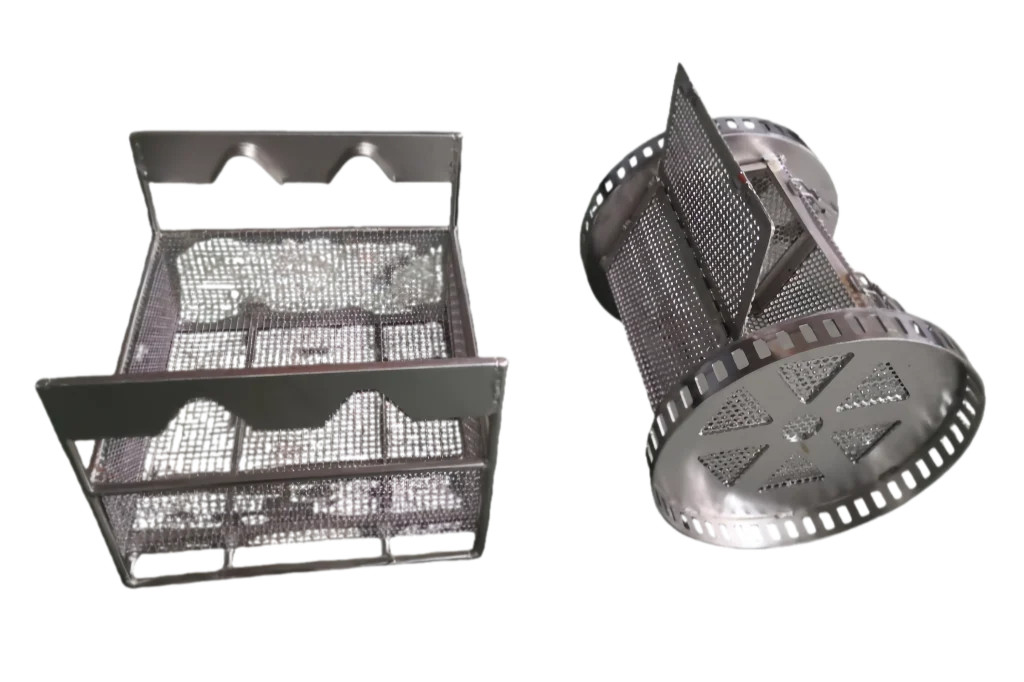
The difference is cavitation distribution. Ultrasonic energy follows the sound field, which bends around simple surfaces but loses intensity inside holes smaller than about twice the wavelength. At 40 kHz, that means cavities deeper than roughly 8 mm see much weaker cleaning action. For automotive parts with deep blind holes — bearing cages, valve bodies, hydraulic manifolds — we have found that a rotary basket which continuously reorients the part during the ultrasonic cycle outperforms a static fixture by a wide margin. The rotation moves trapped air pockets and exposes each cavity to the focused cavitation zone. In one configuration for a precision bearing supplier, switching from a square fixed basket to a 360° rotating round basket reduced particle counts after cleaning by more than half, with no change to the ultrasonic power or detergent chemistry.
Weight matters as much as geometry. Engine components — cylinder heads, crankshafts, gearboxes — regularly exceed 500 kg. A system engineered for light aluminium housings may have a tank structure and hoist that deflect under that load, misaligning the parts so that spray nozzles or cavitation zones miss the target surfaces. Heavy-load engineering — reinforced stainless steel tanks, load-bearing baskets with stiffening ribs, and robotic lifting with overload protection — becomes mandatory. We specify tank and basket reinforcement for any part load above roughly 300 kg, not simply to protect the equipment but to keep the part position stable enough that every cleaning stage is repeatable from batch to batch.
Critical System Configurations for Different Automotive Part Types
There is no single ultrasonic cleaning system that covers every automotive part profile cost-effectively. The table below groups the main configuration types by part complexity, throughput, and load, based on projects we have commissioned.
| Tipo de Sistema | Typical Automotive Use | Max Load | Etapas de Limpeza | Drying Option |
|---|---|---|---|---|
| Benchtop / Single-Tank | Small batches, prototype components, lab clean | ~50 kg | Degrease + manual rinse | Ar quente |
| Multi-Tank Manual Transfer | Medium-volume stampings, CNC parts, fastener batches | ~300 kg | Pre-clean → ultrasonic → rinse → dry | Hot air / Vacuum |
| Fully Automatic Multi-Tank | Precision parts requiring multiple stages, mid-volume | Up to 2000 kg | Ultrasonic degrease → rinse → passivation → dry | Vacuum or hot air |
| Inline / Tunnel Conveyor | High-volume uniform parts: aluminium shells, fasteners, steering shafts | Conveyor pitch limit | Spray wash → ultrasonic → rinse → air knife → hot air dry | Air knife + hot air |
| Rotary Basket (batch) | Small complex parts with deep blind holes | Up to 2000 kg | Ultrasonic degrease → rinse → optional passivation → dry | Vacuum or hot air |
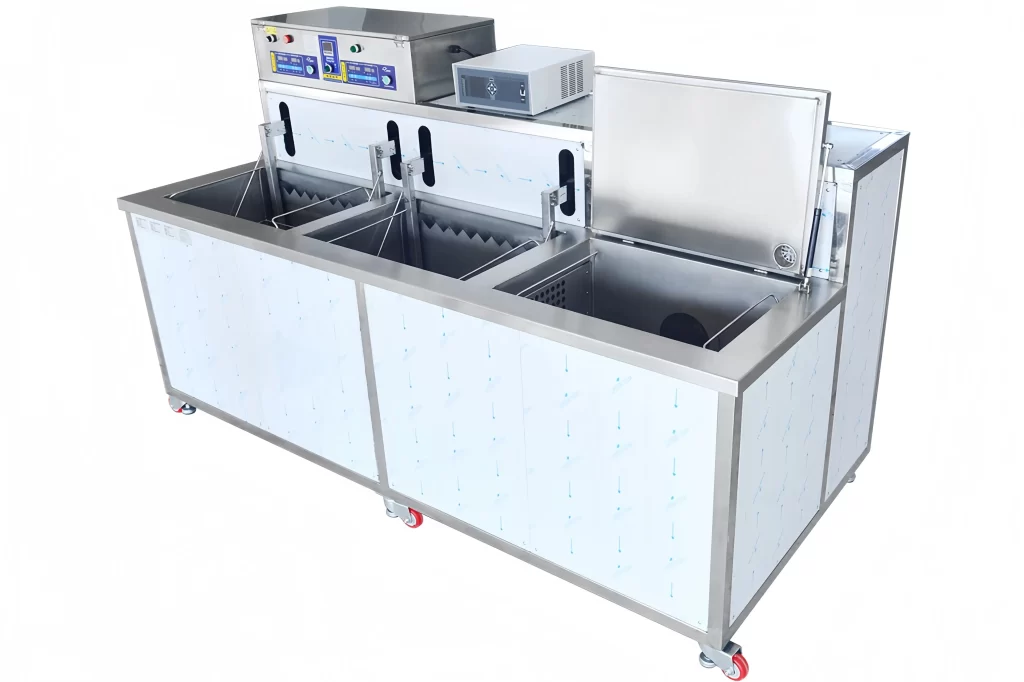
Medium-volume automotive lines that transition between part families often adopt a semi-automatic multi-tank layout. Operators transfer baskets between a heated ultrasonic degrease tank, a rinse tank, and a drying station using a manual or semi-automatic hoist. This layout keeps investment lower than a fully automated line but still delivers a multi-stage process that a single-tank cleaner cannot match. When throughput climbs above roughly 10 baskets per hour, however, manual transfer becomes the bottleneck, and an inline conveyor system starts to justify its cost through labour reduction alone.
For long runs of a single part — for example, CNC machined aluminium shells for telecom or automotive housings — an inline conveyor system with integrated spray wash, ultrasonic immersion, DI water rinse, and air-knife drying can clean, rinse, and dry a part every few seconds. The GTKCLEAN inline cleaner for aluminium shells moves parts through a 1000 mm wide conveyor at a speed of about 0.8 m/min, combining multi-direction spray nozzles with an ultrasonic station to remove release agents, chips, and fingerprints in one continuous pass. The heat recovery system in that line captures roughly 40% of the drying energy and feeds it back into the hot water heating loop, a detail that materially changes the operating cost when the line runs three shifts.
cURL Too many subrequests by single Worker invocation. To configure this limit, refer to https://developers.cloudflare.com/workers/wrangler/configuration/#limits
Integrating Automation and Production Line Flow
cURL Too many subrequests by single Worker invocation. To configure this limit, refer to https://developers.cloudflare.com/workers/wrangler/configuration/#limits
cURL Too many subrequests by single Worker invocation. To configure this limit, refer to https://developers.cloudflare.com/workers/wrangler/configuration/#limits
cURL Too many subrequests by single Worker invocation. To configure this limit, refer to https://developers.cloudflare.com/workers/wrangler/configuration/#limits
cURL Too many subrequests by single Worker invocation. To configure this limit, refer to https://developers.cloudflare.com/workers/wrangler/configuration/#limits
Automotive Cleanliness Standards and Process Validation
cURL Too many subrequests by single Worker invocation. To configure this limit, refer to https://developers.cloudflare.com/workers/wrangler/configuration/#limits
cURL Too many subrequests by single Worker invocation. To configure this limit, refer to https://developers.cloudflare.com/workers/wrangler/configuration/#limits
cURL Too many subrequests by single Worker invocation. To configure this limit, refer to https://developers.cloudflare.com/workers/wrangler/configuration/#limits
Supplier Selection: Engineering Depth Matters More Than Catalogue Breadth
cURL Too many subrequests by single Worker invocation. To configure this limit, refer to https://developers.cloudflare.com/workers/wrangler/configuration/#limits
cURL Too many subrequests by single Worker invocation. To configure this limit, refer to https://developers.cloudflare.com/workers/wrangler/configuration/#limits
cURL Too many subrequests by single Worker invocation. To configure this limit, refer to https://developers.cloudflare.com/workers/wrangler/configuration/#limits
cURL Too many subrequests by single Worker invocation. To configure this limit, refer to https://developers.cloudflare.com/workers/wrangler/configuration/#limits
cURL Too many subrequests by single Worker invocation. To configure this limit, refer to https://developers.cloudflare.com/workers/wrangler/configuration/#limits
Critical Questions About Automotive Ultrasonic Cleaning Systems
cURL Too many subrequests by single Worker invocation. To configure this limit, refer to https://developers.cloudflare.com/workers/wrangler/configuration/#limits
cURL Too many subrequests by single Worker invocation. To configure this limit, refer to https://developers.cloudflare.com/workers/wrangler/configuration/#limits
cURL Too many subrequests by single Worker invocation. To configure this limit, refer to https://developers.cloudflare.com/workers/wrangler/configuration/#limits
cURL Too many subrequests by single Worker invocation. To configure this limit, refer to https://developers.cloudflare.com/workers/wrangler/configuration/#limits
cURL Too many subrequests by single Worker invocation. To configure this limit, refer to https://developers.cloudflare.com/workers/wrangler/configuration/#limits
cURL Too many subrequests by single Worker invocation. To configure this limit, refer to https://developers.cloudflare.com/workers/wrangler/configuration/#limits
cURL Too many subrequests by single Worker invocation. To configure this limit, refer to https://developers.cloudflare.com/workers/wrangler/configuration/#limits
cURL Too many subrequests by single Worker invocation. To configure this limit, refer to https://developers.cloudflare.com/workers/wrangler/configuration/#limits
cURL Too many subrequests by single Worker invocation. To configure this limit, refer to https://developers.cloudflare.com/workers/wrangler/configuration/#limits
cURL Too many subrequests by single Worker invocation. To configure this limit, refer to https://developers.cloudflare.com/workers/wrangler/configuration/#limits
Se estiver interessado, consulte estes artigos relacionados:
Sistemas de Limpeza Ultrassónica Manuais vs Automatizados Um Guia Abrangente
Limpeza de Peças com Soluções Aquosas: Guia Técnico para Fabricantes
 Portuguese
  English
  German
  Spanish
  French
  Russian