
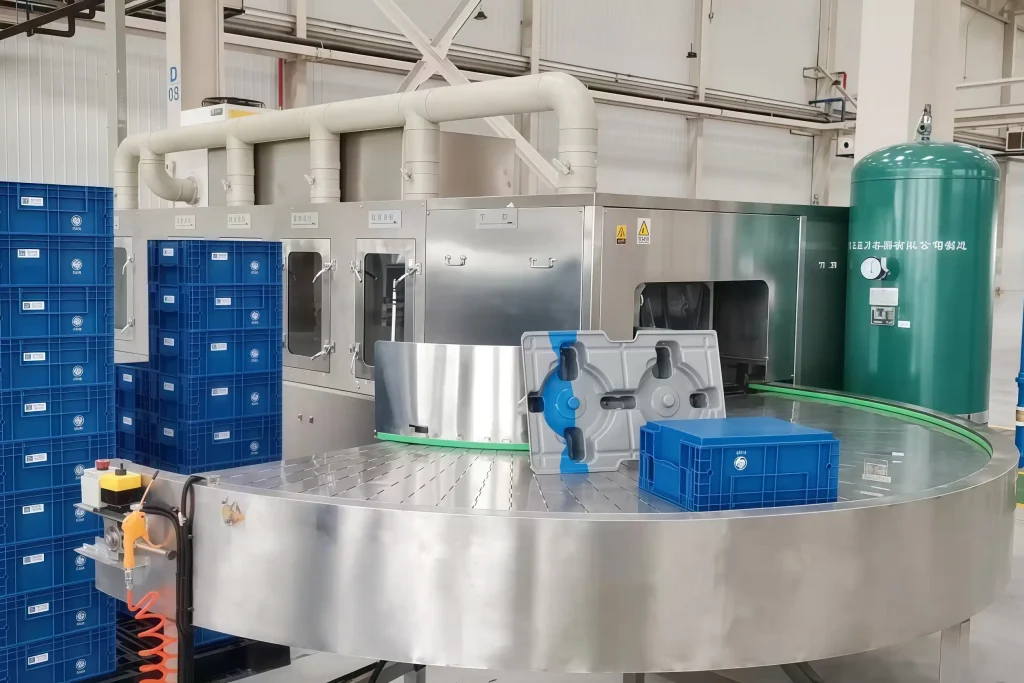
When standard off-the-shelf parts washers fall short on throughput or cannot handle your part geometry, custom conveyor belt ultrasonic cleaning systems become the practical engineering solution. These systems combine the cavitation power of ultrasonic cleaning with automated material handling, enabling continuous high-volume cleaning without operator intervention. In twenty years of designing industrial cleaning lines, I've seen well-engineered custom systems reduce labor costs by over 60% while improving cleanliness consistency across millions of parts. But getting that return depends on making the right mechanical and process decisions early—conveyor speed and load capacity, tank geometry, drying method, and how the system will tie into your existing production line.
What Sets Custom Conveyor Belt Ultrasonic Systems Apart
A standard ultrasonic cleaning machine is a batch processor. You load a basket, run a cycle, unload, and repeat. A conveyor-based ultrasonic system fundamentally changes that rhythm. Parts travel continuously through one or more cleaning, rinsing, and drying stages on a belt or chain conveyor. The ultrasonic transducers are integrated directly into tank bottoms or side walls, delivering cavitation energy to parts as they pass through.
The distinction matters most when you are handling hundreds or thousands of parts per hour, or when parts are too large to batch-load efficiently. I've worked on lines where a single gearbox housing weighed over 200 kg. Loading and unloading that piece manually between tanks would bottleneck the entire upstream machining cell. A custom overhead conveyor with an ultrasonic immersion station solved that—parts arrived suspended on fixtures, dipped into the ultrasonic tank for a programmed dwell, then lifted and moved to rinse and dry.
Design Decisions That Determine Cleaning Performance
Custom does not mean arbitrary. Every parameter is dialed in against your part and production target. The table below outlines the primary design variables we lock in during the engineering phase.
| Design Parameter | Typical Range | Key Considerations |
|---|---|---|
| Belt speed | 0.5–2.0 m/min | Throughput vs. required ultrasonic dwell time; adjustable via VFD drive |
| Frequência ultrassónica | 25–40 kHz for heavy soil; 68–80 kHz for precision parts | Lower frequencies produce more aggressive cavitation; higher frequencies avoid surface damage |
| Tank length / dwell | 1–3 meters of active ultrasonic zone | Dwell time must exceed minimum clean time; verified with test coupons during validation |
| Drying method | Air knife + hot air; vacuum for deep recesses | Parts with blind holes often trap water—vacuum or high-velocity air knife needed |
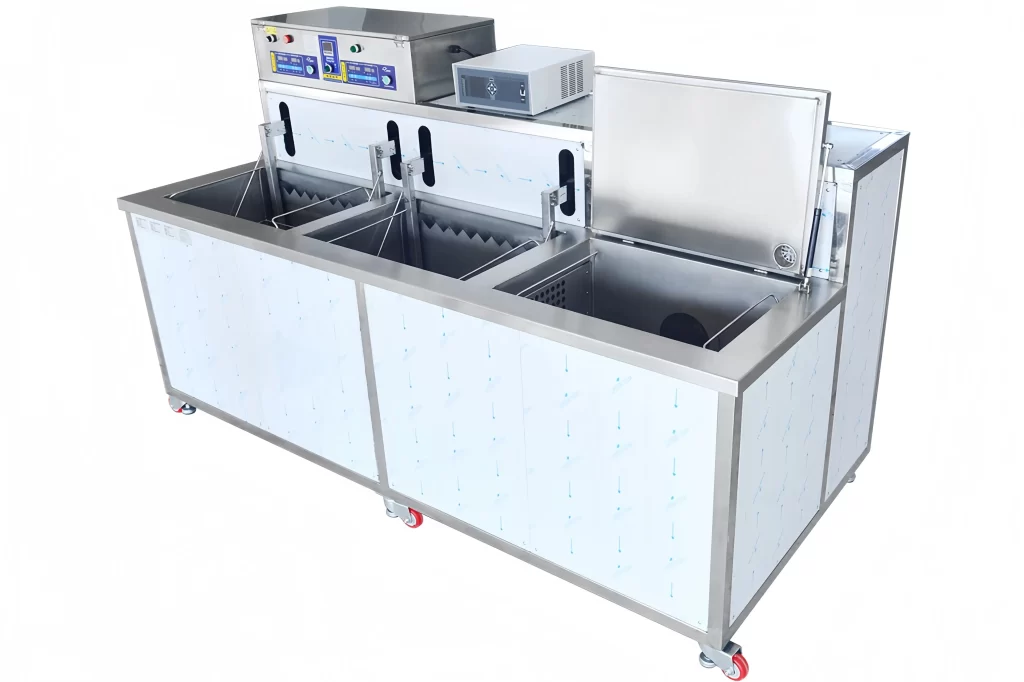
| Conveyor load | Up to 2000 kg distributed load | Basket and rail design must prevent part shift during immersion and cavitation agitation |
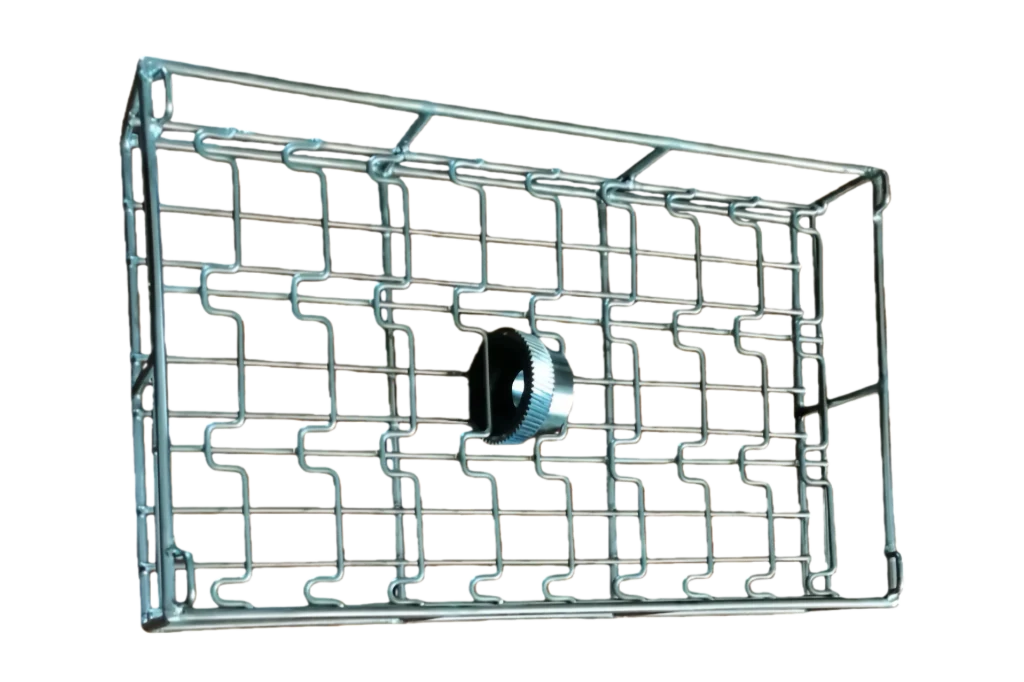
Parts that appear straightforward can still dictate the final design. We supplied a fastener cleaning line where the customer initially requested a spray-only tunnel. Testing showed that rolled threads retained drawing oil that spray could not fully remove. A 600 mm ultrasonic immersion zone added before the rinse tanks solved the problem—cycle time stayed the same because belt speed was already constrained by the drying stage.
If your production line involves multiple part families with different geometries, the conveyor system must accommodate quick-change fixturing. I've learned to reserve at least 200 mm of free board above the belt line so that later part variants with taller profiles don't force a tank rebuild.
Inline Integration Without Production Line Disruption
Integrating a custom conveyor ultrasonic cleaner into an existing plant layout is where the real engineering value shows up. The cleaning system must match the upstream and downstream equipment line heights for smooth part transfer, and the conveyor indexing must synchronize with machining or assembly takt times.
In a project for a die-cast aluminum housing line, we positioned the cleaning conveyor directly after the CNC cell. Parts exited machining and dropped onto our belt within 3 seconds, eliminating a manual handling station. The ultrasonic degreasing stage removed cutting fluid and the thin layer of mold release that had survived a previous spray wash. The air knife and hot air drying stage delivered dry parts to the leak-test station without a buffer. Total footprint was 11 meters. The previous off-line cleaning batch process had required three operators and a 40-minute buffer inventory between CNC and test; the inline system reduced that to zero buffer and a single machine tender who also monitored the cleaning line.
That kind of integration is not achievable with an off-the-shelf machine. It requires custom tank dimensions, a bespoke conveyor drive that speaks the same automation language as the cell controller, and drying capacity matched to the line speed. We typically specify Siemens or Mitsubishi PLCs for this environment because they interface reliably with most factory automation networks.
If your program involves parts with surface finish requirements that must survive ultrasonic exposure—polished aluminum or coated surfaces—it is worth confirming the frequency and power density with a sample run before finalizing your BOM. Send your part drawings to [email protected] and we'll run a test cleaning and provide a surface analysis.
Keeping Operating Costs Under Control
A custom conveyor system is a capital investment. The operating cost picture—solution consumption, energy, maintenance—determines whether it earns its keep over five to ten years.
For water-based systems, the biggest ongoing cost is usually the rinsing stage. Each liter of DI water that overflows carries away heat and detergent. We minimize this with conductivity-controlled cascading rinses: the final rinse overflows into the penultimate rinse, which overflows into the ultrasonic tank, making up for drag-out. The result is a water consumption rate roughly half that of a single-tank overflow setup.
On a system cleaning stamping oil from formed steel parts, the oil separator continuously skims surface oil and returns cleaned solution to the tank, extending bath life from an average 2 days to over 10 days. The separator alone paid for itself in under 8 months through reduced solution purchases and disposal charges.
Energy costs are dominated by tank heating and drying. Large tanks—especially those that need to hold 60–65 °C for effective degreasing—benefit from insulation and floating covers. Even a 10 mm insulation layer reduces heat loss by roughly 30%. We include tank insulation as standard on custom water-based systems above 1000 liters.
cURL Too many subrequests by single Worker invocation. To configure this limit, refer to https://developers.cloudflare.com/workers/wrangler/configuration/#limits
Common Questions About Conveyor Belt Ultrasonic Cleaning Systems
What parts are not suitable for conveyor belt ultrasonic cleaning?
cURL Too many subrequests by single Worker invocation. To configure this limit, refer to https://developers.cloudflare.com/workers/wrangler/configuration/#limits
How long does a custom system take from order to commissioning?
cURL Too many subrequests by single Worker invocation. To configure this limit, refer to https://developers.cloudflare.com/workers/wrangler/configuration/#limits
Can existing ultrasonic generators and tanks be retrofitted to a conveyor?
cURL Too many subrequests by single Worker invocation. To configure this limit, refer to https://developers.cloudflare.com/workers/wrangler/configuration/#limits
How do you validate cleaning performance on a conveyor line?
cURL Too many subrequests by single Worker invocation. To configure this limit, refer to https://developers.cloudflare.com/workers/wrangler/configuration/#limits
cURL Too many subrequests by single Worker invocation. To configure this limit, refer to https://developers.cloudflare.com/workers/wrangler/configuration/#limits
cURL Too many subrequests by single Worker invocation. To configure this limit, refer to https://developers.cloudflare.com/workers/wrangler/configuration/#limits
Sistemas de Limpeza de Correias Transportadoras: Guia Avançado para Eficiência Industrial
Qual é o princípio técnico das máquinas de limpeza de hidrocarbonetos (solventes)?
Máquinas Manuais de Limpeza Ultrassónica: Quando Usá-las
Soluções de limpeza de peças automotivas - GTK
 Portuguese
  English
  German
  Spanish
  French
  Russian