

Stamping parts leave the press coated with drawing oils, anti-rust compounds, and metal fines—contaminants that compromise electroplating, painting, and welding if not removed completely. Ultrasonic cleaning systems for stamping parts remove these by generating cavitation bubbles that scrub every surface, including blind holes and thread roots, without damaging the part. But not every system handles the mix of residues and geometry found on a stamping line. Having designed industrial cleaning equipment for manufacturers across 20 countries over more than two decades, I know that a poorly specified machine creates bottlenecks, and a well-configured one eliminates a persistent quality hazard. This article explains what stamping operations need from an ultrasonic cleaner, how to configure the stages, and what to verify before committing to a supplier.
What Contaminants Need to Be Removed from Stamped Parts
Stamped components rarely carry a single type of contamination. A production batch typically holds drawing oils or synthetic lubricants pressed into micro-recesses, metal fines from die wear, anti-rust inhibitors applied for storage, and general shop dust. If the stamping is post-treated with a rust-preventive film, that film becomes another layer that must be dissolved before any coating line accepts the part. The problem is that these residues are chemically different. Drawing oil wants a degreasing stage with the right chemistry and temperature, while fine metal chips need mechanical action to loosen from edges and blind holes. A single dunk tank with detergent rarely touches oil trapped in a deep drawn cup or chips wedged into a thread root. We size the cleaning load by analysing the worst-case part from the press line, not the average, because one contaminated part in a batch of a thousand will still fail a salt spray test after painting.
Key Design Features of a Stamping Parts Ultrasonic Cleaner
A stamping line generates thin, formed components that nest, stack, and trap fluid. The tank design, transducer placement, and basket architecture must force cavitation into the features that refuse to drain. Our work has shown that three elements make the difference.
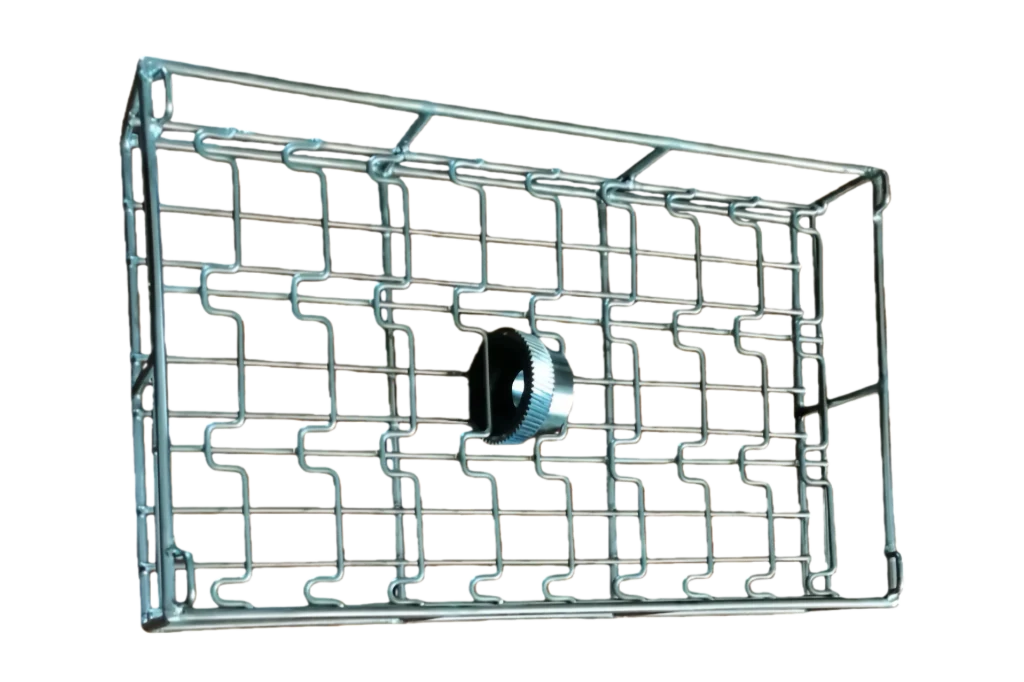
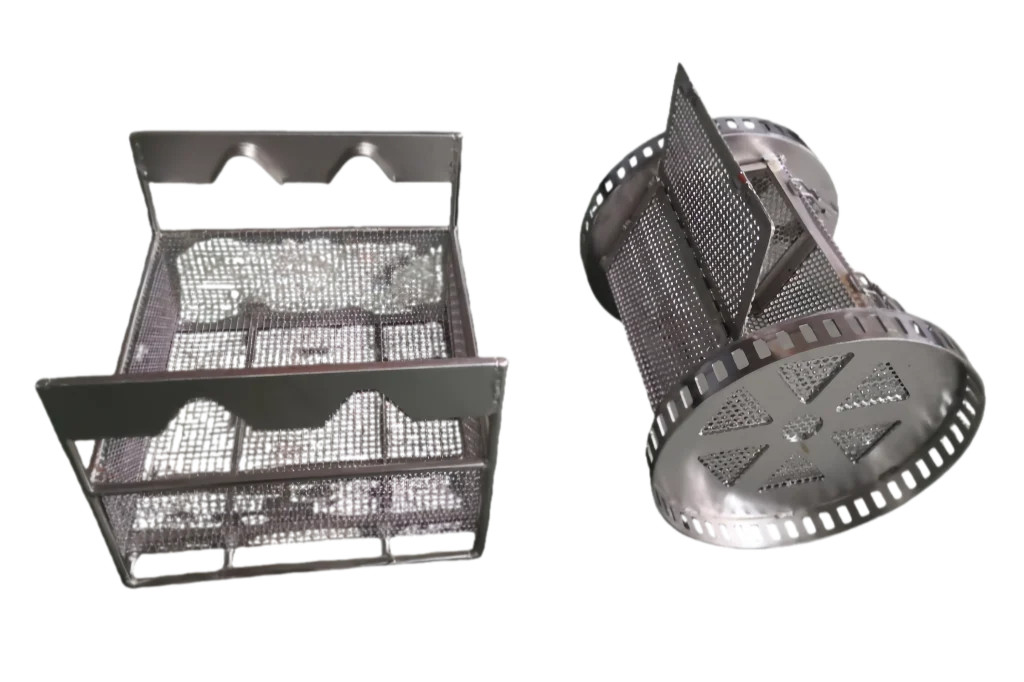
Basket configuration. Baskets determine whether fluid reaches every surface. For parts with blind holes, circular rotating baskets turn the workpiece continuously through the ultrasonic field. Flat sheet stampings ship in square baskets with dividers that prevent contact and allow the cavitation front to sweep across the surface. The basket material matters as much as the form: stainless steel baskets resist chemical attack and transfer ultrasonic energy efficiently, whereas plastic baskets absorb too much energy and slow the cleaning rate.
Filtration and circulation. A tank without active filtration loads with oil and particulate within a shift. Stamping oil separates quickly and floats, but re-emulsified oil and metal powder stay suspended and re-deposit on parts during the rinse cascade. A multi-stage filtration system with oil skimming, bag filters, and a final cartridge filter keeps the cleaning fluid at specification across an eight-hour run. Circulation pumps maintain detergent concentration and temperature uniformity, so the first basket of the morning cleans the same as the hundredth.
Drying stage design. Wet stampings flash-rust within minutes in a humid plant. Hot air drying works for open shapes, but parts with cup forms or folded flanges trap water. For those, vacuum drying draws moisture out of crevices by lowering the boiling point. Choosing the right drying method depends on part geometry and the time window before the next process step.
How to Configure a Multi-Stage Ultrasonic Cleaning Process
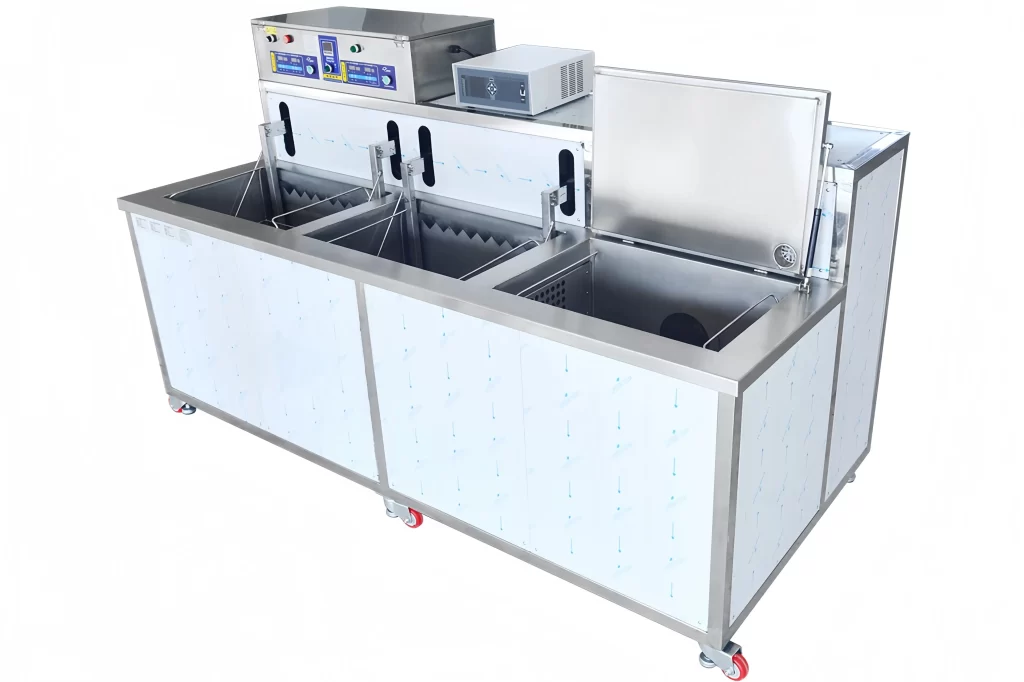
The cleaning sequence for stampings follows a logical path: rough degreasing, precision ultrasonic cleaning, rinsing, and drying. Skipping a stage or compressing time causes the residues to migrate downstream rather than disappear.
| Stage | Finalidade | Typical Parameters |
|---|---|---|
| Rough ultrasonic degreasing | Dissolve stamping oil and anti-rust film; suspend heavy particulate | 40–60 °C, 5–6 min, alkaline or neutral detergent, 20–40 kHz |
| Fine ultrasonic cleaning | Reach blind holes, thread roots, and micro-cavities; remove residual film | 30–50 °C, 3–5 min, RO water with detergent, higher frequency (40–80 kHz) for delicate surfaces |
| Rinse (multi-stage) | Remove detergent and suspended solids; prevent water spots | 2–3 cascading tanks, deionized water final rinse, conductivity ≤ 5 μS/cm |
| Secagem | Eliminate moisture; prevent flash rust | Hot air (80–120 °C) or vacuum drying for complex geometries, 8–15 min |
The rough cleaning stage removes 90 % of the contamination; the fine stage guarantees that what remains is below the acceptance threshold of the coating or welding line. We often insert an air-knife blow-off between the fine clean and the first rinse to strip excess detergent, which cuts rinse water consumption and detergent carryover. This is not a standard feature on every machine but pays back in a high-volume line.
Integrating Ultrasonic Cleaning into a Stamping Production Line
Cleaning is not an isolated bath; it is a process node that sits between the stamping press and the next value-added operation. If the washer runs a 12-minute cycle but the press discharges a full basket every 8 minutes, the line stacks parts before the washer and starves the coating line behind it. Cycle time must match the line takt, and the automation interface—loading robot, conveyor index, basket transfer—must signal its state to the plant’s MES so that a fault triggers a controlled stop rather than a pile-up of unwashed parts.
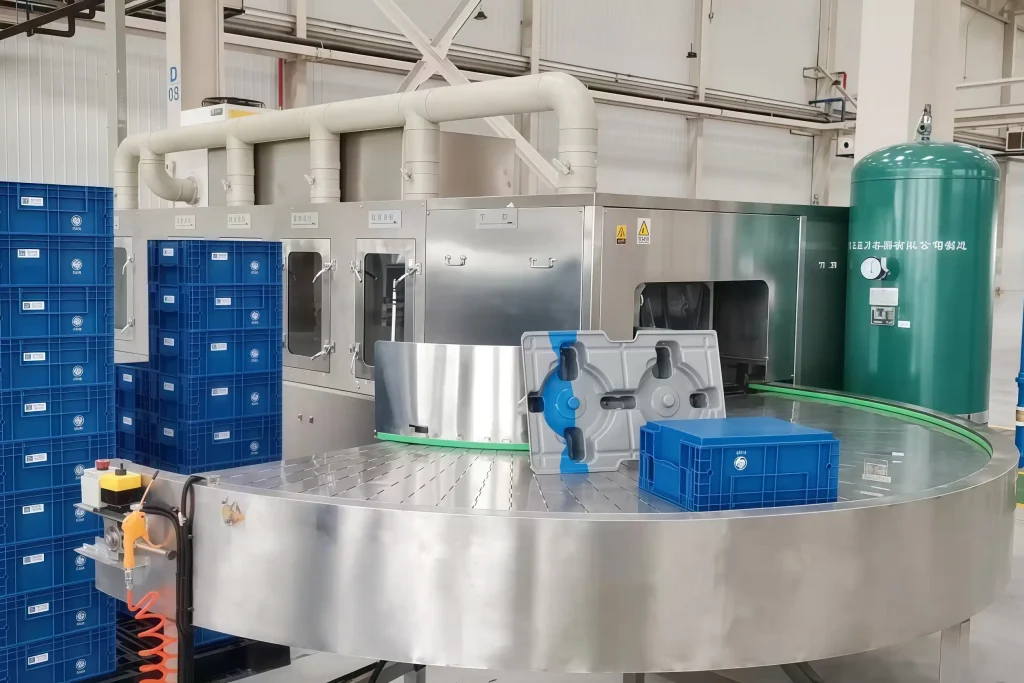
For manual or semi-automated lines, our engineers size the machine to handle peak production with a buffer zone. For fully automated inline lines, the cleaning system becomes a pass-through tunnel with conveyors timed to the press stroke rate. The decision between a batch system and a continuous inline system depends on throughput and part variety. A high-mix stamping plant running multiple part numbers per shift usually benefits from batch processing with recipe-driven controls, where the operator selects a pre-programmed cleaning profile. A dedicated line stamping one part at high volume justifies an inline machine with fixed parameters.
What to Verify Before Choosing a Cleaning Equipment Supplier
A cleaning system is a capital investment that must survive ten years of daily production. Checking the supplier’s engineering depth matters more than comparing data sheets.
Design for your parts, not a catalog. A supplier who offers a standard model without asking for part drawings, contaminant analysis, and production targets is guessing. We request sample parts to run cleaning trials and measure cleanliness using gravimetric analysis or dyne testing. The results determine tank size, transducer placement, and chemical specification—not the other way around.
Material and build quality. Tanks should be SUS304 or SUS316 stainless steel, fully welded, with radiused corners to avoid particle traps. Transducer bonding must be permanent. A machine built with thin-gauge steel and bolted seams will leak and lose ultrasonic transmission within a few years. Inspect the frame, the pump seals, and the piping—these components fail first when maintenance intervals stretch.
Control system and remote support. A Siemens or Mitsubishi PLC with a colour touchscreen allows recipe storage, fault logging, and remote diagnostics. If the system cannot tell the operator which tank temperature is out of spec or which filter is due for replacement, troubleshooting becomes guesswork. Remote software upgrade capability has saved our customers days of downtime because a process adjustment could be applied over a VPN instead of waiting for a field technician.
After the warranty period, what matters is whether the supplier carries spares for pumps, heaters, and transducers, and whether they can support a line in a second-shift emergency. We keep a stock of critical spares and offer on-site training during installation so the plant maintenance team knows how to swap a transducer array or clean a circulation filter without waiting for a service call.
Common Questions About Stamping Parts Ultrasonic Cleaning
cURL Too many subrequests by single Worker invocation. To configure this limit, refer to https://developers.cloudflare.com/workers/wrangler/configuration/#limits
cURL Too many subrequests by single Worker invocation. To configure this limit, refer to https://developers.cloudflare.com/workers/wrangler/configuration/#limits
cURL Too many subrequests by single Worker invocation. To configure this limit, refer to https://developers.cloudflare.com/workers/wrangler/configuration/#limits
cURL Too many subrequests by single Worker invocation. To configure this limit, refer to https://developers.cloudflare.com/workers/wrangler/configuration/#limits
cURL Too many subrequests by single Worker invocation. To configure this limit, refer to https://developers.cloudflare.com/workers/wrangler/configuration/#limits
cURL Too many subrequests by single Worker invocation. To configure this limit, refer to https://developers.cloudflare.com/workers/wrangler/configuration/#limits
cURL Too many subrequests by single Worker invocation. To configure this limit, refer to https://developers.cloudflare.com/workers/wrangler/configuration/#limits
cURL Too many subrequests by single Worker invocation. To configure this limit, refer to https://developers.cloudflare.com/workers/wrangler/configuration/#limits
Se estiver interessado, consulte estes artigos relacionados:
Desenhe um Processo Industrial de Limpeza Multietapas Eficiente
Guia do Engenheiro para a Preparação de Superfícies Antes do Revestimento
Máquina de Pré-Limpeza Ultrassónica para Pré-Tratamento de Revestimento PVD/DLC Impecável
Equipamento de Limpeza Ultrassónica Explicado: O Guia Definitivo
 Portuguese
  English
  German
  Spanish
  French
  Russian