
Conveyor parts cleaning systems are the backbone of high‑volume industrial component manufacturing, but choosing the right configuration is rarely about picking the most powerful machine. The real value comes from matching conveyor design, cleaning station layout, and drying architecture to your specific part geometry and throughput requirements. Over twenty years of designing automated cleaning lines has shown me that the difference between a system that runs trouble‑free for a decade and one that causes constant bottlenecks usually comes down to a handful of engineering decisions made before the purchase order is signed.
How Conveyor Parts Cleaning Systems Work in Production Lines
A conveyor parts cleaning system is an inline or pass‑through machine that transports components through successive treatment zones on a continuous belt or chain. Unlike batch washers that handle one basket at a time, these systems move parts through wash, rinse, and drying stages without stopping, making them suited to high‑volume manufacturing where consistent throughput matters as much as final cleanliness.
The typical architecture stacks three to five stations in series. Pre‑wash spray removes loose chips and gross contamination. The main wash stage, often combining high‑pressure spray and ultrasonic cavitation, removes oils, drawing compounds, and fine particles. Rinse stages use deionized water to flush residual detergent, and the final drying station may employ air knives, hot air, or vacuum drying depending on the part's surface sensitivity. An oil‑water separation system and continuous filtration loop are standard features that extend solution life and reduce chemical consumption. For stamping lines, an inline conveyor spray cleaning machine can keep pace with a press running at one part per second, and that production tempo leaves no room for a wash stage that lags behind.
Design Parameters That Determine Cleaning Consistency
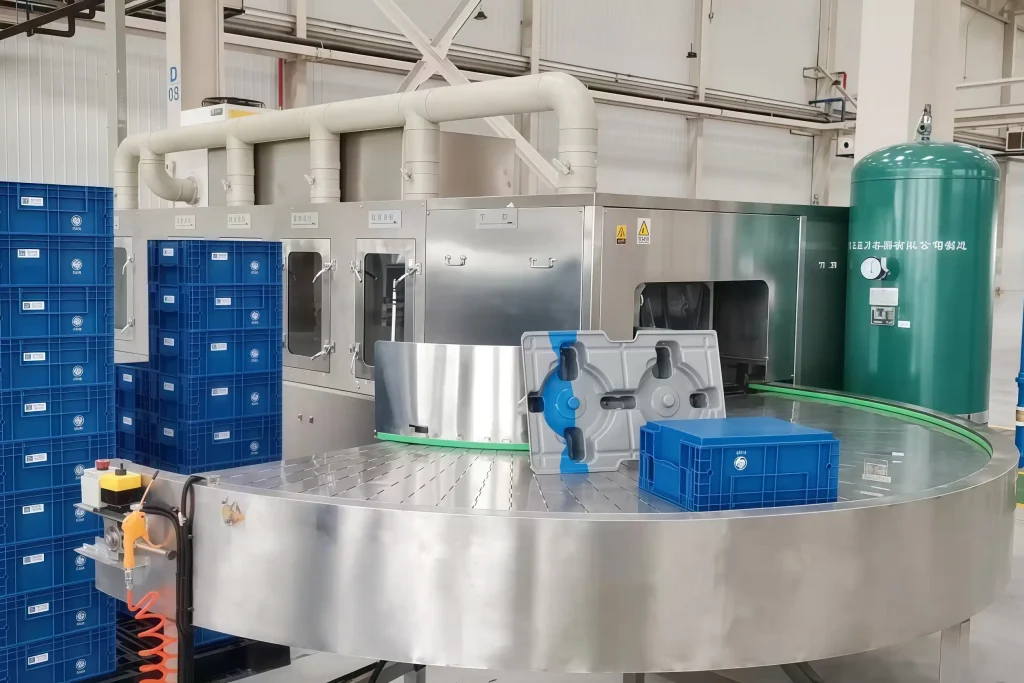
The single most overlooked variable in conveyor cleaning system specification is the conveyor itself: its width, belt material, and carrying capacity define what parts you can run and how many per hour. In practice, a system designed for small fasteners running on a 300 mm wide stainless steel belt cannot simply be scaled up for engine blocks weighing 200 kg without re‑engineering the entire load path, tank structure, and spray manifold layout. We recently supplied a turntable conveyor machine for heavy gearbox housings where the load‑bearing requirement reached 1,500 kg per station, and that dictated a reinforced tank, robotic lifting, and double‑chain drive that would be unnecessary for lighter stampings.
Nozzle placement and spray pressure are equally critical. Multi‑directional spray nozzles must hit blind holes, undercuts, and internal threads that ultrasonic alone cannot always reach in a fast‑moving line. Cleaning solution temperature also plays a role: for removing quenching oil, maintaining 55–65 °C improves oil solubility without accelerating detergent breakdown. In a tunnel‑style conveyor system, typical conveyor speeds range from 0.5 to 1.5 m/min depending on part complexity, and any deviation in nozzle alignment or pressure at the upper speed limit leads to missed spots that downstream operators catch only after assembly.
Matching Cleaning Media and Drying to Part Requirements
The choice between aqueous and solvent‑based cleaning determines not just cleanliness but also the drying architecture and facility requirements. Aqueous conveyor lines work well for cast iron, steel, and aluminium parts when paired with the right alkaline detergent and rust inhibitor, but they demand a multi‑stage rinse with ultrapure water to avoid spotting, plus a powerful air‑knife and hot‑air drying section that can add several meters to the line footprint. For precision‑machined components with tight internal passages, vacuum drying after a solvent‑based wash eliminates water retention and flash‑rust risk, though it brings solvent recovery and vapour extraction systems that add capital and operating expense.
| Meio de Limpeza | Melhor Para | Drying Method | Typical Footprint Impact |
|---|---|---|---|
| Aqueous (alkaline) | Cast iron, steel, aluminium | Air knife + hot air | Longer line due to rinse and dry stages |
| Hydrocarbon solvent | Precision parts, blind holes | Vacuum + vapour | Compact but requires solvent recovery system |
| Modified alcohol | Electronics, optical parts | Vacuum | Compact, low heat, solvent recovery needed |
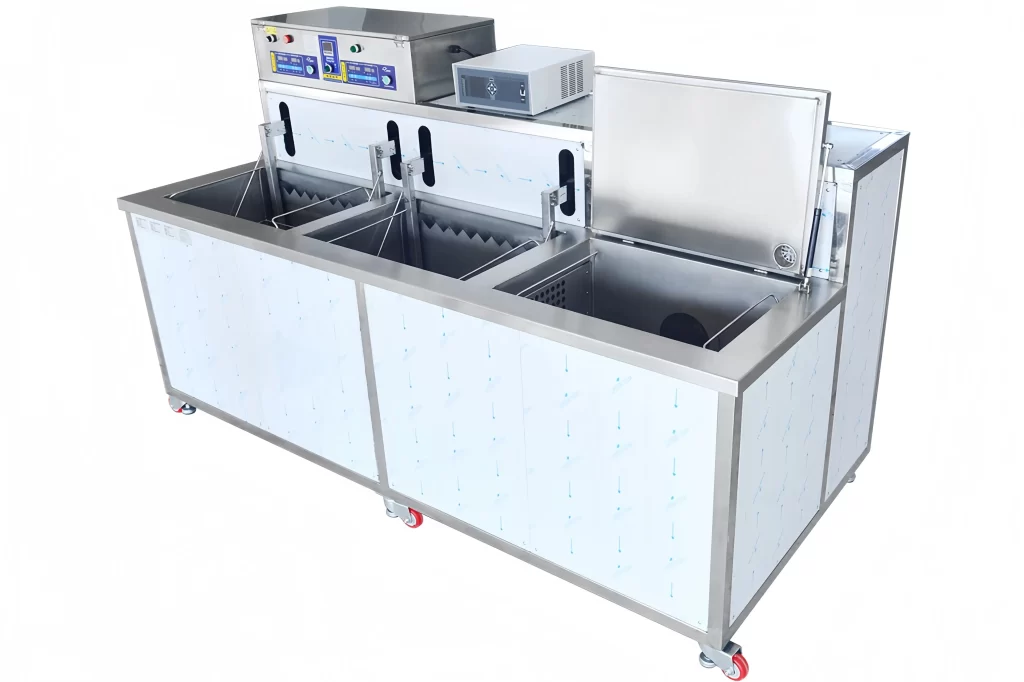
The decision tree narrows quickly when you layer in coating pre‑treatment requirements. Pre‑PVD coating lines, for example, cannot tolerate sub‑micron residues, so a conveyorized multi‑stage ultrasonic line with final DI water rinse of ≤0.06 μS/cm conductivity becomes non‑negotiable. Skipping that step leads to coating adhesion failures that only become visible after the parts are in the field.
Integrating Conveyor Cleaning Systems into Your Production Flow
Conveyor cleaning systems do not operate in isolation; they feed into assembly, coating, or packaging stations, and the interface between the cleaning line and the next process determines real‑world throughput more than the wash cycle time listed on the spec sheet. A tunnel washer with a 0.8 m/min belt speed might theoretically clean 1,200 parts per hour, but if the loading station operator cannot feed parts faster than 900 per hour, the line runs at 75% capacity indefinitely. Manual loading and unloading become the bottleneck.
Automating the infeed and outfeed with robotic pick‑and‑place or integrating the conveyor directly with the stamping press exit conveyor removes that constraint. For high‑volume production of aluminium die‑cast housings, an inline cleaner placed immediately after the casting cell eliminates interim handling and ensures parts arrive at the coating line still warm and dry, which speeds surface preparation. The integration point that most plants overlook is the buffer zone between wash and rinse: without an effective air‑knife or squeegē stage, detergent drag‑out contaminates the rinse water, raising conductivity and forcing more frequent DI water changeovers that hit operating cost directly.
Evaluating Supplier Capabilities for Long‑Term Reliability
Purchasing a conveyor parts cleaning system is less like buying a stand‑alone machine and more like entering a joint engineering project. The supplier needs to understand your part geometry, contamination profile, throughput target, and facility constraints before proposing a configuration, and they need the in‑house R&D and application engineering resources to validate that configuration for your parts. A manufacturer that offers only standard sizes with fixed nozzle positions cannot address the blind‑hole challenges of a complex die‑casting, and a supplier without solvent recovery system expertise adds hidden operating risk if you choose a hydrocarbon‑based line.
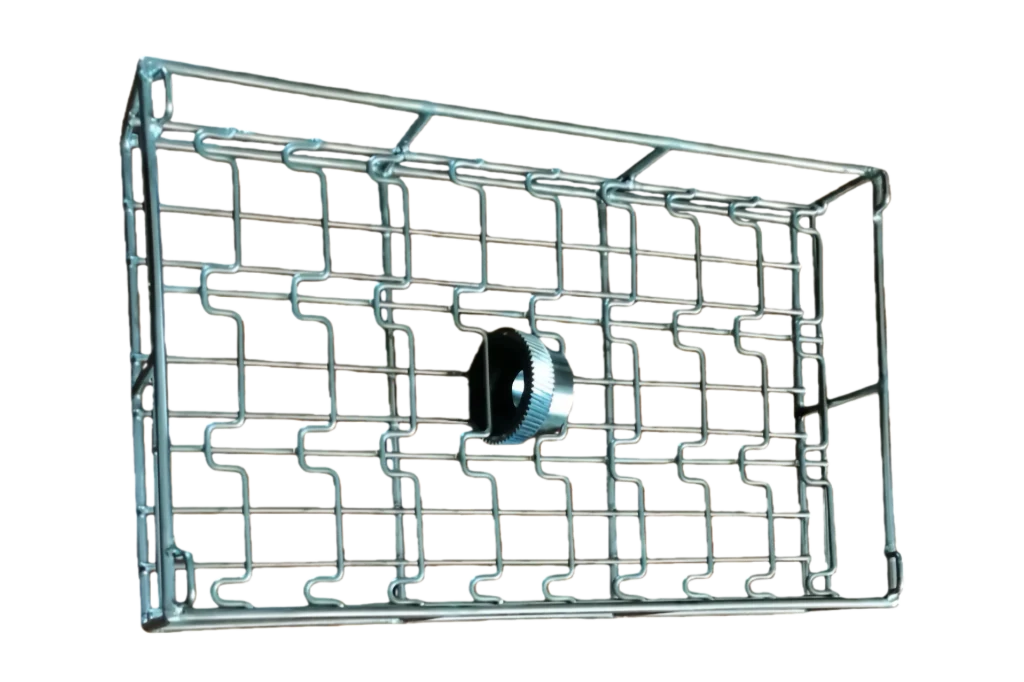
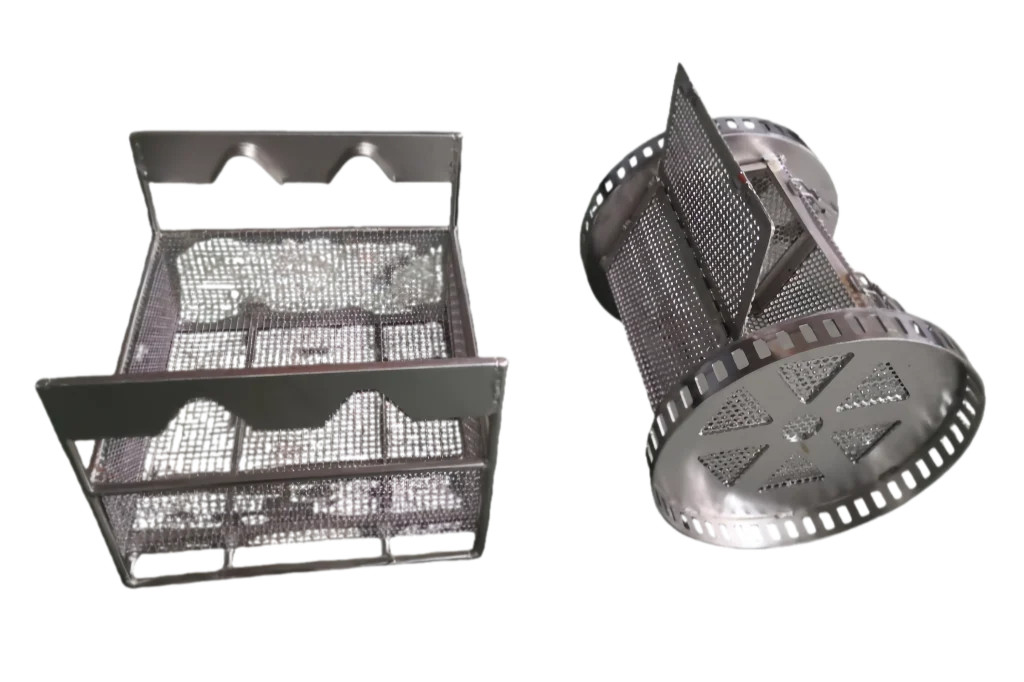
Beyond the equipment, verify that the supplier can provide cleaning baskets engineered for your specific parts, on‑site installation and commissioning support, and remote software upgrade capability. In our experience, the factories that achieve stable, low‑operator‑intervention cleaning for years after installation are the ones that treat the cleaning line as a custom‑engineered process rather than a commodity purchase. When evaluating options, ask for a process validation run with your real production parts, not just sample plates, and confirm that after‑sales support includes on‑site training and local spare parts availability. For complex industrial components requiring high cleanliness before coating or assembly, getting the conveyor design and integration right from the start matters far more than comparing brochure specifications.
If your production involves components with deep holes, complex geometries, or tight pre‑coating cleanliness requirements, confirming the correct conveyor speed, nozzle placement, and drying method before finalising your equipment specification can avoid costly redesign later. Contact GTKCLEAN at [email protected] or call +86 17768507147 to discuss your part requirements and production throughput.
Frequently Asked Questions About Conveyor Parts Cleaning
What throughput can I expect from a conveyor parts cleaning system?
Throughput depends primarily on conveyor width, belt speed, and part loading density rather than a fixed parts‑per‑hour rating. A typical line handling stamped brackets at 1.0 m/min on a 600 mm belt can process roughly 1,200 to 1,800 parts per hour, but for smaller fasteners moving at 2.0 m/min on a wide belt, output can exceed 5,000 parts per hour. The practical limit is usually set by loading capability, not wash cycle time.
How do I choose between ultrasonic and spray cleaning in a conveyor line?
Spray cleaning excels at removing loose chips, heavy oil, and surface‑level contaminants at high speed, while ultrasonic cavitation reaches into blind holes, cross‑drilled passages, and internal threads where spray cannot penetrate effectively. Many high‑value industrial component lines combine both: a spray pre‑wash followed by an ultrasonic immersion stage, then a spray rinse. The combination adds cost and line length, so the decision hinges on whether your parts have internal features that inspection repeatedly flags as insufficiently clean.
How often does a conveyor cleaning system need maintenance?
Routine maintenance points include pump filters replaced weekly, spray nozzles checked monthly for clogging or misalignment, conveyor belt tension verified quarterly, and ultrasonic transducers tested for frequency drift annually. Solvent‑based systems add distillation unit cleaning and carbon filter changes every three to six months depending on contamination load. A well‑maintained system can operate 20 to 24 hours per day for over a decade with only consumable part replacements, provided the initial build quality is sufficient.
Can a conveyor parts washer handle mixed part sizes on the same line?
cURL Too many subrequests by single Worker invocation. To configure this limit, refer to https://developers.cloudflare.com/workers/wrangler/configuration/#limits
What determines the total floor space needed for a conveyor cleaning system?
cURL Too many subrequests by single Worker invocation. To configure this limit, refer to https://developers.cloudflare.com/workers/wrangler/configuration/#limits
Se estiver interessado, consulte estes artigos relacionados:
Arrendamento Versus Compra de Equipamento Industrial de Limpeza Guia Estratégico
Otimizar Frequência Ultrassónica para Materiais Diversos
Escolhendo o Sistema de Limpeza Ultrassónico Certo para a Sua Fábrica
 Portuguese
  English
  German
  Spanish
  French
  Russian