

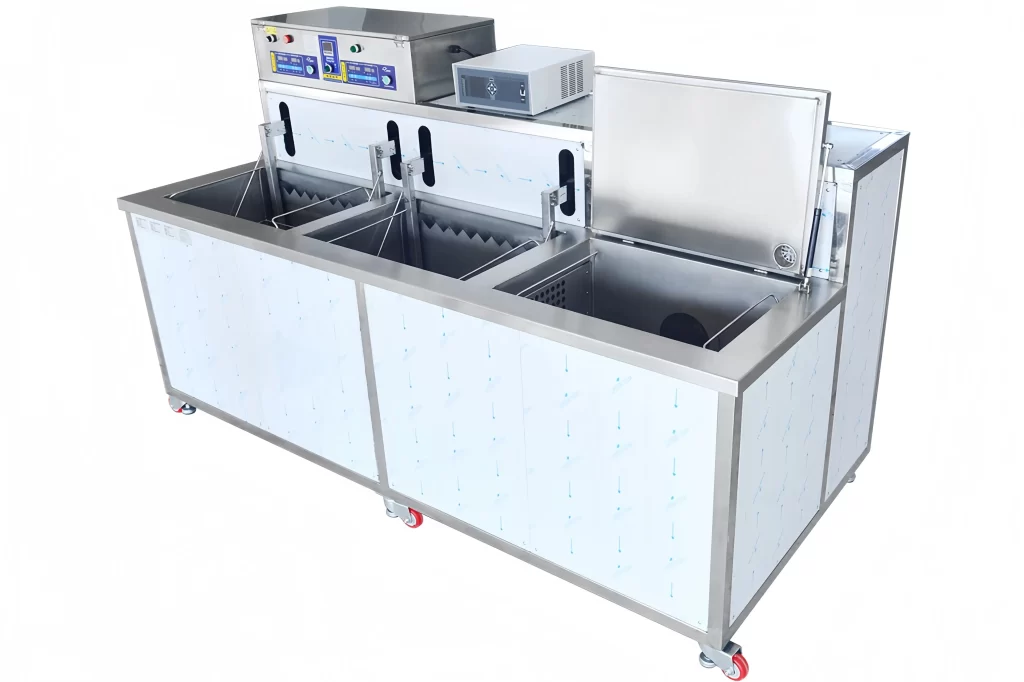
You can prove the cleaning on paper and still get contaminated parts at the end of the shift. When an inline ultrasonic system is integrated into a smart factory line, the failure is rarely the cleaning itself — it is that the machine ran within specification while the line upstream changed something without telling it. In more than twenty years of designing automated cleaning systems for production environments, I have seen this pattern repeat across automotive, aerospace, and electronics lines. The parts arrive slightly different — a new coolant, a faster cycle, a different die release — and the cleaning system, tuned to last month's conditions, keeps running exactly as programmed. Parts come out looking clean. Coating adhesion tells a different story weeks later. This article covers what changes when ultrasonic cleaning moves from a standalone cell into an inline configuration inside a smart factory — particularly how part transfer speed, real-time feedback loops, and cleaning chemistry decisions interact in ways that a specification sheet alone will not reveal.
What Separates Inline Ultrasonic Cleaning from Batch Systems
An inline ultrasonic cleaning system sits inside the production flow. Parts arrive on a conveyor or transfer mechanism, pass through cleaning, rinsing, and drying stages, and exit directly into the next manufacturing operation — coating, assembly, or inspection. No operator moves baskets between tanks. No accumulation of dirty parts waiting for a batch cycle to finish. The system runs at the pace of the line feeding it.
That integration changes the design requirements in three ways that batch systems do not face. First, cleaning cycle time is locked to the production takt time. If the upstream CNC cell delivers a part every 45 seconds, the cleaning system has 45 seconds per part — not a flexible window. Second, part orientation matters continuously rather than at loading only. In a batch rotary system, the basket rotation can compensate for poor initial orientation. Inline, the part travels through fixed spray and ultrasonic zones and the orientation it enters with is the orientation it keeps. Third, drying must complete within the allocated conveyor length. There is no holding station where a wet part can wait for residual moisture to evaporate — the part reaches the end of the line and must be dry and ready for the next process.
Underneath these mechanical constraints is a cleaning physics problem. Ultrasonic cavitation in an inline tank works differently than in a batch immersion tank because the part is moving through the ultrasonic field rather than sitting stationary within it. The exposure time per surface is shorter and the cavitation intensity must be calculated for a moving target. In practice this means the transducer placement, frequency selection, and power density have narrower tolerances in an inline configuration. A batch system with 28 kHz transducers covering the tank floor works because the part soaks in the field for five minutes. The same cleaning result inline at 45 seconds per part requires higher power density or multi-frequency coverage — typically 28 kHz and 40 kHz alternating — and the transducers must be positioned to match the part trajectory, not just the tank volume.
How Smart Factory Connectivity Changes Cleaning System Behavior
The term "smart factory" gets used loosely. For inline ultrasonic cleaning, the distinction that matters is whether the cleaning system receives data from upstream processes or merely reports its own status to a SCADA interface. Most cleaning equipment suppliers offer the second. The difference between the two is the difference between catching a contamination problem at the cleaning station and catching it at the coating adhesion test three days later.
A cleaning system that reads upstream data can adjust before parts enter the tank. If the CNC coolant concentration shifts — something that happens gradually as water evaporates and operators top up — the cleaning chemistry may need a corresponding adjustment in detergent concentration or rinse flow rate. A standalone system has no way to know the coolant changed until cleaning quality drifts. An inline system integrated into the factory network can receive that data point and either alert an operator or, in a closed-loop configuration, adjust its own dosing accordingly.
Temperature is another variable that benefits from upstream data. Parts arriving from a machining operation carry heat. If the machining coolant is running at 35 °C and the parts move directly into the cleaning line, the ultrasonic tank temperature profile changes from what was modeled during commissioning. A smart system compensates by modulating heating or cooling. A dumb system runs at its setpoint and the cleaning result shifts without explanation.
The practical value of connectivity shows up most clearly during product changeovers. In a batch cleaning cell, changeover means swapping baskets and possibly changing a program. In an inline smart factory configuration, the cleaning system can receive the next part number from the MES, load the corresponding cleaning recipe — tank temperatures, ultrasonic power levels, conveyor speed, detergent dosing — and confirm readiness before the first new part arrives. This reduces the window where parts run with the wrong parameters from minutes to seconds. For lines producing multiple part variants on the same conveyor, that window is the difference between zero rejected parts and an entire shift of questionable cleanliness.
Conveyor Speed, Part Geometry, and the Ultrasonic Exposure Equation
The most common mistake I see in inline ultrasonic cleaning specifications is treating conveyor speed and ultrasonic cleaning as independent decisions. A production engineer sets the line speed based on throughput targets. A cleaning engineer specifies the ultrasonic system based on soil type and cleanliness requirements. When those two decisions meet on the factory floor, the part moves faster than the cavitation can clean it.
The relationship is straightforward but unforgiving. Ultrasonic cleaning requires a minimum exposure time — the duration a given surface spends inside the active cavitation zone. That minimum depends on the contaminant: light cutting oil may need 30 seconds of effective cavitation; drawing compound or heat treatment scale may need 90 seconds or more. The conveyor speed determines how long the part stays inside the ultrasonic tank. If the tank length is two meters and the conveyor runs at one meter per minute, exposure time is two minutes. If the same tank runs at three meters per minute, exposure drops to 40 seconds.
The fix is not always a longer tank. Tank length adds floor space and chemistry volume, both of which increase cost. An alternative is higher ultrasonic power density, which reduces the minimum exposure time by increasing cavitation intensity per unit of time. In our work with CNC aluminum shell inline cleaners, we have found that running 28 kHz transducers at approximately 2 W per liter in a batch configuration can be pushed to 3 to 4 W per liter in an inline configuration to achieve equivalent cleaning at shorter dwell times. The trade-off is that higher power density can damage delicate surfaces and increases the risk of cavitation erosion on softer materials. Aluminum and brass parts require careful power mapping — the transducer layout must deliver high intensity where the soil is and lower intensity where the substrate is vulnerable.
Part geometry adds a second layer. A flat stamping passes through the ultrasonic field with all surfaces equally exposed. A machined housing with blind holes travels through the same field, but the cavitation must reach inside those holes to clean them. Conveyor speed that works for the external surfaces may be too fast for the internal ones. The solution is frequently a combination of ultrasonic and targeted spray — the ultrasonic handles general cleaning and the spray nozzles direct cleaning solution into the blind features. But this requires the spray manifold to be positioned precisely relative to the part as it moves, which is an alignment and fixturing challenge that batch systems do not face.
| Parâmetro | Batch Rotary | Inline Conveyor | Inline Considerations |
|---|---|---|---|
| Typical cycle time per part | 5–8 minutes | 30–90 seconds | Locked to takt time; tank length and power must compensate |
| Ultrasonic power density | 1.5–2.5 W/L | 2.5–4 W/L | Higher intensity for shorter dwell; material limits apply |
| Part orientation flexibility | cURL Too many subrequests by single Worker invocation. To configure this limit, refer to https://developers.cloudflare.com/workers/wrangler/configuration/#limits | cURL Too many subrequests by single Worker invocation. To configure this limit, refer to https://developers.cloudflare.com/workers/wrangler/configuration/#limits | cURL Too many subrequests by single Worker invocation. To configure this limit, refer to https://developers.cloudflare.com/workers/wrangler/configuration/#limits |
| cURL Too many subrequests by single Worker invocation. To configure this limit, refer to https://developers.cloudflare.com/workers/wrangler/configuration/#limits | cURL Too many subrequests by single Worker invocation. To configure this limit, refer to https://developers.cloudflare.com/workers/wrangler/configuration/#limits | cURL Too many subrequests by single Worker invocation. To configure this limit, refer to https://developers.cloudflare.com/workers/wrangler/configuration/#limits | cURL Too many subrequests by single Worker invocation. To configure this limit, refer to https://developers.cloudflare.com/workers/wrangler/configuration/#limits |
| cURL Too many subrequests by single Worker invocation. To configure this limit, refer to https://developers.cloudflare.com/workers/wrangler/configuration/#limits | cURL Too many subrequests by single Worker invocation. To configure this limit, refer to https://developers.cloudflare.com/workers/wrangler/configuration/#limits | cURL Too many subrequests by single Worker invocation. To configure this limit, refer to https://developers.cloudflare.com/workers/wrangler/configuration/#limits | cURL Too many subrequests by single Worker invocation. To configure this limit, refer to https://developers.cloudflare.com/workers/wrangler/configuration/#limits |
Cleaning Chemistry in an Inline System: What Changes and Why
cURL Too many subrequests by single Worker invocation. To configure this limit, refer to https://developers.cloudflare.com/workers/wrangler/configuration/#limits
cURL Too many subrequests by single Worker invocation. To configure this limit, refer to https://developers.cloudflare.com/workers/wrangler/configuration/#limits
cURL Too many subrequests by single Worker invocation. To configure this limit, refer to https://developers.cloudflare.com/workers/wrangler/configuration/#limits
cURL Too many subrequests by single Worker invocation. To configure this limit, refer to https://developers.cloudflare.com/workers/wrangler/configuration/#limits
Designing the Drying Stage for Zero Carryover
cURL Too many subrequests by single Worker invocation. To configure this limit, refer to https://developers.cloudflare.com/workers/wrangler/configuration/#limits
cURL Too many subrequests by single Worker invocation. To configure this limit, refer to https://developers.cloudflare.com/workers/wrangler/configuration/#limits
cURL Too many subrequests by single Worker invocation. To configure this limit, refer to https://developers.cloudflare.com/workers/wrangler/configuration/#limits
cURL Too many subrequests by single Worker invocation. To configure this limit, refer to https://developers.cloudflare.com/workers/wrangler/configuration/#limits
Real-Time Monitoring and What It Should Actually Track
cURL Too many subrequests by single Worker invocation. To configure this limit, refer to https://developers.cloudflare.com/workers/wrangler/configuration/#limits
cURL Too many subrequests by single Worker invocation. To configure this limit, refer to https://developers.cloudflare.com/workers/wrangler/configuration/#limits
cURL Too many subrequests by single Worker invocation. To configure this limit, refer to https://developers.cloudflare.com/workers/wrangler/configuration/#limits
cURL Too many subrequests by single Worker invocation. To configure this limit, refer to https://developers.cloudflare.com/workers/wrangler/configuration/#limits
When an Inline System Is the Right Choice — and When It Is Not
cURL Too many subrequests by single Worker invocation. To configure this limit, refer to https://developers.cloudflare.com/workers/wrangler/configuration/#limits
cURL Too many subrequests by single Worker invocation. To configure this limit, refer to https://developers.cloudflare.com/workers/wrangler/configuration/#limits
cURL Too many subrequests by single Worker invocation. To configure this limit, refer to https://developers.cloudflare.com/workers/wrangler/configuration/#limits
cURL Too many subrequests by single Worker invocation. To configure this limit, refer to https://developers.cloudflare.com/workers/wrangler/configuration/#limits
cURL Too many subrequests by single Worker invocation. To configure this limit, refer to https://developers.cloudflare.com/workers/wrangler/configuration/#limits
Common Questions About Inline Ultrasonic Cleaning for Smart Factories
Does an inline ultrasonic system require a dedicated operator?
cURL Too many subrequests by single Worker invocation. To configure this limit, refer to https://developers.cloudflare.com/workers/wrangler/configuration/#limits
Can an inline system handle multiple part types on the same conveyor?
cURL Too many subrequests by single Worker invocation. To configure this limit, refer to https://developers.cloudflare.com/workers/wrangler/configuration/#limits
How does inline ultrasonic cleaning compare to vapor degreasing for high-volume production?
cURL Too many subrequests by single Worker invocation. To configure this limit, refer to https://developers.cloudflare.com/workers/wrangler/configuration/#limits
What is the most common cause of cleaning failure in an inline system after commissioning?
cURL Too many subrequests by single Worker invocation. To configure this limit, refer to https://developers.cloudflare.com/workers/wrangler/configuration/#limits
Se estiver interessado, consulte estes artigos relacionados:
Equipamento de Limpeza Automatizada: Guia Industrial para Principiantes
Limpeza Ultrassónica Automatizada: Elevar a Consistência dos Processos Industriais
Guia do Engenheiro para a Preparação de Superfícies Antes do Revestimento
Seleção de Lavadora de Peças: Guia Definitivo para Fabricantes
 Portuguese
  English
  German
  Spanish
  French
  Russian