

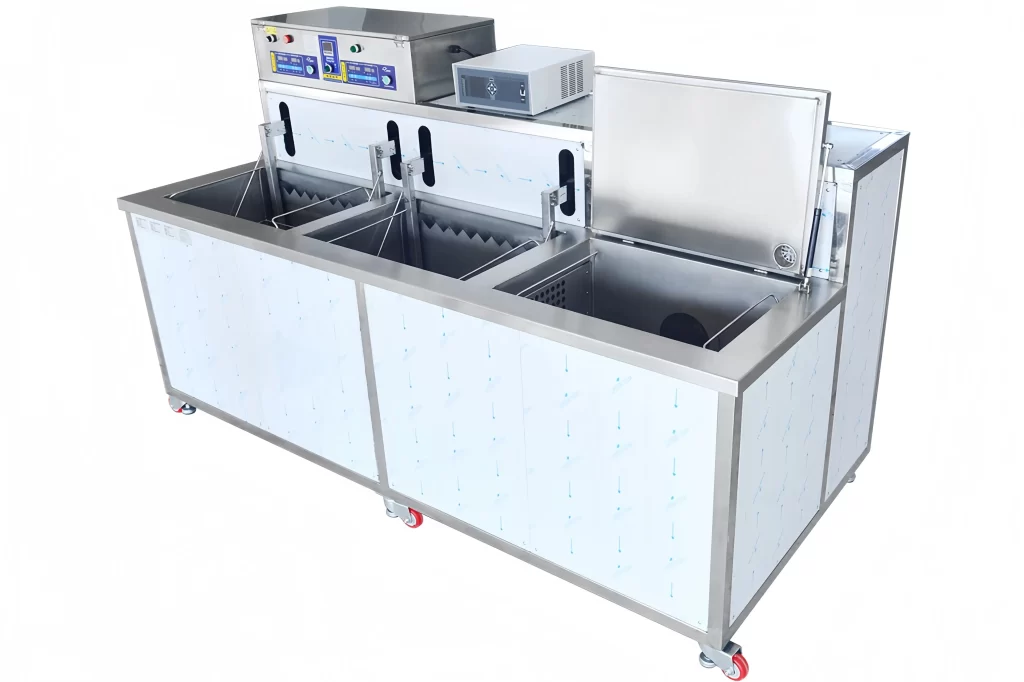
Most comparisons between inline and conveyor ultrasonic cleaning systems stop at surface-level metrics: throughput, footprint, and pump ratings. Production engineers facing a new line or a retrofit, however, quickly learn that the real difference surfaces in parts handling and how consistently each part meets the ultrasonic field. A system that moves parts too fast through a conveyor tunnel without controlled orientation will leave blind holes untreated regardless of tank size; an inline system designed around precise fixturing may achieve cleaner results at high volume while exposing fewer parts to cross-contamination at the tank interface.
How Do Inline and Conveyor Ultrasonic Cleaning Systems Differ Mechanically?
Inline systems transport parts through a sequence of stations in a straight line using a fixed chain or walking beam conveyor. Each part or fixture indexes forward as a unit, typically pausing in each tank for a programmed duration. This indexing motion ensures predictable immersion geometry: the part stays in the same attitude relative to the ultrasonic transducer array, so cavitation energy reaches the same cavities and surfaces cycle after cycle. Conveyor systems, on the other hand, move workpieces on a continuous belt or mesh through a tunnel-like cleaning chamber. Spray manifolds and submerged ultrasonic sections act on parts as they travel, but part orientation can shift — especially with loose, complex shapes — because the belt itself vibrates and flexes. The mechanical stability of inline fixtures compared to a moving belt is often the deciding factor for components with orientation-sensitive features.
Which Part Profiles Are Better Served by Each Configuration?
| Part Characteristic | Inline System | Conveyor System |
|---|---|---|
| Deep blind holes or threaded recesses | Élevée | Modéré |
| Uniform, symmetric bodies | Élevée | Élevée |
| Small, high-count parts (fasteners, washers) | Modéré | Élevée |
| Large, heavy castings | Élevée | Low (belt loading) |
| Parts that must not touch each other | Élevée | Low (tumbling risk) |
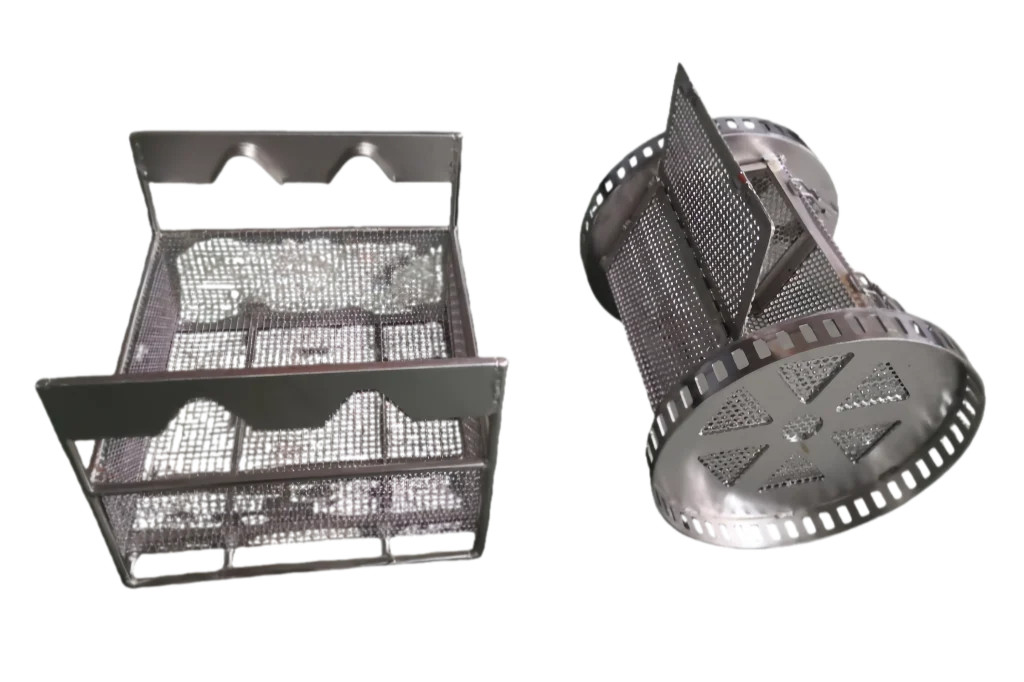
The table above captures what 20 years of on-site commissioning have shown: there is no universal better configuration. For flat plates or cylinder heads that can be racked, either system works. But when we worked on a program cleaning stamping dies with internal oil passages, the inline system’s fixture locked the part’s angle precisely while low-frequency transducers targeted the deep cavities; a conveyor belt would have let the part roll slightly and missed the same spot on each cycle. Conversely, for a fastener manufacturer processing two tons of screws per hour, a tunnel conveyor with spray pre-wash and a submerged ultrasonic section delivered unmatched throughput without part-on-part damage because the belt speed and a carefully profiled guide kept screws separated.
What Integration Challenges Do Production Lines Face With Each Approach?
Inline systems demand more floor space per unit throughput but simplify the interface with upstream and downstream automation. The fixed pitch of the conveyor dog and the part fixture allows a robot to load and unload at known positions every time. This makes inline arrays more predictable when integrating with machining centers that already use palletized handling.
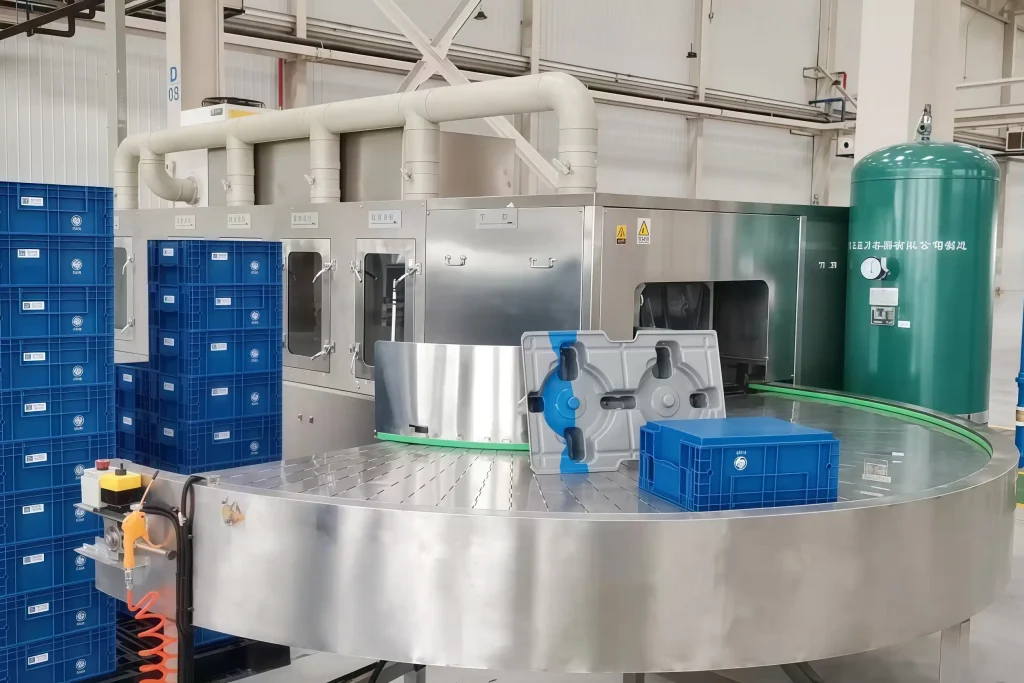
Conveyor belt systems, especially long tunnels, present two integration pain points. The first is carryover: drag-out from one tank pollutes the next unless air knives or blow-off stations are placed correctly between stages. The second is that the belt itself collects detergent residue and metal fines, which then transfer back onto cleaned parts in the drying zone. We address this with routine belt cleaning brushes and strategically placed rinse spray bars, but it is a maintenance requirement that first-time conveyor buyers frequently underestimate. If your line runs 16 hours per day, the week-to-week consistency depends heavily on whether the belt stays clean.
How Does Throughput Affect Cleaning Consistency in Each System?
The standard advice is that conveyor systems offer higher throughput. That is true for simple parts and low cleanliness requirements. But when part geometry demands ultrasonic dwell time, the advantage narrows. A conveyor that shortens dwell to chase cycle time will produce parts that look clean but fail a subsequent coating adhesion test. Inline systems, because each station is independent, let you adjust only the problematic tank without changing the whole line speed. For a customer cleaning precision optical housings, we kept the degreasing tank at a longer cycle while the rinse stations ran faster, something impossible on a single-speed belt.
What Cost Factors Should Guide the Decision?
Most RFQs focus on the capital cost of the washer. That is the smallest part. The bigger costs come from scrap and rework when the configuration does not match the part. We have replaced conveyor systems that produced 8% rework on aluminum die-cast housings because the parts rolled on the belt and left internal channels uncleaned; the replacement inline system with fixed fixtures eliminated the rework and paid for itself in nine months. Solvent consumption, detergent life, and drying energy all vary with how consistently the system transports parts. An inline fixture that drains quickly between tanks reduces carryover and extends bath life, while a belt that drags liquid forward increases chemical usage.
If your program involves parts with orientation-dependent cleaning requirements or a mix of geometries on one line, it is worth confirming the handling concept and cleaning validation data before finalizing the equipment specification. Reach out at [email protected] or call +86 17768507147 and we can review your part drawings and target throughput together.
Common Questions About Inline Versus Conveyor Ultrasonic Systems
In our production, we run many different part numbers in small batches. Which system adapts better?
It depends on the batch size and changeover frequency. Inline systems with quick-release fixtures can swap part-specific nests in a few minutes, making them practical for moderate-variety production. Conveyor lines require more extensive mechanical adjustment of guides and spray manifolds, so they are stronger when the part family is homogeneous and production runs are long. In mixed-part facilities, we usually design an inline system with removable tooling plates that the operator can change between shifts.
Does a conveyor belt introduce more contamination than a chain conveyor?
Belt materials can shed fibers and retain detergent residues that bake on in the dryer. High-quality conveyor designs include belt washing stations and material selection that resists hydrolysis, but the risk is always higher than with a stainless steel chain that stays submerged and is rinsed along with the parts. For medical and electronics components, we default to chain-driven inline fixtures for that reason.
Are inline systems always more expensive per part?
Not when you factor in yield. The fixed indexing of an inline system often reduces cleaning variability enough to lower total inspection and rework costs, even if the initial machine price is higher. The metric to watch is cost per conforming part, not cost per part passing through the machine. A well-configured inline washer that reduces failure from 3% to 0.1% can be the cheapest option by a wide margin.
How do I verify that a supplier’s proposal will actually handle my specific parts?
Request a cleaning trial with your actual production parts, not generic test coupons, and ask for surface cleanliness measurements at multiple locations on the part. A supplier who demonstrates that the system reaches internal cavities and blind holes with measurable consistency is showing what matters. Share your part drawings and cleanliness requirements with our team at [email protected] and we can discuss trial parameters specific to your production.
Si vous êtes intéressé, consultez ces articles liés :
Équipement de nettoyage par ultrasons expliqué : Le guide ultime
Nettoyage des pièces à l'eau : Guide technique du fabricant
Technologie des Transducteurs Ultrasoniques : Le Guide d’un Expert pour le Nettoyage Industriel
Solutions de nettoyage pour pièces estampées - GTK
 French
  English
  German
  Spanish
  Russian
  Portuguese