
In more than two decades of designing and deploying automated cleaning equipment, I've learned one hard truth: a cleaning system that works perfectly in isolation can still fail the moment you bolt it into a production line. The pass-through concept looks straightforward on paper, parts enter on a conveyor, pass through a series of wash, rinse, and dry stages, and exit ready for the next operation. The reality is that making that seamless connection work day after day, shift after shift, demands more attention to integration details than to the cleaning process itself. Most published material on pass-through systems stops at describing the internal stages. This article goes further, into the PLC handshakes, upstream contamination isolation, buffer management, and throughput synchronization that determine whether the system becomes a production asset or a bottleneck.
What a Pass-Through Cleaning System Actually Is
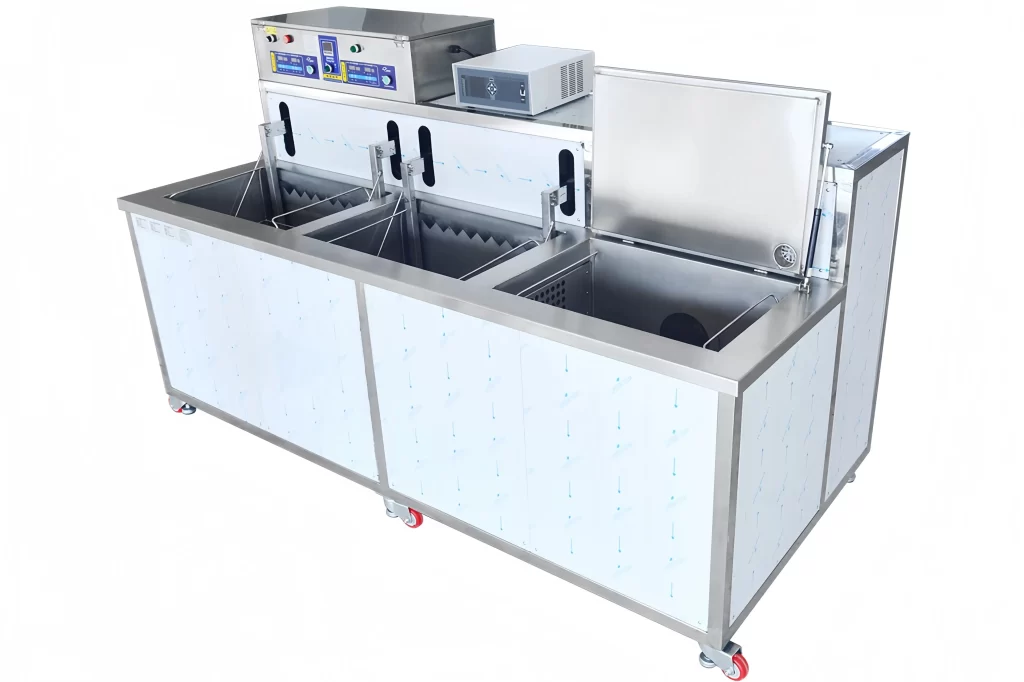
A pass-through cleaning system is an inline machine where parts move continuously or indexed along a conveyor through sequential cleaning zones. Unlike batch systems that process one basket at a time, pass-through designs integrate directly into the production flow, parts enter from one side and exit clean from the other, often at the same rate as the surrounding manufacturing steps. GTKCLEAN's CNC Aluminum Shell Inline Cleaner, for example, uses a conveyor with adjustable speed and multi-directional spray nozzles to handle die-cast aluminum components right after machining, removing release agents and cutting oil before the parts reach assembly. That direct connection to the line is what sets these systems apart from standalone tunnel washers that require manual loading.
The cleaning stages inside a pass-through system vary by application, but a standard configuration includes a spray degreasing zone, a rinse stage with DI or RO water, an air-knife blow-off, and hot air or vacuum drying. For parts with complex internal features, rotary baskets or multi-directional spray bars are added to ensure no blind spots remain. The key differentiator is not the cleaning chemistry but the material handling architecture: a continuous conveyor that runs from the upstream discharge point, through the machine, and out to the downstream pick-up position.
The number of stages and the conveyor path (straight-through, U-shaped, or multi-level) must match the available floor space and the production layout. <Choisir le bon système de nettoyage ultrasonique pour la réussite industrielle> covers how part geometry, throughput volume, and available footprint dictate whether a linear pass-through or a more compact multi-tank rotary system fits the production floor.
Critical Integration Points: Where the Pass-Through Meets the Line
The interface between the pass-through machine and the upstream and downstream equipment is where I've seen more commissioning delays than any other single source. Three physical and control handshake points demand precise specification before ordering.
First, the part orientation and height as it exits the prior machine must match the infeed conveyor of the cleaning system. If a CNC machine unloads parts at 800?mm height and the cleaner infeed is at 700?mm, the difference needs either a transition chute, a robotic pick-and-place, or a custom elevator conveyor. I've dealt with projects where this mismatch wasn't caught until installation, resulting in weeks of rework and a makeshift ramp that compromised part stability. Always specify infeed and outfeed heights, conveyor widths, and part orientation relative to the entire production line, not just the cleaning machine in isolation.
Second, the upstream machine's cycle time and the cleaning system's throughput must be synchronized. If the cleaner is a continuous conveyor running at a fixed speed, it imposes a constant residence time per stage. If the upstream process delivers parts in batches every 90 seconds, the conveyor must either index or include a buffer accumulator to handle the batch without starving or flooding the cleaner. A tunnel system with an accumulation chain before the wash zone resolves this, but that adds length and cost.
Third, the control system handshake requires attention to protocol compatibility. A Siemens PLC in the cleaning system needs to talk to a Mitsubishi PLC on the assembly line, for example, and while most modern PLCs can exchange digital signals via hardwired I/O or Profinet/EtherNet/IP, the exact handshake signals (start, stop, fault, speed feedback, part present) and the data mapping must be defined during the design phase. Leaving this to the installation team almost guarantees a signal mismatch that stops the line.
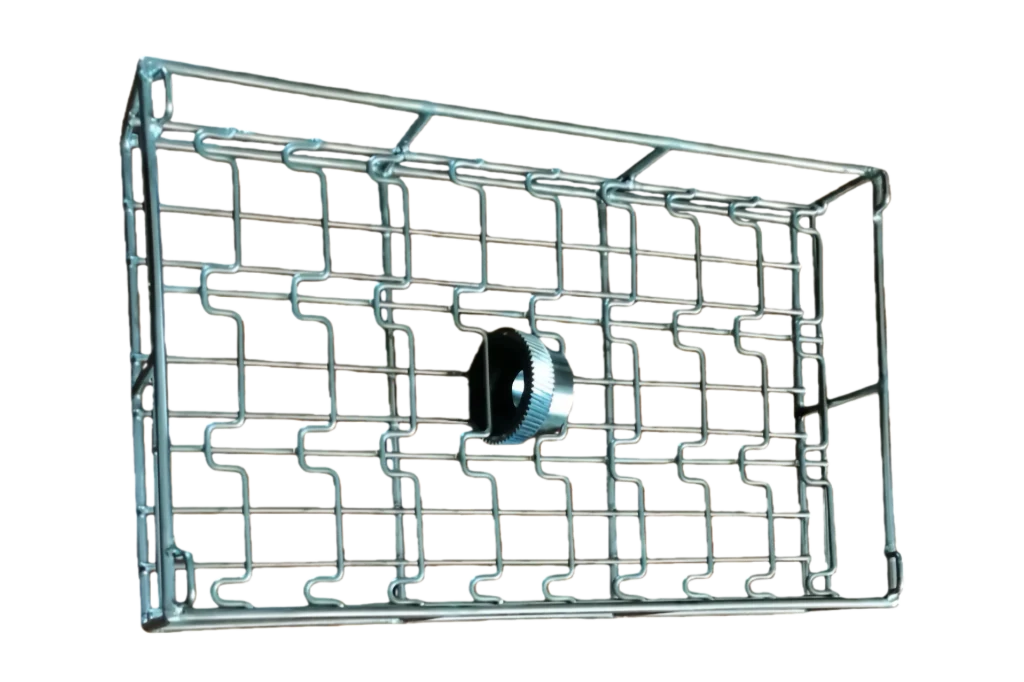
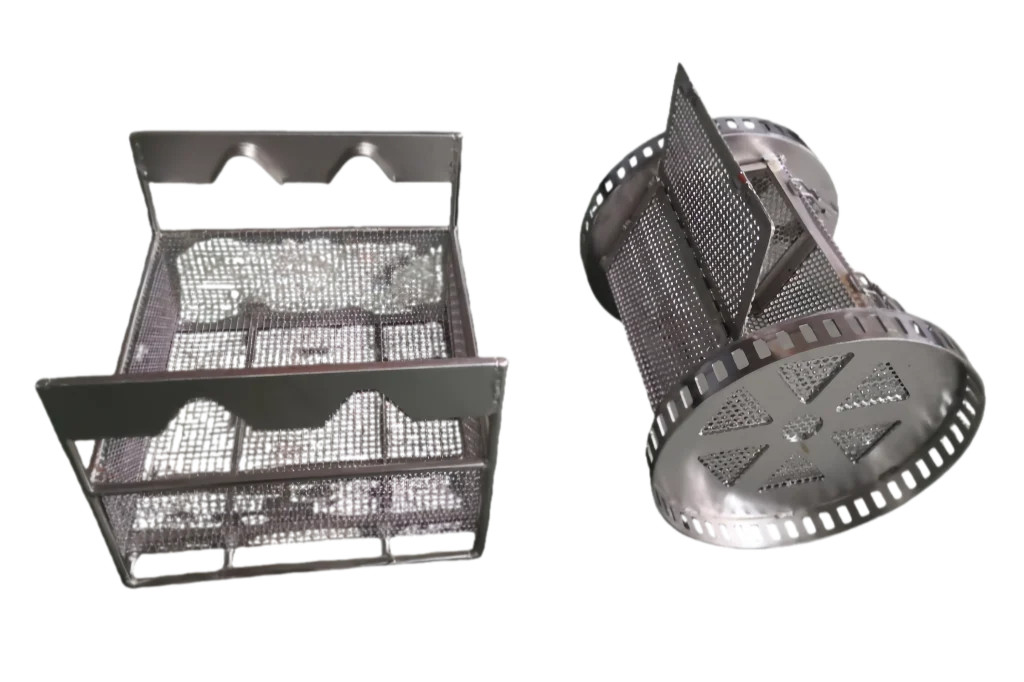
Basket and fixture design directly affects infeed and outfeed reliability. <Composants du système de nettoyage ultrasonique expliqués> explains how custom baskets and part carriers are engineered to hold components securely during high-speed conveyor travel, especially when parts must maintain a precise orientation for subsequent robotic handling.
Sizing Throughput Without Starving or Flooding the System
Throughput capacity in a pass-through machine is not just a conveyor speed number. It's the product of conveyor width, effective cleaning zone length, and the maximum permissible exposure time per stage. If a part requires a minimum 60-second spray wash to remove stamping oil, and the conveyor runs at 1?m/min, the wash stage must be at least 1?m long. But if the production line demands 2?m/min to match upstream output, the wash tunnel length must double to maintain the same exposure time, or additional wash stages must be added in series. In practice, I size pass-through systems by starting with the required throughput in parts per minute, calculating the necessary conveyor speed for the chosen part spacing, and then working backward to the tunnel lengths for each process stage.
A common mistake is assuming that higher conveyor speed solves everything. Speeding up the conveyor reduces dwell time in every stage, and if the drying stage can't keep up, parts exit wet. Adding more powerful air knives or extending the drying tunnel helps, but both increase compressed air consumption and floor space. When a line must handle variable production volumes, I often recommend a two-speed conveyor or an indexing mode that pauses the belt at each station when the upstream flow is intermittent. That preserves cleaning and drying time regardless of line speed.
Table 1: Throughput Comparison for Typical Pass-Through Configurations
| Part Spacing | Conveyor Speed | Effective Throughput | Minimum Wash Length for 90s Dwell |
|---|---|---|---|
| 200 mm | 0.8 m/min | 4 parts/min | 1.2 m |
| 300 mm | 1.2 m/min | 4 parts/min | 1.8 m |
| 400 mm | 0.6 m/min | 1.5 parts/min | 0.9 m |
| 500 mm | cURL Too many subrequests by single Worker invocation. To configure this limit, refer to https://developers.cloudflare.com/workers/wrangler/configuration/#limits | cURL Too many subrequests by single Worker invocation. To configure this limit, refer to https://developers.cloudflare.com/workers/wrangler/configuration/#limits | cURL Too many subrequests by single Worker invocation. To configure this limit, refer to https://developers.cloudflare.com/workers/wrangler/configuration/#limits |
cURL Too many subrequests by single Worker invocation. To configure this limit, refer to https://developers.cloudflare.com/workers/wrangler/configuration/#limits
Control Systems: The PLC Conversation Nobody Writes About
cURL Too many subrequests by single Worker invocation. To configure this limit, refer to https://developers.cloudflare.com/workers/wrangler/configuration/#limits
cURL Too many subrequests by single Worker invocation. To configure this limit, refer to https://developers.cloudflare.com/workers/wrangler/configuration/#limits
cURL Too many subrequests by single Worker invocation. To configure this limit, refer to https://developers.cloudflare.com/workers/wrangler/configuration/#limitsMaîtriser les niveaux d'automatisation dans le nettoyage ultrasonique industrielcURL Too many subrequests by single Worker invocation. To configure this limit, refer to https://developers.cloudflare.com/workers/wrangler/configuration/#limits
Contamination Control Across an Integrated System
cURL Too many subrequests by single Worker invocation. To configure this limit, refer to https://developers.cloudflare.com/workers/wrangler/configuration/#limits
cURL Too many subrequests by single Worker invocation. To configure this limit, refer to https://developers.cloudflare.com/workers/wrangler/configuration/#limits
cURL Too many subrequests by single Worker invocation. To configure this limit, refer to https://developers.cloudflare.com/workers/wrangler/configuration/#limitsSystèmes de nettoyage ultrasonique à base d'eau versus à base de solvantcURL Too many subrequests by single Worker invocation. To configure this limit, refer to https://developers.cloudflare.com/workers/wrangler/configuration/#limits
Specifying the Right System: What to Demand from Your Supplier
cURL Too many subrequests by single Worker invocation. To configure this limit, refer to https://developers.cloudflare.com/workers/wrangler/configuration/#limits
cURL Too many subrequests by single Worker invocation. To configure this limit, refer to https://developers.cloudflare.com/workers/wrangler/configuration/#limits
cURL Too many subrequests by single Worker invocation. To configure this limit, refer to https://developers.cloudflare.com/workers/wrangler/configuration/#limits
Common Questions About Pass-Through Cleaning System Integration
cURL Too many subrequests by single Worker invocation. To configure this limit, refer to https://developers.cloudflare.com/workers/wrangler/configuration/#limits
cURL Too many subrequests by single Worker invocation. To configure this limit, refer to https://developers.cloudflare.com/workers/wrangler/configuration/#limits
cURL Too many subrequests by single Worker invocation. To configure this limit, refer to https://developers.cloudflare.com/workers/wrangler/configuration/#limits
cURL Too many subrequests by single Worker invocation. To configure this limit, refer to https://developers.cloudflare.com/workers/wrangler/configuration/#limits
cURL Too many subrequests by single Worker invocation. To configure this limit, refer to https://developers.cloudflare.com/workers/wrangler/configuration/#limits
cURL Too many subrequests by single Worker invocation. To configure this limit, refer to https://developers.cloudflare.com/workers/wrangler/configuration/#limits
cURL Too many subrequests by single Worker invocation. To configure this limit, refer to https://developers.cloudflare.com/workers/wrangler/configuration/#limits
cURL Too many subrequests by single Worker invocation. To configure this limit, refer to https://developers.cloudflare.com/workers/wrangler/configuration/#limits
Si vous êtes intéressé, consultez ces articles liés :
Température de nettoyage optimale recommandée pour les équipements de nettoyage ultrasonique (y compris des conseils spécifiques pour les pièces en aluminium et la cire de polissage)
Budgetiser pour la mise à niveau des équipements de nettoyage industriel : un guide stratégique
 French
  English
  German
  Spanish
  Russian
  Portuguese