

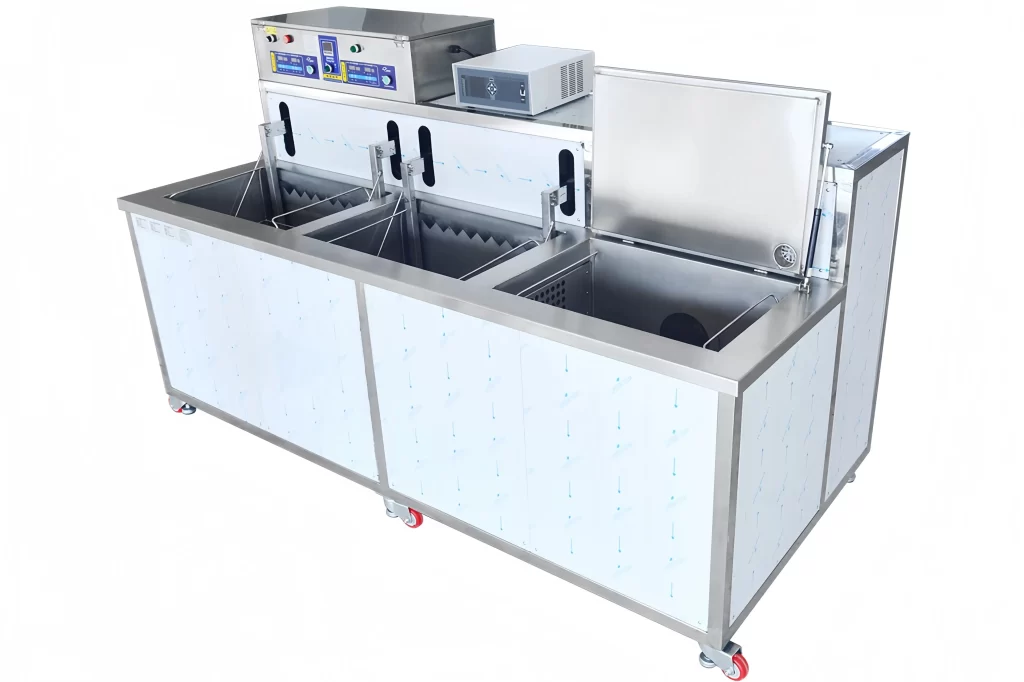
Multi-tank ultrasonic cleaning configuration determines cleaning performance more than any single component because tank sequence, timing, and transfer mechanics directly control contaminant removal and process throughput. As an engineer who has designed automated cleaning systems deployed across more than 20 countries, I have seen how a poorly arranged tank sequence can leave critical residues even when ultrasonic power is adequate, while a well-matched configuration delivers repeatable cleanliness with lower operating cost. The difference is rarely about buying more equipment—it is about connecting each tank's function to the specific part geometry and the contamination it carries.
What Tank Sequence Delivers the Right Cleanliness Level?
A standard multi-tank line might start with a pre-cleaning tank, move to an ultrasonic wash, then one or two rinse tanks, and finish with drying. That template works for general-purpose degreasing, but it often fails when the part has blind holes, internal threads, or heat treatment scale. The sequence must match the contaminant sandwich: what is on the surface, what is inside cavities, and how tightly each layer bonds.
In practice, we begin by identifying the dominant contaminant. For CNC machined parts carrying cutting oil and fine chips, the first tank should be a high-flow spray or immersion stage with moderate ultrasonic to flush loose debris before it recirculates. The second tank then applies stronger ultrasonic cavitation with a heated detergent to break the oil film. A third tank provides a clean rinse, and a fourth applies a DI water rinse if the subsequent process demands residue-free surfaces. If part geometry traps liquid, a hot air or vacuum drying stage follows.
For stamped parts coated in heavy drawing oil, the sequence often requires a heated degreasing tank with ultrasonic and surfactant before even beginning the fine cleaning steps. I have seen lines where skipping that first degreasing stage forced the main ultrasonic wash to work twice as hard and still left a thin film. The additional tank adds capital cost, but it reduces detergent consumption and cycle time enough to pay back within the first year.
The tank material also influences sequence design. Stainless steel 316 is preferred for tanks handling slightly acidic or high-temperature solutions, while 304 suffices for neutral pH and moderate heat. If the process includes a passivation or anti-rust dip after rinsing, that tank must be isolated from the wash section to avoid cross-contamination.
How to Set Ultrasonic Parameters for Each Tank
Treating every tank as needing the same ultrasonic power and frequency is a reliable way to increase cost without improving cleanliness. Each tank in the sequence serves a different purpose, and the ultrasonic energy should match that purpose.
Frequency selection follows the contaminant particle size. Lower frequencies around 20-28 kHz produce larger cavitation bubbles with more aggressive implosion energy, effective for removing thick grease or scale from robust metal surfaces. Higher frequencies of 40-80 kHz create smaller bubbles that penetrate narrow gaps and blind holes without damaging delicate surfaces. In a multi-tank line, the first wash tank often runs at 25-28 kHz to bulk-clean, while the second wash or rinse tank may shift to 40 kHz for fine cleaning and to help detach particles loosened by the first stage.
Power density matters more than total wattage. A tank with 2,400 watts of ultrasonic output that distributes that energy across a large volume may underperform a smaller tank with 1,500 watts concentrated in the part zone. We typically specify at least 10-15 watts per litre for general degreasing, and up to 25 watts per litre for heavy contamination or complex geometries. However, if the part is thin-walled or has sensitive coatings, we reduce power density to avoid cavitation erosion and instead extend cycle time.
Temperature control is not just about heating the cleaning solution; it stabilises cavitation intensity. At 45-65 °C, most aqueous detergents reach their optimum solvency, and the ultrasonic field becomes more uniform. I've observed that a tank operating at 35 °C can show a 20-30% drop in cleaning efficiency compared to the same tank at 55 °C, simply because the fluid viscosity and gas content differ. Circulation filtration between tanks helps maintain temperature and cleanliness, extending solution life. If you are cleaning parts prior to coating, the rinse water should be at a lower temperature, typically 30-40 °C, to prevent flash drying and water spotting.
Manual vs Automated Basket Transfer: When Each Makes Sense
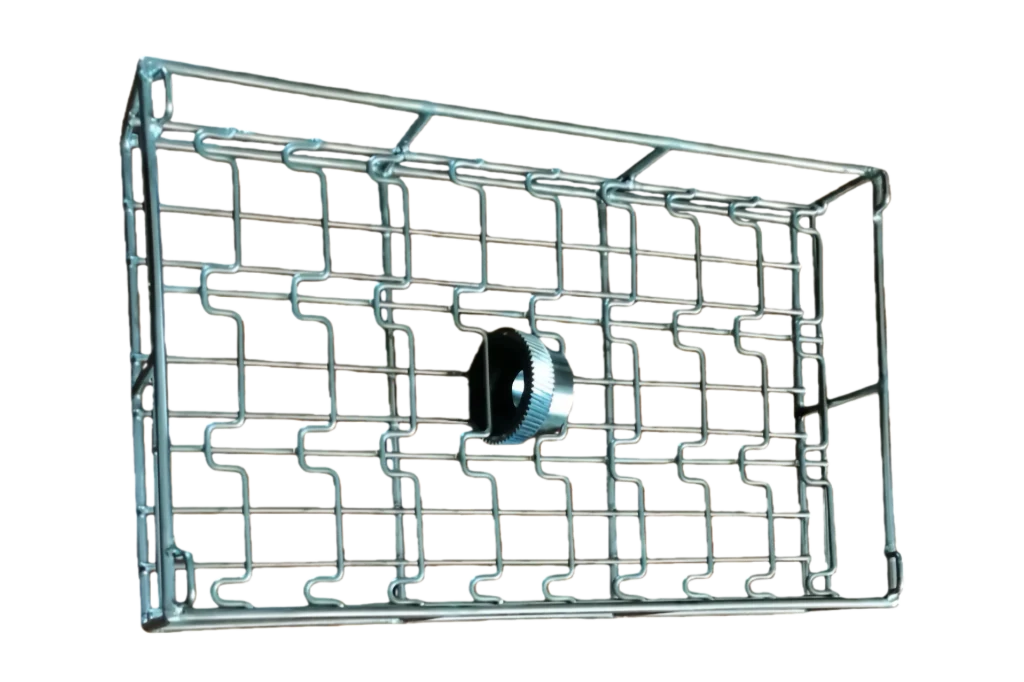
The decision between manual, semi-automatic, and fully automatic transfer shapes both capital cost and process consistency. A manual line where an operator moves baskets between tanks can work well for low-volume, high-mix production where cycle times are long and labor cost is manageable. But it introduces variability: dwell times can drift, and the operator may inadvertently cross-contaminate tanks. For R&D labs and job shops running fewer than 20 baskets per day, manual transfer with a clear process sheet and timer is often the most capital-efficient choice.
Semi-automatic systems, where a hoist or conveyor moves baskets on a fixed program but loading and unloading remain manual, strike a balance for medium volumes. These lines are common in precision hardware and medical device manufacturing, where cycle consistency is important but the part variety demands frequent program changes. The GTKCLEAN multi-tank hydrocarbon ultrasonic cleaner, for example, uses a rotary basket with automated transfer through degreasing, ultrasonic wash, rinse, and vacuum drying, while still allowing the operator to inspect parts between stages.
Fully automatic inline or rotary transfer systems eliminate operator-dependent timing altogether. When throughput exceeds 50 baskets per day and part geometry is consistent, automation pays back through consistent dwell times, reduced labor, and lower reject rates. The key configuration decision is not whether to automate but where to automate. A common mistake is automating the washing stages while leaving drying as a manual step, creating a bottleneck that erases the gains from faster upstream processing.
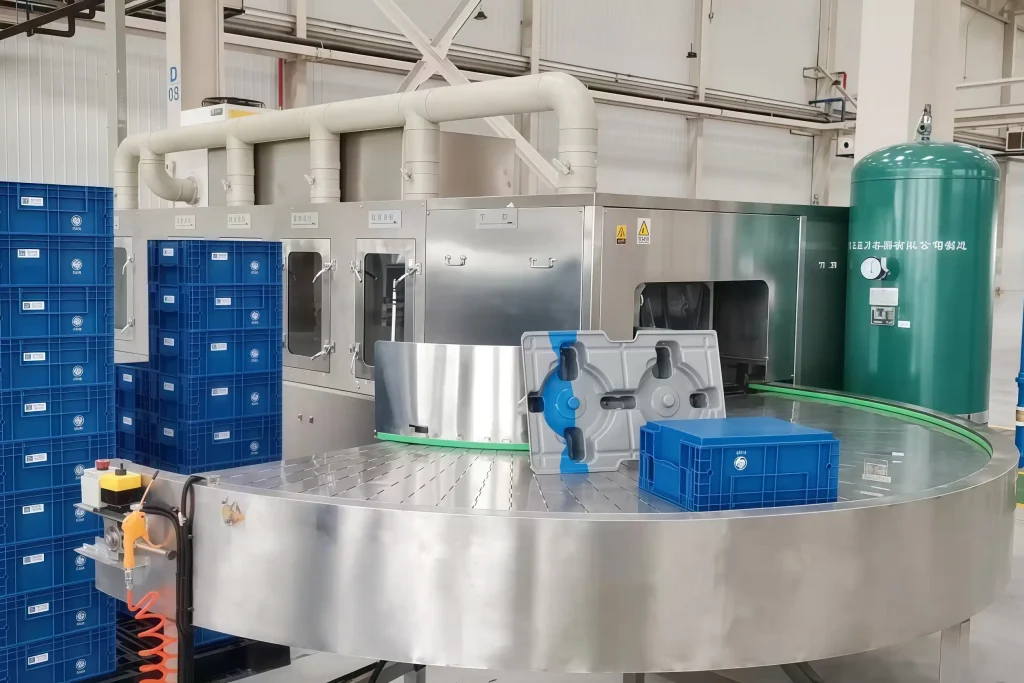
The following table summarises typical transfer modes and their fit:
| Transfer Mode | Basket Handling | Débit | Best for |
|---|---|---|---|
| Manuel | Operator moves baskets | < 20 baskets/day | Low volume, high mix |
| Semi-Automatic (hoist/rotary) | Programmed transfer, manual load/unload | 20-50 baskets/day | Medium volume, varied parts |
| Fully Automatic inline | Conveyor or robotic | > 50 baskets/day | High volume, consistent geometry |
If your program includes parts with recessed features where basket orientation affects cleaning, a rotary basket with 360° rotation during ultrasonic exposure significantly improves consistency. The rotation allows the cavitation field to reach surfaces that would otherwise shadow, but it requires that the basket design securely fixates each part to prevent contact damage.
Integrating Multi-Tank Systems into Your Production Line
A multi-tank system that cleans parts perfectly but does not match the production cadence becomes a costly island. Integration starts with defining the required cleaning throughput in parts per hour and then aligning cycle times and tank volumes to maintain that pace without accumulating queues.
For example, if the downstream assembly line consumes 120 parts per hour, the cleaning system must match or slightly exceed that rate after accounting for transfer time and drying. If each ultrasonic wash cycle is 6 minutes, you need a basket capacity that processes enough parts per cycle to meet the hourly target. Often, increasing basket size is simpler than reducing cycle time, but larger baskets require larger transducers and heating systems to maintain power density and temperature uniformity.
Drying is the most common integration bottleneck. Hot air drying can take as long as the wash and rinse cycles combined. Switching to vacuum drying can reduce drying time by 50-70% for parts with complex internal cavities, but it adds capital cost. I have seen production lines where a vacuum drying module reduced total process time from 25 minutes to 15 minutes per basket, enabling the cleaning line to keep up with a faster assembly line without adding a parallel system.
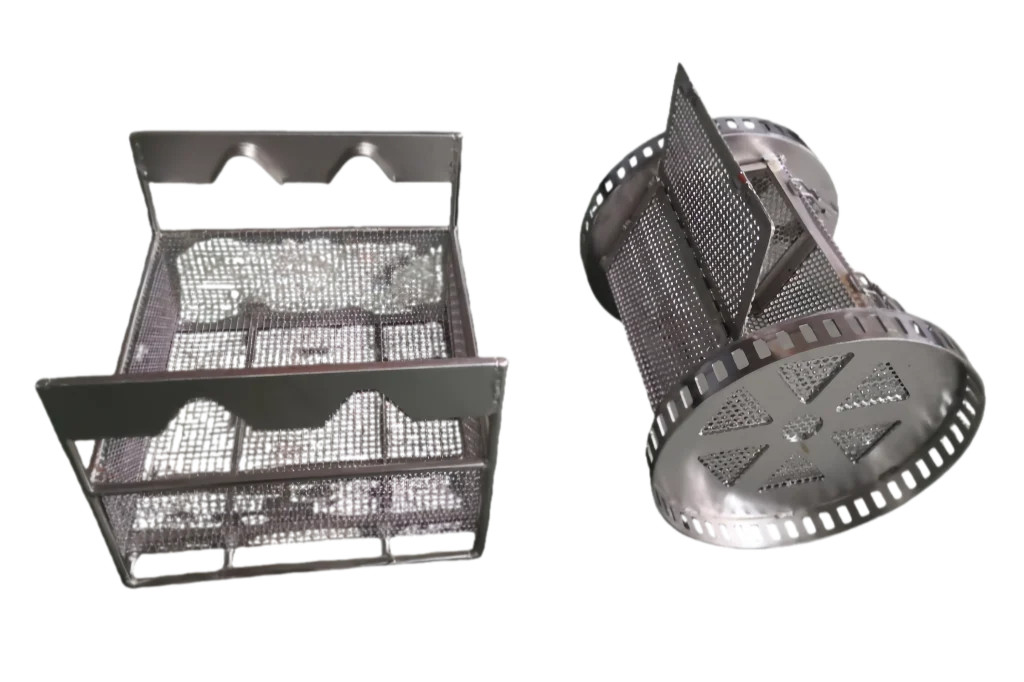
Filtration and recirculation between tanks also affect integration. A multi-tank line with shared filtration can save floor space and reduce maintenance, but it introduces a risk that a contamination spike in one tank reaches others. Dedicated filtration per tank is safer for processes with strict cleanliness requirements. We configure the circulation loop to include bag filters for large particles and cartridge filters down to 1 micron for the final rinse tank when parts are destined for coating or assembly.
If you are planning to integrate with an existing production line and the available floor space is tight, the tank layout can be arranged in a U-shape or L-shape to reduce the footprint. The critical constraint is not the tank dimensions but the access for maintenance and loading. Customising the configuration to the available space rather than forcing a standard layout often saves more than it costs in engineering time.
Validating a Multi-Tank Configuration Before Full Deployment
cURL Too many subrequests by single Worker invocation. To configure this limit, refer to https://developers.cloudflare.com/workers/wrangler/configuration/#limits
cURL Too many subrequests by single Worker invocation. To configure this limit, refer to https://developers.cloudflare.com/workers/wrangler/configuration/#limits
cURL Too many subrequests by single Worker invocation. To configure this limit, refer to https://developers.cloudflare.com/workers/wrangler/configuration/#limits
cURL Too many subrequests by single Worker invocation. To configure this limit, refer to https://developers.cloudflare.com/workers/wrangler/configuration/#limits
Questions Engineers Ask About Multi-Tank Configuration
cURL Too many subrequests by single Worker invocation. To configure this limit, refer to https://developers.cloudflare.com/workers/wrangler/configuration/#limits
cURL Too many subrequests by single Worker invocation. To configure this limit, refer to https://developers.cloudflare.com/workers/wrangler/configuration/#limits
cURL Too many subrequests by single Worker invocation. To configure this limit, refer to https://developers.cloudflare.com/workers/wrangler/configuration/#limits
cURL Too many subrequests by single Worker invocation. To configure this limit, refer to https://developers.cloudflare.com/workers/wrangler/configuration/#limits
cURL Too many subrequests by single Worker invocation. To configure this limit, refer to https://developers.cloudflare.com/workers/wrangler/configuration/#limits
cURL Too many subrequests by single Worker invocation. To configure this limit, refer to https://developers.cloudflare.com/workers/wrangler/configuration/#limits
cURL Too many subrequests by single Worker invocation. To configure this limit, refer to https://developers.cloudflare.com/workers/wrangler/configuration/#limits
cURL Too many subrequests by single Worker invocation. To configure this limit, refer to https://developers.cloudflare.com/workers/wrangler/configuration/#limits
Si vous êtes intéressé, consultez ces articles liés :
Guide stratégique de location versus achat de matériel de nettoyage industriel
Réduire les coûts énergétiques dans le nettoyage ultrasonique industriel
Solutions de nettoyage préalable au revêtement pour PVD - GTK
Solutions de nettoyage pour pièces estampées - GTK
Quel est le meilleur appareil de nettoyage avant revêtement pour les usines de revêtement PVD, DLC et CVD ?
 French
  English
  German
  Spanish
  Russian
  Portuguese