

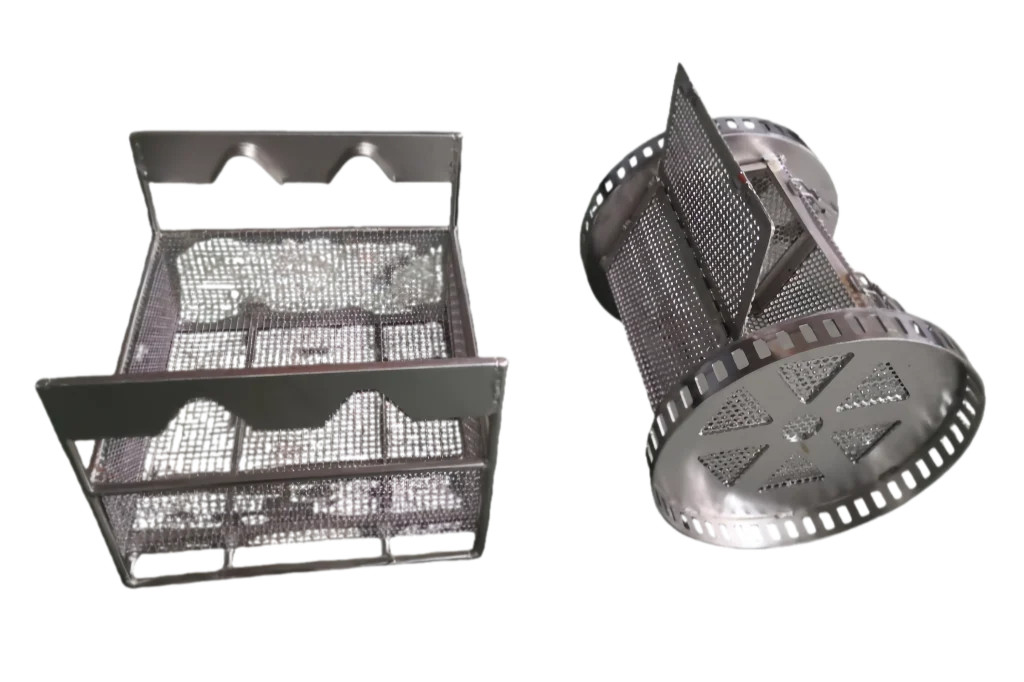
Most process engineers focus on ultrasonic frequency, power, and chemistry when troubleshooting cleaning inconsistency. They assume the basket is just a container. In two decades of deploying automated cleaning lines, I have seen the opposite: the basket is often the root cause of both part damage and incomplete cleaning. A basket that shields the workpiece from cavitation or traps contamination between stages will turn an otherwise capable system into a bottleneck. Getting the basket right early prevents rejects that are hard to trace later.
Why Basket Design Dictates Ultrasonic Cleaning Performance
The ultrasonic tank generates cavitation bubbles that implode against surfaces, dislodging contaminants. The basket sits between the transducers and the parts. If it absorbs or deflects too much acoustic energy, cleaning effectiveness drops before the solution ever reaches the workpiece. Solid sheet-metal baskets with small drainage holes are a common offender: they reflect ultrasonic waves and create dead zones where parts remain dirty. In a production environment, that means rework or manual brushing after the automated cycle, which defeats the purpose of the investment.
Beyond energy transmission, the basket shapes how fluid and loosened contaminants flow out of the part. Tight pockets without drainage paths hold dirty solution, cross-contaminating parts in the rinse tank. We have measured cleanliness variations exceeding 30% between supposedly identical parts cleaned in the same cycle, simply because the basket masked certain faces on some units. In precision applications like pre-coating or bearing assembly, that variance is unacceptable.
Material Selection: Balancing Durability and Cavitation
Three material families dominate industrial basket construction, and the choice is rarely about cost alone.
Stainless steel is the default for water-based systems and high-temperature drying. SUS304 handles most alkaline detergents and temperatures up to 80 °C. SUS316 adds molybdenum for better resistance to chlorinated solutions and pickling acids. The drawback is acoustic impedance: a heavy-gauge stainless frame can absorb ultrasonic energy, especially at higher frequencies (40 kHz and above). Thinner wire diameters and expanded metal panels improve transmission but reduce weight-bearing capacity, which becomes a trade-off engineers must make consciously.
Plastics like polypropylene and PVDF are chemically inert and lightweight, so they transmit ultrasound more efficiently than stainless. They also eliminate the risk of metal-to-metal contact scratches on delicate finished surfaces. The limitation is temperature: PP softens above 80 °C and cannot survive hot-air drying cycles above 100 °C without deformation. PVDF extends the thermal window but at significantly higher cost. I use plastic baskets whenever parts are polished or coated and the drying stage stays under 90 °C.
PTFE (Teflon) baskets are reserved for aggressive chemistry: strong acids, high-purity solvents, or sticky residues that adhere to metal and plastic alike. They are expensive and mechanically weaker, so we typically specify them only for small-batch precision work where chemical compatibility is the overriding concern.
| Matériau | Energy Transmission | Max Temp (°C) | Chemical Resistance | Capacité de charge |
|---|---|---|---|---|
| SUS304 | Moderate (heavy gauge reduces cavitation) | 80–100 | Good (alkaline) | Élevée |
| PP | Élevée | 80 | Excellent (acids, solvents) | Low–Medium |
| PVDF | Élevée | 120 | Excellent | Moyen |
| PTFE | Très élevé | 150 | Outstanding | Faible |
Geometry and Perforation: Ensuring Full Fluid Access
The single biggest mistake I see in custom basket design is treating the basket as a box with holes rather than as an acoustic window. Ultrasonic energy travels best through open liquid, so the basket structure should present the minimum possible surface area in the path between transducer and part. The ideal is a frame that holds parts in position with as little solid material as possible, using wire mesh, expanded metal, or perforated sheet with open area ratios above 60%.
Perforation size and pattern matter for reasons beyond energy. Holes that are too small trap air bubbles, creating a cushion that attenuates ultrasound. Holes that are too large let small parts slip through or protrude where they can contact tank walls. For stamped metal parts and fasteners, we commonly use mesh with 3–6 mm openings and stagger the rows so that no linear path obstructs fluid flow. For parts with blind holes, the basket must be designed so that the blind side faces upward or allows rotation, otherwise cavitation cannot enter the cavity.
Load Planning and Fixturing to Prevent Part Damage
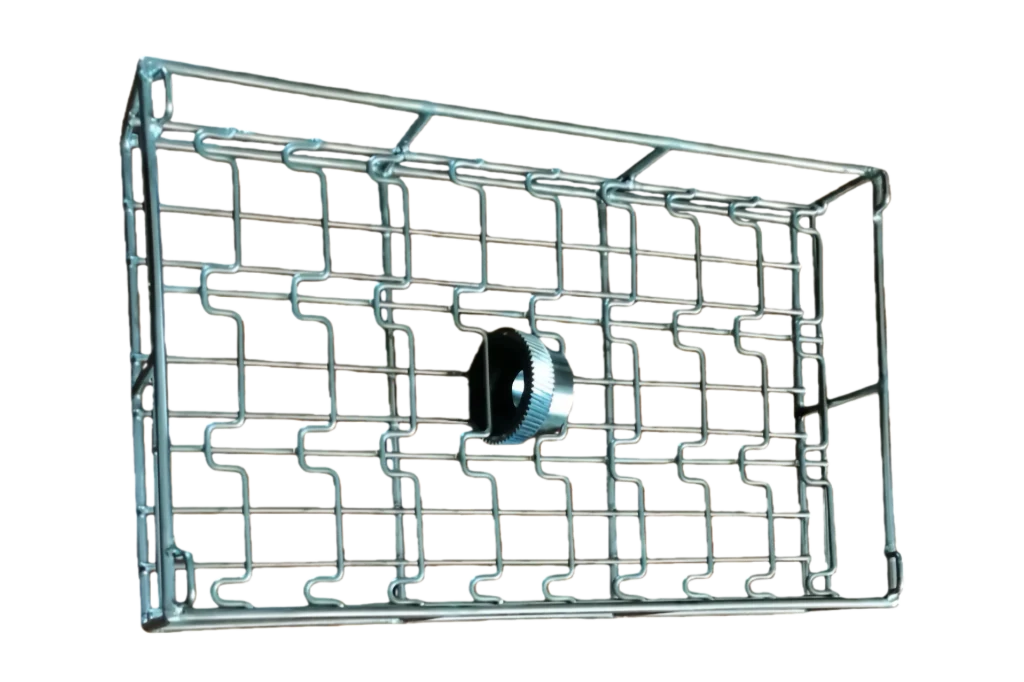
Ultrasonic energy causes parts to vibrate independently, which can create micromotion between parts resting against each other. This is not a basket durability issue; it is a part-quality issue. Mating surfaces on precision-machined components can develop fretting marks in a single cycle if the basket allows part-to-part contact under vibration. I have seen optical component batches scrapped because the basket design placed polished faces against wire dividers without elastomeric cushioning.
The fix is part-specific fixturing: individual slots, spring clips, or silicone-tipped pins that hold each part separated and stationary. Rotary baskets add a further safeguard: by slowly turning the load during cleaning, they prevent any single face from permanently masking another part. This is especially effective for components with internal threads and cross-drilled holes, where a static orientation always traps air in some cavities. The rotary motion continuously reorients parts, ensuring fresh fluid reaches every surface.
Heavy parts present a different challenge. A 50 kg gearbox housing cannot be fixtured like a 200-gram valve body. The basket structure must carry the load through repeated hoist transfers without deforming. We reinforce corners, weld cross-braces, and integrate lifting lugs designed for the hoist mechanism, not just for crane hooks. Load-bearing baskets above 500 kg require finite-element analysis to avoid fatigue cracks after thousands of cycles. If your program involves workpieces above 200 kg and the basket vendor cannot show you stress analysis, contact us at [email protected] before committing to a design.
Matching Basket Design to Automation and Tank Configuration
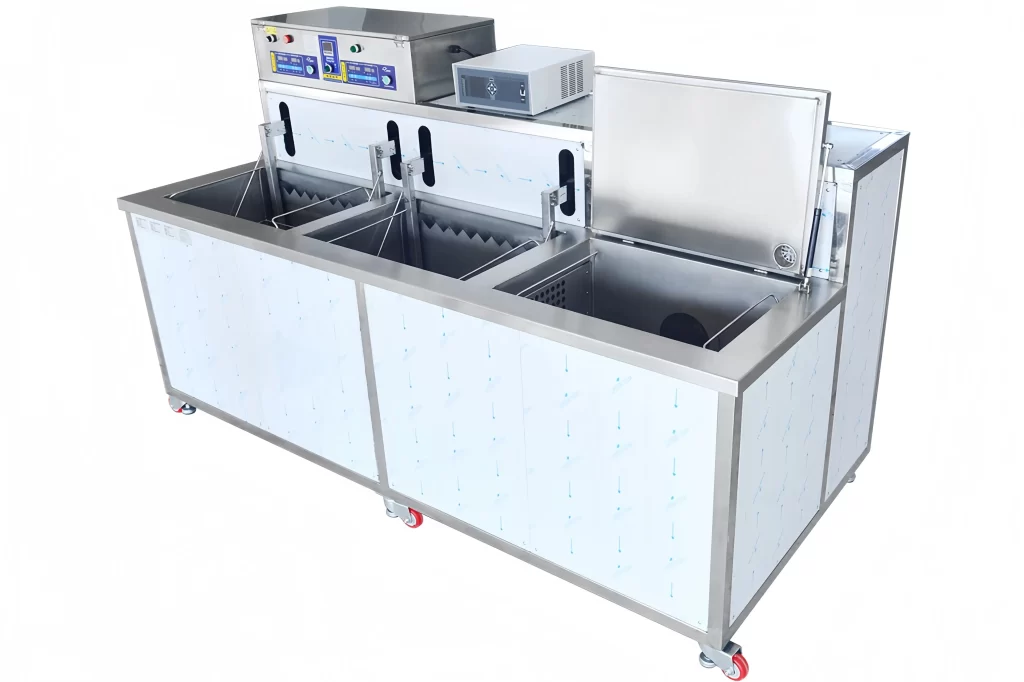
A basket that works in a manual benchtop cleaner may fail in a fully automated multi-tank line. Automation introduces constraints: the basket must be dimensionally consistent so that robotic grippers or walking-beam transfers engage reliably. It must survive immersion and withdrawal speeds that create significant drag forces. And it must drain completely within the transfer time between tanks, otherwise drag-out contaminates the next stage.
In multi-tank systems, we often design baskets with sloped floors and drain channels to accelerate fluid removal. The basket edges are rounded to prevent catching on tank walls or transfer guides. For systems with air-knife or vacuum drying, the basket must present the parts at the correct angle to the air stream. This coordination between basket, machine, and drying module is one of the most underrated factors in final cleanliness. I recall a project where a customer's residue problem disappeared after we modified the basket tilt angle by 8 degrees to improve drainage following the rinse step.
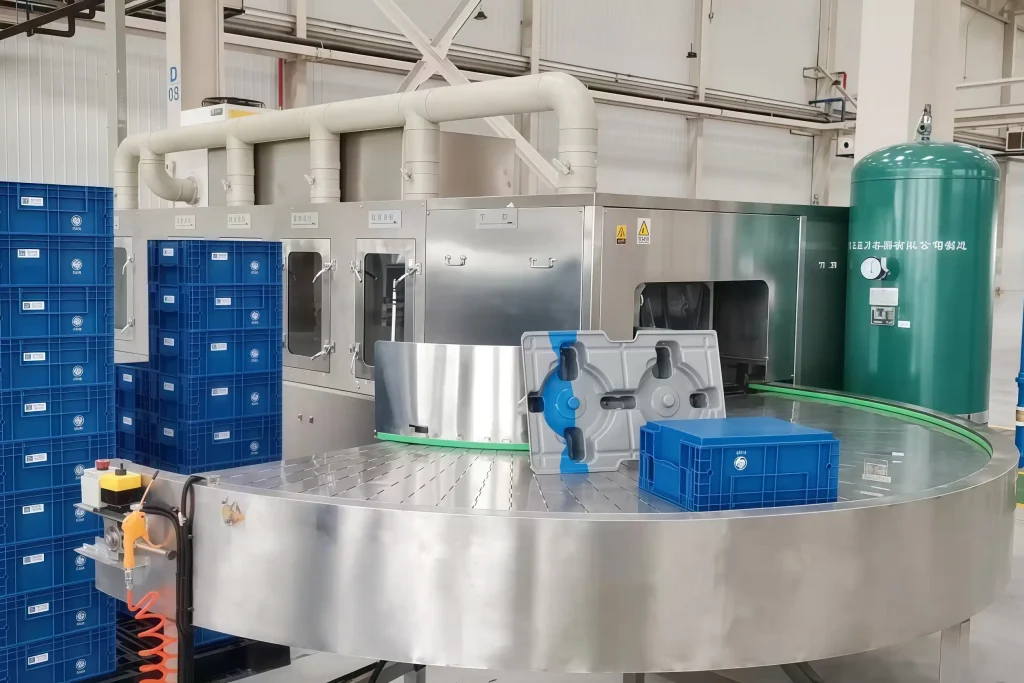
Conveyor-based cleaning lines use belt-compatible baskets or dedicated fixtures that bolt to the conveyor chain. Here the basket must also withstand the continuous tension and vibration of the belt drive. We use thicker gauge stainless and weld all joints; wire ties and snap-fits fail under continuous operation. Basket weight must also be accounted for in conveyor motor sizing: a line of 20 heavy baskets on a 15-meter belt can exceed the drive's rated load if the original calculation assumed lighter fixtures.
Protecting Your Investment Through Basket Maintenance
Basket damage accumulates slowly until the effect on parts becomes obvious. Wire mesh that frays from repeated loading and unloading leaves sharp strands that scratch parts. Deformed corners change the basket's footprint, causing misalignment in automated transfer stations. Chemical attack from aggressive cleaning media thins stainless walls over time, leading to sudden collapse when a hoist lifts a loaded basket.
In our post-deployment support, we recommend a simple checklist for operators: inspect welds and wire intersections for cracks weekly, weigh baskets monthly to detect chemical thinning, and replace any basket that no longer sits flat by more than 2 mm across its base. A $300 basket replacement is cheaper than a $30,000 batch of rejected parts that were scratched or improperly cleaned.
Common Questions About Ultrasonic Cleaning Basket Design
How do I choose between stainless steel and plastic baskets for my ultrasonic system?
It depends primarily on your cleaning chemistry, drying temperature, and part fragility. Stainless steel is the right choice for alkaline water-based systems with hot-air drying above 90 °C, especially when parts are heavy. Plastic baskets are better for sensitive surfaces and aggressive solvents, provided the drying stage stays under 80 °C. If your process uses hydrocarbon solvents with vacuum drying, either material can work because there is no thermal stress, and I usually recommend stainless for longevity.
Can poor basket design cause cavitation erosion on parts?
Yes, and in a specific way. Cavitation erosion normally attacks the tank walls and transducer surfaces, not the parts themselves, because the implosion energy dissipates quickly with distance. But when a basket cradles a part rigidly and the part resonates at the ultrasonic frequency, cavitation bubbles can form near the contact point repeatedly, eroding the material. This occurs most often on thin-walled aluminum housings held tightly against a rigid metal basket frame. Using compliant mounts or plastic dividers eliminates the resonance path.
What basket features improve cleaning consistency in high-volume production?
cURL Too many subrequests by single Worker invocation. To configure this limit, refer to https://developers.cloudflare.com/workers/wrangler/configuration/#limits
cURL Too many subrequests by single Worker invocation. To configure this limit, refer to https://developers.cloudflare.com/workers/wrangler/configuration/#limits
cURL Too many subrequests by single Worker invocation. To configure this limit, refer to https://developers.cloudflare.com/workers/wrangler/configuration/#limits
cURL Too many subrequests by single Worker invocation. To configure this limit, refer to https://developers.cloudflare.com/workers/wrangler/configuration/#limits
cURL Too many subrequests by single Worker invocation. To configure this limit, refer to https://developers.cloudflare.com/workers/wrangler/configuration/#limits
Si vous êtes intéressé, consultez ces articles liés :
Équipements de nettoyage automatisés : un guide industriel pour débutants
Choisir le bon système de nettoyage ultrasonique pour la réussite industrielle
Guides sur les systèmes de nettoyage ultrasonique manuel : applications et limitations
Nettoyage ultrasonique multi-bacs : une plongée approfondie dans les configurations industrielles
Laveurs ultrasoniques semi-automatisés : Analyse coût vs performance
 French
  English
  German
  Spanish
  Russian
  Portuguese