

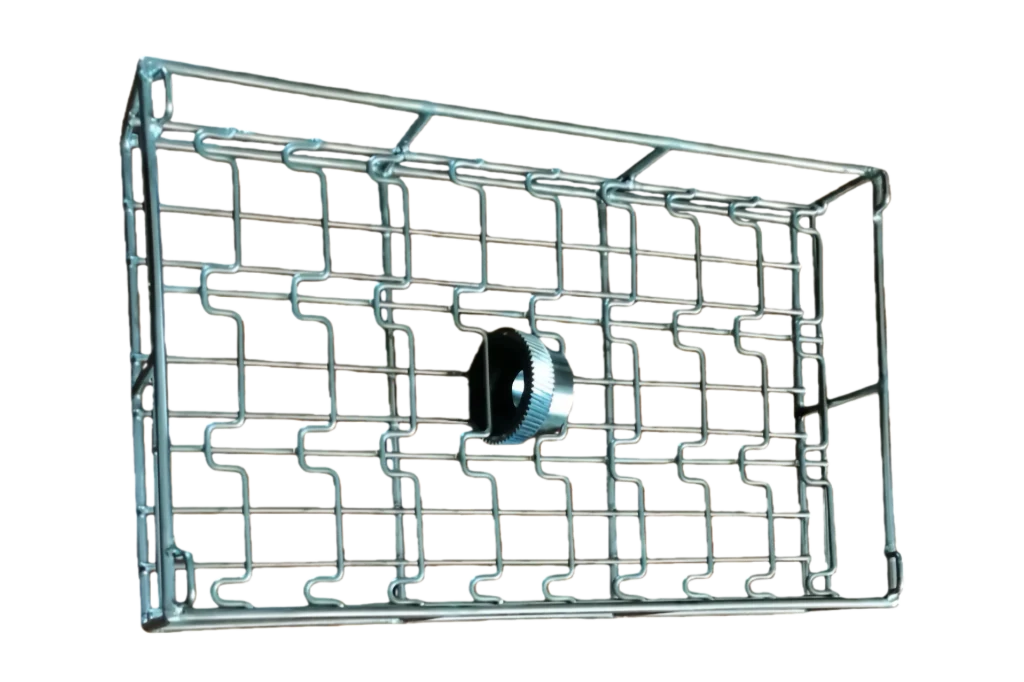
Production managers often fixate on the number of cleaning tanks, assuming more stations guarantee better results. In practice, a single-tank machine with well-engineered basket rotation and fluid management can outperform a multi-tank line where parts are poorly oriented or fluid drag‑out contaminates downstream stages. Choosing the right tank configuration for ultrasonic cleaning is less about counting tanks and more about matching how parts are loaded, oriented, and moved through cleaning, rinsing, and drying steps. This selection guide treats tank layout as a production‑engineering decision, not just a washer specification, and examines the interplay between part geometry, automation level, and throughput requirements to avoid the most common and costly configuration mistakes.
Why Tank Configuration Matters More Than Tank Count
The number of tanks in an ultrasonic cleaning system is a poor proxy for cleaning performance. A three‑tank setup where the first station degreases, the second rinses with hard water, and the third blows hot air can leave water marks and residues that a two‑tank system with DI water rinse and air‑knife drying would eliminate. The layout of tanks – their size, the transfer method between them, and how fluid drains from the workpiece – determines cleanliness more than the tank count.
| Configuration | Typical Tanks | Avantages | Inconvénients | Best Fit |
|---|---|---|---|---|
| Single‑station | 1 multi‑function tank | Smallest footprint, lowest cost | Cannot run parallel clean/rinse; cross‑contamination risk | Low‑volume, simple parts |
| Multi‑tank (linear) | 2–6 separate tanks | Dedicated wash, rinse, dry; cleaner rinse stages | Larger footprint, manual or semi‑auto transfer needed | Mid‑volume, multi‑step cleaning |
| Inline conveyor | Single chamber, zones | Continuous flow, high throughput | Fixed process, harder to configure for mixed parts | High‑volume, uniform parts |
What matters is whether the configuration prevents re‑deposition of contaminants. In a multi‑tank system, if the basket does not drain fully between tanks, the rinse water quickly becomes contaminated, defeating the purpose of a separate rinse stage. Design‑driven configuration accounts for drain time, part orientation, and fluid management, not the number of tanks.
How does tank layout affect cleaning consistency?
A layout where parts exit each tank at the same orientation they entered tends to trap fluid in blind holes and recesses, producing inconsistent drying and potential staining. When the system design forces the basket to tip or rotate between stages – even in a two‑tank setup – consistency improves noticeably. I have witnessed production lines where adding a simple 15‑degree tilt station between the wash and rinse tanks eliminated previously recurring water‑spot rejects entirely, without adding a single tank.
Matching Tank Layout to Part Geometry and Production Flow
The most persistent cleaning failures I see originate from a mismatch between the tank configuration and the part’s physical shape. Deep blind holes, narrow recesses, and internal threads hold cleaning fluid like a reservoir. If the tank layout does not allow the basket to rotate or the part to be re‑oriented between stages, that trapped fluid carries into the next tank, contaminating rinse or drying stages and leaving residues that cause corrosion or coating failure.
The tank configuration must respect drainage paths. For cylindrical parts with through‑holes, vertical orientation in a square basket often works well across multiple tanks. For parts with blind pockets, a rotary basket in a single‑tank machine that changes position during the wash cycle can flush cavities more effectively than a linear multi‑tank setup where the basket stays flat. Semi‑automatic multi‑tank systems with manual basket transfer allow an operator to tip, jiggle, or re‑lay parts between stations, which can be valuable for complex geometries in lower‑volume production.
Production flow imposes additional constraints. If a line produces multiple part types, the tank configuration must accommodate changeover without extensive re‑fixturing. A multi‑tank system with adjustable basket supports and quick‑change hangers enables switching between part families in minutes, whereas a fixed inline conveyor might require hours of setup. The layout of tanks along the production line should also match the natural material flow: an L‑shaped or U‑shaped multi‑tank configuration can reduce operator walking distance and keep the work area compact.
Making Automation Work with the Right Tank Configuration
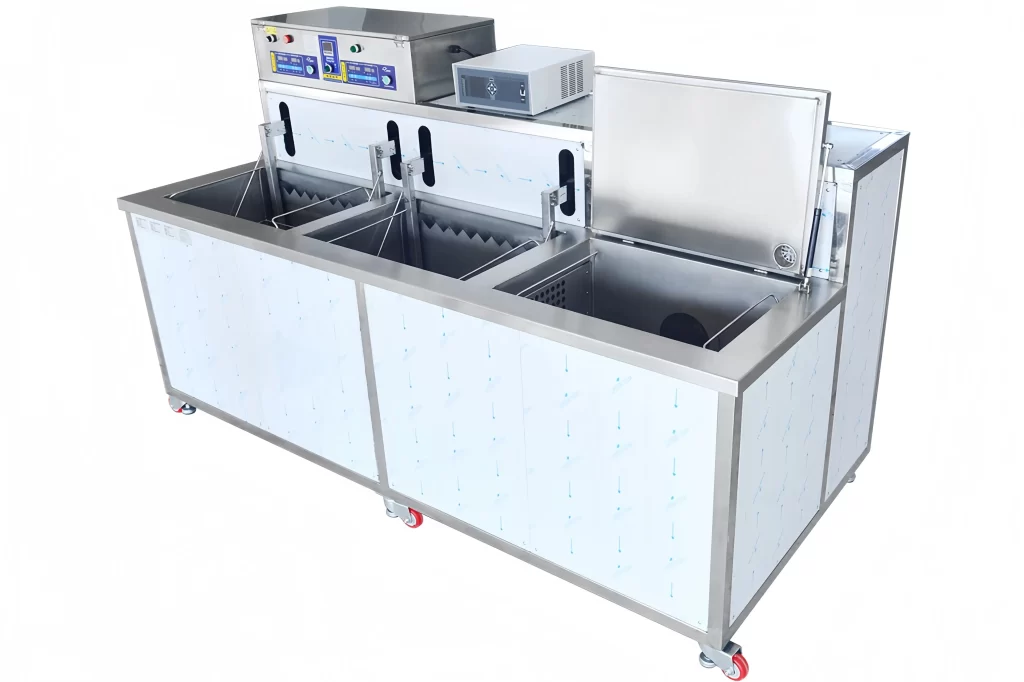
Automated lines impose the strictest requirements on tank configuration. When robotic handlers move baskets through cleaning, rinsing, and drying tanks, every tank’s height, rim design, and transfer slot must align with the robot’s reach and grip. A custom multi‑tank system such as the fully automatic Pre PVD Coating Parts Ultrasonic Cleaners from GTKCLEAN integrates high‑pressure spray, ultrasonic degreasing, multiple ultrapure water rinses, and vacuum drying in a linear configuration where the work basket moves under PLC control. The tanks are positioned and dimensioned so the robot can lower the basket precisely into each station and raise it without dripping contaminants onto adjacent tanks.
If your program involves parts with varied geometries that share a single production line, program‑controlled process recipes become essential. The multi‑tank configuration must allow the PLC to skip stations or adjust dwell times per recipe. A tank layout that forces every part through every station with the same cycle time severely limits the line’s flexibility. I recommend discussing configuration with the supplier early, as retrofitting a fixed‑sequence multi‑tank line to accommodate variable recipes is costly. For guidance on integrating a configurable multi‑tank system with robotic loading, reach out at [email protected] or call +86 17768507147.
Evaluating the True Cost of Multi‑Tank Configurations
The cost of a tank configuration is not just the purchase price of extra tanks. Multi‑tank systems increase the chemical inventory, heating energy, and floor space, but they can deliver faster cycle times per part because cleaning, rinsing, and drying happen in parallel. A single‑station machine must perform all three tasks sequentially, tying up the operator and limiting throughput.
cURL Too many subrequests by single Worker invocation. To configure this limit, refer to https://developers.cloudflare.com/workers/wrangler/configuration/#limits
cURL Too many subrequests by single Worker invocation. To configure this limit, refer to https://developers.cloudflare.com/workers/wrangler/configuration/#limits
Getting the Right Tank Configuration for Your Production
cURL Too many subrequests by single Worker invocation. To configure this limit, refer to https://developers.cloudflare.com/workers/wrangler/configuration/#limits
cURL Too many subrequests by single Worker invocation. To configure this limit, refer to https://developers.cloudflare.com/workers/wrangler/configuration/#limits
cURL Too many subrequests by single Worker invocation. To configure this limit, refer to https://developers.cloudflare.com/workers/wrangler/configuration/#limits
Common Questions About Ultrasonic Cleaning Tank Configuration
Do I always need multiple tanks to clean complex parts?
cURL Too many subrequests by single Worker invocation. To configure this limit, refer to https://developers.cloudflare.com/workers/wrangler/configuration/#limits
What if my parts are large and heavy?
cURL Too many subrequests by single Worker invocation. To configure this limit, refer to https://developers.cloudflare.com/workers/wrangler/configuration/#limits
Can manual basket transfer between tanks achieve consistent results?
cURL Too many subrequests by single Worker invocation. To configure this limit, refer to https://developers.cloudflare.com/workers/wrangler/configuration/#limits
Does a rotary basket eliminate the need for a separate rinse tank?
cURL Too many subrequests by single Worker invocation. To configure this limit, refer to https://developers.cloudflare.com/workers/wrangler/configuration/#limits
Si vous êtes intéressé, consultez ces articles liés :
Systèmes de nettoyage ultrasonique manuels vs automatisés : un guide complet
Maîtriser les systèmes de nettoyage par solvants hydrocarburés pour la précision industrielle
Le guide de l'ingénieur pour la préparation de surface avant le revêtement
Solutions de nettoyage pour pièces industrielles moulées sous pression - GTK
Concevoir un processus de nettoyage industriel efficace à plusieurs étapes
 French
  English
  German
  Spanish
  Russian
  Portuguese