

Yes, but only when the cleaning process is designed around the least-compatible material in the part, not the metal component. Many parts-cleaning operations run ultrasonic or spray processes successfully on plastic housings, rubber seals, and assemblies that combine polymers with metals, ceramics, or glass. The challenge is not whether these materials can be cleaned; it is how cavitation, heat, chemical exposure, and drying stress affect each material phase. This guide explains the failure modes to watch, how to set conservative starting parameters, and how to validate a process before full production.
How Ultrasonic Energy Interacts With Plastics and Rubber
Ultrasonic cleaning relies on cavitation bubbles that form and collapse in the cleaning liquid. On rigid metal surfaces, bubble collapse is sharply focused and removes oil, chips, and particulate efficiently. On softer polymer surfaces, some of that mechanical energy is absorbed, so the cleaning effect can be less uniform and the thermal effect can be more localized at the surface. Plastics and rubber also interact with the cleaning chemistry differently from metals. They can absorb water or solvent, lose plasticizer, swell, craze, or develop microcracks. The material’s response depends less on whether cavitation is present and more on frequency, temperature, cycle time, detergent type, and part geometry [1], [2].
Material-Specific Considerations
Each polymer family has distinct failure modes in a cleaning bath. A part that is simply described as “plastic” does not provide enough information for process design. The table below groups common materials and the risks to address.
| Material family | Common failure modes | Conservative approach |
|---|---|---|
| Semi-crystalline plastics such as PE, PP, POM, and nylon | Softening, swelling, stress cracking | Mild aqueous detergent; moderate temperature; avoid strong solvent degreasers unless tested |
| Amorphous plastics such as PC, PMMA, ABS, and PSU | Crazing, microcracking, adhesive bond attack | Shorter cycles; gentle cavitation; avoid solvent-based prewash |
| Rubber and elastomers such as NBR, EPDM, FKM, and silicone | Swelling, seal lip damage, compression set | Test each compound; limit exposure time; verify dimensions and hardness after cleaning |
| Multi-material assemblies | Crevice retention, differential expansion, metal-polymer interface attack | Stage aggressive cleaning away from sensitive polymer phases; controlled rinse and drying |
For rubber components, ISO 1817 describes immersion testing for mass, volume, and hardness change after exposure to liquids [3]. This type of data should guide detergent selection before a full assembly is committed to a production cleaning process.
Multi-Material Assembly Risks
The more serious failure modes occur when a rigid metal insert is bonded, threaded, or overmolded into a polymer body. The metal surface sees strongly focused cavitation, while the adjacent polymer may absorb energy unevenly. A cleaning solution that is safe for the metal may attack the polymer phase, and a solvent that is acceptable for a seal may extract plasticizer or weaken an adhesive bond. Crevices at the metal-polymer interface can retain fluid after rinsing, which leads to residue, corrosion, or later outgassing. Assemblies with blind holes, O-ring grooves, or threaded inserts require longer rinse cycles and stronger drying because capillary retention resists removal.
Multi-material assemblies fail most often when the cleaning process is optimized for the metal component and the polymer is treated as an afterthought.
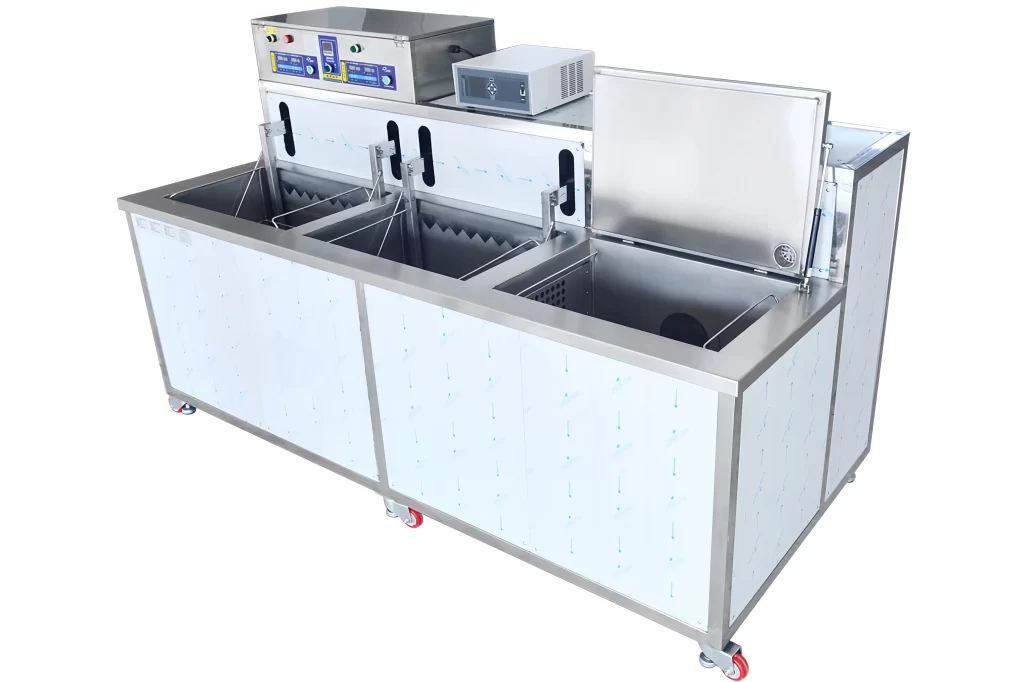
(https://www.gtkclean.com/multi-tank-ultrasonic-cleaning-a-deep-dive-into-industrial-configurations/) covers how staged tanks separate aggressive degreasing from gentle rinsing for mixed-material loads.
Process Parameters That Reduce Risk
When a mixed-material basket needs to be cleaned in a single system, set the process around the most sensitive polymer in the load. Choose the highest ultrasonic frequency that still removes the target soil. Higher-frequency operation generally produces smaller cavitation bubbles and lower mechanical impact on soft surfaces; lower-frequency operation may be required for heavy metal soil but raises the risk of polymer surface damage. If heavy metal contamination and sensitive plastics both appear in the same basket, stage the work: run an aggressive preclean on metal-dominated parts before a gentler ultrasonic finishing stage for the complete assembly.
Temperature is another variable that needs to be controlled carefully. A detergent supplier may recommend a temperature that is effective on cutting oils but too high for an amorphous plastic or a low-durometer elastomer. Start at the lower end of the detergent’s recommended range for polymer-rich loads, and increase only after the part passes dimensional and visual inspection. Drying is equally important: trapped rinse water in a plastic-metal interface can cause staining, residue, or corrosion, so air-knife, vacuum, or hot-air drying should be selected with the assembly geometry in mind.
For example, a glass-filled nylon manifold with EPDM seals and stainless-steel inserts may clean acceptably with a higher-frequency cycle and mild aqueous detergent, but show seal-edge cracking under a lower-frequency heavy-soil recipe. Running a small validation batch before committing the production fixture is the reliable way to separate process effect from material limit.
cURL Too many subrequests by single Worker invocation. To configure this limit, refer to https://developers.cloudflare.com/workers/wrangler/configuration/#limits
cURL Too many subrequests by single Worker invocation. To configure this limit, refer to https://developers.cloudflare.com/workers/wrangler/configuration/#limits
Validation and Inspection
cURL Too many subrequests by single Worker invocation. To configure this limit, refer to https://developers.cloudflare.com/workers/wrangler/configuration/#limits
cURL Too many subrequests by single Worker invocation. To configure this limit, refer to https://developers.cloudflare.com/workers/wrangler/configuration/#limits
cURL Too many subrequests by single Worker invocation. To configure this limit, refer to https://developers.cloudflare.com/workers/wrangler/configuration/#limits
cURL Too many subrequests by single Worker invocation. To configure this limit, refer to https://developers.cloudflare.com/workers/wrangler/configuration/#limits
Quick Compatibility Check
cURL Too many subrequests by single Worker invocation. To configure this limit, refer to https://developers.cloudflare.com/workers/wrangler/configuration/#limits
Contact GTKCLEAN for a Compatibility Review
cURL Too many subrequests by single Worker invocation. To configure this limit, refer to https://developers.cloudflare.com/workers/wrangler/configuration/#limits
Preguntas frecuentes
Can ultrasonic cleaning damage plastic parts?
cURL Too many subrequests by single Worker invocation. To configure this limit, refer to https://developers.cloudflare.com/workers/wrangler/configuration/#limits
What frequency should I use for plastic and rubber assemblies?
cURL Too many subrequests by single Worker invocation. To configure this limit, refer to https://developers.cloudflare.com/workers/wrangler/configuration/#limits
How do I validate a cleaning process for multi-material parts?
cURL Too many subrequests by single Worker invocation. To configure this limit, refer to https://developers.cloudflare.com/workers/wrangler/configuration/#limits
Can metal, plastic, and rubber be cleaned in the same bath?
cURL Too many subrequests by single Worker invocation. To configure this limit, refer to https://developers.cloudflare.com/workers/wrangler/configuration/#limits
Referencias
cURL Too many subrequests by single Worker invocation. To configure this limit, refer to https://developers.cloudflare.com/workers/wrangler/configuration/#limits cURL Too many subrequests by single Worker invocation. To configure this limit, refer to https://developers.cloudflare.com/workers/wrangler/configuration/#limitscURL Too many subrequests by single Worker invocation. To configure this limit, refer to https://developers.cloudflare.com/workers/wrangler/configuration/#limits
cURL Too many subrequests by single Worker invocation. To configure this limit, refer to https://developers.cloudflare.com/workers/wrangler/configuration/#limits cURL Too many subrequests by single Worker invocation. To configure this limit, refer to https://developers.cloudflare.com/workers/wrangler/configuration/#limitscURL Too many subrequests by single Worker invocation. To configure this limit, refer to https://developers.cloudflare.com/workers/wrangler/configuration/#limits
cURL Too many subrequests by single Worker invocation. To configure this limit, refer to https://developers.cloudflare.com/workers/wrangler/configuration/#limits cURL Too many subrequests by single Worker invocation. To configure this limit, refer to https://developers.cloudflare.com/workers/wrangler/configuration/#limitscURL Too many subrequests by single Worker invocation. To configure this limit, refer to https://developers.cloudflare.com/workers/wrangler/configuration/#limits
cURL Too many subrequests by single Worker invocation. To configure this limit, refer to https://developers.cloudflare.com/workers/wrangler/configuration/#limits cURL Too many subrequests by single Worker invocation. To configure this limit, refer to https://developers.cloudflare.com/workers/wrangler/configuration/#limitscURL Too many subrequests by single Worker invocation. To configure this limit, refer to https://developers.cloudflare.com/workers/wrangler/configuration/#limits
Si estás interesado, consulta estos artículos relacionados:
¿Cuál Es El Principio Técnico de las Máquinas de Limpieza con Hidrocarburos (Solventes)?
Cestas de limpieza industrial: por qué son importantes para la eficiencia del lavado de tus piezas
¿Qué Es la Onda Ultrasonica?
Sistemas de limpieza ultrasónica industrial: La guía completa
 Spanish
 English
 German
 French
 Russian
 Portuguese