

When a hydraulic system fails from contamination, the root cause is rarely the components themselves – it’s the cleaning process that didn’t get them clean enough. I’ve seen returned valve blocks where one blind hole still carried a pocket of machining chips, and hydraulic motor end caps where assembly lube trapped particles that later scored precision surfaces. Meeting particle standards isn’t about working harder at the wash station; it’s about building a process that leaves nothing to chance.
Understanding Particle Standards for Hydraulic Components
Most hydraulic cleanliness specifications reference ISO 4406, which classifies particle counts in three size ranges: ≥4 µm, ≥6 µm, and ≥14 µm per milliliter of fluid. A common aerospace-level target, for example, is 15/13/10, but I’ve worked with programs that demanded as low as 13/10/7 for servo-hydraulic applications.
What gets overlooked is that particle standards apply to the component as it enters assembly – not just the bulk fluid once the system is running. A freshly machined valve body can shed millions of particles from cross-drilled intersecting bores and threaded ports. If your cleaning process doesn’t remove that embedded burden, the system’s filters become the primary cleaning stage, and they were never designed for that.
The challenge splits into three legs. First, removing particles from deep, blind, and intersecting geometries without simply relocating them. Second, avoiding recontamination during rinsing and drying – a water spot is a mineral deposit, and a compressed-air blow-off can aerosolize contaminants right back onto the surface. Third, verifying that the part actually meets the target before it gets assembled.
Why Automated Ultrasonic Cleaning Outperforms Manual Methods for Particle Control
I’ve watched skilled technicians spend twenty minutes scrubbing a single hydraulic manifold with brushes, pipe cleaners, and solvent spray, and the particle-count results still vary by a factor of three from one part to the next. Manual cleaning is limited by two things: access and consistency. A brush can’t generate cavitation inside a cross-drilled hole, and no two operators apply the same motion, pressure, or dwell time.
Automated ultrasonic cleaning addresses the access problem by flooding the part with cleaning liquid and generating cavitation bubbles that collapse at every surface – internal threads, undercut grooves, and dead-end drilling tips included. The mechanical impact reaches where tooling never could. But the bigger reliability gain is reproducibility. Once you lock in a tank sequence, solution temperature, ultrasonic frequency, and basket rotation speed, every part sees the identical energy input. That’s the basis of statistical process control for cleanliness.
From a contamination-budget perspective, manual cleaning’s variability forces you to over-filter the hydraulic system later. An automated line that delivers consistent cleanliness at the component level shrinks the downstream burden. That’s not a small difference when you’re assembling hundreds of components per shift.
Designing an Ultrasonic Cleaning Process That Targets Sub-5-Micron Particles
Removing particles below 10 µm from hydraulic component surfaces requires more than a single ultrasonic dunk. The process I typically recommend follows a staged sequence: a degreasing stage using alkaline or neutral detergent at 45–65°C, a first rinse with turbulent fresh water or reverse-osmosis water, a second precision rinse using deionized water with conductivity ≤5 µS/cm, and finally drying under hot air or vacuum.
The degreasing stage has to handle the heavy lifting. Cavitation at 28–40 kHz works well for dislodging cutting fluids and chips from steel manifolds, but when internal passages are tight, I often specify a rotary basket that turns the part 360° during ultrasonic exposure. This prevents air pockets that would otherwise shield certain bores from cavitation, and it lets fluid drain completely at each rinse transfer so residues aren’t carried into the next tank.
Water quality is where many lines fall short. If the final rinse uses municipal water, dissolved minerals precipitate as the part dries, leaving spots that act as particle anchors. Deionized water systems – with an in-line resistivity sensor to maintain the water at ≥18 MΩ·cm – eliminate that variable. I’ve seen a supplier struggle for weeks to pass a 15/13/10 validation only to discover that their rinse water was introducing more particles than the cleaning process was removing.
Solvent-based processes can work, too, especially when the part has complex internal cavities that water-based chemistry struggles to evaporate from. Modified alcohol or hydrocarbon solvents used in vacuum ultrasonic systems combine deep penetration with fast, residue-free drying. The trade-off is higher initial equipment cost and the need for a vapor-condensation solvent-recovery system to manage consumption and emissions.
Validating Cleanliness and Maintaining Process Control
A cleaning process that isn’t verified is a guess dressed up as a procedure. The minimum validation sequence I rely on includes an initial deep-clean baseline, a series of production-test parts run through the full cycle, followed by particle extraction and analysis per ISO 18413 or a customer-specified method. For hydraulic manifolds, we typically flush the internal passages with filtered solvent, collect the effluent, and count particles via optical microscope or automatic particle counter, comparing the result against the target ISO code.
Passing the validation once doesn’t mean the process stays in control forever. Detergent concentration drifts, ultrasonic transducers lose efficiency, rinse tanks accumulate contamination, and filter elements load up. I require a weekly check of bath concentration and conductivity, monthly cleaning-curve tests using foil-erosion or calorimetric methods to verify ultrasonic output, and a quarterly full-flow particle extraction on a production part as a spot audit.
When a production line has multiple part numbers, cross-contamination risk multiplies if the cleaning tank runs the same fluid for different alloys. Aluminum fines recirculated in the plumbing from a previous batch will find their way into steel parts in the next cycle, creating hard-particle contamination that’s visible only under analysis. Segregating fluids or adding dedicated in-tank filtration loops becomes a necessity at that scale.
If your program requires documentation for each batch – common in aerospace and defense work – the cleaning system must support traceability: tank temperatures, cycle times, and rinse-water resistivity logged per part or per basket. A PLC-controlled system with recipe storage makes this straightforward, while a manually operated bench-top with no data export turns it into a paperwork burden that eventually gets skipped.
Selecting a Cleaning System That Produces Repeatable Cleanliness
When I help a manufacturing team specify equipment, the first question is never “how many gallons” or “what frequency” – it’s “what is the worst-case particle burden on the dirtiest part in the family?” That drives tank capacity, filtration sizing, and whether you need single-station or multi-tank architecture.
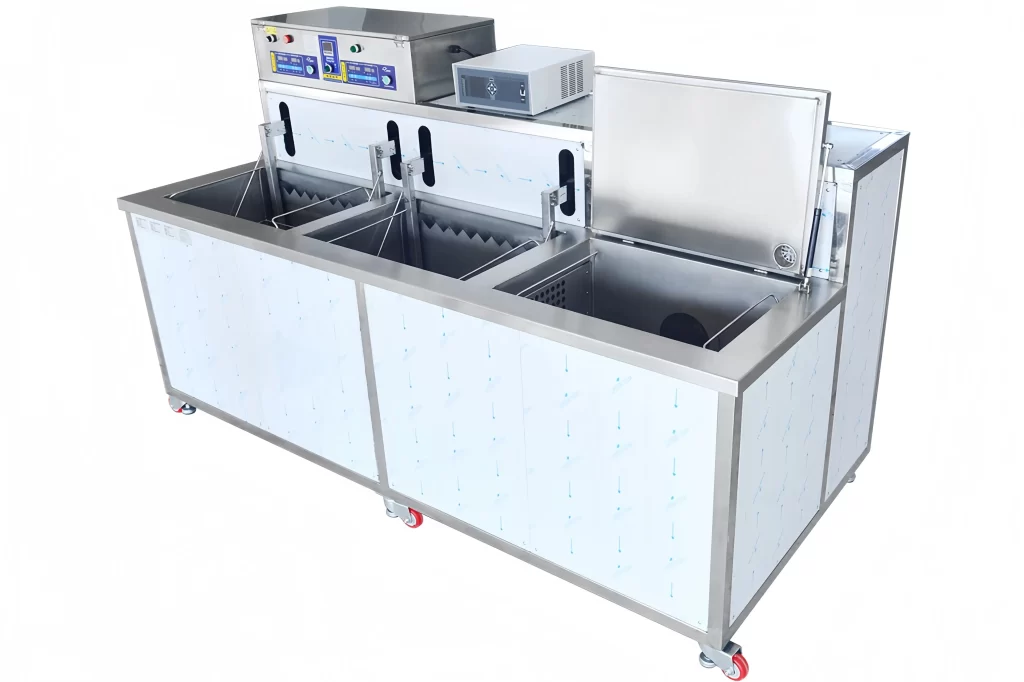
For hydraulic components that must meet particle standards in medium-to-high volume, a multi-tank automated system with a robotic or linear basket transfer is the standard I’d recommend. Each tank serves one function – degreasing, first rinse, precision rinse, drying – and the work doesn’t need to wait for batch changes. The GTKCLEAN automated ultrasonic cleaners we design for CNC-machined parts, for example, use a rotary or linear basket transport and include real-time monitoring of temperature, conductivity, and ultrasonic power. That kind of control allows a production engineer to set the cycle parameters once and trust that the 500th part of the day sees the same cleaning energy as the first.
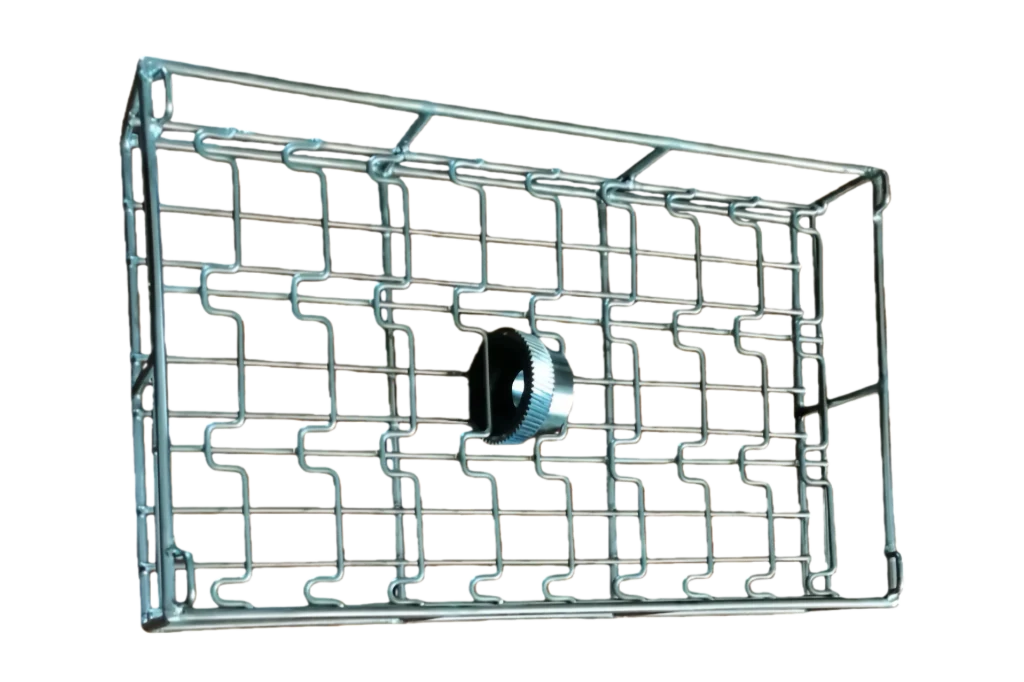
Basket design matters more than people assume. A poorly designed basket traps fluid in pockets that don’t drain, drags rinse contamination into the drying stage, and can even shield parts from cavitation if the mesh is too dense. Custom baskets with dedicated part carriers – cut to the component’s envelope – reduce fluid carryover and keep parts properly oriented for maximum ultrasonic exposure. The cost is modest compared to the cost of a failed lot of assemblies.
Your cleaning chemistry supplier should be involved early in the equipment selection. Some water-based detergents foam aggressively under 40 kHz cavitation, requiring defoaming systems or a shift to a different surfactant. Some solvents are incompatible with certain elastomeric seals in the tank plumbing. These are solvable problems, but trying to solve them after installation extends commissioning by weeks.
Common Questions About Cleaning Hydraulic Components to Particle Standards
In our shop, we manually clean hydraulic parts and they seem fine. Why invest in automation?
Manual cleaning passes visual inspection most of the time, but particle standards aren’t about what’s visible – they’re about microscopic debris that wears pumps and clogs servo valves. If your system reliability has been acceptable and you’re not losing warranty claims to contamination, manual methods may be sufficient for your current volume. As production scales or compliance requirements tighten, the cost of a recall or a field failure typically exceeds the capital cost of an automated line within its first two years.
We use a spray washer with hot water – can that meet ISO 15/13/10?
Spray washing removes surface contamination well but can’t reliably clean the insides of blind holes, threaded pockets, and intersecting bores. Those internal features act as particle traps that only cavitation or high-pressure-jet impingement can dislodge. If your hydraulic components have any internal passages, spray-only systems generally won’t meet particle standards without a separate ultrasonic or targeted-jet cleaning stage.
How do I know if my parts are really clean to the specification without a lab?
You need a particle extraction and counting process, which might be in-house or through a partner lab. For internal monitoring, a simplified flush-and-filter method with a microscope can give you a go/no-go indication once you correlate it with the formal lab method. But full certification to a client’s standard typically requires an accredited lab to perform the analysis and issue a report.
Is solvent cleaning necessary, or will water-based chemistries work for most hydraulic components?
In the majority of cases I’ve been involved with, water-based alkaline or neutral detergents combined with deionized water rinses and hot-air drying have met the required particle standards. Solvent systems become the better choice when the geometry includes extremely low-tolerance, deep cavities where water may not fully evaporate, or when the production line already uses a closed-loop solvent infrastructure for other parts. The decision should be based on a test with your actual worst-case part.
Our parts come back with flash rust after water-based cleaning. What’s the fix?
Flash rust forms when the part exits the final rinse and waits too long before drying, or when the rinse water isn’t sufficiently deionized. The fix is usually a combination of faster transfer into the dryer, heated rinse water to raise the part temperature (so it dries faster upon exit), and a rust inhibitor added to the final rinse when the material requires it. If you’re cleaning a mix of cast iron and steel parts, inhibitor is a practical necessity.
I’ve heard ultrasonic cleaning can pit or erode soft aluminum surfaces. Is that a real risk?
Cavitation erosion is real but is almost always a result of operating at the wrong frequency for the material, or running parts for far longer than necessary. Hydraulic aluminum components should typically be cleaned at 40–80 kHz, which produces smaller, gentler cavitation bubbles that don’t focus destructive energy on the surface. When you see erosion damage in practice, it’s usually because a 20 kHz system was used without adjusting power or cycle time for the aluminum part. Programming the right frequency band and a validated cycle time eliminates this risk.
Share your part number and annual volume, and we’ll confirm the tank configuration and process parameters that match your cleanliness specification. Reach me at [email protected] or call +86 17768507147.
Si estás interesado, consulta estos artículos relacionados:
Eliminar Residuos en la Limpieza de Piezas Pre-Revestidas: Una Guía de Expertos
Tecnología de Transductores Ultrasónicos: Guía de un Experto para la Limpieza Industrial
Soluciones de Limpieza de Moldes de Precisión
 Spanish
  English
  German
  French
  Russian
  Portuguese