

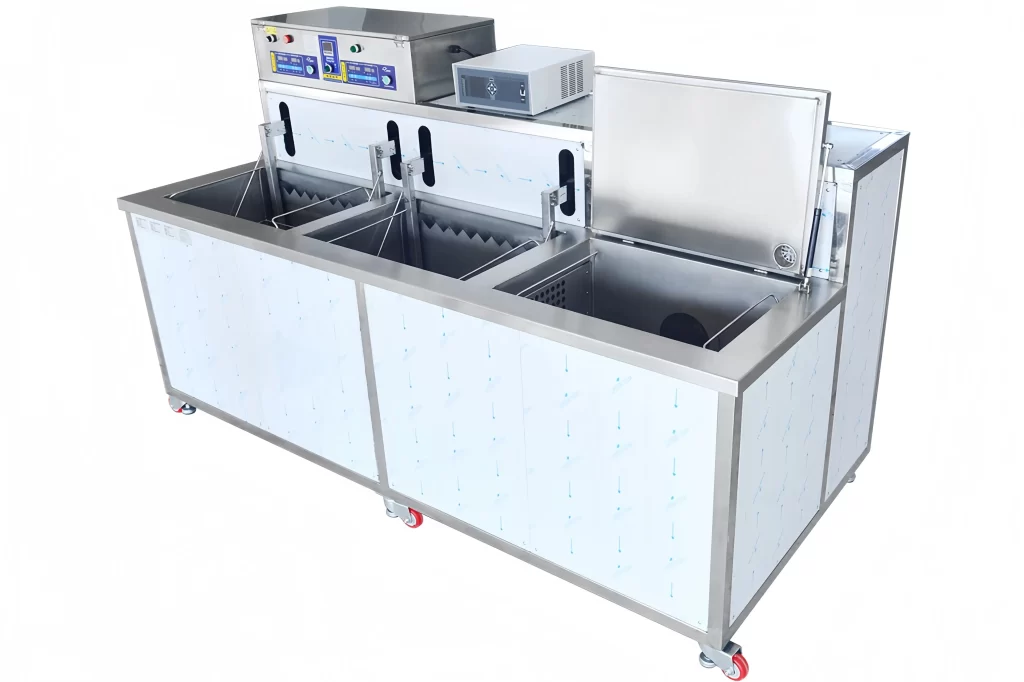
Pass-through ultrasonic cleaning machines provide high-throughput parts cleaning for automated production lines, but their true value depends on matching part geometry, drying requirements, and integration constraints to the system’s design. In my twenty years of designing and deploying industrial cleaning systems across more than twenty countries, I’ve seen too many projects where the decision to adopt a pass-through configuration was driven solely by production volume, without evaluating whether the parts could actually move through a linear process without creating new bottlenecks. This article examines the specific criteria and technical parameters that determine when pass-through ultrasonic cleaning makes sense, and when a batch or multi-tank system would perform better.
How Pass-Through Ultrasonic Cleaning Fits Into Automated Production Lines
A pass-through ultrasonic cleaning machine is fundamentally a continuous-flow system. Parts are placed on a conveyor that carries them through one or more cleaning, rinsing, and drying stations in sequence. Unlike a batch system where an entire basket of parts is lowered into a tank and held for a set cleaning time before moving to the next stage, pass-through equipment processes parts as they move past fixed ultrasonic transducers and spray headers. This difference in material handling is what makes the configuration suitable for high-volume, repetitive production.
The cleaning mechanism remains the same: cavitation generated by ultrasonic vibration plates or transducers creates microscopic bubbles that collapse and dislodge contaminants. However, in a pass-through design, the ultrasonic exposure time is determined by conveyor speed and the length of the active ultrasonic zone. A part traveling at 0.8 meters per minute through a zone of 2 meters receives roughly 2.5 minutes of ultrasonic cleaning. That dwell time, combined with the specific frequency and power density of the transducers, must be sufficient to reach the required cleanliness specification. If the part has complex internal passages, blind holes, or heavy contamination that require longer cavitation exposure, a pass-through system at a given throughput may not deliver adequate cleaning without slowing the line or adding extra ultrasonic stages.
Inline ultrasonic cleaners, tunnel washers, and pass-through systems are terms that sometimes get used interchangeably, but in practice there is a distinction. Inline usually implies a straight-line configuration integrated directly into a production conveyor, with parts being cleaned without changing carriers. Tunnel washers often refer to spray-only or spray-plus-immersion systems. Pass-through ultrasonic specifically denotes a system where the conveyor passes through ultrasonic immersion tanks, and often includes spray pre-wash, rinse, and drying modules. Understanding these differences helps when comparing proposals from different equipment builders.
Key Production Parameters That Make Pass-Through the Right Choice
The decision to use pass-through ultrasonic cleaning instead of a rotary basket or multi-tank batch system should be driven by three measurable production parameters: required throughput, part asymmetry, and cleanliness specification.
Throughput is the most obvious filter. If your line must process 200 parts per hour or more, and those parts arrive at a steady rate rather than in intermittent batches, pass-through becomes the logical architecture. The conveyor speed can be tuned to match upstream and downstream cycle times, creating a predictable, automated flow. In a CNC machining cell, for instance, parts emerging from the machine tool every 90 seconds can be placed directly onto the cleaner’s infeed conveyor, cleaned, dried, and delivered to assembly or packaging without accumulation.
Part geometry matters just as much as quantity. A pass-through system works best when parts have a consistent orientation that exposes the critical surfaces to the full cleaning action. Flat or regularly shaped components, such as stampings, aluminum shells, fasteners, and certain castings, travel well on belt or chain conveyors and can be effectively cleaned by fixed-position transducers and spray nozzles. In contrast, parts with deep blind holes, internal threads, or geometry that traps cleaning solution require a part orientation change during cleaning. That is very difficult to achieve in a straight-through conveyor design. I’ve seen production engineers try to solve this by adding multiple ultrasonic tanks with different fixture angles, but the added complexity and floor space often eliminate the throughput advantage they were trying to achieve. In such cases, a rotary basket system that continuously rotates the parts through 360 degrees inside a tank provides far more effective cleaning, even if it is a batch process.
Cleanliness specification is the third gate. If your process requires a particulate cleanliness level measured in microns per ISO 16232 or similar, you need to verify that the dwell time under ultrasonics and the final rinse stages in a pass-through system can achieve that. The multi-stage design, often including a high-pressure spray pre-wash, an ultrasonic degreasing section, a pure-water or DI water rinse, and hot-air or vacuum drying, can deliver very high cleanliness when properly calibrated. Our experience with pre-coating cleaning lines, for example, shows that a pass-through configuration with multiple rinse stages and a final DI water rinse at controlled temperature can consistently achieve the surface quality needed for PVD or CVD coating. But this only works when the ultrasonic power and frequency are matched to the contaminant and the conveyor speed allows adequate exposure.
Calculating Cycle Time and Throughput for Continuous Operation
The throughput capability of a pass-through system is determined by the conveyor speed and the length of each processing section. If you know the required cleaning time for your part, you can calculate the necessary length of the ultrasonic zone. For example, if testing shows that 3 minutes of ultrasonic immersion at 40 kHz and 60°C removes the stamping oil to the required level, and you need a throughput of 300 parts per hour, the ultrasonic tank must be long enough to provide 3 minutes of dwell time at whatever conveyor speed achieves that part flow.
The relationship is: Tank Length (m) = Conveyor Speed (m/min) × Required Dwell Time (min). If each part requires 3 minutes of ultrasonic exposure, and the conveyor must run at 1.0 m/min to meet hourly production, the ultrasonic tank must be 3.0 meters long. If that length exceeds feasible tank dimensions, you either slow the conveyor (reducing throughput), add multiple ultrasonic stages, or reconsider whether a batch system with higher parallel capacity is more appropriate.
I’ve designed systems where we used a two-stage ultrasonic section to split the required dwell time into two 2-meter tanks, giving sufficient cleaning without an excessively long single tank. This approach also improves cleaning effectiveness because parts pass through a fresh cleaning solution in the second tank. The tradeoff is increased floor space and cost.
Beyond the ultrasonic section, rinse and drying stages also consume floor space and time. Drying is frequently the bottleneck. A vacuum drying module can remove moisture from blind holes much faster than hot air, but it is more expensive and requires careful sealing. In one project for fasteners requiring zero water spotting, we incorporated high-pressure air knives followed by hot-air tunnels to achieve complete drying at 0.6 m/min. The drying section ended up longer than the cleaning section. The lesson is that throughput calculations must include drying time, not just cleaning exposure.
Integration, Drying, and Layout Challenges in Real Deployments
Physical integration with existing production lines is where the design theory meets the shop floor. A pass-through system needs a linear footprint, which can be 10 meters or longer when you include the infeed belt, pre-wash, ultrasonic, rinse, drying, and outfeed. In crowded factories, finding that straight-line space can be difficult. We have delivered pass-through systems that include powered curves and elevation changes, but these add complexity, maintenance points, and cost. If your facility can accommodate a linear layout, pass-through is straightforward. If not, a compact multi-tank batch system with an overhead transfer mechanism might actually have a smaller footprint and better space utilization.
Part carriers also demand attention. In a pass-through line, the same conveyor belt or chain carries parts through wash, rinse, and dry sections. The belt material must withstand temperatures up to 80°C, resist chemical attack from cleaning solutions, and not shed fibers that contaminate cleaned parts. Stainless steel mesh belts are common, but for small fasteners, a plastic belt with minimal surface contact is better to avoid marking. The part fixture must also allow drainage in every station; liquid pooling in a pocket will ruin the next process. I recall a stamping line where parts would trap rinse water in a recess, causing flash rusting during hot-air drying. Redesigning the fixture angle by just 7 degrees solved the problem.
Drying is the single most common integration failure. A system that cleans perfectly but delivers wet or spotted parts will still shut down the line. The drying method must be selected based on part geometry. Hot-air knife drying works well for flat external surfaces but cannot remove moisture from internal passages. Vacuum drying is more effective for complex parts but requires a sealed chamber and adds cycle time. If your part has deep blind holes, you may need to combine vacuum drying with a blow-off station. In our pre-PVD cleaning lines, we use a combination of air knives, hot air, and vacuum drying to ensure no moisture remains before coating.
Comparing Capital and Operating Costs with Batch Systems
A pass-through ultrasonic cleaning system typically requires a higher initial capital investment than a multi-tank batch system of comparable cleaning power. The conveyor structure, drive motors, and associated controls add cost. However, the labor savings can be substantial. A batch system usually requires an operator to load and unload baskets, whereas a pass-through system can be integrated with robotic part handling, reducing labor to zero direct touch time. For high-volume lines producing millions of parts per year, the labor savings alone often justify the higher capital cost within twelve to eighteen months.
Operating costs also differ. Pass-through systems tend to have larger tank volumes to maintain stable temperatures and solution chemistry across extended production runs, which means higher solution consumption unless on-board filtration and recycling are effective. Our CNC aluminum shell inline cleaners, for example, use a circulation filtration system and an oil-water separator to extend cleaning fluid life, typically reducing detergent consumption by 40% compared to systems without recovery. Energy consumption is another factor. The drying section, particularly if using hot air or vacuum pumps, can be the largest energy user. A tunnel washer of medium size might have a total installed power of 120 kW but actual running consumption of 40–65 kWh. This should be compared against the energy cost of a batch system where tanks are heated throughout the shift regardless of throughput.
An effective way to compare is to calculate cost per part cleaned. Take the system’s annual energy, detergent, labor, maintenance, and amortized capital cost, and divide by the number of parts cleaned. For pass-through systems with high utilization, cost per part is often lower than batch systems because labor is near zero and energy per part drops with continuous operation. For lower-volume production, a batch system may have a lower per-part cost because the capital outlay is so much smaller. This is not a generic recommendation; it is a calculation that must be done with your specific part quantity, and that is exactly the kind of analysis we perform when quoting a system.
When a Pass-Through Configuration May Not Be the Best Option
Having spent much of this article describing the advantages and design factors, I should be direct about the situations where pass-through ultrasonic cleaning is the wrong choice, because that recognition is equally valuable in preventing a bad investment.
The first red flag is frequent part changeovers. If your facility cleans 20 different part numbers per shift, each requiring a different conveyor pitch, fixture, and cleaning time, a pass-through line becomes a constant changeover exercise. Each adjustment adds downtime, and the fixturing cost multiplies. A batch rotary system, where a basket is filled with different parts and cleaned on a flexible recipe, handles variety far more gracefully.
The second is cleaning of parts with severe contamination that requires soaking. Heavy stamping compounds, heat treat scale, or thick rust preventatives need time for the chemistry to penetrate and loosen deposits. While a pass-through system can include a spray pre-wash or an initial immersion soak pit, the core advantage of continuous flow is undermined if parts must stop and soak. Better to use a batch system with dedicated soak stages.
The third is parts with difficult geometry that cannot be adequately drained or dried in a continuous motion. If liquid pools and cannot be evacuated, the part will exit the drying section still wet, which can cause corrosion, contamination, or poor adhesion of downstream coatings. As mentioned earlier, fixture redesign can sometimes solve this, but not always.
Fourth, if your production volume is too low to justify the capital outlay. A pass-through system running only one shift, five days a week, at half its design speed will never achieve the cost-per-part advantage. The payback period stretches, and the floor space it occupies could be used for other value-adding equipment. In those circumstances, a semi-automated multi-tank batch system with manual basket transfer frequently offers better return on investment.
If you are assessing a production line that sits in any of these scenarios, pass-through ultrasonic may not be the correct architecture. In those cases, we often steer clients toward a rotary basket ultrasonic system or a modular multi-tank configuration, which preserves cleaning quality without forcing an inefficient linear flow.
If your program involves parts with variable geometries, frequent changeovers, or stringent drying demands, it is worth confirming the precise cycle time and fixture requirements before finalizing system specification. The misapplication of a pass-through system is far more expensive than the extra purchase price of the correct configuration. For a specific assessment of your part mix and throughput targets, you can send your part numbers and cleaning requirements to [email protected] or call +86 17768507147 for a technical evaluation.
Common Questions About Pass-Through Ultrasonic Cleaning Systems
What's the difference between a pass-through ultrasonic cleaner and a tunnel washer?
A tunnel washer generally refers to a spray-only continuous cleaning system, where high-pressure nozzles remove contaminants as parts move through a tunnel. A pass-through ultrasonic cleaner combines spray stages with ultrasonic immersion tanks, using cavitation to reach internal passages and small crevices that spray alone cannot access. The presence of ultrasonic tanks is the distinguishing feature and is the reason pass-through ultrasonic is chosen for more demanding cleanliness requirements, such as pre-coating or precision assembly. Tunnel washers are simpler and lower-cost for heavy bulk contamination, but they cannot match the fine cleaning of ultrasonics.
Can pass-through systems handle heavy or oversized parts?
cURL Too many subrequests by single Worker invocation. To configure this limit, refer to https://developers.cloudflare.com/workers/wrangler/configuration/#limits
How long does a typical cleaning cycle take?
cURL Too many subrequests by single Worker invocation. To configure this limit, refer to https://developers.cloudflare.com/workers/wrangler/configuration/#limits
Is pass-through ultrasonic cleaning suitable for precision parts requiring very high cleanliness?
cURL Too many subrequests by single Worker invocation. To configure this limit, refer to https://developers.cloudflare.com/workers/wrangler/configuration/#limits
What maintenance does a pass-through system require?
cURL Too many subrequests by single Worker invocation. To configure this limit, refer to https://developers.cloudflare.com/workers/wrangler/configuration/#limits
Si estás interesado, consulta estos artículos relacionados:
Diseñar un proceso de limpieza industrial eficiente y en varias etapas
El vínculo indispensable entre las tecnologías de recubrimiento y los sistemas de limpieza industrial
¿Cómo garantizar una adhesión perfecta del recubrimiento sin manchas de agua o manchas?
Sistemas de limpieza ultrasónica para piezas pre-PVD (recubrimiento)
 Spanish
  English
  German
  French
  Russian
  Portuguese