

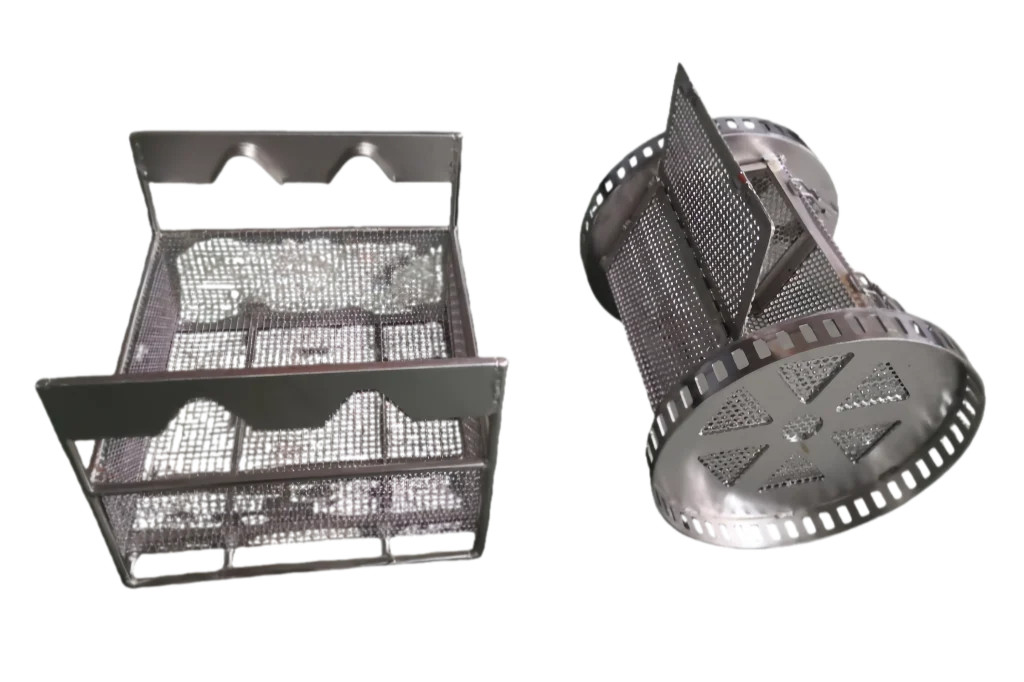
Rotary basket ultrasonic cleaners are widely recommended for parts with blind holes and complex geometries, but the mechanism that makes them effective is also the source of their most common failures. In two decades of designing automated cleaning systems, I have seen more installations undermined by basket design mistakes than by any other factor. This article explains when a rotary system is the right investment, what basket configurations protect your parts while maximizing throughput, and how to evaluate specifications so the equipment does exactly what your production line needs.
When Rotary Basket Cleaning Makes the Difference
Static ultrasonic tanks work well for simple geometries, but parts with recesses, intersecting holes or concave surfaces trap contaminants where cavitation alone cannot reach them. A rotary basket cleaner rotates the parts through the ultrasonic field, continuously reorienting them so every surface is exposed to the cleaning action. This makes it the go-to solution for bearings, fasteners, silicone parts and CNC machined components with blind or threaded holes.
We apply rotary systems when rejection rates from residual oil, chips or polishing compound exceed what a static immersion line can achieve. The key metric is contaminant entrapment: if a part design includes a cavity deeper than it is wide, a static bath will rarely clear it. Rotation forces the cleaning medium through those cavities, carrying particles out instead of letting them settle. For batch cleaning of high-mix, high-complexity workpieces, the process consistency gains from rotation alone can cut rework by a measurable margin.
However, rotation is not free. The basket and drive mechanism add capital cost and maintenance points. If your parts are flat stampings or simple turned components with no internal features, a multi-tank ultrasonic line with fixed baskets may deliver the same cleanliness at lower cost. The rotary system earns its place when geometry, not just contamination level, is the primary cleaning challenge.
Basket Design and Load Handling That Protect Your Parts
The basket is not a container. It is a fixturing tool that determines cleaning uniformity, part safety and throughput. A poorly designed basket turns a rotary cleaner into a part-damaging machine, especially with heavy or delicate workpieces.
The first design decision is basket shape. Round baskets with internal baffles are best for parts that need tumbling action to expose blind holes from every angle, but tumbling can cause surface marring on polished or coated components. Square baskets keep parts oriented in a fixed direction, preventing collision damage, and work well for plate-type or thin-walled parts where surface finish matters. In our work, we have shifted from round to square baskets when the customer's reject cause shifted from residual oil to handling scratches, sometimes within the same product family.
Load capacity is the next constraint. Standard rotary baskets handle up to a few hundred kilograms, but the drive motor, seals and tank structure must be engineered for higher weights. Our larger systems support up to 2000 kg per basket, using reinforced stainless steel carriers and oversized bearings. If your part weight approaches or exceeds 500 kg, insist on a load-tested basket and drive assembly during factory acceptance. I have seen a 700 kg gearset distort an undersized basket within weeks, causing inconsistent rotation and eventually a drive failure that stopped the line.
The table below summarizes the trade-offs between the two basket types.
| Característica | Round Basket | Square Basket |
|---|---|---|
| Best for | Blind holes, intricate recesses, fasteners | Plate parts, polished surfaces, thin walls |
| Part motion | Tumbling, 360° reorientation | Fixed orientation, gentle handling |
| Collision risk | Higher without baffling or fixturing | Bajo |
| Typical load limit | 200–2000 kg | 200–2000 kg |
Basket material also matters. 304 or 316 stainless steel resists corrosion in water-based processes. For acid pickling or aggressive solvents, PVDF or PTFE linings protect both the basket and the parts. The basket's own cleanliness must be maintained; residue trapped in basket mesh re-deposits on subsequent batches.
How Rotation Speed and Ultrasonic Settings Affect Cleaning Quality
Rotation speed and ultrasonic frequency interact in ways that generic process recipes often overlook. Too slow, and parts in the center of the basket may never see the active cavitation zone. Too fast, and cavitation bubbles collapse prematurely against the part surface without enough dwell time to loosen tenacious contaminants.
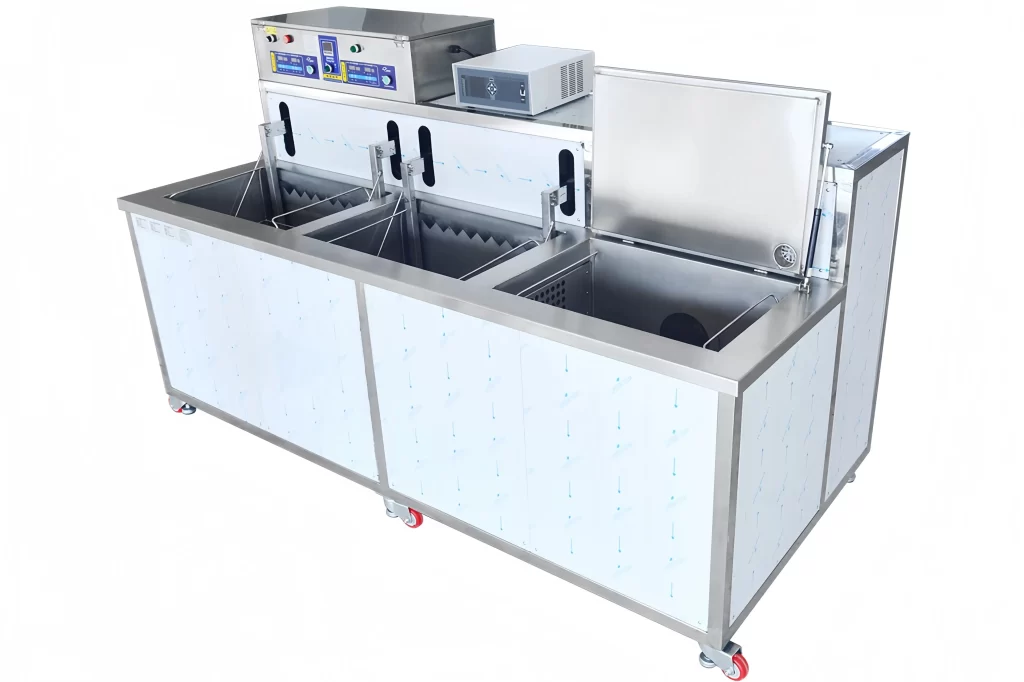
In our process development, we have found that a speed of 3 to 8 rpm is effective for most small to medium precision parts, while larger, heavier components often need 2 to 4 rpm to allow the cleaning medium time to penetrate deep cavities. Higher speeds do not always mean faster cleaning; they sometimes mean more splash, more air entrainment and less consistent cavitation. The ultrasonic frequency must be matched to the contaminant type: lower frequencies (20–28 kHz) produce more aggressive cavitation for cutting oils and chips, while higher frequencies (40–80 kHz) are gentler and reach fine features without eroding delicate surfaces.
If your program involves precision parts with tight tolerances, confirming that rotation speed and frequency are matched to your specific contaminants before finalizing a design is worth a discussion — reach out at [email protected] to share your cleaning challenge.
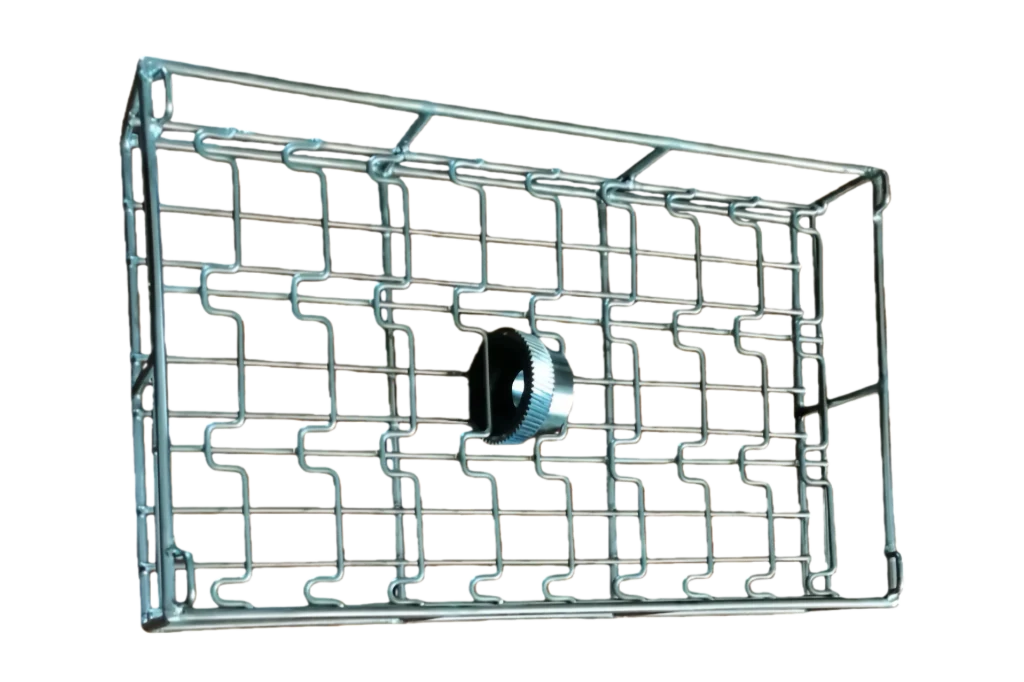
Another overlooked factor is the fill ratio. Filling the basket above 70% of its volume reduces the relative motion between parts and liquid, turning the ultrasonic field into a damped shadow rather than an active cleaning front. We recommend loading baskets to 50–60% of their gross volume for uniform results, and using dedicated fixturing for parts that cannot tumble.
Throughput, Automation, and Process Integration
Rotary basket systems can be configured as stand-alone single-station units or integrated into multi-tank automated lines with ultrasonic degreasing, rinsing, passivation and drying. The choice depends on your required cycle time, labor model and floor layout.
For medium-volume production, a semi-automatic multi-tank line with manual basket transfer gives operators control over soak times while still delivering consistent ultrasonic exposure. For high-volume, lights-out operation, a fully automatic system with PLC-controlled basket lift, traverse and tank sequencing eliminates operator variability. Siemens or Mitsubishi PLCs with HMI touchscreens are standard on our automated lines, and remote software upgrade capability means process recipes can be adjusted without a site visit.
cURL Too many subrequests by single Worker invocation. To configure this limit, refer to https://developers.cloudflare.com/workers/wrangler/configuration/#limits
cURL Too many subrequests by single Worker invocation. To configure this limit, refer to https://developers.cloudflare.com/workers/wrangler/configuration/#limits
Evaluating Rotary Basket Systems for Your Production Line
cURL Too many subrequests by single Worker invocation. To configure this limit, refer to https://developers.cloudflare.com/workers/wrangler/configuration/#limits
cURL Too many subrequests by single Worker invocation. To configure this limit, refer to https://developers.cloudflare.com/workers/wrangler/configuration/#limits
cURL Too many subrequests by single Worker invocation. To configure this limit, refer to https://developers.cloudflare.com/workers/wrangler/configuration/#limits
cURL Too many subrequests by single Worker invocation. To configure this limit, refer to https://developers.cloudflare.com/workers/wrangler/configuration/#limits
| Parámetro | cURL Too many subrequests by single Worker invocation. To configure this limit, refer to https://developers.cloudflare.com/workers/wrangler/configuration/#limits | cURL Too many subrequests by single Worker invocation. To configure this limit, refer to https://developers.cloudflare.com/workers/wrangler/configuration/#limits | cURL Too many subrequests by single Worker invocation. To configure this limit, refer to https://developers.cloudflare.com/workers/wrangler/configuration/#limits |
|---|---|---|---|
| cURL Too many subrequests by single Worker invocation. To configure this limit, refer to https://developers.cloudflare.com/workers/wrangler/configuration/#limits | 45–65°C | 30–40°C | cURL Too many subrequests by single Worker invocation. To configure this limit, refer to https://developers.cloudflare.com/workers/wrangler/configuration/#limits |
| Frecuencia ultrasónica | 20–28 kHz | cURL Too many subrequests by single Worker invocation. To configure this limit, refer to https://developers.cloudflare.com/workers/wrangler/configuration/#limits | cURL Too many subrequests by single Worker invocation. To configure this limit, refer to https://developers.cloudflare.com/workers/wrangler/configuration/#limits |
| cURL Too many subrequests by single Worker invocation. To configure this limit, refer to https://developers.cloudflare.com/workers/wrangler/configuration/#limits | 5–6 min | cURL Too many subrequests by single Worker invocation. To configure this limit, refer to https://developers.cloudflare.com/workers/wrangler/configuration/#limits | 3–5 min |
cURL Too many subrequests by single Worker invocation. To configure this limit, refer to https://developers.cloudflare.com/workers/wrangler/configuration/#limits
cURL Too many subrequests by single Worker invocation. To configure this limit, refer to https://developers.cloudflare.com/workers/wrangler/configuration/#limits
Common Questions About Rotary Basket Ultrasonic Cleaning
Does rotary basket cleaning work for parts with delicate surface finishes?
cURL Too many subrequests by single Worker invocation. To configure this limit, refer to https://developers.cloudflare.com/workers/wrangler/configuration/#limits
What is the typical throughput difference between single-station and multi-tank rotary systems?
cURL Too many subrequests by single Worker invocation. To configure this limit, refer to https://developers.cloudflare.com/workers/wrangler/configuration/#limits
How do I prevent parts from being damaged during rotation?
cURL Too many subrequests by single Worker invocation. To configure this limit, refer to https://developers.cloudflare.com/workers/wrangler/configuration/#limits
Can a rotary basket system handle both water-based and solvent-based cleaning processes?
cURL Too many subrequests by single Worker invocation. To configure this limit, refer to https://developers.cloudflare.com/workers/wrangler/configuration/#limits
What maintenance do the rotary drive components require?
cURL Too many subrequests by single Worker invocation. To configure this limit, refer to https://developers.cloudflare.com/workers/wrangler/configuration/#limits
Si estás interesado, consulta estos artículos relacionados:
Cómo integrar la limpieza automatizada en las líneas de producción
¿Cuál Es El Principio de una Máquina de Limpieza por Ultrasonidos?
Sistemas de lavado ultrasónico en línea para un control de proceso mejorado
 Spanish
  English
  German
  French
  Russian
  Portuguese