

When a production line depends on cleaning hundreds or thousands of small parts per shift, the margin between “clean enough” and a costly reject is narrow. I have seen this repeatedly in automotive and precision machining plants: a conventional ultrasonic bath with a stationary basket fails to clear cutting oil from a 2 mm blind hole, leaving residue that ruins a coating step downstream. The fix is not more power or longer cycle time; it is how you present the part to the cleaning energy. Rotary basket ultrasonic cleaning systems solve this by continuously rotating the part load through the cavitation field, but the real engineering difference for small parts lies in basket design, part securing, and process parameters that keep delicate components safe while achieving repeatable cleanliness.
Why a Rotating Basket Matters for Ultrasonic Cleaning
In any ultrasonic cleaner, cavitation bubbles collapse and generate high‑energy micro‑jets that strip contamination from surfaces. In a static tank, however, the intensity is uneven. Parts in dead zones—shadowed by other parts or tank walls—receive less cleaning action. When we move to a rotating basket, every part is repeatedly repositioned. A 360° rotation ensures that blind holes, recesses, and internal threads are exposed to the cavitation field from multiple angles. For small parts such as fasteners, silicone seals, bearing components, or M2 threaded inserts, static cleaning often leaves a thin film of drawing or quenching oil because the liquid inside a tiny recess does not refresh. Rotation forces fresh solution into those cavities every few seconds, and we have measured cleanliness improvements that static baskets cannot match simply because the part orientation keeps changing.
Rotating Basket Designs That Prevent Small Part Damage
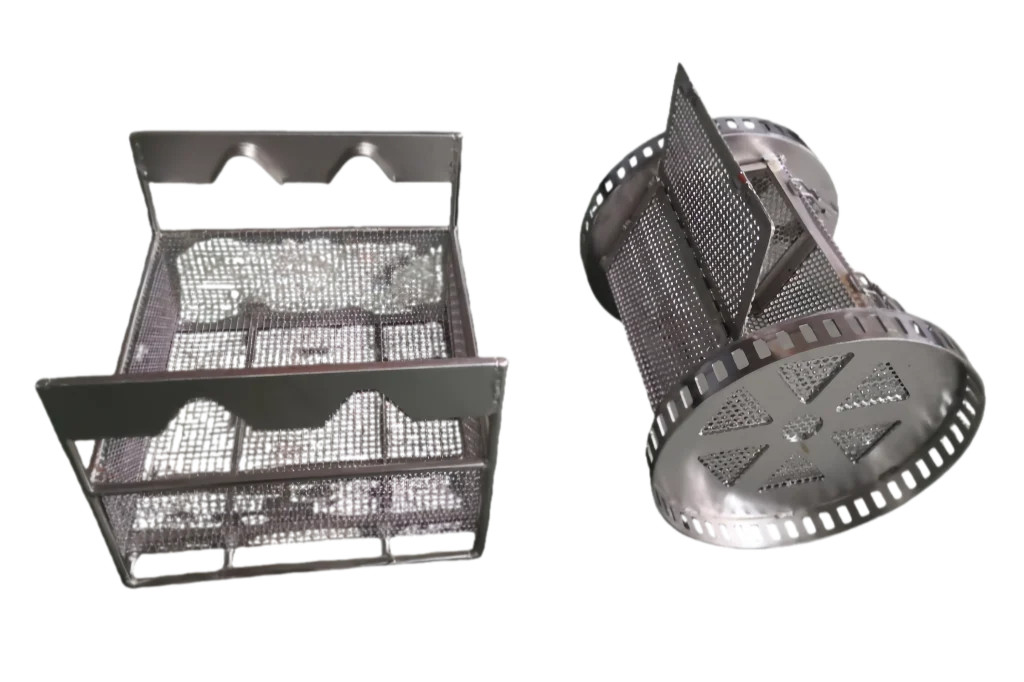
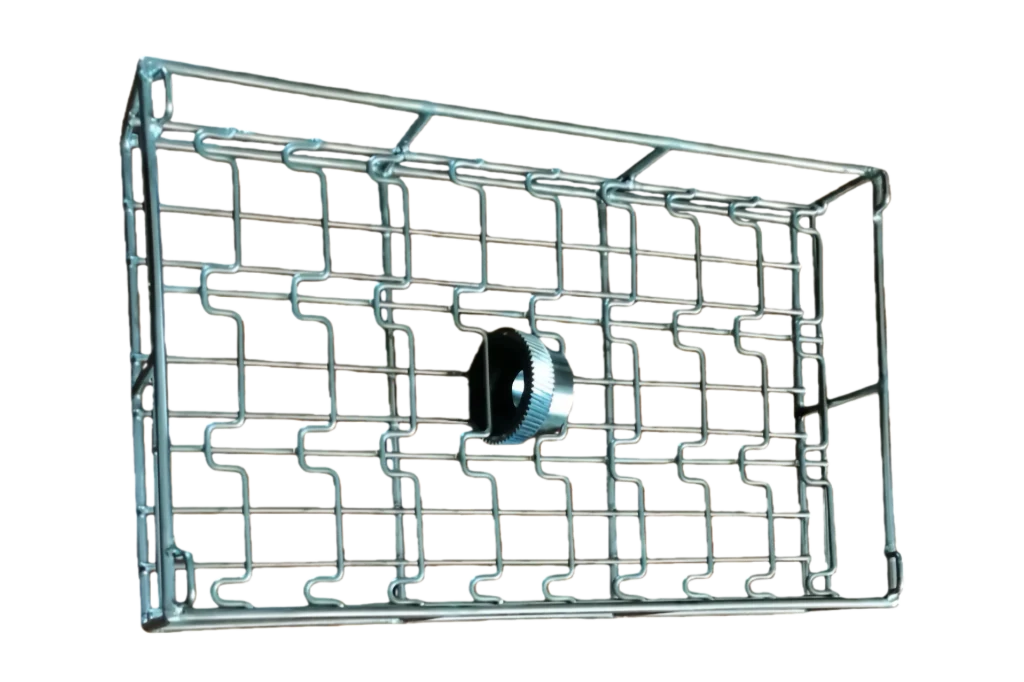
The most common mistake I see when engineers first specify a rotary basket cleaner for small parts is assuming that any round basket will work. Small parts, especially hardened steel pins, electronic contacts, or thin‑walled brass fittings, will collide if the basket rotation tumbles them freely. This is why our engineering team at GTKCLEAN applies two distinct basket concepts. Round baskets are used when the parts have blind holes or complex geometries but can be individually fixtured; the basket rotates slowly while the parts are held in dedicated nests or spring clips. Square baskets with internal dividers are used for plate‑type or scratch‑sensitive parts where any part‑to‑part contact is unacceptable. I have visited a manufacturing line where a supplier’s generic rotary basket was scratching PVD‑grade optical housings simply because the parts were allowed to roll over each other; switching to a compartmented square basket eliminated the problem without changing the cleaning chemistry.
Beyond collision protection, basket material and mesh size become critical for very small parts. Openings must be small enough that a washer or pin cannot escape, yet large enough for ultrasonic energy and cleaning fluid to pass through unimpeded. Stainless steel mesh in SUS304 or 316 with aperture sizes below 1 mm is typical, but we also specify electro‑polished surfaces to prevent micro‑burrs from catching parts. For chemically aggressive processes, PP or PTFE linings are added. This level of detail rarely appears in catalog specifications, yet it is the difference between a system that works on paper and one that runs three shifts without jamming or product damage.
Process Parameters That Make or Break Small Part Cleaning
Even with the best basket, the cleaning results will drift if the process is not tuned for small parts. Ultrasonic frequency selection is one example. Lower frequencies around 20–28 kHz produce larger cavitation bubbles and more aggressive cleaning, which can pit delicate surfaces or dislodge small parts from their fixtures. For components below 10 mm in any dimension, we often recommend 40 kHz or 80 kHz to generate finer, gentler cavitation that penetrates tiny gaps without causing erosion. I recall a program cleaning fuel injector components where moving from 28 kHz to 40 kHz eliminated micro‑pitting that had been flagged during quality audits, without increasing the cycle time.
Cleaning solution temperature and flow are equally specific. Small parts reach thermal equilibrium quickly, so a tank temperature of 50–65 °C is usually sufficient for degreasing with aqueous detergents. But if the washing tank has dead zones, thermal stratification can occur, and a part sitting in a cooler pocket will not degrease completely. We engineer circulation and overflow weirs to maintain consistent temperature and contaminant removal throughout the tank, and we add filtration loops that capture particulate as it is liberated. This is particularly important when cleaning small parts because the same fine chips that are the target of the cleaning can re‑deposit onto parts if the filtration system is undersized.
If your program involves parts smaller than 5 mm or components with internal threads, it is worth confirming that the system’s filtration rating and flow pattern have been validated for that geometry. We have helped teams avoid rework by specifying multi‑stage filtration with magnetic separators at the design stage, which is far cheaper than retrofitting later.
Reach out at [email protected] with your part details and we can review the process parameters that fit your production volume.
Drying Small Parts Without Water Spots or Residue
After rinsing, small parts present a drying challenge that larger components do not. Water trapped inside a blind hole or between closely packed parts in a basket will leave spots, which become nucleation sites for corrosion or coating defects. Hot air drying alone can fail because a droplet inside a 1.5 mm hole requires surface tension to break before it can evaporate. That is why we almost always combine an air knife blow‑off station with hot air or vacuum drying for small part lines. The air knife removes bulk water, while the hot air or low‑pressure vacuum finishing step handles residual moisture in recesses.
Some applications, particularly pre‑PVD or pre‑plating cleaning, demand absolute water‑spot‑free surfaces. In those cases we implement a final rinse with deionized water (conductivity ≤ 0.06 µS/cm) immediately before drying and use a cleanroom‑class HEPA filter on the drying air. The modest added investment in DI water and filtration is often recovered in reduced coating rework rates. A parts manufacturer we worked with saw a 40% drop in coating adhesion failures after integrating controlled drying into their rotary basket line.
Automation and Throughput for High‑Volume Small Parts
Rotary basket systems are not only about cleaning quality; they directly influence production throughput and operator headcount. A fully automated rotary basket cleaner can be programmed to run the complete sequence—loading, ultrasonic wash, rinse, passivation (if needed), and drying—with no operator intervention except loading the basket at the start of the cycle and unloading it at the end. For high‑volume manufacturers producing small parts by the tens of thousands per day, multiple baskets can be cycled through a multi‑tank line so that cleaning never becomes the bottleneck.
From the control side, a Siemens or Mitsubishi PLC with a touchscreen HMI allows recipes to be stored for different part numbers. If your product mix changes frequently, this becomes essential. The operator selects the part number and the PLC automatically adjusts basket rotation speed, ultrasonic power, tank temperatures, and cycle timing. Remote access for program updates and diagnostics is also available, and in our global deployments we often perform process tuning remotely rather than flying an engineer to the site.
Common Questions About Rotary Basket Ultrasonic Cleaning
Can a rotary basket cleaner handle very small parts without them falling through the basket?
Yes, if the basket is designed for it. We use fine‑mesh stainless steel liners with aperture sizes as low as 0.5 mm. For parts smaller than that, the basket can be fitted with mesh inserts or the parts can be loaded into smaller dedicated containers that are then placed inside the rotating basket. The key is to assess the smallest dimension of your part and specify a mesh that provides at least 30% open area for fluid flow while retaining the part.
How do I know if my parts need a square or a round basket?
It depends on the part geometry and surface sensitivity. Round baskets are chosen when the parts benefit from tumbling and multiple orientations to reach blind holes, as long as the parts are robust enough to survive mild contact. Square baskets with dividers or nests are chosen when the part has a critical surface finish that cannot tolerate any contact, or when the part is flat and best cleaned lying flat. We often prototype both options during the specification phase.
Is a rotary basket system overkill for a low‑volume job shop?
It depends on the cleanliness requirement and part variety, not just volume. A benchtop rotary cleaner can be a compact, flexible solution for job shops that need to clean small batches of diverse parts. The rotation still provides more uniform cleaning than a static tank, and the automated cycle frees up operator time. The capital cost difference is modest once you account for rework and labor.
Do I need a multi‑tank system for small parts, or is a single‑tank enough?
If your cleaning is limited to degreasing and a light rinse, a single‑tank rotary unit with sequential process steps can work. But when you require a dedicated wash, DI rinse, and vacuum drying to achieve a water‑spot‑free specification, a multi‑tank or inline system is necessary to avoid cross‑contamination. We help clients map out the required number of stages based on the specific contaminants and final cleanliness standard.
What after‑sales support should I expect from a rotary basket cleaner supplier?
Beyond the standard warranty, look for remote diagnostic capability, availability of spare parts from regional hubs, and a supplier that can provide process optimization support as your product mix evolves. In our experience, the most common support requirement is recipe adjustment for new part numbers, which is best handled remotely. At GTKCLEAN we provide remote software upgrades and on‑line troubleshooting across the 20+ countries we operate in. If you are developing a new part and want to confirm the cleaning recipe before committing to full production, share your part drawing and target cleanliness spec with us at [email protected]; we can simulate the process and give you a realistic throughput estimate.
Si estás interesado, consulta estos artículos relacionados:
Preguntas esenciales para proveedores de equipos de limpieza industrial
Comparación de inversión en limpieza automatizada versus manual para la industria
Diseño de cestas de limpieza industrial: optimización del rendimiento y la durabilidad
Mantenimiento del sistema de limpieza con solventes: una guía completa
Cómo Elegir Equipos de Limpieza para la Fabricación de Dispositivos Médicos
 Spanish
  English
  German
  French
  Russian
  Portuguese