

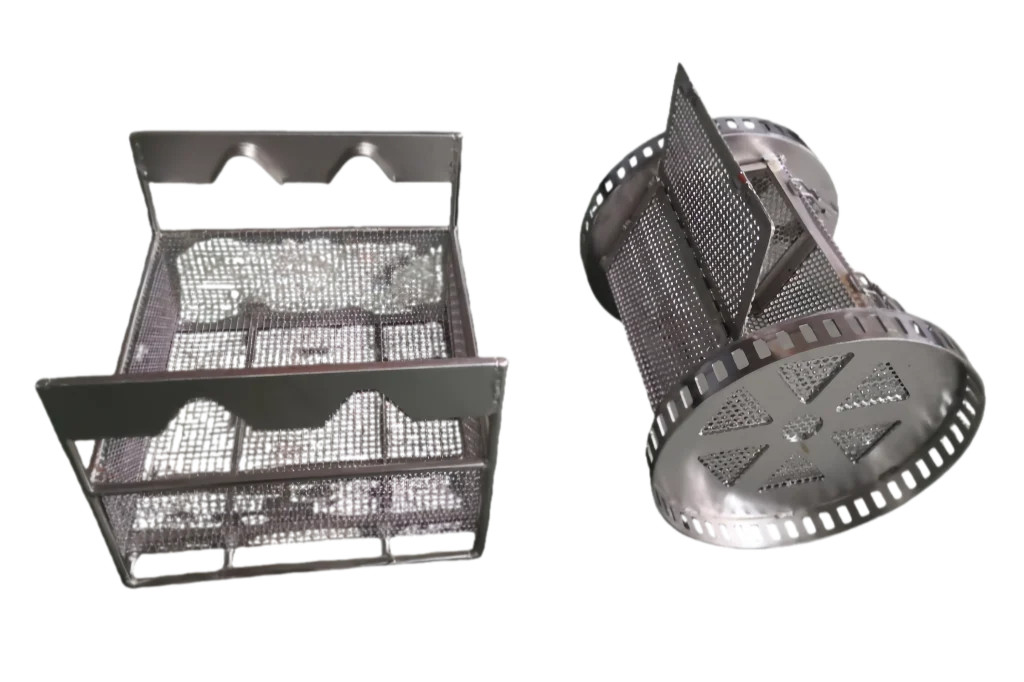
Precision components with blind holes, internal threads, and complex geometries present a cleaning challenge that standard immersion ultrasonic systems often fail to solve. A static basket leaves some surfaces shielded from cavitation for the entire cycle, producing inconsistent results that downstream processes like coating, assembly, or inspection will expose. Rotary ultrasonic cleaning systems address this by continuously repositioning parts through the ultrasonic field, but their real-world effectiveness depends on design decisions made long before the first cycle runs. After two decades of specifying and deploying these systems across industries from automotive to medical device manufacturing, I have found that the gap between acceptable and exceptional cleaning results narrows to three factors: basket design, rotation parameter matching, and process validation.
How Rotary Motion Changes Ultrasonic Cleaning Performance
In a static ultrasonic tank, cavitation bubble formation and collapse concentrate along the transducer-facing surfaces. Whatever part geometry faces away from that energy remains in a relative dead zone. For a flat washer or simple plate, this matters little. For a precision-machined housing with intersecting cross-drilled holes, it means coolant residue stays put in the cavities that never face the transducer array.
Rotation changes the energy distribution pattern by continuously exposing every external surface and internal cavity to the high-intensity cavitation zone. More practically, it creates a mechanical flow effect inside blind holes. As the part rotates through the cleaning medium, the liquid inside cavities experiences pressure differentials that pulse fresh solution into and spent solution out of confined spaces. I have measured cleanliness improvement of over 40% on cross-drilled hydraulic components simply by moving from static to rotary fixturing with the same ultrasonic power input.
The interaction between rotation speed and ultrasonic frequency also matters. At 20 kHz, cavitation bubbles are larger and more energetic. Fast rotation at this frequency can create uneven cleaning if the part moves through the cavitation field faster than bubbles can fully form and collapse on surface contaminants. At 40 kHz or 80 kHz, where cavitation is finer and more uniformly distributed, higher rotation speeds work beneficially to ensure all surfaces receive equal exposure. For most precision work below 100 mm in diameter, we default to 28–40 kHz with rotation between 3 and 8 rpm, adjusting based on the smallest internal feature that needs cleaning.
Basket Design Considerations for Precision Components
The basket is not a container. It is a process control device. Its design determines which surfaces see cavitation, how parts are protected during cleaning, and whether the system can be automated.
Rotary ultrasonic systems use either round baskets for complex three-dimensional parts or square baskets for flat, plate-type components. Round baskets rotate continuously, tumbling parts gently to expose all surfaces. Square baskets can rotate incrementally or in indexed positions, which matters when parts have one critical surface that must not contact anything. For collision-sensitive components like finished bearing races or polished optical housing surfaces, individual fixturing within the basket is non-negotiable.
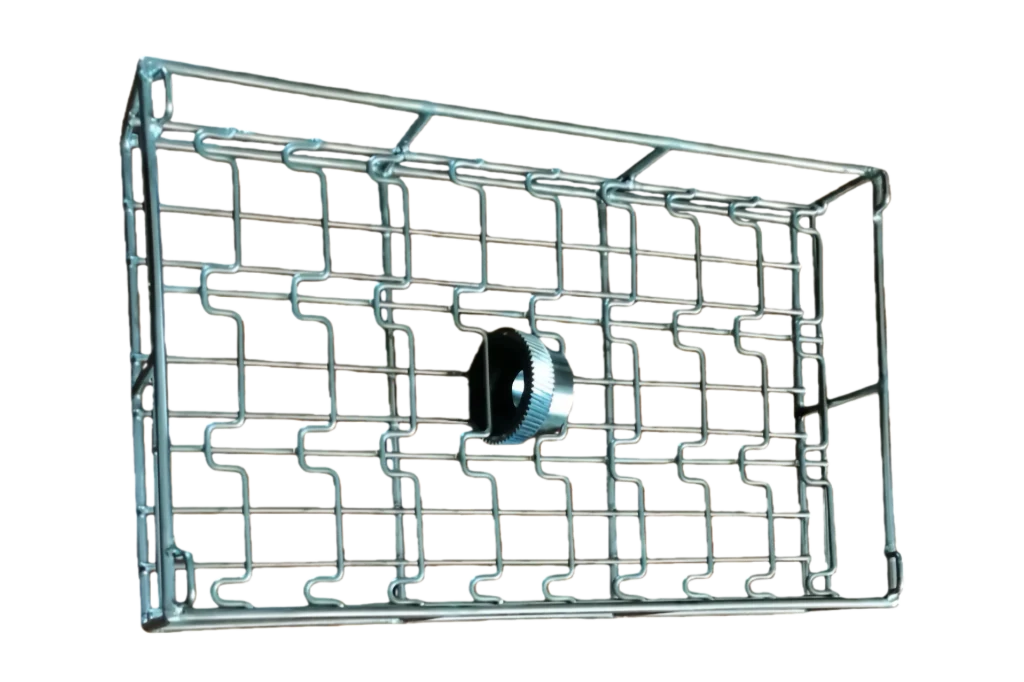
The basket material decision carries more weight than it seems. Stainless steel 304 baskets are standard, but for precision aluminum components, even 304 can leave micro-scratches if parts tumble freely. In those cases, we specify SUS316 with electropolished surfaces, or PTFE-coated contact points for the most delicate parts. At GTKCLEAN, we have built rotary systems handling loads up to 2,000 kg with reinforced basket structures, motors, and tank frames engineered specifically for those loads. But load capacity is only one number. The ratio of basket open area to total surface area determines how much ultrasonic energy actually reaches the parts. Too much metal and the basket absorbs energy meant for cleaning. Too open and heavy parts distort the basket over time. For precision work, I typically design baskets with 60 to 70 percent open area, using wire diameters of 3 to 5 mm for most industrial loads.
Part fixturing inside the basket is where many systems fall short. A precision fuel system component with a 0.2 mm orifice requires a different holding strategy than a transmission gear being degreased before assembly. If your program involves parts with feature sizes below 0.5 mm, it is worth confirming that the basket design includes positive fixturing rather than relying on part-on-part contact during rotation. Send your part drawings and throughput targets to [email protected] and we can confirm the fixturing configuration that matches your geometry.
| Basket Type | Idéal pour | Rotation Mode | Typical Load |
|---|---|---|---|
| Round, full-immersion | Complex 3D parts, blind holes | Continuous 360° | Up to 500 kg |
| Square, indexed | Flat parts, single critical surface | Indexed positions | Up to 800 kg |
| Reinforced heavy-duty | Large castings, engine blocks | Continuous or indexed | Up to 2000 kg |
| Custom-fixtured | cURL Too many subrequests by single Worker invocation. To configure this limit, refer to https://developers.cloudflare.com/workers/wrangler/configuration/#limits | cURL Too many subrequests by single Worker invocation. To configure this limit, refer to https://developers.cloudflare.com/workers/wrangler/configuration/#limits | cURL Too many subrequests by single Worker invocation. To configure this limit, refer to https://developers.cloudflare.com/workers/wrangler/configuration/#limits |
Matching System Configuration to Part Requirements
cURL Too many subrequests by single Worker invocation. To configure this limit, refer to https://developers.cloudflare.com/workers/wrangler/configuration/#limits
cURL Too many subrequests by single Worker invocation. To configure this limit, refer to https://developers.cloudflare.com/workers/wrangler/configuration/#limits
cURL Too many subrequests by single Worker invocation. To configure this limit, refer to https://developers.cloudflare.com/workers/wrangler/configuration/#limits
cURL Too many subrequests by single Worker invocation. To configure this limit, refer to https://developers.cloudflare.com/workers/wrangler/configuration/#limits
cURL Too many subrequests by single Worker invocation. To configure this limit, refer to https://developers.cloudflare.com/workers/wrangler/configuration/#limits
Process Validation and Quality Control for Precision Cleaning
cURL Too many subrequests by single Worker invocation. To configure this limit, refer to https://developers.cloudflare.com/workers/wrangler/configuration/#limits
cURL Too many subrequests by single Worker invocation. To configure this limit, refer to https://developers.cloudflare.com/workers/wrangler/configuration/#limits
cURL Too many subrequests by single Worker invocation. To configure this limit, refer to https://developers.cloudflare.com/workers/wrangler/configuration/#limits
cURL Too many subrequests by single Worker invocation. To configure this limit, refer to https://developers.cloudflare.com/workers/wrangler/configuration/#limits
Integrating Rotary Systems into Automated Production Lines
cURL Too many subrequests by single Worker invocation. To configure this limit, refer to https://developers.cloudflare.com/workers/wrangler/configuration/#limits
cURL Too many subrequests by single Worker invocation. To configure this limit, refer to https://developers.cloudflare.com/workers/wrangler/configuration/#limits
cURL Too many subrequests by single Worker invocation. To configure this limit, refer to https://developers.cloudflare.com/workers/wrangler/configuration/#limits
Achieving Consistent Results with Rotary Ultrasonic Cleaning
cURL Too many subrequests by single Worker invocation. To configure this limit, refer to https://developers.cloudflare.com/workers/wrangler/configuration/#limits
cURL Too many subrequests by single Worker invocation. To configure this limit, refer to https://developers.cloudflare.com/workers/wrangler/configuration/#limits
cURL Too many subrequests by single Worker invocation. To configure this limit, refer to https://developers.cloudflare.com/workers/wrangler/configuration/#limits
Common Questions About Rotary Ultrasonic Cleaning for Precision Parts
How do I determine whether my parts need a rotary system or a standard ultrasonic cleaner?
cURL Too many subrequests by single Worker invocation. To configure this limit, refer to https://developers.cloudflare.com/workers/wrangler/configuration/#limits
What basket material should I specify for precision aluminum components?
cURL Too many subrequests by single Worker invocation. To configure this limit, refer to https://developers.cloudflare.com/workers/wrangler/configuration/#limits
Can rotary ultrasonic systems handle parts with internal threads smaller than M3?
cURL Too many subrequests by single Worker invocation. To configure this limit, refer to https://developers.cloudflare.com/workers/wrangler/configuration/#limits
How often should I validate cleaning results on a rotary system in production?
cURL Too many subrequests by single Worker invocation. To configure this limit, refer to https://developers.cloudflare.com/workers/wrangler/configuration/#limits
What is the most common mistake when specifying a rotary ultrasonic cleaning system for precision work?
cURL Too many subrequests by single Worker invocation. To configure this limit, refer to https://developers.cloudflare.com/workers/wrangler/configuration/#limits
Si vous êtes intéressé, consultez ces articles liés :
Passer à des systèmes de nettoyage ultrasoniques automatisés pour plus d’efficacité
Guides des systèmes de nettoyage ultrasoniques industriels : applications diverses
Comment garantir une adhérence parfaite du revêtement sans taches d'eau ni traces ?
Comment choisir des systèmes ultrasoniques multi-tank pour un volume élevé
Pourquoi les fabricants de revêtements choisissent l'équipement de nettoyage préalable GTKCLEAN
 French
  English
  German
  Spanish
  Russian
  Portuguese