

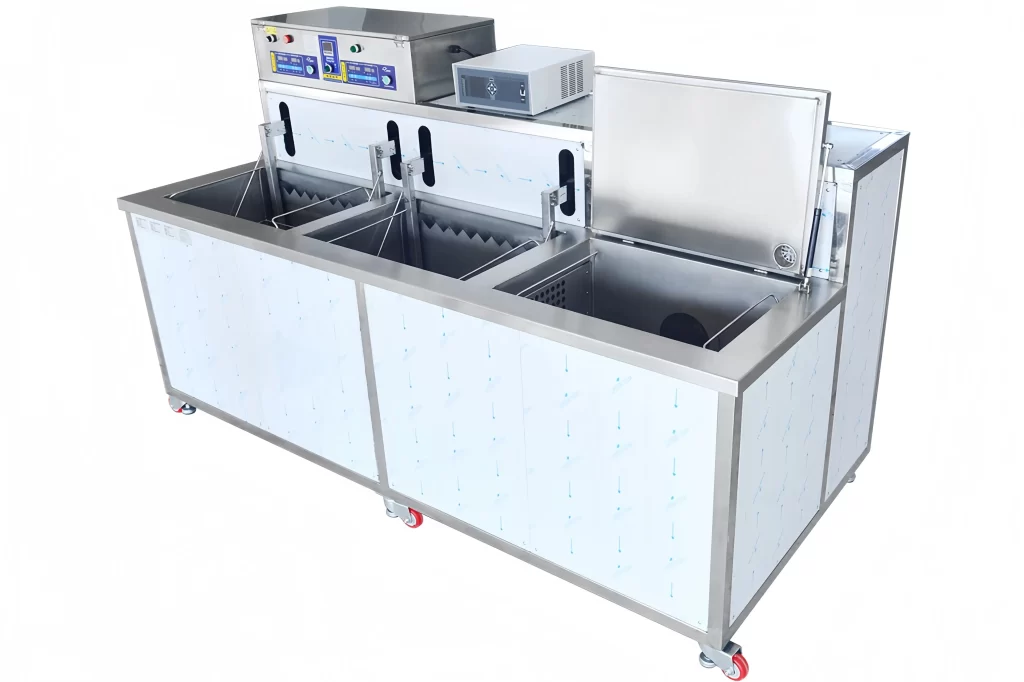
For manufacturers supplying aerospace, medical, or precision automotive components, surface contamination that exceeds specified limits can mean scrapped batches and lost certifications. A multi-tank ultrasonic washer engineered to meet high cleanliness requirements is often the only production-scale solution that delivers repeatable, particle-free surfaces. But bolting extra tanks onto a generic design rarely works. The difference between a reliable system and one that underperforms lies in the precise configuration of cleaning stages, chemical management, and drying method. Our work deploying ultrasonic systems across 20+ countries has repeatedly shown that a carefully designed multi-tank system can achieve ISO 16232 level 7 or better consistently, while an ill-configured setup creates as many problems as it solves.
How Multi-Tank Configurations Improve Cleaning Performance
Single-tank ultrasonic washers struggle with high cleanliness because contaminants removed in the cleaning stage remain suspended in the bath and can redeposit on part surfaces during rinsing. Multi-tank systems isolate each process step, preventing cross-contamination between stages. The typical progression moves parts from a degreasing tank through one or more ultrasonic rinse tanks to a fresh DI water rinse and finally drying. This sequential isolation is what enables a system to hit single-digit particle counts repeatedly over high-volume production runs.
We've observed in projects where a customer initially used a single-tank manual washer that recontamination was the primary reason for failing post-wash particle tests. Switching to a three-tank automatic line—ultrasonic wash with filtration, DI rinse, hot air dry—immediately brought parts within the required cleanliness spec. The key is that each tank removes a different contaminant fraction without reintroducing earlier residues.
The number of tanks and their specific functions should be driven by the heaviness of the incoming soil load and the target cleanliness. For example, a line processing machined aluminum housings with cutting oil and fine chips might require a high-pressure spray pre-wash, an ultrasonic degrease tank, a low-frequency ultrasonic rinse, a DI cascade rinse, and finally vacuum drying. That's a five-tank configuration. Conversely, a lightly loaded stamping line might work well with a four-tank setup: ultrasonic wash, first DI rinse, second DI rinse, hot air dry.
Key Process Stages for High Cleanliness Results
The cleaning stages in a high-cleanliness multi-tank washer are not interchangeable. Each must be selected and tuned for the part material, geometry, and contaminant type.
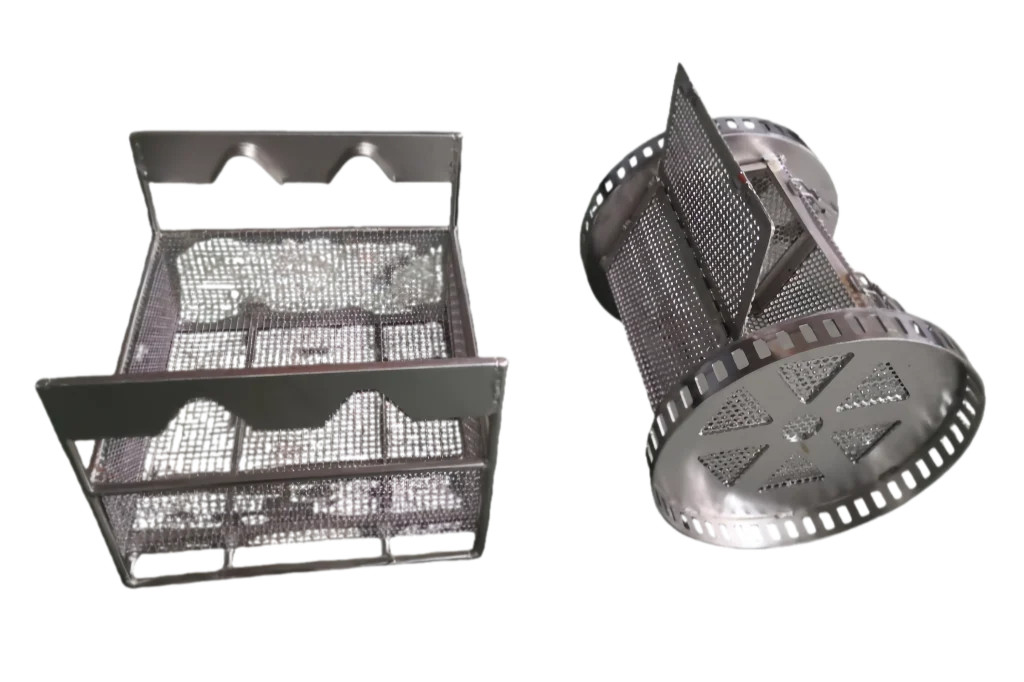
Pre-clean or degreasing removes bulk oils and greases. We typically use an alkaline detergent heated to 45–65°C, with ultrasonic agitation at 28–40 kHz depending on the part. Filtration loops on this tank are critical to extend chemical life and prevent re-deposition.
Ultrasonic rinse uses clean water or a neutral solution to remove loosened particulate. The ultrasonic frequency in this stage often shifts higher (40–80 kHz) to reach into micro-recesses and blind holes. This is particularly important for parts like fuel system components where a single 50 µm particle can cause a failure.
DI water rinse replaces the previous bath with deionized water to eliminate ionic residue. In our multi-tank systems, we maintain final rinse conductivity below 5 µS/cm, often using a cascade overflow design to keep the rinse water clean. High-purity rinsing is non-negotiable for pre-coating applications where residual ions cause coating defects.
Secado prevents water spots and ensures parts are ready for assembly or packaging. Hot air drying at 80–100°C is sufficient for many geometries, but complex parts with blind holes often require vacuum drying to pull moisture out of internal cavities. Our experience with vacuum drying on PVD pre-coating lines has shown that it eliminates water-spot-related adhesion failures.
The table below summarizes these stages and typical parameters.
| Stage | Typical Duration | Temperatura | Key Parameter |
|---|---|---|---|
| Ultrasonic degrease | 5–10 min | 45–65°C | Frequency 28–40 kHz |
| Ultrasonic rinse | 3–5 min | 30–40°C | Frequency 40–80 kHz |
| DI water rinse | 2–3 min | Ambient–30°C | Conductivity ≤5 µS/cm |
| Drying (hot air) | 5–10 min | 80–100°C | Clean, filtered air |
If your program involves parts with deep internal cavities or very low residue limits, it is worth confirming that the drying stage can achieve the required residual moisture level before finalizing your BOM—reach out to us at [email protected] to evaluate your options.
Tailoring Tank Sequencing and Chemical Control to the Cleanliness Standard
The sequence of tanks and the chemistry used in each must align with the specific cleanliness standard your parts must meet. ISO 16232, for instance, specifies different particle size and count limits for different component cleanliness levels. Achieving Level 3 (very clean) requires more aggressive degreasing, multiple rinses, and validated measuring of final particulate levels. VDA 19, the German standard, adds requirements for residual film and ionic contamination, which influences the choice of detergent and the need for a dedicated deionized rinse with conductivity monitoring.
cURL Too many subrequests by single Worker invocation. To configure this limit, refer to https://developers.cloudflare.com/workers/wrangler/configuration/#limits
cURL Too many subrequests by single Worker invocation. To configure this limit, refer to https://developers.cloudflare.com/workers/wrangler/configuration/#limits
Drying Methods for Zero-Residue Surfaces
cURL Too many subrequests by single Worker invocation. To configure this limit, refer to https://developers.cloudflare.com/workers/wrangler/configuration/#limits
cURL Too many subrequests by single Worker invocation. To configure this limit, refer to https://developers.cloudflare.com/workers/wrangler/configuration/#limits
cURL Too many subrequests by single Worker invocation. To configure this limit, refer to https://developers.cloudflare.com/workers/wrangler/configuration/#limits
cURL Too many subrequests by single Worker invocation. To configure this limit, refer to https://developers.cloudflare.com/workers/wrangler/configuration/#limits
Designing Your Wash Line for Reliable High-Cleanliness Output
cURL Too many subrequests by single Worker invocation. To configure this limit, refer to https://developers.cloudflare.com/workers/wrangler/configuration/#limits
cURL Too many subrequests by single Worker invocation. To configure this limit, refer to https://developers.cloudflare.com/workers/wrangler/configuration/#limits
cURL Too many subrequests by single Worker invocation. To configure this limit, refer to https://developers.cloudflare.com/workers/wrangler/configuration/#limits
Questions to Ask When Specifying a Multi-Tank Ultrasonic Washer
How do I know if I need a three-tank, four-tank, or five-tank system?
cURL Too many subrequests by single Worker invocation. To configure this limit, refer to https://developers.cloudflare.com/workers/wrangler/configuration/#limits
Can I use the same detergent in all tanks?
cURL Too many subrequests by single Worker invocation. To configure this limit, refer to https://developers.cloudflare.com/workers/wrangler/configuration/#limits
What is the most common cause of failing a cleanliness test after a multi-tank wash?
cURL Too many subrequests by single Worker invocation. To configure this limit, refer to https://developers.cloudflare.com/workers/wrangler/configuration/#limits
Si estás interesado, consulta estos artículos relacionados:
Mejore la Eficiencia de Limpieza en la Fabricación Automotriz: Una Guía Estratégica
Proceso de Limpieza por Ultrasonidos: Una Guía Técnica Paso a Paso
Retorno de inversión en Sistemas de Limpieza Industrial: Calculando tu retorno de inversión
¿Cómo elegir la mejor potencia ultrasónica para una máquina de limpieza por ultrasonidos?
 Spanish
  English
  German
  French
  Russian
  Portuguese