

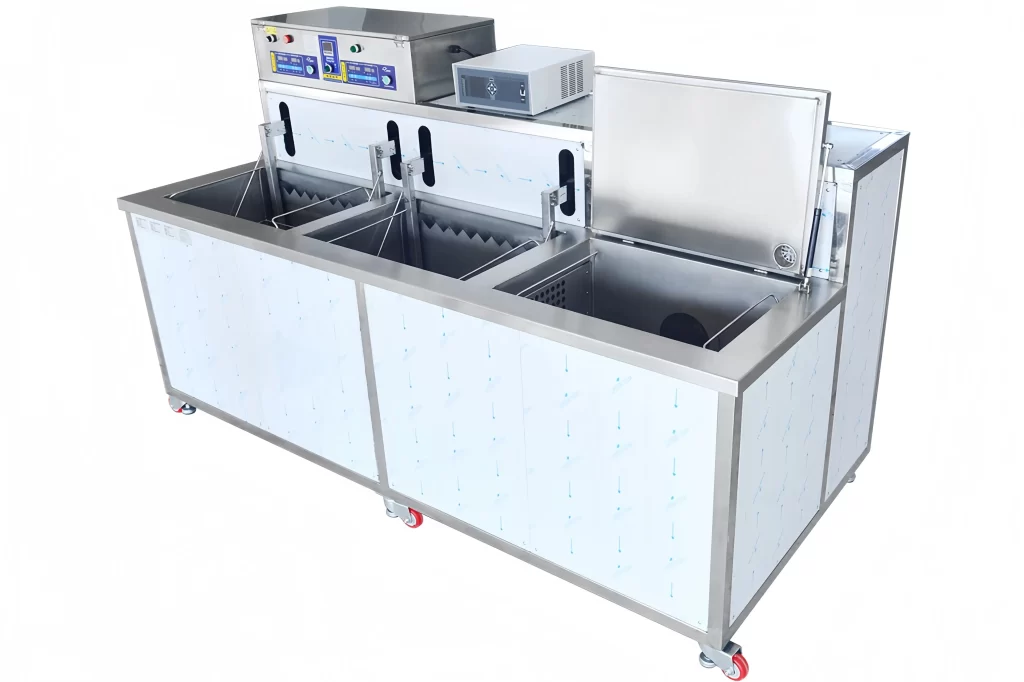
Benchtop ultrasonic cleaners offer a quick, accessible way to clean small precision parts, but their limitations become apparent when you move from prototyping to production. As an engineer who has designed cleaning lines for manufacturers across 20 countries, I’ve seen these machines handle light soiling effectively in R&D labs. Yet when parts accumulate stamping oil, demand repeatable cycle times, or carry blind holes, the gap between a benchtop unit and an automated system widens quickly. This article maps out where benchtop cleaners deliver value, where they fall short, and the performance thresholds that signal it is time to consider a larger, automated solution.
What Benchtop Ultrasonic Cleaners Do Well
Benchtop ultrasonic cleaners sit right on the workbench, running at frequencies between 20 kHz and 80 kHz with tanks from roughly 30 to 187 litres. The GTKCLEAN range, for instance, uses 304 or 316 stainless steel tanks, ultrasonic power from 750 W to 2,400 W, and heating elements up to 6,000 W. That hardware is enough for many routine tasks. Laboratories use them to clean delicate glassware and small instruments without abrasive scrubbing. Jewelers rely on them to remove polishing compound from intricate settings. Medical device re-processers clean surgical tools before sterilization. In machine shops, benchtop units handle light cutting-oil residue on small batches of parts that will be assembled or inspected the same day.
The real strength is simplicity. You fill the tank with a water-based detergent or a mild solvent, heat it to 45–65 °C, and start the cycle. There is no complex PLC program to write, no conveyor to align. For R&D departments, toolrooms, and prototype lines where the variety of parts is high but the volume is low, a benchtop cleaner keeps workflow moving without demanding any material handling engineering. A single operator can load, run, and unload several batches in a shift, provided the parts are not heavy and the soil load is modest.
Cleaning small parts manually works well until the volume climbs. <Manuelle Ultraschallreinigungsmaschinen: Wann sie eingesetzt werden sollten> describes how repetitive manual tasks introduce variability in rinse quality and cycle timing once throughput moves beyond a few baskets per hour.
Key Specifications That Shape Performance
Performance does not scale linearly with tank size. The real drivers are ultrasonic power density, frequency, and heating capability. A 30 L tank with only 750 W of ultrasonic power produces weak cavitation in the corners of the bath; the same tank with 1,500 W will strip tenacious cutting oil from a batch of small turned parts in half the time. Frequency matters equally. Lower frequencies around 20–28 kHz generate larger, more aggressive cavitation bubbles that tackle thick grease and carbon deposits. Higher frequencies near 40–80 kHz produce smaller, gentler bubbles that reach into fine cracks and blind holes without damaging polished surfaces.
Heating also has a practical ceiling. Benchtop heaters typically range from 1,000 W to 6,000 W. With a 100 L tank, 6,000 W brings the solution from ambient to 60 °C in roughly 45 minutes. That is acceptable for a first batch in the morning, but if you plan to run back-to-back cycles with cold top-up water, the recovery time stretches. In a production environment, that delay compounds. I have seen shops try to work around it by pre-heating water in a separate kettle, which defeats the purpose of an easy, single-tank machine.
Where Benchtop Cleaners Fall Short in Industrial Environments
The limitations are not about poor design. They are about the nature of a single-tank, manually operated machine. The first hard boundary is throughput. A single operator loading and unloading a 50 L tank might process 12 to 15 batches in an eight-hour shift. If each batch holds 20 small parts, that is 300 parts per day. As soon as production demands 500 or 1,000 parts per day, the operator becomes the bottleneck. You either extend shifts, buy more benchtop units, or both. Those extra units then need extra floor space, extra power drops, and extra manual effort. The hidden cost of labour—loading, rinsing, drying, and inspecting—typically exceeds the purchase price of the machines within the first year.
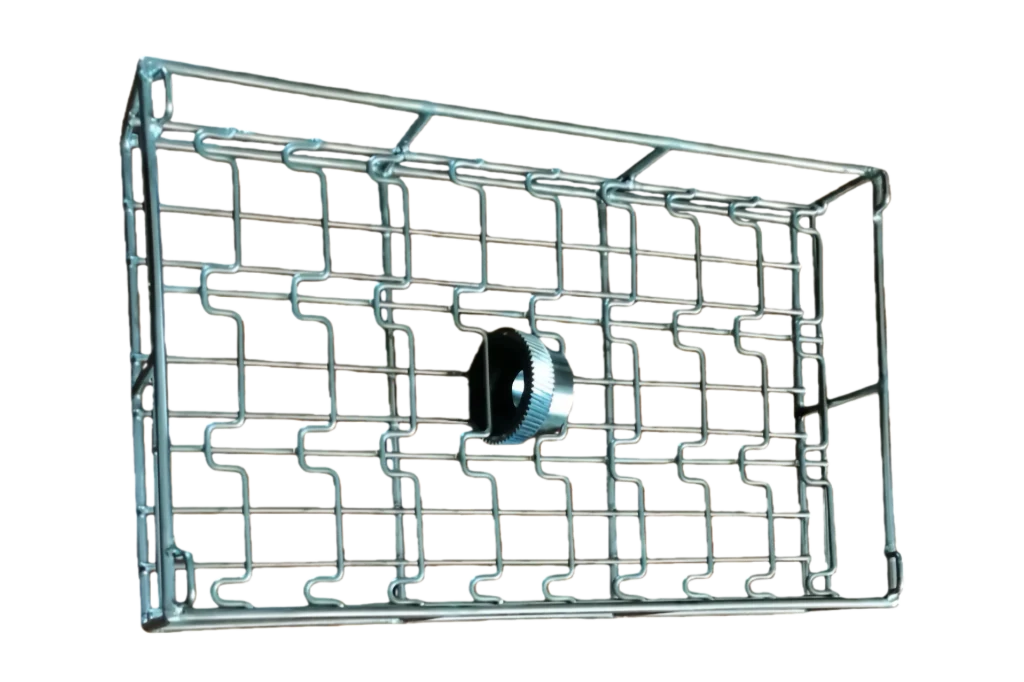
The second limitation is process consistency. A benchtop tank lacks separate wash, rinse, and drying stages. The operator must lift the basket out of the hot detergent, drain it, perhaps dip it in a standalone rinse bucket, and then dry the parts with compressed air or paper towels. That sequence changes from person to person and shift to shift. For parts heading into PVD coating or anodizing, any residual detergent film causes adhesion failures. I have seen coating suppliers reject entire lots because water spots or surfactant residue remained on the part surface, traceable back to an inconsistent manual rinse step.
A third boundary is solvent handling. While benchtop units primarily run water-based chemistries, some users try to use mild hydrocarbon solvents in the hope of faster degreasing. An open-top benchtop tank offers no vapour containment; solvent evaporates into the room, creating a health and fire hazard that most shop-floor risk assessments will not accept. Industrial solvent machines solve this with sealed chambers and integrated vapour recovery, something a benchtop simply cannot provide.
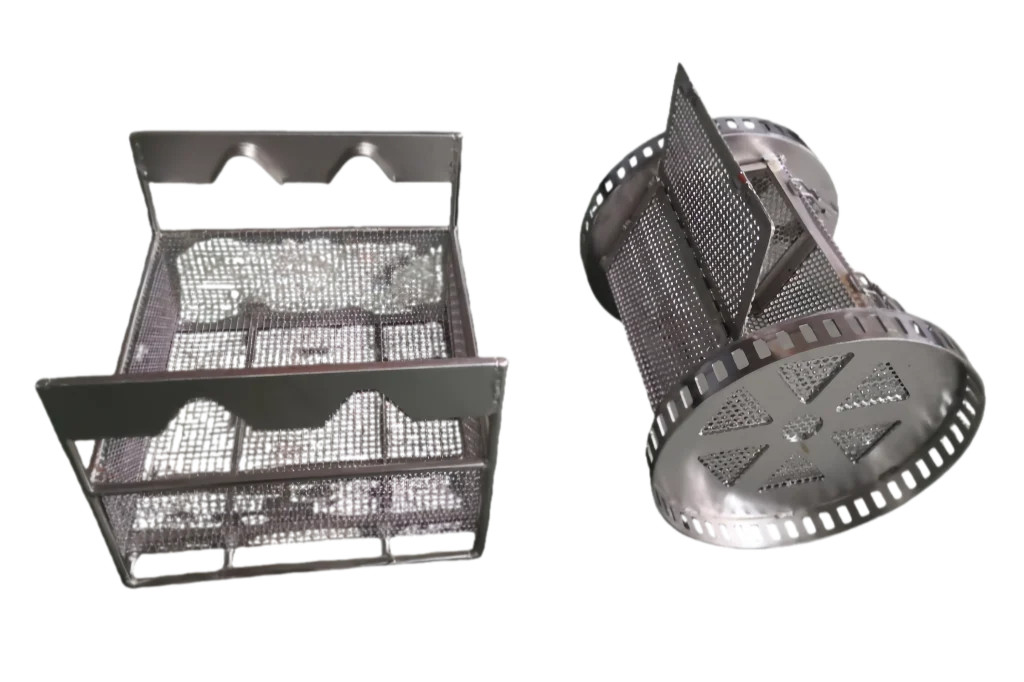
The fourth gap is cleaning blind holes and complex internal features. A benchtop tank generates a uniform ultrasonic field, but the part orientation is fixed. If a blind recess points upward, gas bubbles can trap inside and prevent cavitation. In a multi-tank rotary basket system, the basket rotates continuously, exposing every surface. In a benchtop, the operator must manually reposition the basket partway through the cycle—another variable.
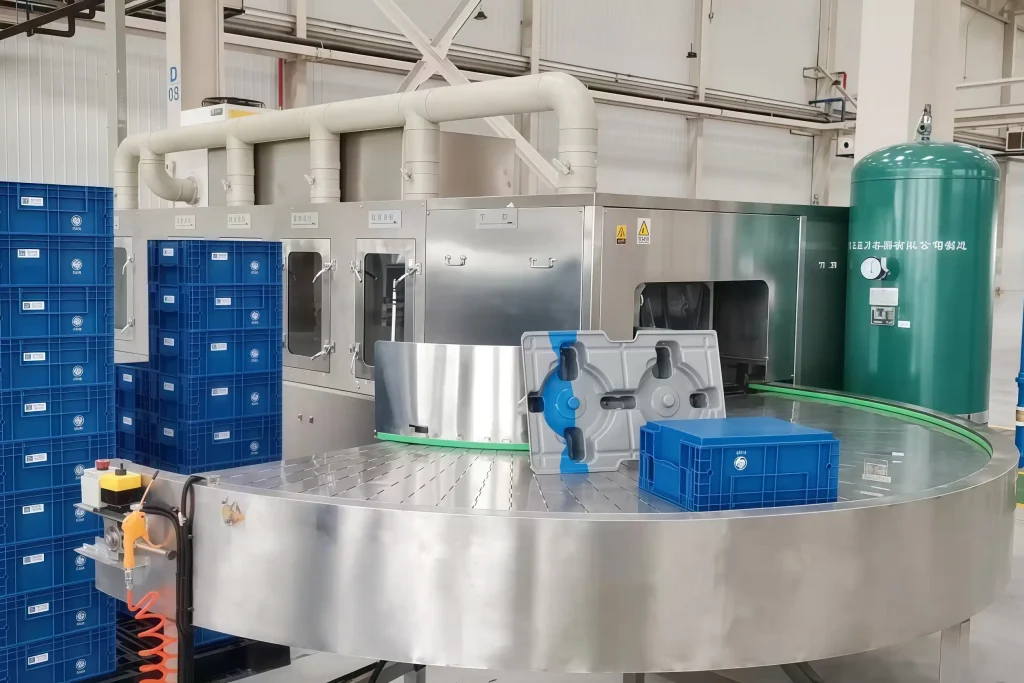
As cleaning demands grow, the choice between benchtop and multi-tank configurations becomes central. <Wie man Mehrbehälter-Ultraschallsysteme für hohe Volumina auswählt> explains how multi-stage designs add dedicated rinsing and drying stations that cut cycle time and raise cleanliness consistency.
When to Move Beyond Benchtop Cleaning
A few practical signals tell you it is time to leave the benchtop behind. The first is when your rinse-and-dry step takes longer than the ultrasonic cleaning step itself. That is your process telling you it needs automation. The second signal is when you start stacking benchtop machines to meet volume. Two 100 L units with three operators already occupy more floor space and labour than a single automated two-tank system that one operator oversees. The third signal is a customer audit or coating supplier rejection tied to inconsistent cleanliness—those failures rarely go away by adding another manual rinse bucket.
The table below compares typical benchtop operation against a multi-tank automated system across the factors that most often trigger an upgrade.
| Faktor | Benchtop Ultrasonic Cleaner | Multi-Tank Automated System |
|---|---|---|
| Throughput (parts/shift) | 200–500 (operator-limited) | 2,000–8,000 (line-speed) |
| Rinse and dry | Manual, variable | Automated, validated |
| Part orientation | cURL Too many subrequests by single Worker invocation. To configure this limit, refer to https://developers.cloudflare.com/workers/wrangler/configuration/#limits | cURL Too many subrequests by single Worker invocation. To configure this limit, refer to https://developers.cloudflare.com/workers/wrangler/configuration/#limits |
| cURL Too many subrequests by single Worker invocation. To configure this limit, refer to https://developers.cloudflare.com/workers/wrangler/configuration/#limits | cURL Too many subrequests by single Worker invocation. To configure this limit, refer to https://developers.cloudflare.com/workers/wrangler/configuration/#limits | cURL Too many subrequests by single Worker invocation. To configure this limit, refer to https://developers.cloudflare.com/workers/wrangler/configuration/#limits |
| cURL Too many subrequests by single Worker invocation. To configure this limit, refer to https://developers.cloudflare.com/workers/wrangler/configuration/#limits | cURL Too many subrequests by single Worker invocation. To configure this limit, refer to https://developers.cloudflare.com/workers/wrangler/configuration/#limits | cURL Too many subrequests by single Worker invocation. To configure this limit, refer to https://developers.cloudflare.com/workers/wrangler/configuration/#limits |
| cURL Too many subrequests by single Worker invocation. To configure this limit, refer to https://developers.cloudflare.com/workers/wrangler/configuration/#limits | cURL Too many subrequests by single Worker invocation. To configure this limit, refer to https://developers.cloudflare.com/workers/wrangler/configuration/#limits | cURL Too many subrequests by single Worker invocation. To configure this limit, refer to https://developers.cloudflare.com/workers/wrangler/configuration/#limits |
Planning Your Upgrade: What to Look for in an Automated System
cURL Too many subrequests by single Worker invocation. To configure this limit, refer to https://developers.cloudflare.com/workers/wrangler/configuration/#limits
cURL Too many subrequests by single Worker invocation. To configure this limit, refer to https://developers.cloudflare.com/workers/wrangler/configuration/#limits
cURL Too many subrequests by single Worker invocation. To configure this limit, refer to https://developers.cloudflare.com/workers/wrangler/configuration/#limits
cURL Too many subrequests by single Worker invocation. To configure this limit, refer to https://developers.cloudflare.com/workers/wrangler/configuration/#limits
cURL Too many subrequests by single Worker invocation. To configure this limit, refer to https://developers.cloudflare.com/workers/wrangler/configuration/#limitsAutomatisierte Ultraschallreinigung: Steigerung der Prozesskonsistenz in der IndustriecURL Too many subrequests by single Worker invocation. To configure this limit, refer to https://developers.cloudflare.com/workers/wrangler/configuration/#limits
Getting the Right System for Your Production Targets
cURL Too many subrequests by single Worker invocation. To configure this limit, refer to https://developers.cloudflare.com/workers/wrangler/configuration/#limits
cURL Too many subrequests by single Worker invocation. To configure this limit, refer to https://developers.cloudflare.com/workers/wrangler/configuration/#limits
Common Questions About Benchtop Ultrasonic Cleaning
Can a benchtop unit clean parts with blind holes effectively?
cURL Too many subrequests by single Worker invocation. To configure this limit, refer to https://developers.cloudflare.com/workers/wrangler/configuration/#limits
Why do some parts come out of a benchtop cleaner with water spots?
cURL Too many subrequests by single Worker invocation. To configure this limit, refer to https://developers.cloudflare.com/workers/wrangler/configuration/#limits
What is the largest part a benchtop cleaner can handle?
cURL Too many subrequests by single Worker invocation. To configure this limit, refer to https://developers.cloudflare.com/workers/wrangler/configuration/#limits
How do I know when to add a second benchtop unit versus moving to a multi-tank system?
cURL Too many subrequests by single Worker invocation. To configure this limit, refer to https://developers.cloudflare.com/workers/wrangler/configuration/#limits
Is it possible to use hydrocarbon solvents in a benchtop ultrasonic cleaner?
cURL Too many subrequests by single Worker invocation. To configure this limit, refer to https://developers.cloudflare.com/workers/wrangler/configuration/#limits
Wenn Sie interessiert sind, schauen Sie sich diese verwandten Artikel an:
Vergleich der Investitionen in automatisierte versus manuelle Reinigung für die Industrie
Optimierung der industriellen Reinigung zur Reduzierung der Lösungskosten
 German
  English
  Spanish
  French
  Russian
  Portuguese