

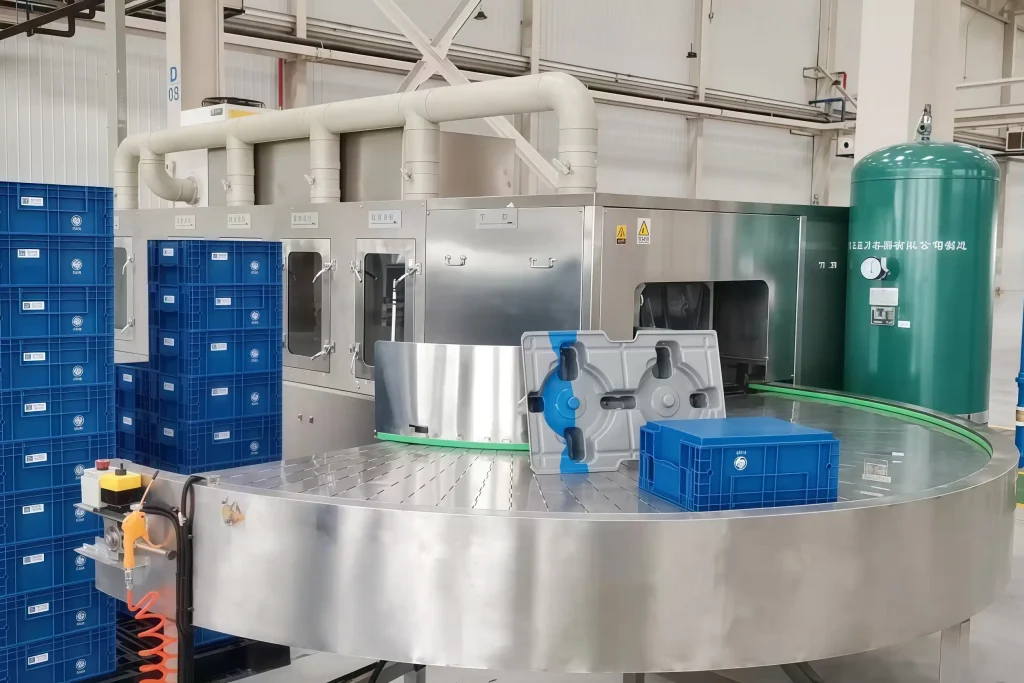
Tunnel cleaning systems achieve consistent, high-throughput industrial parts cleaning, but real-world performance comes down to how the design is matched to specific part geometry, contamination, and throughput targets. In two decades of designing automated cleaning lines for clients in automotive, aerospace, and precision machining, I have repeatedly seen that a standard "off-the-shelf" approach fails when part features like blind holes, recesses, or fragile surfaces are involved. A system that cleans one part perfectly can leave residue on another if the conveyor speed, spray configuration, or chemical delivery was chosen without accounting for those differences. This article covers the critical design parameters and performance trade-offs that engineers, production managers, and procurement teams must evaluate when specifying a tunnel cleaning system. It walks through conveyor and part handling, process design, throughput versus cleanliness balancing, and how customization turns a generic washer into a reliable production asset.
Tunnel Cleaning System Design and Cleaning Performance
A tunnel cleaning system is not a single machine but a continuous, multi-stage line where conveyor, spray, ultrasonic, rinse, and drying sections work as one. The performance of the whole system depends on decisions made at each stage. In my experience, the most common source of under-performance is a mismatch between the cleaning media contact time and the part contamination level. For example, die-cast aluminum shells with release agent require a longer spray dwell time at higher pressure than stamped steel parts with light oil. If the conveyor speed is set to match the faster part, the aluminum parts will exit with residue.
The table below summarizes how key design choices directly affect cleaning outcomes.
| Design Parameter | Performance Impact | Typical Adjustment Range |
|---|---|---|
| Conveyor speed | Determines cycle time and contact duration; faster speed reduces dwell time in spray and ultrasonic zones. | 0.5–1.0 m/min for heavy contamination, up to 2 m/min for light soils |
| Spray nozzle type and pressure | Flat fan nozzles cover large surfaces; conical nozzles reach gaps. Higher pressure (5–10 bar) improves mechanical removal but may cause foaming. | 2–10 bar depending on part geometry |
| Ultraschallfrequenz | Lower frequencies (20–28 kHz) produce larger cavitation bubbles for heavy soils; higher frequencies (40–80 kHz) for precision parts. | 20 kHz for stampings, 40 kHz for electronics |
| Number of rinse stages | Each additional stage reduces drag-out and improves final cleanliness, but increases footprint and water use. | 2–3 stages for most applications, 4+ for critical coatings |
I have learned that a 10% increase in conveyor speed can cut cleaning efficacy by more than 25% on parts with deep recesses because the cavitation in the ultrasonic tank does not have enough time to dislodge particles. That is not a linear trade-off, and it explains why setting speed purely by production targets often produces reject parts.
Tunnel Cleaning System Conveyor and Part Handling Design Factors
Conveyor design is the skeleton of a tunnel cleaning system. If it cannot hold the part securely in the right orientation through every stage, no amount of spray pressure or ultrasonic power will save the result. In our cleaning equipment design work, the first question we ask is not "how fast" but "what is the worst-case orientation for contamination retention?" The conveyor must then be built to keep that orientation or rotate the part through multiple positions.
The choice between belt, chain, and roller conveyors depends on part size, weight, and cleaning compatibility.
| Conveyor Type | Am besten geeignet für | Einschränkungen |
|---|---|---|
| Mesh belt | Small to medium parts, high throughput, good drainage | Limited for parts that nest or shift |
| Slat / chain | Heavy or irregular parts, fixtures possible | More complex cleaning access |
| Roller | Parts with flat bottoms, heavy loads | Not for small parts that can jam |
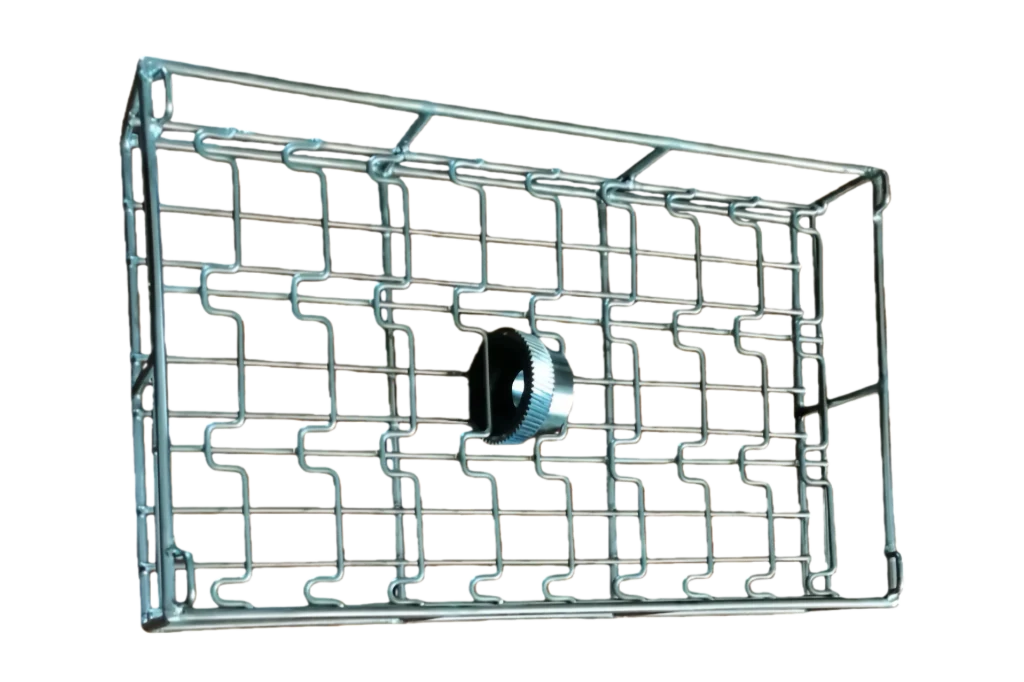
Part fixture design is equally important. A fixture that touches too much of the part surface creates "shadow" areas where spray and ultrasonic waves cannot reach. We design fixtures that contact only non-critical surfaces or use rotating baskets that expose all faces during the cycle. For an automotive bearing washing project, the rotary basket approach achieved a 40% improvement in blind‑hole cleanliness compared to a static fixture.
Spray, Ultrasonic, and Chemical Process Design Parameters
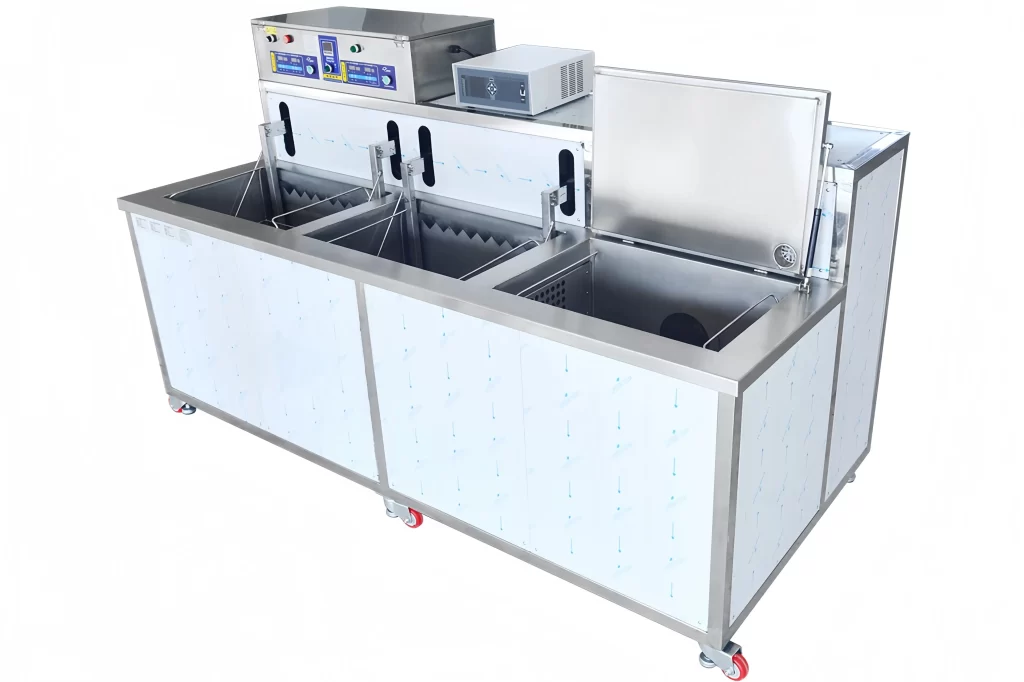
Once the part is moving correctly through the tunnel, the cleaning process itself must be configured for the specific contaminant. Most tunnel systems combine spray pre-wash, ultrasonic immersion, rinse, and drying. The design parameters within each stage determine whether the system meets the cleanliness specification.
For spray zones, nozzle placement and overlap are critical. I prefer a layout with angled nozzles above and below the conveyor, arranged so that every square centimeter of the part sees at least two spray streams. Pressure is typically 3–8 bar, with higher pressure for oil removal and lower for delicate parts. In ultrasonic tanks, the frequency and power density must be matched to the component material and soil type. For machined steel parts with cutting oil, 20 kHz at 10–15 watts per liter works well. For aluminum parts, 40 kHz reduces the risk of surface pitting.
Chemical selection interacts with mechanical action. Alkaline detergents at 50–65 °C are effective for most metal parts; for aluminum, pH must stay below 10 to avoid etching. Rinse water quality is the last link in the chain—if the final rinse uses untreated tap water, mineral deposits will undo the cleaning. We always specify DI water with conductivity ≤ 5 µS/cm for critical applications, such as pre-coating or medical device cleaning.
cURL Too many subrequests by single Worker invocation. To configure this limit, refer to https://developers.cloudflare.com/workers/wrangler/configuration/#limits
Throughput and Cleanliness Trade-Offs in High-Volume Production
cURL Too many subrequests by single Worker invocation. To configure this limit, refer to https://developers.cloudflare.com/workers/wrangler/configuration/#limits
cURL Too many subrequests by single Worker invocation. To configure this limit, refer to https://developers.cloudflare.com/workers/wrangler/configuration/#limits
cURL Too many subrequests by single Worker invocation. To configure this limit, refer to https://developers.cloudflare.com/workers/wrangler/configuration/#limits
Customizing Tunnel Cleaning Systems for Specific Manufacturing Needs
cURL Too many subrequests by single Worker invocation. To configure this limit, refer to https://developers.cloudflare.com/workers/wrangler/configuration/#limits
cURL Too many subrequests by single Worker invocation. To configure this limit, refer to https://developers.cloudflare.com/workers/wrangler/configuration/#limits
cURL Too many subrequests by single Worker invocation. To configure this limit, refer to https://developers.cloudflare.com/workers/wrangler/configuration/#limits
Common Questions About Tunnel Cleaning System Design and Performance
cURL Too many subrequests by single Worker invocation. To configure this limit, refer to https://developers.cloudflare.com/workers/wrangler/configuration/#limits
cURL Too many subrequests by single Worker invocation. To configure this limit, refer to https://developers.cloudflare.com/workers/wrangler/configuration/#limits
cURL Too many subrequests by single Worker invocation. To configure this limit, refer to https://developers.cloudflare.com/workers/wrangler/configuration/#limits
cURL Too many subrequests by single Worker invocation. To configure this limit, refer to https://developers.cloudflare.com/workers/wrangler/configuration/#limits
cURL Too many subrequests by single Worker invocation. To configure this limit, refer to https://developers.cloudflare.com/workers/wrangler/configuration/#limits
cURL Too many subrequests by single Worker invocation. To configure this limit, refer to https://developers.cloudflare.com/workers/wrangler/configuration/#limits
Wenn Sie interessiert sind, schauen Sie sich diese verwandten Artikel an:
Das richtige Ultraschallreinigungssystem für den industriellen Erfolg wählen
Erklärung der Komponenten eines Ultraschallreinigungssystems
Auswahl eines zuverlässigen Herstellers für Ultraschallgeräte: Ein strategischer Leitfaden
Präzise CNC-Teilereinigungslösungen - GTK
 German
  English
  Spanish
  French
  Russian
  Portuguese