

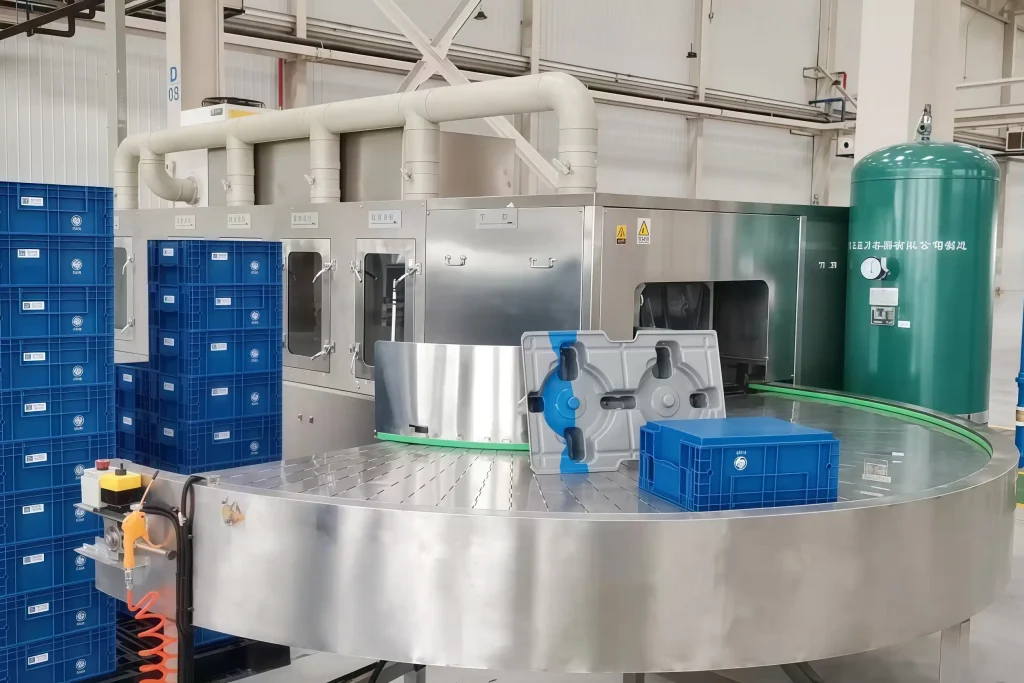
Manufacturers investing in precision die cast components consistently confront one bottleneck: parts emerge from the mold with a tenacious layer of release agent that, if not fully removed, guarantees coating adhesion failure and costly rework. Mold release agent removal from die cast parts becomes an unavoidable process gate before surface treatments like PVD, powder coating, or painting. Through twenty years of designing automated cleaning systems for global production lines, I have observed that the gap between an acceptable surface and a reject often comes down to how thoroughly invisible residues are eliminated, not how aggressively you clean.
Why Complete Mold Release Removal Matters
Release agents migrate into microscopic surface pores and blind holes during casting, leaving a film that acts as a barrier between the metal substrate and any subsequent coating. Even submicron residues disrupt bonding, producing peeling, blistering, or uneven coverage that scrap entire batches. In our work with automotive and telecom die cast aluminum housings, we consistently find that coating adhesion failures trace back to incomplete cleaning, not coating material defects. The requirement is straightforward: the surface must reach a cleanliness level where water break-free testing shows no hydrophobic spots. Anything less and the coating process is compromised before it begins.
The Limitations of Manual Cleaning for Die Cast Parts
Manual scrubbing or benchtop ultrasonic tanks might work for prototyping, but they collapse under production volumes. Operators cannot reach internal cavities of complex castings reliably. Process inconsistency means every part gets a slightly different level of cleaning, which translates to unpredictable quality. Takt times stretch because manual handling and separate drying steps break the production rhythm. More critically, relying on operators to judge cleanliness introduces errors: a part that looks clean may still carry release agent on threaded holes or underside recesses that only fails adhesion testing later. High-volume die casting operations need a repeatable, validated process, not manual discretion.
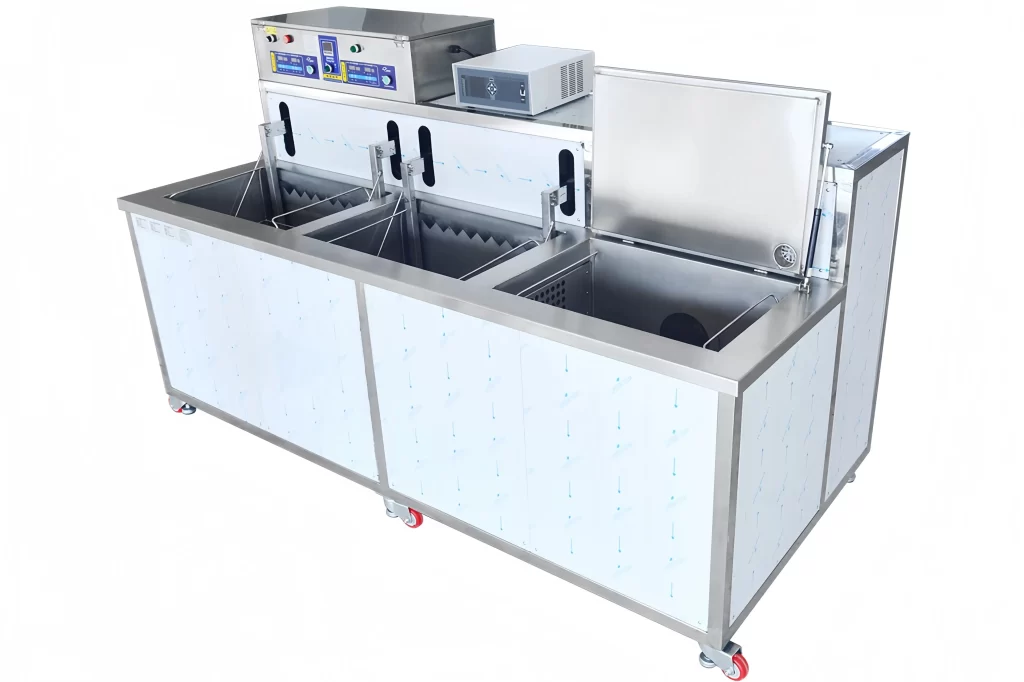
Automated Ultrasonic Systems for Mold Release Removal
Automated inline ultrasonic cleaning systems solve the repeatability problem by moving parts through a precisely controlled sequence of stations. A conveyor carries components through ultrasonic degreasing, rinsing, and drying without human touchpoints. For die cast parts, the key is the combination of multi-directional spray that blasts bulk contaminants from surfaces and ultrasonic cavitation that penetrates blind holes, threads, and internal cavities. In our CNC aluminum shell inline cleaners, spray nozzles surround the part so no area remains shadowed, while the ultrasonic stage agitates cleaning solution into every recess. The result is a documented process that yields the same cleanliness on part one as on part ten thousand.
Process Parameters That Determine Success
Effective mold release removal depends on four parameters that must be dialed in for the specific part geometry and release agent chemistry. Cleaning temperature – typically 45-65°C – accelerates release agent dissolution without risking solution degradation. The cleaning medium choice matters: aqueous alkaline detergents handle most silicone-based and synthetic release agents, while hydrocarbon solvents offer faster degreasing for heavy deposits. Ultrasonic frequency selection affects how cavitation bubbles target different contaminants; 28-40 kHz balances power and reach for cast aluminum. Drying method is the final quality gate – air knife drying followed by hot air eliminates water spots that would create new defects, and for parts with deep cavities, vacuum drying ensures complete moisture removal.
| Parameter | Manual Ultrasonic Tank | Automated Single-Station | Inline Multi-Stage Conveyor |
|---|---|---|---|
| Throughput (parts/hr) | 20-80 | 50-120 | 200-600 |
| Process Consistency | Operator-dependent | PLC-controlled, repeatable | Fully validated, documented |
| Coverage of Blind Holes | Inconsistent | Good with rotary basket | Excellent – multi-angle spray + ultrasonic |
| Labor Requirement | High | Medium | Low (auto load/unload) |
| Typical Cycle Time | 10-20 min | 8-12 min | 5-8 min |
If your program involves parts with deep blind holes or narrow internal channels, confirming that the cleaning system provides full cavitation penetration and complete drying is not a small detail – reach out at [email protected] to run a cleaning trial on your sample parts.
Integrating Cleaning Systems into Production Lines
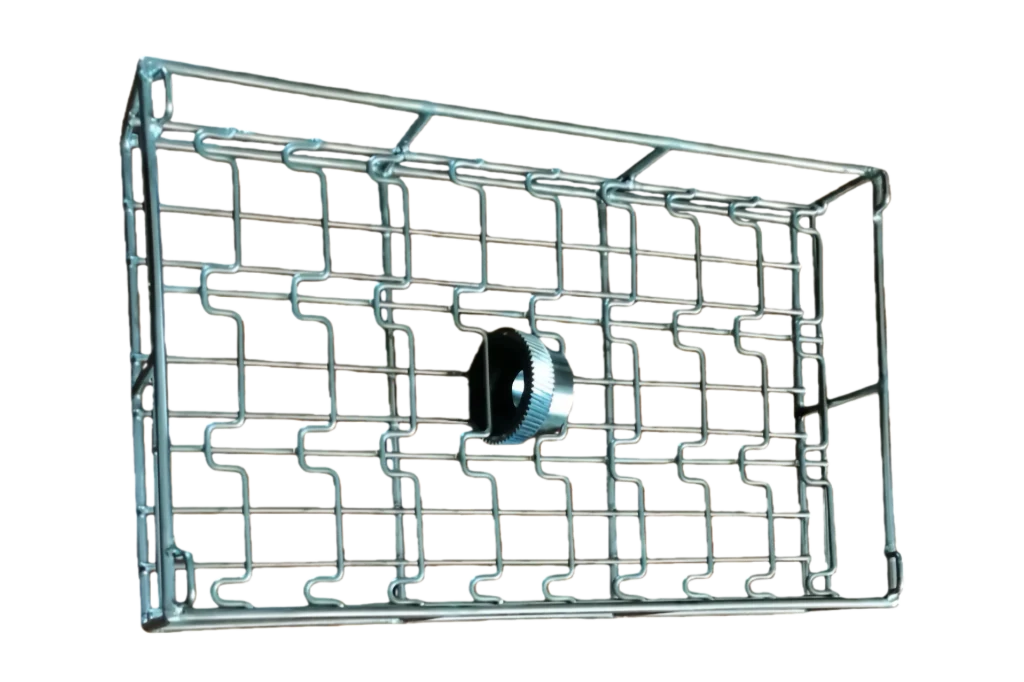
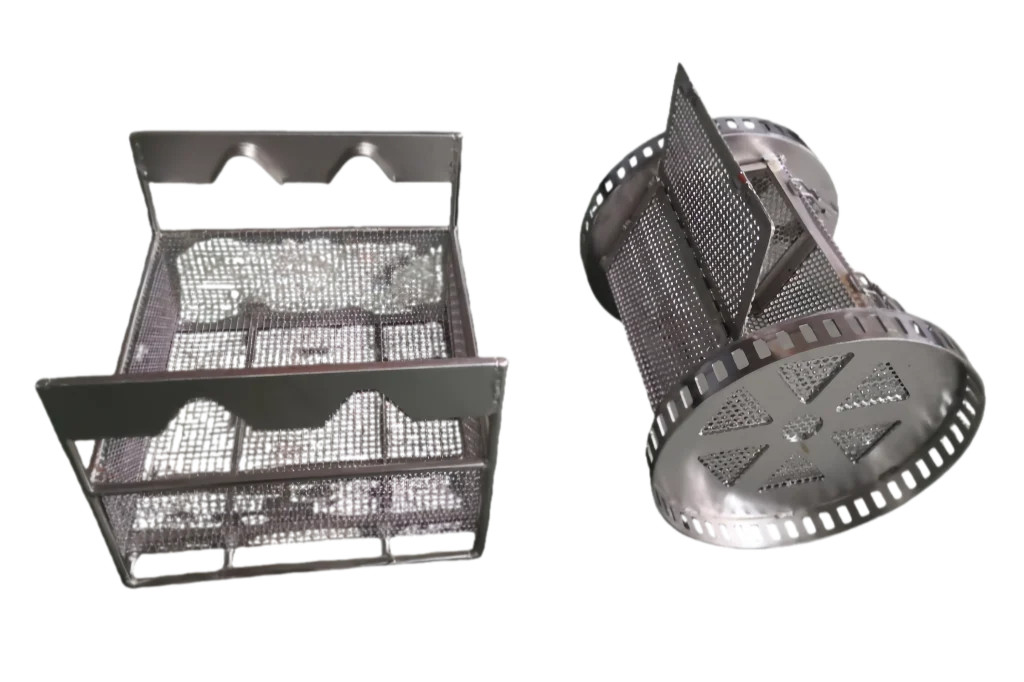
Adding automated cleaning should not create a standalone island but feed into the production flow. In an automotive die casting cell, the cleaning system typically sits directly after casting and trimming, with parts loaded automatically via conveyor or robot. The cleaning line then empties directly into coating booths or assembly stations. This integration eliminates intermediate handling and storage where recontamination can occur. Basket design becomes critical: cleaning baskets must allow solution drainage from all surfaces and be compatible with both the cleaning conveyor and downstream automation. GTKCLEAN’s custom baskets are engineered to match part geometry, ensuring parts are fixed securely while exposing all surfaces to cleaning action.
Evaluating the Investment: Throughput, Quality, and Cost
The financial case for automated cleaning rests on reducing rework and increasing throughput. Every percentage point of coating reject reduction directly recovers material and labor cost. Consider a die casting line producing 500 parts per hour: manual cleaning struggles to keep pace, and even a 3% adhesion failure rate results in 15 rejects per hour that must be stripped, cleaned again, recoated, and re-inspected. An automated ultrasonic system capable of matching the casting rate eliminates this queue and its associated scrap. Beyond direct cost, consistent cleanliness enables higher coating performance, which translates to fewer field failures and warranty claims – the kind of hidden cost that manual processes mask until customer returns expose them.
Common Questions About Die Cast Part Cleaning
Why does mold release agent cause coating failures?
Release agents are designed to prevent adhesion to the mold surface; they perform the same function on the coating. Any residue creates a low-energy surface that coatings cannot bond to, leading to delamination under mechanical or thermal stress.
Can ultrasonic cleaning alone remove all release agent residues?
Ultrasonic cavitation reaches blind holes and recesses effectively, but dense deposits may require a preceding spray stage to dislodge bulk contaminants before ultrasonic fine cleaning. A multi-stage system with spray, ultrasonic, and rinse gives the most reliable result.
What solvent works best for mold release agents?
Aqueous alkaline detergents handle most release agents used in aluminum die casting without safety or VOC concerns. For tenacious synthetic release agents, modified alcohol or hydrocarbon solvent systems accelerate cleaning, especially when combined with vacuum drying to ensure complete solvent removal.
Do I need a rotary basket for die cast parts?
If your parts have multiple orientations or blind holes that trap fluid, a rotary basket that flips the part during cleaning and rinsing significantly improves drainage and drying. For simpler geometries, a fixed basket with strategic spray angles is sufficient.
Is automated inline cleaning only for high volumes?
While inline systems excel at high throughput, even medium-volume producers benefit from the consistency and labor reduction. The decision comes down to how much rework your current manual process generates and whether that cost justifies the automation. Send your part number and production volume to [email protected], and we can provide a process recommendation specific to your die cast components.
If you're interested, check out these related articles:
Automated Ultrasonic Cleaning Systems for Advanced Manufacturing
Die-Cast Cleaning Solutions for Industrial Parts - GTK
Automotive Parts Cleaning Solutions - GTK
 English
  German
  Spanish
  French
  Russian
  Portuguese