
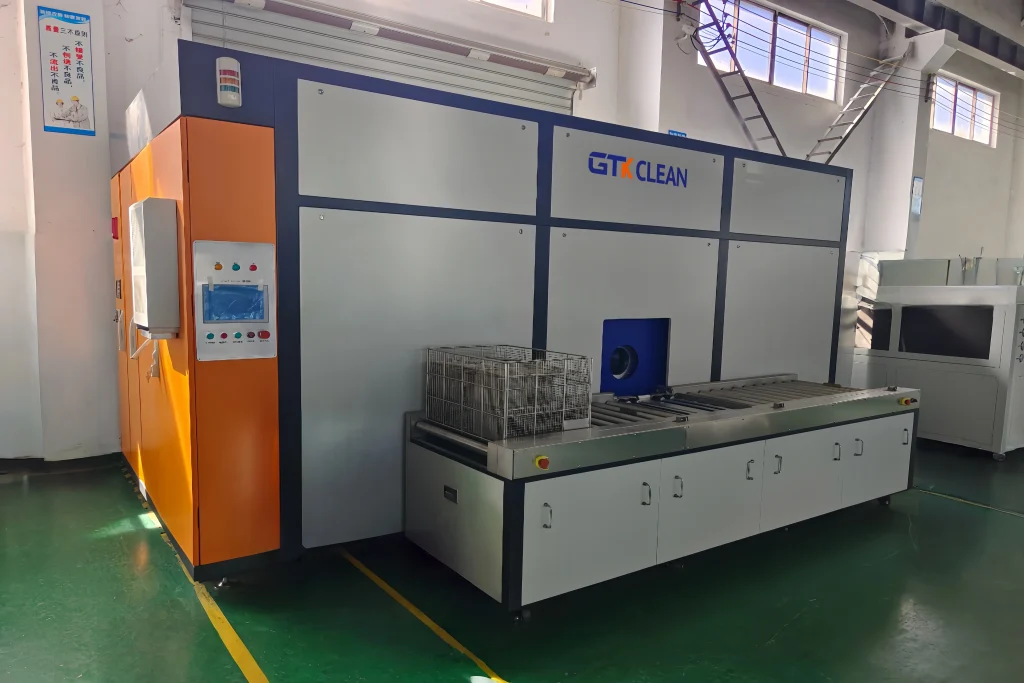
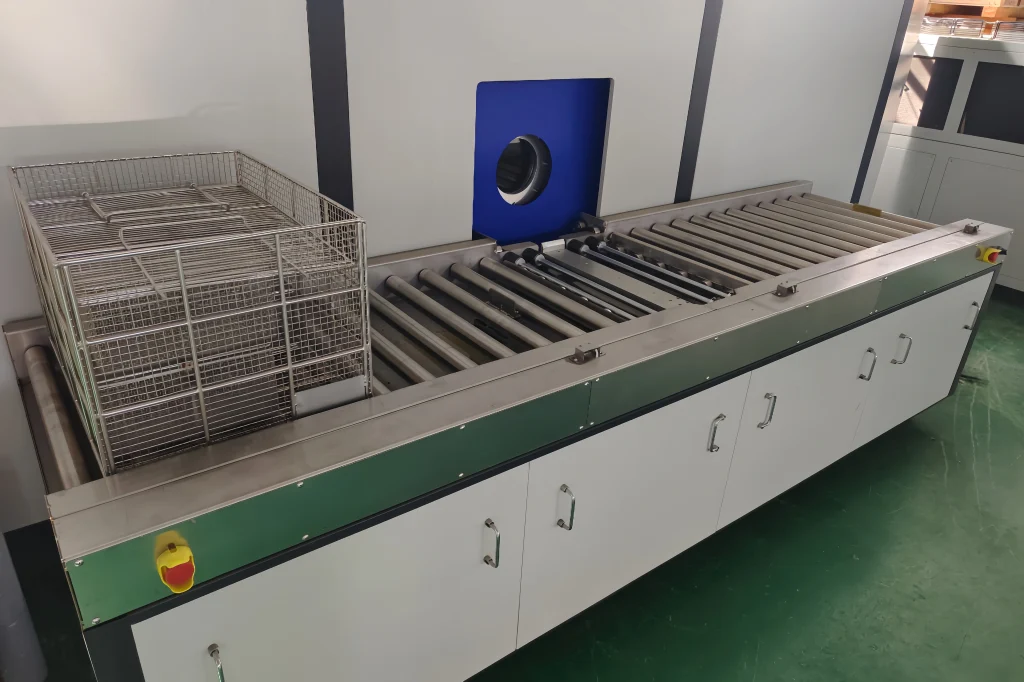
How Do Hydrocarbon Solvent Vacuum Cleaning Systems Work?
- Under vacuum conditions, hydrocarbons solvent serve as the cleaning medium, they can deeply penetrate and dissolve oil stains and impurities on the surface of workpieces during the cleaning process. For hardware parts, stamped parts, and die-cast parts with complex structures—due to their irregular shapes, blind holes, etc.—cleaning fluids cannot easily penetrate these areas under normal pressure.
- In a vacuum environment, air trapped in the blind holes and recesses of the workpiece is expelled. Coupled with the“cavitation effect“ generated by ultrasonic waves, it becomes easier to strip off grease, dust, wax, and other contaminants from the surface of the cleaning parts.
- In a vacuum environment, the boiling point of liquids is reduced; by utilizing the “Vacuum boiling effct,” the liquid in blind holes and recesses accelerates the rapid drying of the workpiece, thereby significantly enhancing the cleaning effect.
- Hydrocarbons solvent can be recovered through distillation using vacuum technology and recycled, achieving zero emissions, reducing cleaning costs, and making it one of the most advanced cleaning technologies available.
Why Precision Hardware Makers Choose Solvent (Hydrocarbon) Ultrasonic Cleaners?
- The reason is that cutting oil is added during cutting, drilling, and milling processes in hardware production, leaving substantial oil residue on the surface of hardware parts.
- Solvent (Hydrocarbon) cleaners, however, deliver the best and most efficient oil removal results. Crucially, hydrocarbon cleaning solvents can be regenerated, recycled, and reused indefinitely .
- Solvent (Hydrocarbon) cleaning washer are equipped with a distillation and regeneration function, eliminating the need for cleaning fluid discharge. This aligns perfectly with the demands of today’s eco-friendly cleaning practices.
- For the environmentally conscious hardware processing industry, this represents a significant advantage.
Equipment Cleaning Process Flow:
1st-Stage Hydrocarbon Spray & Rinse → Vacuum Ultrasonic Cleaning → Cleaning Fluid Draining → 2nd-Stage Hydrocarbon Spray Cleaning → Vacuum Ultrasonic Cleaning → Vapor Cleaning → Vacuum Drying → Unloading
Equipment Features
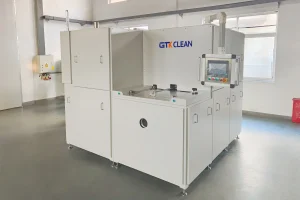
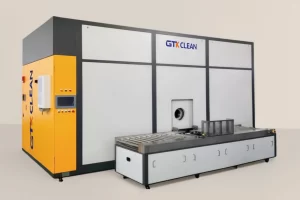
- This is an automatic single-station hydrocarbon ultrasonic cleaning machine.
- Realizes multi-stage cleaning, rinsing, vacuumvapor cleaning and drying functions within a single chamber.
- During ultrasonic cleaning and vacuum drying processes, the cleaning basket can be automatically set to either rotating or stationary mode.
- Adopts a multi-stage precision filtration system that meets nearly all cleanliness level requirements.
- Customizable dedicated cleaning baskets are available for parts of different shapes, with multiple cleaning processes provided for flexible selection.
- Compatible with hydrocarbon or modified alcoholfor cleaning, enabling flexible switching between the two.
- Utilizes an indirect steam heating system, which is more eco-friendly and efficient than traditional oil conduction heating, reducing power consumption.
- Equipped with a comprehensive vapor condensation system to reduce emissions; VOCs emissions fully comply with environmental protection standards.
- Built-in vacuum distillation system enables solvent regeneration and recycling.
- The human-machine interface (HMI) directly displays equipment status diagrams and operating parameters, supporting remote control functionality.
- Automatic cleaning process switching can be achieved with a barcode scanner (optional feature).
- Password settings with multiple equipment management authority levels effectively prevent human operational errors.
- Incorporates advanced safety design concepts, features low noise levels, and is designed for simplified operation and maintenance.
Equipment Technical Parameters:
| Parameter | Specification |
| Overall Dimensions | L4800 mm × W (2400+900) mm × H2500 mm |
| Cleaning Basket Dimensions | L670 mm × W480 mm × H400 mm |
| Cleaning Cycle | 12–15 min (for two cleaning processes); 8–9 min (for single cleaning process) |
| Installed Power | 75 kW (3-phase 5-wire, 380 V, 50 Hz) |
| Initial Solvent Loading Capacity | ≤ 1800 L |
| Cleaning Fluid Consumption | ≤ 200 L/month |
| Maximum Workpiece Loading Capacity per Batch | ≤ 200 kg |
If you haven’t yet explored the benefits of hydrocarbon ultrasonic cleaning technology, contact us today. We’ll provide you with a professional, sustainable cleaning solution.

 English
  German
  Spanish
  French
  Russian
  Portuguese