
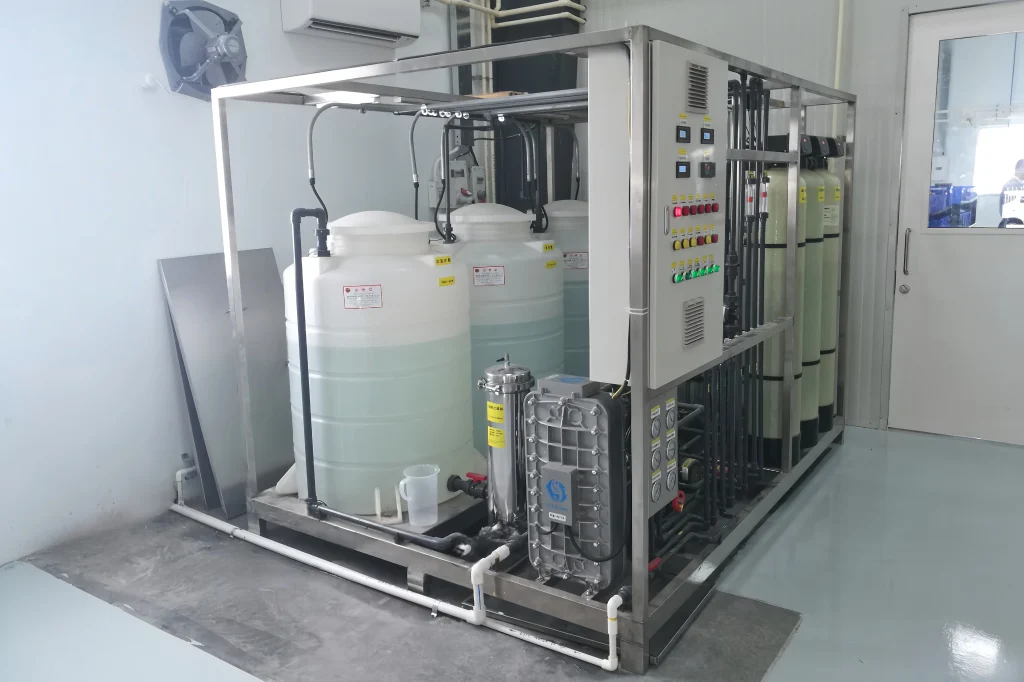
Pure Water Systems
Pure water systems are not just “support equipment”—they are foundational to maintaining product quality, regulatory compliance, and operational safety across industries. From protecting patient health in healthcare to enabling advanced electronics manufacturing, the demand for pure water equipment stems from its ability to eliminate impurities that would otherwise compromise performance, safety, or profitability.
Pure water systems, which remove impurities such as ions, microorganisms, suspended solids, and organic compounds through processes like reverse osmosis (RO), ultrafiltration (UF), and deionization (DI), are indispensable in numerous industries. The following sections outline key application sectors and explain why each relies on pure water equipment.
1. Pharmaceutical Industry
Pure water is a critical component in pharmaceutical manufacturing, with applications including:
Production of active pharmaceutical ingredients (APIs), where water acts as a solvent or reaction medium.
Preparation of drug formulations (e.g., injectables, oral liquids) and cleaning of manufacturing equipment (to prevent cross-contamination).
Compliance with global standards like Good Manufacturing Practice (GMP), which mandates strict water purity levels (e.g., Purified Water USP, Water for Injection USP).
Rationale: Impurities in water—such as heavy metals (lead, arsenic), bacteria, or endotoxins—can alter the chemical stability of drugs, reduce efficacy, or cause adverse health effects (e.g., infections, toxicity) in patients. Even trace contaminants may render medications non-compliant with regulatory requirements, leading to product recalls or legal penalties.
2. Electronics Industry
The electronics sector, particularly semiconductor and microchip manufacturing, depends on ultra-pure water (UPW) for:
Cleaning wafers (silicon substrates) during chip production, where even nanoscale particles or ions can damage delicate circuitry.
Rinsing photoresist materials and cooling precision equipment (e.g., etching machines).
Manufacturing printed circuit boards (PCBs) to prevent corrosion of conductive pathways.
Rationale: Modern semiconductors feature circuit lines as thin as 2–3 nanometers. A single micron-sized particle or stray ion (e.g., sodium, chloride) can cause short circuits, rendering chips non-functional. UPW (with resistivity ≥18.2 MΩ·cm at 25°C) eliminates these risks, ensuring high yields and reliable performance of electronic devices.
3. Food and Beverage Industry
Pure water systems are widely used in food and beverage production for:
Processing (e.g., brewing beer, making soft drinks, diluting concentrates) to maintain consistent flavor and product quality.
Cleaning and sanitizing equipment (e.g., tanks, pipelines) to meet food safety standards (e.g., FDA, EU Food Safety Authority).
Producing bottled water (e.g., mineral water, purified drinking water) by removing contaminants like chlorine, pesticides, or bacteria.
Rationale: Impurities in water directly impact product taste, shelf life, and safety. For example, high mineral content (e.g., calcium, magnesium) can make beer bitter or cause scaling in brewing equipment; microorganisms (e.g., E. coli, Salmonella) may lead to foodborne illnesses. Pure water ensures consistency across batches and reduces the risk of product spoilage or health crises.
4. Power Generation Industry
Power plants (especially thermal and nuclear facilities) use pure water for:
Feeding boilers that generate steam to drive turbines (steam cycle power generation).
Cooling generators and preventing corrosion in heat exchangers and pipelines.
Maintaining water quality in nuclear reactors (to avoid radiation contamination and equipment degradation).
Rationale: Tap water or untreated water contains minerals (e.g., calcium carbonate, magnesium sulfate) that precipitate as scale when heated. Scale buildup reduces heat transfer efficiency in boilers, increasing fuel consumption and energy costs. Additionally, dissolved oxygen and ions in water cause corrosion of metal components, shortening equipment lifespan and risking catastrophic failures (e.g., boiler tube leaks). Pure water minimizes scaling and corrosion, ensuring safe, efficient power production.
Benefits of Pure Water Equipment
Pure water equipment is engineered to transform raw or municipal water into purified or ultra-pure water, tailored to meet strict industry standards. Its design integrates cutting-edge technologies and user-centric features, delivering tangible benefits across manufacturing, pharmaceuticals, electronics, and more. Below is a breakdown of its core features and the advantages they provide.
Pure Water System Process Flow: Raw water (with conductivity ≤ 600 μS/cm and turbidity ≤ 5) enters the sand filter and carbon filter for filtration to remove suspended solids, colloids, organic substances, residual chlorine, and other impurities from the raw water. The filtered water then enters the precision filter for treatment, followed by the reverse osmosis (RO) main unit. Inside the RO main unit, most of the salts in the water are removed to achieve purification. Product water from the RO system is stored in the RO pure water tank before entering the secondary reverse osmosis system, and subsequently the EDI system for polishing mixed bed treatment.
System Process Flow Diagram:
Tap water → City water valve → Raw water tank →Raw water pump → Reducing agent dosing system → Quartz sand filter → Activated carbon filter → Scale inhibitor dosing system →Precision filter (5μm) → 1st stage high-pressure pump → 1st stage RO system → 1st stage RO water tank → 2nd stage high-pressure pump → 2nd stage RO system → 2nd stage high-pressure pump → 2nd stage RO water tank → EDI booster pump → TOC → EDI system → Polishing mixed bed → Terminal filter → Point of use
Pretreatment System
Water pretreatment refers to the preliminary treatment conducted in advance of water purification processes. Its purpose is to remove large quantities of impurities from natural water (such as sediment, clay, organic matter, microorganisms, and mechanical impurities), as the presence of these substances severely impacts the quality and effectiveness of purified water treatment.
After being processed by the pretreatment system, raw water meets the inlet water quality requirements for reverse osmosis membrane modules, thereby ensuring the safe and stable operation of the reverse osmosis system.
Components included in the pretreatment system are: quartz sand filters, activated carbon filters, softeners, raw water tanks, pipes, valves, and connectors, among others.
EDI System Instruction (Electrodeionization)
The EDI (Electrodeionization) system is a critical deep-purification unit in pure water equipment, designed to produce high-purity water by removing residual ions from pre-treated water (typically from reverse osmosis systems). Operating without chemical regenerants, it integrates ion-exchange resin with an electric field to achieve continuous deionization, making it ideal for industries requiring ultra-pure water (e.g., pharmaceuticals, electronics, and power generation).
Working Principle
The EDI module contains alternating cation-exchange and anion-exchange membranes, filled with ion-exchange resin beads. When an electric current is applied, cations (e.g., Na⁺, Ca²⁺) migrate toward the cathode through cation membranes, while anions (e.g., Cl⁻, SO₄²⁻) migrate toward the anode through anion membranes. These ions are flushed away via a concentrate stream, leaving purified water (freshwater stream) with extremely low conductivity. The electric field also regenerates the resin in-situ, eliminating the need for acid/alkali regeneration—ensuring chemical-free operation.
Key Components & Operation Requirements
Core Components: Ion-exchange membranes, mixed-bed resin, electrodes (anode/cathode), freshwater channels, concentrate channels, and a control panel.
Inlet Water Requirements: Must be pre-treated by RO (conductivity ≤ 50 μS/cm), with TOC ≤ 0.5 ppm, hardness ≤ 1 ppm, and free chlorine ≤ 0.05 ppm to prevent membrane fouling or resin degradation.
Operating Parameters: Typical freshwater flow rate: 50–2000 L/h (model-dependent); operating pressure: 0.2–0.4 MPa; current: 1–5 A (adjusted based on inlet water quality).
Maintenance & Safety
Regular Checks: Inspect membrane integrity monthly to prevent cross-contamination between streams; clean concentrate channels quarterly to remove scaling (using citric acid solution if needed).
Resin Care: Replace resin every 2–3 years (or as indicated by rising freshwater conductivity).
Safety: Ensure proper grounding of electrodes to avoid electric shock; shut down the system before maintenance.
Performance Output
Produces water with conductivity ≤ 0.1 μS/cm (equivalent to resistivity ≥ 10 MΩ·cm), meeting standards such as USP Purified Water (for pharmaceuticals) and SEMI F20 (for electronics manufacturing). Its continuous, chemical-free operation reduces labor and waste disposal costs, making it a sustainable choice for high-purity water needs.
Why Medical Industry Cleaners Require Pure Water Equipment
In the medical industry, pure water equipment is non-negotiable for cleaning machines, as it directly safeguards patient safety and equipment reliability.
Eliminate Contamination Risks: Tap water contains bacteria, endotoxins, and heavy metals. Residues from these impurities on surgical instruments or implantable devices could cause infections or adverse patient reactions. Pure water removes nearly all contaminants, ensuring no harmful leftovers post-cleaning.
Protect Precision Medical Tools: Devices like endoscopes or surgical lasers have delicate components. Mineral deposits from ordinary water can clog tiny channels or damage sensors, ruining equipment functionality. Pure water prevents such buildup, extending tool life.
Meet Strict Regulations: Standards like FDA or CE mandate “medically pure” cleaning for medical devices. Pure water equipment produces water that meets these criteria, ensuring compliance and avoiding regulatory violations.
In short, pure water turns medical cleaners into a critical line of defense for patient health and operational compliance.

 English
  German
  Spanish
  French
  Russian
  Portuguese