
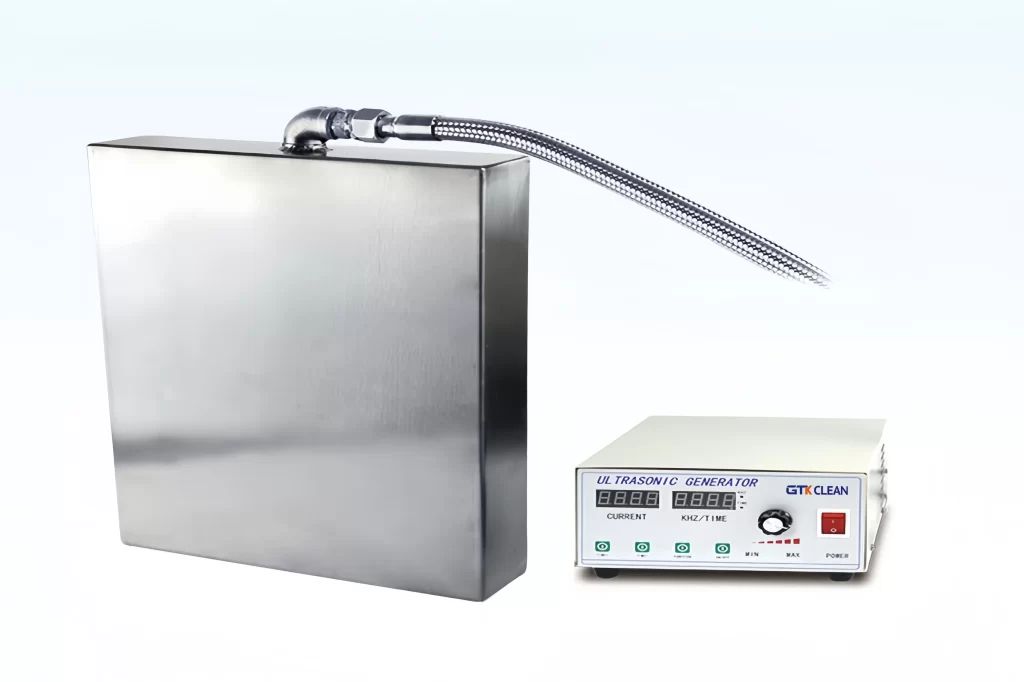
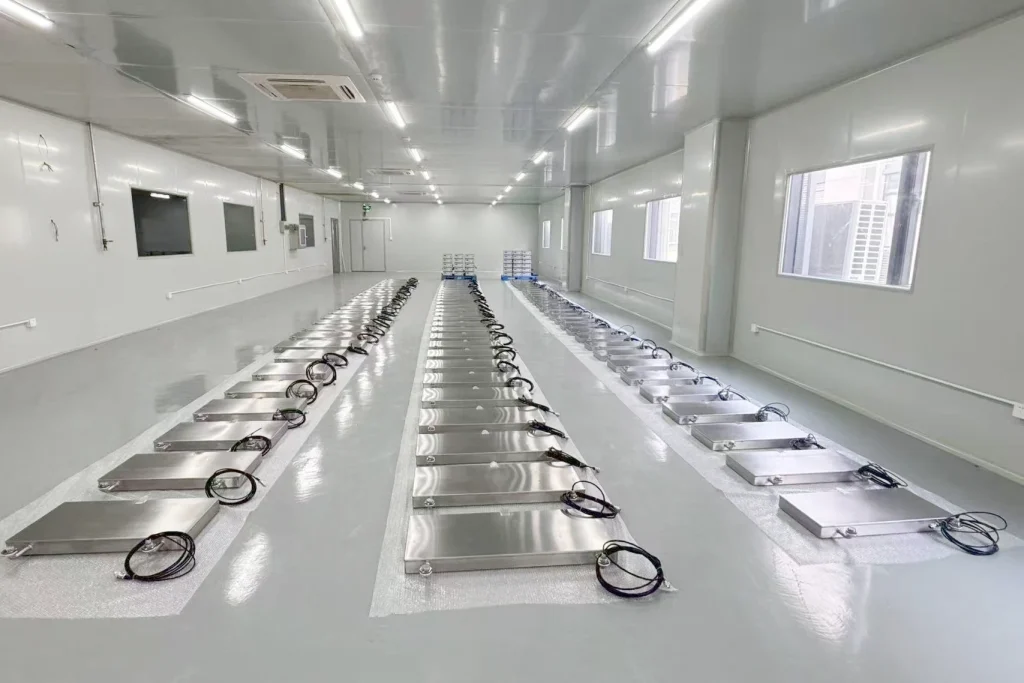
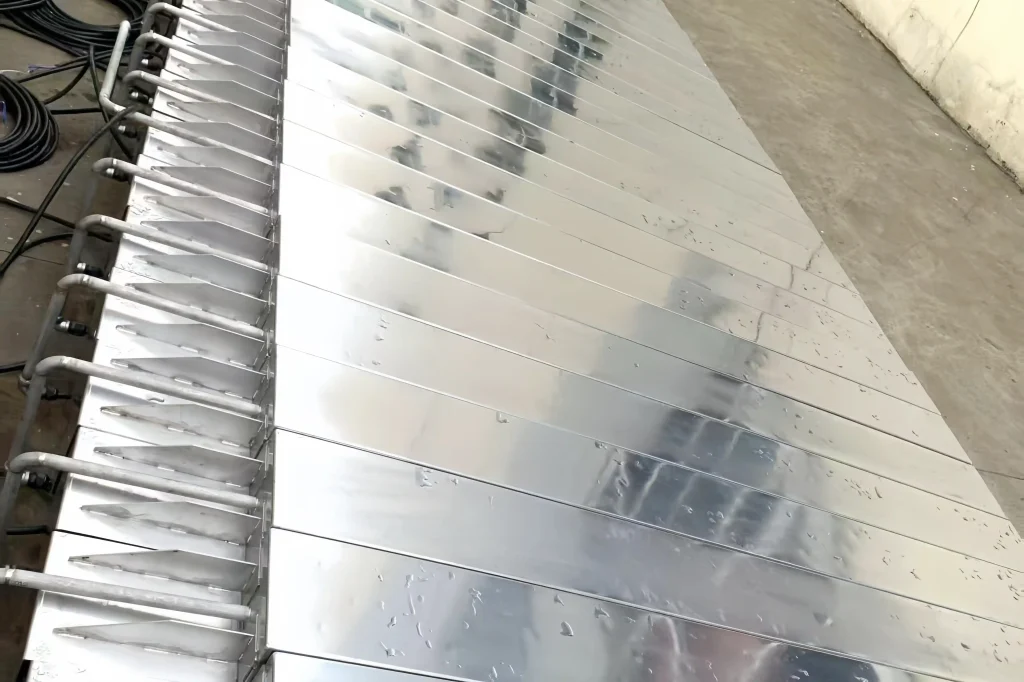
Ultrasonic Immersible Transducer (Plate–Style)
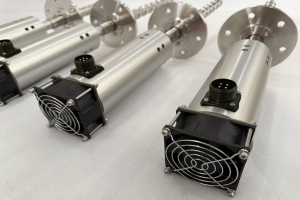
Our ultrasonic immersible transducer is most important component of industrial ultrasonic cleaning equipment. Its function is to convert the high-frequency electrical signals generated by an ultrasonic generator (power supply) into high-intensity mechanical vibrations (ultrasonic waves) of the same frequency, and transmit them to every corner of the cleaning tank through a liquid medium, thereby creating a powerful cleaning effect.
A complete ultrasonic immersible transducer normally consists of three main components:
(1) Ultrasonic Transducer
This device converts electrical energy into mechanical energy. Currently, the most commonly used is the piezoelectric ceramic transducer. When a high-frequency alternating current is applied to the piezoelectric ceramic, it generates rapid mechanical vibrations (at frequencies up to tens of thousands of times per second) in response to the current flow, thus converting electrical energy into mechanical energy. This rapidly vibrating mechanical energy is the source of ultrasonic waves.
Ultrasonic transducer operation process:
Piezoelectric ceramic energized → Vibrate → Produce ultrasound
(2)Substrate Installation
It is a stainless steel plate used to fix and mount multiple transducers. The transducers are firmly bonded to the substrate using a special adhesive (such as epoxy ).
The substrate must have excellent mechanical strength and corrosion resistance. At the same time, it should effectively transmit the vibrations generated by the transducers to the entire plate surface, forming a uniform vibration field.
(3)Waterproof Housing
It protects the internal transducers and electrical connections from corrosion by cleaning fluids. The housing is usually made of stainless steel and has excellent sealing performance.
Energy Transmission Process:
Power supply from the ultrasonic generator → Transducers convert electrical energy into mechanical vibrations → Mechanical energy is transmitted to the cleaning fluid.
How does an Immersible Ultrasonic Transducer work?
Its working principle is based on the “cavitation effect” in physics.
Vibration Generation: The ultrasonic transducer performs high-frequency vertical vibration through high-frequency electrical signals (usually at 20kHz, 28kHz, 40kHz, etc.). For example, 40kHz means 40,000 vibrations per second.
Pressure Wave Transmission: This vibration forms dense, alternating high-pressure and low-pressure regions in the cleaning fluid.
Cavitation Bubble Formation and Collapse:
- In low-pressure areas, a large number of tiny, invisible vacuum bubbles (cavitation bubbles) form within the liquid.
- Subsequently in high-pressure zones, these cavitation bubbles are rapidly compressed, collapsing and imploding.
Process Flows:
The implosion of cavitation bubbles generates extremely intense localized shock waves (pressure up to thousands of atmospheres) and high-velocity micro-jets (with speeds up to 400 km/h). These massive energy pulses continuously impact every micro-crack and blind hole on the workpiece surface, thereby:
- Stripping away dirt (such as oil stains, dust, polishing paste, and carbon deposits).
- Breaking down adherents.
- Achieving high-efficiency and thorough cleaning
Key Features and Advantages of Ultrasonic Immersible Transducer
- Capable of cleaning workpieces with complex structures, blind holes , and fine crevices that are difficult to handle manually cleaning methods.
- Uniform ultrasonic distribution throughout the cleaning tank ensures consistent cleaning results for every workpiece.
- Causes no physical damage to delicate workpieces such as precision parts, optical lenses, or electronic components.
- Typically reduces both the quantity and frequency of chemical cleaners used, minimizing environmental impact.
- Easily integrated into automated production lines for large-volume, continuous cleaning operations.
How to Choose an Ultrasonic Immersible Transducer
1. Frequency Selection
- Low frequency (20kHz-30kHz): Features high energy and strong cavitation intensity. It is suitable for cleaning large, sturdy workpieces with heavy oil stains and large-particle impurities, such as hardware parts and metal stamping parts.
- Medium to high frequency (40kHz-80kHz and above): The higher the frequency, the denser the cavitation bubbles, but the gentler their intensity and the lower the noise. It is suitable for cleaning precision, delicate workpieces like electronic components, optical lenses, and semiconductor wafers, effectively reducing minor cavitation-induced erosion on the workpiece surface.
2. Material and Sealing
Choose high-quality stainless steel (e.g., 304, 316) for the shell and substrate. Ensure good sealing to prevent liquid infiltration, which could cause short circuits or damage.
3. Power Density
Refers to the power per unit area of the vibrating plate (expressed in W/L or W/cm²). The heavier the dirt, the higher the required power density.
4. Installation Method
It can be installed on the side or the bottom of the cleaning tank. The latter is the most common option, as it enables more uniform ultrasonic distribution.
5. Maintenance
Avoid starting the transducer without cleaning fluid. Without heat dissipation and energy transfer, the transducer will be instantly damaged.
Regularly clean dirt deposited on the surface of the transducer to maintain its optimal working efficiency.
Main Application Fields
The applications of ultrasonic transducers are extremely extensive, covering almost all industrial and daily scenarios that demand high-quality cleaning:
Manufacturing Industry: Cleaning precision mechanical parts, metal stamping parts, oil pumps and nozzles, bearings, gears, cutting tools, etc.
Electronics Industry: Cleaning printed circuit boards (PCBs), silicon wafers, electronic components, wafers, connectors, etc.
Medical Industry: Cleaning surgical instruments, dental tools, laboratory utensils, pharmaceutical equipment, etc. (with extremely high hygiene requirements).
Optical Industry: Cleaning eyeglass lenses, camera lenses, optical lenses, optical fiber connectors, etc.
Jewelry & Watches: Cleaning gold and silver jewelry, watches, and delicate crafts to remove oil stains and oxides.
Automotive Industry: Cleaning carburetors, engine parts, fuel injectors, valves, battery plates, etc.
Laboratories: Cleaning glassware such as beakers, test tubes, volumetric flasks, etc.
Catering Industry: Commercial ultrasonic dishwashers, vegetable washers, etc.
For more details, please contact us – any size can be custom-manufactured with no additional design charge.

 English
  German
  Spanish
  French
  Russian
  Portuguese