
Picking the right ultrasonic cleaning system for your factory floor isn't something you rush. Get it wrong and you're looking at rework, bottlenecks, maybe even damaged parts. Get it right and the thing practically pays for itself. GTKCLEAN has spent over twenty years developing industrial cleaning technology, holding 28 technical patents along the way. That experience translates into systems built for real production environments, not lab conditions.
How Ultrasonic Cleaning Actually Works in Industrial Settings
Ultrasonic cleaning uses high-frequency sound waves to generate microscopic cavitation bubbles in liquid. When these bubbles collapse, they create tiny but powerful jets that blast contaminants off surfaces. Oils, greases, metal chips, and stubborn residues get stripped away, even from blind holes and tight crevices that would be impossible to reach otherwise.
Frequency matters more than most people realize. Lower frequencies around 20-28 kHz produce larger, more aggressive bubbles. These work well for heavy-duty cleaning on robust parts with serious contamination. Higher frequencies in the 40-80 kHz range create smaller, gentler bubbles. You want these for delicate components or when removing fine particulates without risking surface damage.
The transducers doing the heavy lifting are typically piezoelectric ceramics. They convert electrical energy into mechanical vibrations that drive the ultrasonic waves through the cleaning solution. GTKCLEAN's R&D team has focused heavily on maximizing cavitation efficiency, which directly impacts how clean your parts actually get.
What to Look For When Choosing Industrial Ultrasonic Equipment
Several factors determine whether a system will perform in your specific application.
Power requirements come first. Part size, material composition, and contamination severity all influence how much ultrasonic energy you need. Undersized systems struggle with heavy soils. Oversized systems waste energy and can damage sensitive components.
Tank dimensions need to match your production reality. Can the system accommodate your largest parts? Will it handle your daily throughput without becoming a bottleneck?
Material compatibility deserves careful attention. Both the cleaning solution and tank construction must work with your parts. Some alloys react poorly with certain chemistries. Some plastics degrade under specific conditions.
Automation level depends on your workflow. High-volume operations benefit from integrated systems that minimize manual handling. GTKCLEAN offers customizable designs with features like reinforced tanks and load-bearing baskets for heavy or oversized components.
Single-Frequency Versus Multi-Frequency Systems
Single-frequency cleaners operate at one fixed frequency. A 28 kHz unit handles robust parts with heavy contamination effectively. A 40 kHz unit serves general-purpose cleaning needs well.
Multi-frequency systems switch between or combine different frequencies. This flexibility lets you optimize cleaning for various contamination types and material sensitivities within one machine. When you're dealing with mixed production runs or complex cleaning challenges, multi-frequency capability often proves worth the investment. GTKCLEAN's patented solutions frequently incorporate this technology for exactly these situations.
Fitting Ultrasonic Cleaning Into Your Production Line
A cleaning system that doesn't integrate smoothly with your existing workflow creates problems. Manual transfer steps slow things down. Inconsistent handling leads to variable results.
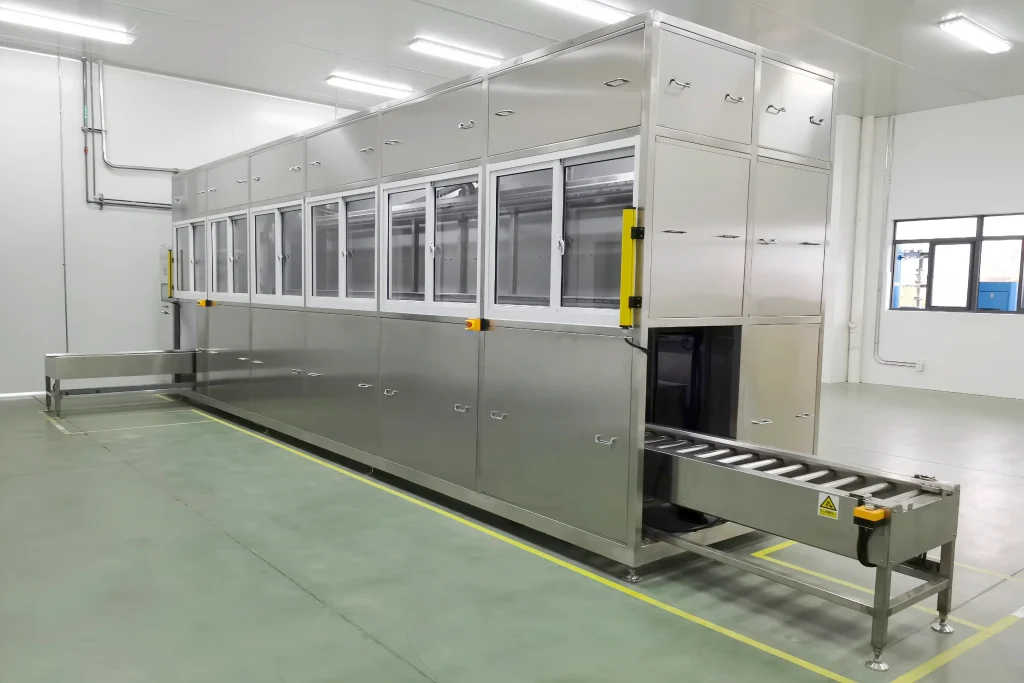
Automated solutions address these issues directly. CNC Aluminum Shell Inline Cleaners use continuous conveyor systems for multi-stage processing. Parts move through spray degreasing, rinsing, air-knife drying, hot air drying, and cooling without manual intervention.
Fastener Tunnel Cleaners handle screws, bolts, and nuts through automated inline sequences. The parts flow continuously through cleaning, rinsing, and drying stages.
These systems connect with existing conveyor infrastructure and production line equipment. Material keeps moving. Throughput stays high.
Sizing Your System Correctly
Getting the size and power right requires looking at several variables together.
Start with your production volume. How many parts per hour or per day? What are the physical dimensions of your largest components?
Factor in contamination characteristics. Heavy machining oils demand more aggressive cleaning than light dust. Baked-on residues need more energy than fresh contamination.
Consider part geometry. Intricate shapes with internal passages often need higher power density to ensure complete cleaning.
Think about cycle time requirements. Faster cycles require more power. Longer cycles can work with less.
GTKCLEAN's approach evaluates all these elements to recommend appropriate system capacity. That might mean a Benchtop Ultrasonic Cleaner for small batch work or a Heavy-Duty Automated Ultrasonic Cleaner capable of handling components up to 2000 kg.
Understanding the True Cost of Ownership
The purchase price tells only part of the story. Long-term operational costs determine actual ROI.
Energy consumption adds up over thousands of operating hours. Systems designed for efficiency reduce this burden.
Cleaning solution usage matters too. Circulation filtration extends fluid life and cuts waste. Pre PVD Coating Parts Ultrasonic Cleaners include ultrapure water systems and circulation filtration specifically to minimize water and detergent consumption.
Aqueous cleaning solutions often prove more cost-effective than solvent alternatives over time. They're also easier to handle from an environmental compliance standpoint.
Maintenance requirements affect downtime and labor costs. Durable components and intelligent control systems reduce both. GTKCLEAN designs with these considerations built in.
Meeting Safety and Environmental Requirements
Industrial cleaning operations face real regulatory scrutiny. Ignoring compliance creates liability and operational risk.
Safety features in well-designed systems include intelligent controls with automatic alarms and fault diagnostics. Hydrocarbon Solvent Ultrasonic Cleaning Systems incorporate temperature control, gas monitoring, and exhaust systems as standard.
Wastewater treatment requires attention. Overflow rinsing and circulation systems minimize discharge volumes. Some applications need dedicated treatment before wastewater can be released.
Proper handling protocols for cleaning agents protect workers and ensure regulatory compliance. GTKCLEAN provides guidance on these practices as part of system implementation.
Specific Safety and Environmental Considerations
Noise levels from ultrasonic equipment require management in some facilities. Chemical handling procedures must account for the specific solutions being used. Electrical safety standards apply to all industrial equipment.
Environmental regulations focus primarily on wastewater discharge limits and proper disposal of spent cleaning solutions. Aqueous systems generally face simpler compliance paths than solvent-based alternatives. Closed-loop designs and effective filtration reduce environmental impact and simplify regulatory compliance.
Work With GTKCLEAN
Better cleaning precision and smoother operations start with the right equipment choice. Suzhou Grintek Environmental Technology Co.,Ltd. brings two decades of focused R&D and 28 technical patents to industrial cleaning challenges. From ultrasonic systems to fully automated lines, we build solutions that fit real factory conditions. Reach out at [email protected] or +86 17768507147 for a consultation tailored to your specific requirements.
Common Questions About Industrial Ultrasonic Cleaning
How Does Cleaning Chemistry Affect System Performance
The cleaning solution you choose directly impacts results. Different formulations target specific contaminants. Aqueous agents and solvent alternatives each have their applications. Using the right chemistry enhances cavitation effectiveness and improves soil removal. Wrong chemistry reduces cleaning performance or damages parts.
What Maintenance Keeps These Systems Running
Regular transducer and tank inspections catch wear before it becomes failure. Filtration systems need periodic cleaning. Cleaning solutions require timely replacement. Electrical connections should be checked. Proper ventilation must be maintained. Following manufacturer guidelines extends equipment life and keeps performance consistent.
Can Systems Be Customized for Unusual Parts
GTKCLEAN specializes in custom configurations. Unusual geometries, challenging materials, and specific cleaning requirements all get addressed through tailored designs. Custom tank sizes, power configurations, and specialized Cleaning Baskets ensure thorough, safe cleaning for components that standard systems can't handle properly.
 English
  German
  Spanish
  French
  Russian
  Portuguese