

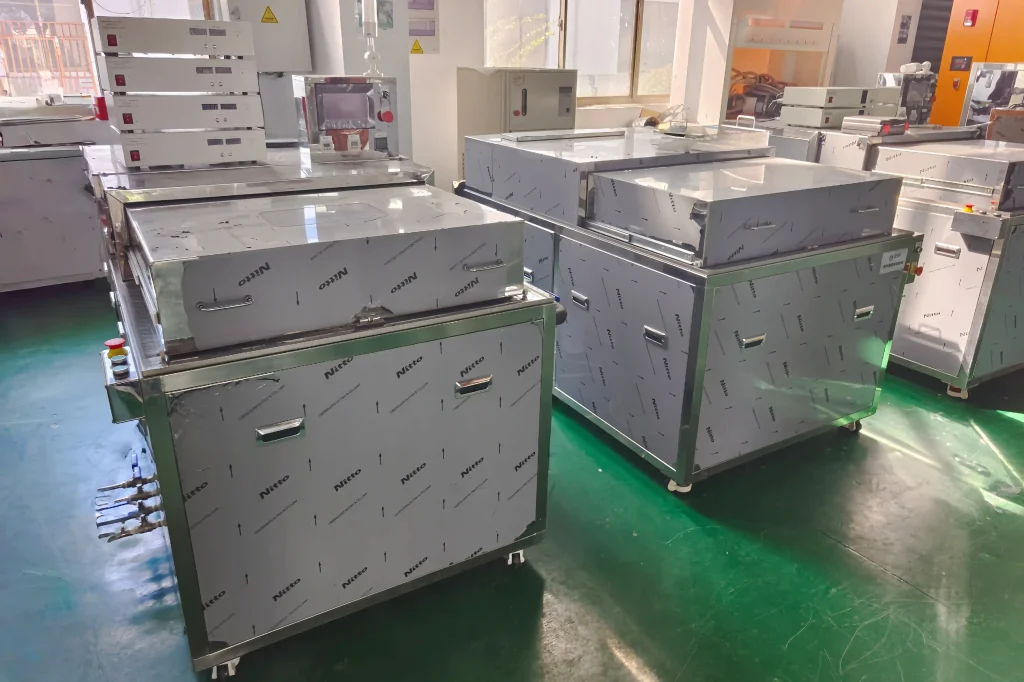
What should be noted for the daily care and maintenance of ultrasonic cleaning machines?
1. General Description
If the equipment is operated in damp environments, corrosive fumes, or dusty areas without following proper guidelines, it may develop faults in the transducers, ultrasonic circuits, and other components, affecting normal operation.
High-Q piezoelectric ceramic chips and heating elements are sensitive to moisture, conductive dust, and physical impact. Exposure can lead to degraded insulation, electric leakage, short circuits, component detachment, or ceramic cracking.Likewise, ultrasonic circuit boards exposed to moisture, corrosive gases, conductive dust, or unstable voltage may experience arcing, corroded pins, breakdown, or burnout of power components.
2. Operating Precautions
- Place the cleaning machine and ultrasonic generator in a dry, well ventilated area, perform regular maintenance, and keep the unit and surrounding floor clean.
- Ensure the power supply stays within 380/220 ±5 VAC; otherwise, electrical components may be damaged.
- Do not install the machine in damp or corrosive environments, as this may damage transducers and circuit boards.
- Never run the heater or ultrasonic function without cleaning liquid in the tank — this will damage heating elements and transducers.
- Avoid hard objects striking the tank bottom or transducers. Do not place parts directly on the tank floor, as this may cause transducers to detach.
- Prevent cleaning solution from overflowing. Do not spray water directly onto the machine, as moisture entering transducers, heaters, or circuit boards will cause malfunctions.
- Regularly clean the tank bottom and remove dirt from the machine body to keep the stainless steel housing clean and ensure stable long term performance.
- Replace dirty cleaning solution promptly and clean the tank. Buildup can corrode the tank bottom and cause leaks.
- If the machine will be idle for an extended period, drain all liquid, clean the unit thoroughly, and cover it with plastic film.
- During the warranty period, any damage caused by improper installation, corrosive environments, or misuse will be repaired at the user’s expense for materials only.
3. Maintenance & Care
- Regularly remove dirt and deposits to keep the body and tank clean and dry.
- Keep the surrounding area clean to ensure good drainage and avoid standing water.
- Periodically check the equipment grounding and insulation resistance of transducers (normal value ≥ 5 MΩ). If insulation is low, improve the environment and use drying methods.
- Maintain good ventilation to prevent steam and dust from entering the ultrasonic generator.
- Open the generator cover regularly and use compressed air to remove dust from the circuit board to extend service life.
4. Simple Troubleshooting
- Power switch does not turn on: Check if the main relay is faulty.
- Heating not working in a tank: Inspect the heating element for damage.
- No ultrasonic output: Check for damaged power components or shorted transducers.
- Weak ultrasonic output: Usually caused by moisture, dust contamination, or physical damage to transducers, leading to leakage, short circuits, cracks, or partial detachment.
- If the transducers or ultrasonic generator are damaged, stop operation immediately and contact our service team.
5. Transportation & Installation
- Handle with care during lifting and moving. Use the installed casements if available; avoid impacts or shocks.
- Install in a dry, ventilated area with moderate temperature and humidity. Place the machine level and allow at least 0.2 m clearance around it for ventilation and heat dissipation.
- Use a power supply matching the voltage and current rating shown in the technical specifications.
 English
  German
  Spanish
  French
  Russian
  Portuguese