
Selecting the Right Industrial Cleaning System Manufacturer
Getting the manufacturer choice wrong costs more than money. I've seen operations limp along with equipment that technically works but never quite fits the production rhythm, creating bottlenecks that compound over months. The decision shapes everything from daily throughput to how much your maintenance team dreads Monday mornings. What follows covers the evaluation criteria that actually matter when you're trying to separate capable partners from catalog-pushers.
What Your Operation Actually Needs From a Cleaning System
Starting with a clear picture of your cleaning requirements sounds obvious, but most evaluation processes skip this step or treat it superficially. The contaminants you're dealing with determine everything downstream. Oils behave differently than chips. Burrs require mechanical action that dust doesn't. And the cleanliness level you need isn't just a preference—it's often dictated by what happens next in your process.
Pre-PVD coating work illustrates this well. Those processes demand ultrapure water systems achieving conductivity at or below 0.06 μS/cm. Anything higher leaves water spots and secondary contamination that ruins the coating adhesion. That's not a nice-to-have specification; it's a hard requirement that eliminates most general-purpose equipment from consideration.
Material compatibility trips up more purchasing decisions than people admit. Aluminum reacts to certain cleaning agents in ways that steel doesn't. Delicate precision components with blind holes need entirely different handling than heavy castings. The geometry of your parts—whether they have narrow slits, deep recesses, or complex internal passages—shapes which cleaning technologies can actually reach the contamination. And throughput matters. A system that cleans beautifully but can't keep pace with your production line creates its own problems.
Process integration deserves more attention than it typically gets. The cleaning system has to fit physically into your facility, connect with your material handling approach, and match your automation level. Building a detailed requirements checklist before talking to any industrial cleaning system manufacturer saves considerable time and prevents the common mistake of being sold equipment that solves problems you don't have.
Why Manufacturer R&D Depth Shapes Equipment Performance
The difference between manufacturers with genuine R&D programs and those assembling commodity components shows up in equipment performance and longevity. Deep technical expertise translates into solutions that handle edge cases your operation will inevitably encounter. GTKCLEAN's 20+ years of R&D work and 28 technical patents reflect sustained investment in understanding how cleaning actually works at the process level, not just how to build tanks and pumps.
Proprietary technologies matter because cleaning challenges vary enormously. Ultrasonic cleaning systems use cavitation—the formation and collapse of microscopic bubbles—to reach contamination in places spray systems can't touch. Complex geometries with blind holes and narrow slits that would trap oils indefinitely get cleaned thoroughly when the ultrasonic parameters are tuned correctly. Solvent cleaning systems, particularly hydrocarbon-based designs, handle tough contaminants like stamping oil that water-based systems struggle with.
Automated cleaning equipment with rotary baskets solves a specific problem: ensuring 360° cleaning coverage while preventing parts from scratching or colliding during the process. This matters enormously for precision components where surface finish affects function. The customization capability of a manufacturer determines whether you get equipment sized and configured for your actual parts, production volumes, and cleanliness standards—or whether you're adapting your process to fit their standard offerings.
What Certifications Should an Industrial Cleaning System Manufacturer Possess?
ISO 9001 certification indicates systematic quality management, meaning the manufacturer has documented processes and actually follows them. CE marking confirms compliance with European safety and environmental requirements. Beyond these baseline certifications, industry-specific standards matter depending on your application. Environmental certifications demonstrate attention to regulatory compliance that affects your own operations. These credentials provide reasonable assurance about product reliability and operational safety, though they're starting points rather than guarantees.
Matching Equipment Types to Your Cleaning Challenges
A manufacturer's product portfolio reveals whether they can address your specific situation or will try to force-fit their standard offerings. GTKCLEAN's range spanning ultrasonic cleaning systems, solvent cleaning systems, conveyor belt cleaning systems, and water treatment systems reflects capability across different industrial cleaning applications. That breadth matters because cleaning challenges vary dramatically.
CNC machined parts typically carry cutting fluids, metal chips, and burrs that require multi-stage approaches. Automated systems combining high-pressure spray, ultrasonic degreasing, and DI water rinse handle this contamination mix effectively. Stamping parts present different challenges—oils, compounds, and anti-rust residues lodged in blind holes and tiny gaps that resist simple spray cleaning. Specialized ultrasonic systems reach these hidden areas.
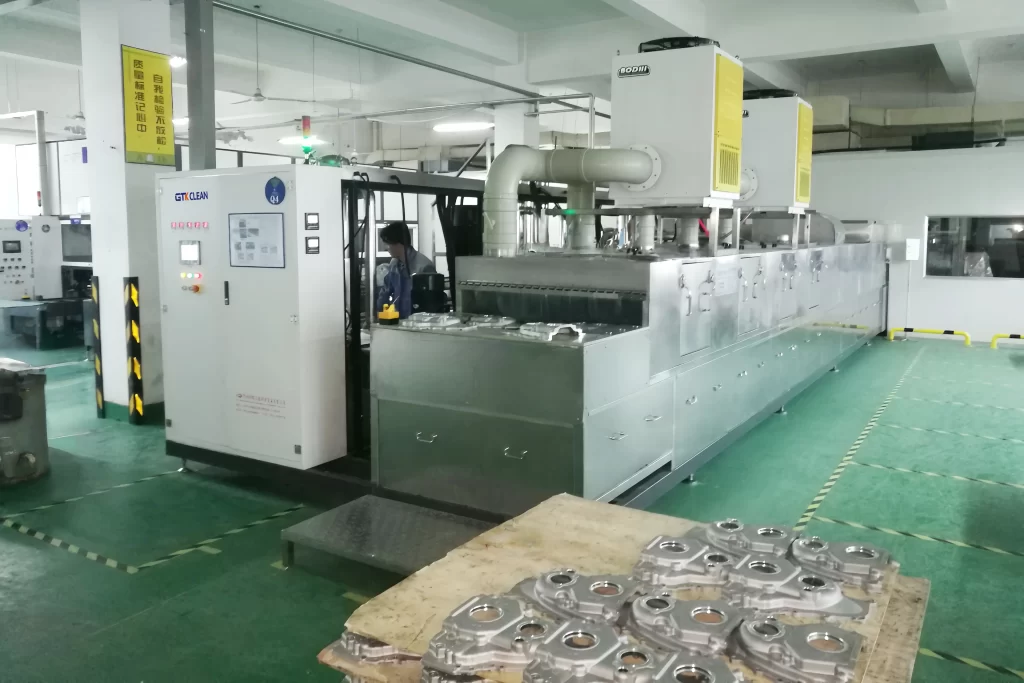
Scale changes the equipment requirements entirely. Heavy-duty automated ultrasonic cleaners handle large components weighing up to 2000 kg—engine blocks, gearboxes, large molds—where the cleaning system must accommodate both the physical weight and the thermal mass of the parts. Continuous production of smaller items like fasteners or aluminum shells calls for inline conveyor belt cleaning systems that maintain throughput without batch processing delays.
| System Type | Key Feature | Application Example |
|---|---|---|
| Ultrasonic Cleaners for CNC Machined Parts | Automated multi-stage cleaning, rotary baskets | Precision CNC components, aerospace parts |
| Heavy-Duty Automated Ultrasonic Cleaners | High-load engineering, customizable | Engine blocks, large molds, gearboxes |
| CNC Aluminum Shell Inline Cleaners | Continuous conveyor, multi-directional spray | Die-cast aluminum components for automotive |
| Fastener Tunnel Cleaners | Automated inline, oil-water separation | Screws, bolts, nuts in high-volume production |
| Multi-Tank Hydrocarbon Ultrasonic Cleaners | Rotary basket, vacuum ultrasonic, solvent recycling | New energy vehicle battery housings, stamped parts |
Support Infrastructure That Keeps Equipment Running
Global reach sounds like marketing language until you need a replacement part or technical support across time zones. An industrial cleaning system manufacturer serving clients in over 20 countries, as GTKCLEAN does, has necessarily built the logistics and support infrastructure to deliver parts and expertise regardless of location. That infrastructure directly affects your uptime when something goes wrong.
After-sales support quality varies enormously between manufacturers. The meaningful indicators include access to technicians who understand your specific equipment, training programs that build internal capability, and parts availability that doesn't require weeks of waiting. Remote diagnostics and software upgrade capabilities extend equipment life and improve performance without requiring on-site visits for every adjustment. A manufacturer's commitment to ongoing support reflects their confidence in the equipment and their interest in long-term customer relationships rather than one-time sales.
How Do I Assess the Long-Term Reliability of a Cleaning System?
Track record matters more than specifications. Seek out user testimonials and reference installations in applications similar to yours. Warranty coverage indicates manufacturer confidence—longer warranties with fewer exclusions suggest genuine belief in equipment durability. Component quality affects longevity directly; GTKCLEAN's use of high-quality stainless steel and reliable PLC components reflects attention to the parts that determine how long systems last. Ask about preventative maintenance schedules and what they actually involve.
Total Cost Calculations That Reveal True Value
Purchase price represents a fraction of what industrial cleaning equipment actually costs over its operational life. Energy consumption, cleaning agent usage, water consumption, and labor requirements accumulate into the total cost of ownership that determines whether the investment makes financial sense. Systems with circulation filtration and solvent recovery significantly reduce ongoing cleaning fluid expenses—savings that compound year after year.
Return on investment from cleaning equipment comes from multiple sources. Automated systems reduce labor requirements while improving consistency. Better cleaning quality means fewer defects reaching downstream processes and less rework. Energy efficiency features like integrated heat recovery reduce utility costs. The calculation requires honest assessment of current costs and realistic projections of improvement, but the analysis typically justifies investment in capable equipment over cheaper alternatives that cost more to operate.
Building Flexibility Into Equipment Decisions
Production requirements change. Materials evolve. Cleanliness standards tighten. Equipment purchased today needs to accommodate tomorrow's demands without complete replacement. Scalable cleaning systems with modular designs or clear upgrade paths provide that flexibility. The alternative—equipment that works perfectly for current needs but can't adapt—creates expensive replacement cycles.
Integration capability matters for future-proofing. Systems designed to accommodate various part sizes or with adjustable cleaning cycles adapt more readily to specification changes. GTKCLEAN's customizable designs handling deep holes, blind holes, and complex parts reflect engineering that anticipates variation rather than optimizing for a single configuration. Selecting a manufacturer that prioritizes adaptable design protects the investment against predictable uncertainty about future requirements.
What Is the Typical Lifespan of an Industrial Ultrasonic Cleaning System?
Quality industrial ultrasonic cleaning systems commonly operate for 10-20 years with appropriate maintenance. Construction materials, component quality, and usage intensity all influence actual lifespan. Stainless steel tanks resist corrosion that shortens equipment life. Reliable transducers and generators maintain cleaning performance over time. Regular maintenance following manufacturer recommendations, combined with responsive support when issues arise, extends equipment durability significantly beyond minimum expectations.
Frequently Asked Questions About Industrial Cleaning System Manufacturers
How Do I Ensure an Industrial Cleaning System Manufacturer Meets Environmental Regulations?
Verify compliance with applicable standards including EPA requirements, REACH regulations, and RoHS directives depending on your markets and materials. Manufacturers prioritizing environmental performance offer eco-friendly cleaning agents, closed-loop solvent systems that minimize emissions, and water treatment solutions that enable discharge compliance or water recycling. GTKCLEAN openly shares environmental certifications and demonstrates sustainable practices in equipment design. Request documentation rather than accepting verbal assurances.
What Are the Advantages of Choosing a Manufacturer With Extensive R&D in Industrial Cleaning?
Manufacturers with substantial R&D investment, like GTKCLEAN with over 20 years of development work and 28 technical patents, deliver equipment reflecting deep understanding of cleaning processes. This translates into superior cleaning performance, greater efficiency, and genuine customization capability for specific applications. R&D-driven manufacturers also design equipment anticipating future cleanliness requirements rather than merely meeting current standards. Access to cutting-edge technologies in Ultrasonic Cleaning Systems and solvent cleaning provides competitive advantages in quality and cost.
Can Industrial Cleaning System Manufacturers Provide Customized Solutions for Unique Production Lines?
Leading industrial cleaning system manufacturers specialize in customized solutions rather than forcing standard equipment into non-standard applications. GTKCLEAN leverages engineering expertise across their product range—Ultrasonic Parts Cleaners, solvent systems, Conveyor Belt Ultrasonic Cleaning machine, and water treatment systems—to design equipment matching specific requirements. This tailored approach ensures optimal integration with existing processes, addresses particular part geometries, and meets precise cleanliness standards. The result is maximized efficiency and performance for your specific industrial cleaning needs.
Optimize Your Industrial Cleaning With GTKCLEAN
Ready to optimize your industrial cleaning processes with a globally recognized leader? GTKCLEAN combines 20+ years of R&D expertise and 28 technical patents to deliver superior, customized cleaning solutions, from ultrasonic to solvent and water treatment systems. Contact us today at [email protected] or +86 17768507147 for a consultation tailored to your specific industrial cleaning challenges and discover how our innovative equipment can elevate your operational efficiency and cleanliness standards.
 English
  German
  Spanish
  French
  Russian
  Portuguese