

How Are Industrial Ultrasonic Cleaners Priced?
Overview
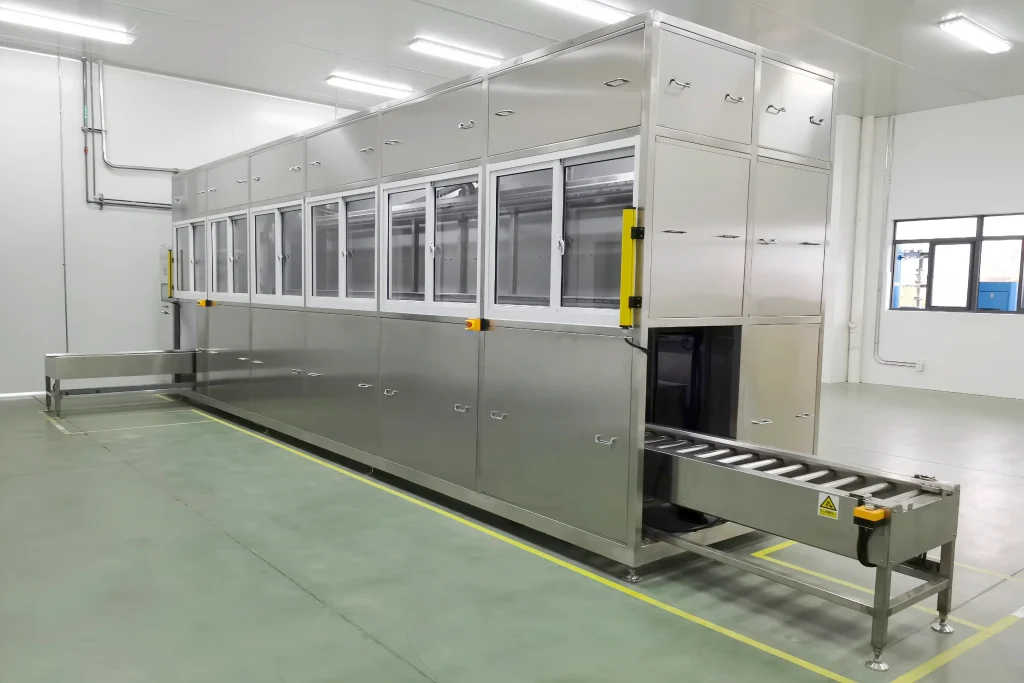
First, let’s clarify what an industrial ultrasonic cleaning machine is. It is a high-tech industrial cleaning system that offers much higher efficiency and speed than traditional cleaning methods, without damaging parts during the process.
Common frequencies for industrial ultrasonic cleaners are 25 kHz, 28 kHz, and 40 kHz, with power selected based on the parts being cleaned and production volume. These machines are generally larger, designed for high-volume industrial production. They often involve specialized cleaning processes, so requirements are stricter. Most feature stainless steel tanks, high-Q transducers, and a separate control panel for adjustable temperature and timer settings.
Types
Industrial ultrasonic cleaners are typically categorized as:
- Benchtop / small ultrasonic cleaners
- Single-tank ultrasonic cleaners
- Multi-tank ultrasonic cleaners
Small and single-tank models usually come in standard sizes with reference prices available.Multi-tank systems, however, are difficult to price generally, as costs vary significantly depending on materials, process design, and configuration.
Reference Price
We can only provide a price list for our company’s standard ultrasonic cleaners for reference.
Key Features
Thorough, Non-Damaging CleaningUltrasonic energy acts throughout the cleaning liquid, so any part exposed to the solution is cleaned effectively. Complex geometries, gaps, and hidden surfaces are cleaned uniformly, with no blind spots.
Reduced Labor IntensityThe high-efficiency cleaning action eliminates heavy manual scrubbing. This improves cleaning quality while creating a cleaner, safer, and more organized workplace for operators.
Eco-Friendly OperationUltrasonic cleaning reduces chemical consumption and environmental impact, lowering exposure to toxic solvents. Many industrial models include a high-efficiency circulation and filtration system that allows cleaning solution to be reused, saving water and chemicals, cutting operational costs, and supporting environmental compliance.
Flexible, Multi-Purpose ProcessingBy using different cleaning chemistries, the system can perform a wide range of processes:degreasing, derusting, dust removal, de-waxing, chip removal, phosphating, passivation, and more.
The introduction of ultrasonic cleaning has greatly reduced reliance on manual labor. Today, various models are used across industries, most notably household and industrial ultrasonic cleaners.
The main differences between household and industrial units include:
- Cleaning application and part size
- Physical machine size
- Internal components and construction
- Ease of operation
- Cleaning efficiency and overall cost
These differences are significant, so buyers can easily distinguish between the two based on their intended use.
 English
  German
  Spanish
  French
  Russian
  Portuguese