

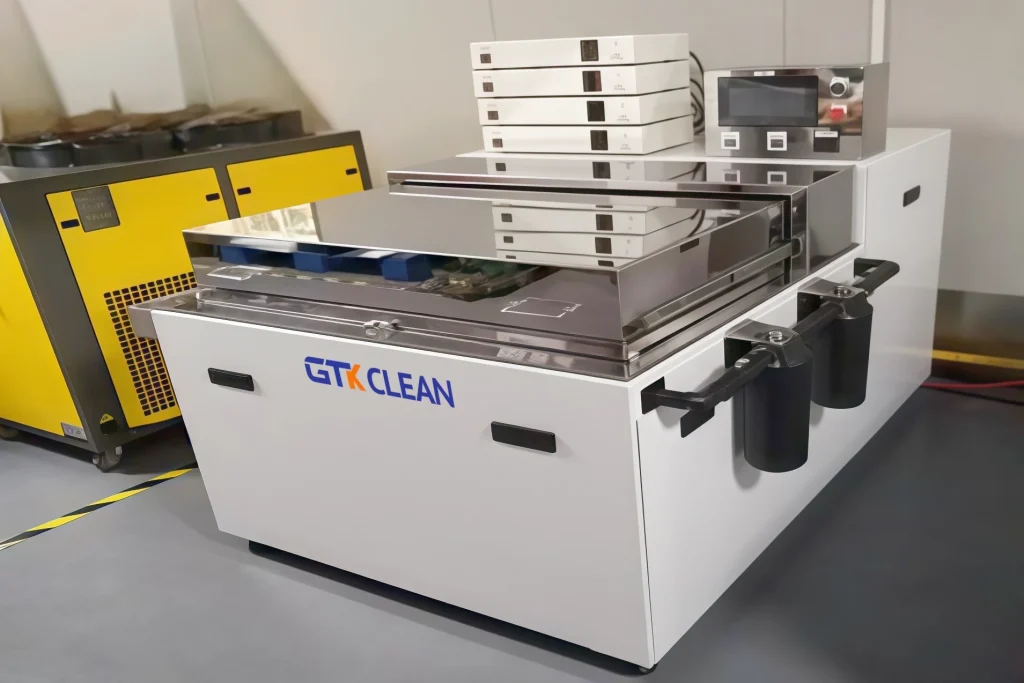
How Does Ultrasonic Deburring Work?
Burrs are inevitably generated to varying degrees during the manufacturing of and non-metallic parts. These burrs negatively impact the inspection, assembly, functional performance and service life of aerospace components.
There are many deburring methods, generally classified into four categories:
Coarse Deburring (Hard Contact)
Includes cutting, grinding, filing and scraping.
Standard Deburring (Soft Contact)
Includes belt sanding, lapping, elastic wheel grinding and polishing.
Precision Deburring (Flexible Contact)
Includes high-pressure flushing, electrochemical machining, electrolytic grinding and barrel finishing.
Ultra-Precision Deburring (High-precision Contact)
Includes abrasive flow deburring, magnetic grinding deburring, electrolytic deburring, thermal energy deburring, and high-power ultrasonic deburring.These processes deliver high dimensional accuracy and surface finish for precision parts.
When ultrasonic energy acts on liquid, it creates microscopic vacuum cavities during the rarefaction cycle of sound wave vibration.As these tiny cavities collapse instantly, they generate extreme instantaneous pressure of hundreds of atmospheres — a physical phenomenon known as cavitation.
Ultrasonic deburring removes micro burrs from component surfaces by utilizing the intense impact force produced by cavitation collapse.
Ultrasonic deburring is not suitable for all types of burrs. It is ideal mainly for microscopic burrs that can only be seen under a microscope.For visible burrs to the naked eye, ultrasonic treatment works only when the burr adhesion is weak.Burrs that require cutting or tool trimming cannot be removed by ultrasonic methods.
Industrial Applications of Ultrasonic Cleaning
Ultrasonic cleaning is widely used in applications with strict cleanliness requirements:precision machining intermediate cleaning, pre-assembly cleaning, and complex-shaped parts with holes such as porous holes, deep holes, curved holes, blind holes and micro holes. It also works excellently on medium and small parts with stubborn bonded contaminants.
Besides removing surface oil and grease, ultrasonic cleaning effectively cleans residual lapping compound, polishing paste and similar paste-like contaminants.It also removes light surface rust and oxide layers.
With specially formulated cleaning solution, ultrasonic cleaning achieves outstanding results on carbon deposit removal, with proven mature application experience.
In locomotive manufacturing and maintenance, ultrasonic cleaning is commonly adopted for small and medium precision parts:cylinder heads, rolling bearings, gears, valve components, pump parts, filter elements, short shafts, fuel pump plunger assemblies, injector needle valves and delivery valve assemblies.
Overseas manufacturers use high-power ultrasonic cleaning systems for diesel engine blocks and large locomotive components.Some domestic diesel engine repair factories have also adopted high-power ultrasonic cleaners for engine block maintenance (cylinder bore 150~230 mm), achieving perfect cleaning results.
Advantages of Ultrasonic Cleaning
- Simple process and easy operation.
- Low labor intensity and superior cleaning quality.
- High cleaning efficiency.
- Easy to automate batch part cleaning, making it a high-potential industrial cleaning technology.
We appreciate your trust and support. We’re ready to communicate openly and partner with you on all your equipment needs.You may contact us by email ([email protected]) or WhatsApp (+86 17768507147) for custom ultrasonic cleaning solutions.
Ultrasonic Cleaner Q&A
Q: What are the common deburring methods?
A: Manual deburring, chemical deburring, electrolytic deburring, ultrasonic deburring, high-pressure water jet deburring, thermal deburring, cryogenic deflashing, and magnetic deburring.
Q: Which deburring technology protects parts without surface damage?
A: Ultrasonic deburring is the ideal choice.
Q: What methods remove burrs on screw threads?
A: Sandblasting, vibratory finishing, magnetic grinding, and ultrasonic deburring.
Q: How does ultrasonic deburring work?
A: Ultrasonic cavitation generates instantaneous pressure up to hundreds of atmospheres, stripping micro burrs away from component surfaces.
Q: What other names are there for ultrasonic transducers?
A: They are generally called ultrasonic transducers or ultrasonic vibration plates.
Q: Where can ultrasonic transducers be installed?
A: Ultrasonic transducers can be mounted on any flat, solid metal surface.
 English
  German
  Spanish
  French
  Russian
  Portuguese