

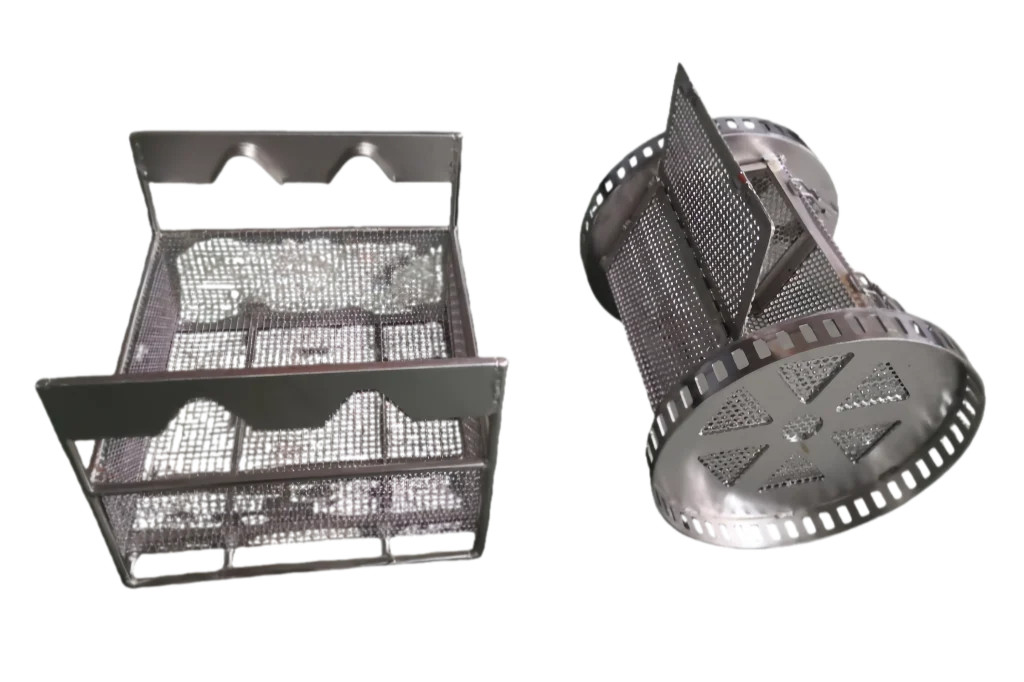
Industrial cleaning gets complicated fast. The baskets holding parts during cleaning cycles seem like simple containers, but they determine whether a process actually works or just moves contamination around. After two decades developing cleaning systems and accumulating 28 technical patents, GTKCLEAN has learned that basket design separates adequate results from genuinely clean parts. The material, the mesh geometry, the way parts sit during agitation—these details compound into either consistent performance or frustrating variability.
Material Choice Shapes Basket Performance and Lifespan
Picking the right material for industrial cleaning baskets matters more than most operators initially expect. The wrong choice leads to premature failure, contamination transfer, or chemical reactions that damage the very parts you're trying to clean. Material science drives these decisions, and understanding the tradeoffs prevents expensive mistakes.
Cleaning environments vary dramatically, and each demands specific material properties.
Stainless Steel remains the workhorse option. Its corrosion resistance handles most water-based cleaning solutions and many solvents without degrading. High-temperature processes don't faze it. SUS304 works for general applications, while SUS316 handles more aggressive chemistry. The material tolerates ultrasonic cavitation forces without structural fatigue, making it reliable for repeated cycles.
Titanium steps in when stainless steel can't survive. Strong acids, concentrated alkalis, and extreme temperatures push beyond what even 316 stainless can handle. Titanium costs more, but in highly corrosive environments, it outlasts alternatives by years. High-temperature ultrasonic cleaning processes particularly benefit from titanium's stability.
Engineered Polymers solve different problems entirely. PP, PVDF, and PTFE offer chemical resistance profiles that metals can't match against specific aggressive compounds. They weigh less, which matters for manual handling and robotic systems with payload limits. Delicate parts that scratch easily benefit from polymer contact surfaces. PTFE adds non-stick properties that help with viscous residues or harsh chemical baths where metal contamination would ruin the cleaned parts.
Chemical resistance, temperature limits, and mechanical strength all factor into selection. Baskets in ultrasonic systems face cavitation forces that stress welds and joints. Solvent cleaning demands materials that won't react with or absorb the cleaning agents. Getting this wrong means replacing baskets frequently or, worse, introducing contamination into precision cleaning processes.
| Material | Key Properties | Typical Applications |
|---|---|---|
| Stainless Steel | Durable, heat & corrosion-resistant | General water/solvent cleaning, high-temp processes |
| Titanium | Superior corrosion resistance, high strength | Highly corrosive acids/alkalis, high-temp ultrasonic |
| Engineered Polymers | Lightweight, chemical-resistant, scratch-safe | Delicate parts, specific chemical baths |
| PTFE (Teflon) | Exceptional chemical resistance, non-stick | Viscous or harsh chemical cleaning, delicate components |
What are the best materials for industrial cleaning baskets?
The best material depends entirely on what you're cleaning and how. Stainless steel (SUS304 or SUS316) handles most ultrasonic cleaning applications well because it resists cavitation damage and tolerates common cleaning chemistries. Solvent cleaning often requires titanium or engineered polymers like PP, PVDF, or PTFE because these materials resist chemical attack that would degrade steel. Acidic or alkaline solutions push the decision toward titanium or specific plastics that outperform stainless in those environments. There's no universal answer—the cleaning process dictates the material.
Basket Geometry Determines Whether Parts Actually Get Clean
Material selection gets you started. Design determines whether the basket actually works. A poorly designed basket blocks cleaning media from reaching surfaces, allows parts to collide during agitation, or traps contaminants instead of releasing them. Good design anticipates how fluid moves, how parts behave under vibration, and how the basket integrates into the larger system.
Several design elements demand attention.
Part Fixturing prevents the chaos that happens when loose parts move during cleaning cycles. Ultrasonic agitation and spray cleaning generate forces that throw parts around. Without secure positioning, components collide, scratch each other, and shadow surfaces from cleaning action. Delicate parts require especially careful fixturing to survive the process intact.
Mesh Size and Opening Geometry balance competing needs. The openings must allow cleaning fluid and ultrasonic energy to pass through freely. Too small, and you block the very forces doing the cleaning work. Too large, and small parts escape or fall through. The mesh pattern also affects how evenly cleaning action distributes across the basket's contents.
Drainage Optimization affects what happens after cleaning. Baskets that trap fluid carry contaminated solution into rinse stages or drying operations. Poor drainage extends cycle times and increases chemical carryover between process steps. Designs that shed liquid quickly improve throughput and reduce cross-contamination.
Flow-Through Structures ensure cleaning media reaches all surfaces. Closed or partially blocked designs create dead zones where contamination persists. Open basket architectures promote uniform fluid circulation during immersion cleaning and allow spray patterns to penetrate during spray cleaning stages.
Compartmentalization protects parts from each other when batch cleaning multiple components. Individual cells prevent contact between parts, ensuring consistent cleaning quality across the entire load. This matters especially for precision components where surface damage creates rejects.
These design choices directly affect cleanliness outcomes, rework rates, and component lifespan. Systems like Heavy-Duty Automated Ultrasonic Cleaners and Rotary Basket Ultrasonic Cleaning Systems depend on properly designed baskets to deliver their intended performance.
How does basket design impact cleaning efficiency?
Basket design controls how thoroughly cleaning agents and ultrasonic energy contact part surfaces. Open structures with appropriate mesh sizing allow cavitation bubbles and fluid flow to reach blind holes, internal cavities, and tight geometries. Proper fixturing eliminates shadowing where one part blocks another from cleaning action. Parts stay positioned for uniform exposure throughout the cycle. These factors combine to reduce cycle times, improve first-pass cleanliness rates, and increase throughput. Poor basket design forces longer cycles, multiple passes, or manual rework to achieve acceptable results.
Automated Systems Demand Baskets Engineered for Integration
Automation changes what baskets must accomplish. Manual handling forgives design compromises that automated systems expose immediately. Robots need precise grip points. Conveyors require stable transport characteristics. Transfer mechanisms demand predictable basket behavior. Industrial cleaning baskets for automated lines must function as precision components, not just containers.
Robotic Handling imposes strict requirements on basket dimensions, weight distribution, and gripping features. Robots grab baskets at defined points and expect consistent engagement every cycle. Variations in basket geometry cause mishandling, dropped loads, or system faults. Weight must fall within manipulator payload limits while maximizing part capacity.
Conveyor System Compatibility matters for continuous processing lines. Baskets must track properly through cleaning stages without wandering or jamming. Base geometry affects stability during transport. Engagement features ensure proper positioning at each station.
Secure Locking Mechanisms prevent disasters during transfer and agitation. Parts dislodging mid-cycle contaminate cleaning baths, damage equipment, or create safety hazards. Closures must withstand the forces generated during ultrasonic cleaning and mechanical agitation while remaining easy to operate during loading and unloading.
Draining and Drying Features become critical in automated sequences. Baskets move directly from cleaning to rinsing to drying without manual intervention. Designs that trap fluid create water spots, leave solvent residues, or extend drying times that bottleneck the entire line. Effective drainage and airflow paths keep automated systems moving at designed throughput rates.
Structural Durability sustains performance over thousands of cycles. Automated systems run continuously, subjecting baskets to repetitive mechanical stress. Baskets must resist deformation, maintain dimensional accuracy, and preserve their functional features despite constant use.
Industrial cleaning baskets optimized for automation enhance reliability across systems including Ultrasonic Cleaning machines for CNC Machined Parts and Tunnel Cleaning Systems.
Why is custom basket design crucial for complex parts?
Complex parts present challenges that standard baskets can't address. Intricate geometries need fixturing that positions surfaces for cleaning access while protecting fragile features from damage. Delicate components require contact surfaces that won't scratch or mar. Internal cavities and blind holes demand basket designs that promote fluid flow into these difficult-to-reach areas. Medical device cleaning baskets and aerospace component cleaning applications particularly benefit from custom designs that ensure consistent, validated results. Generic baskets compromise either cleaning effectiveness or part protection—custom designs optimize both.
Maintenance Practices Extend Basket Service Life
Industrial cleaning baskets represent significant investment, especially custom designs for specialized applications. Proper maintenance extends their useful life and maintains cleaning performance over time. Neglected baskets degrade gradually, introducing variability into processes that seemed stable.
Regular Inspection catches problems before they cause failures. Look for cracks at weld joints, deformation from overloading, corrosion spots indicating material breakdown, and wear at contact points. Weekly visual checks during routine maintenance prevent minor issues from becoming basket replacements.
Thorough Cleaning removes accumulated residues that compromise basket function. Cleaning agents leave deposits. Contaminants from parts build up on mesh surfaces. These accumulations can transfer to subsequent loads or interfere with drainage. Periodic cleaning of the baskets themselves maintains their effectiveness.
Proper Storage prevents damage between uses. Dry, ventilated storage areas prevent corrosion on metal baskets and degradation of polymer materials. Stacking methods matter—improper stacking deforms baskets or damages fixturing features. Dedicated storage racks protect investment in custom designs.
Load Capacity Limits exist for good reasons. Overloading stresses basket structures beyond design limits. Welds crack. Frames deform. Mesh stretches. Respecting weight limits preserves basket geometry and extends service life.
Chemical Compatibility Monitoring addresses process changes over time. Cleaning chemistries evolve as requirements change. New cleaning agents may attack basket materials that worked fine with previous formulations. Verify compatibility whenever process chemistry changes.
Following these protocols keeps cleaning baskets performing effectively throughout their intended service life.
GTKCLEAN Brings Two Decades of Cleaning System Expertise
GTKCLEAN has built industrial cleaning equipment for customers ranging from small manufacturers to Fortune 500 corporations across more than 20 countries. That experience, combined with 28 technical patents and continuous R&D investment, informs every aspect of our cleaning system designs. We develop complete automated cleaning equipment including ultrasonic systems, solvent cleaning systems, and conveyor-based lines.
Cleaning baskets integrate into these systems as engineered components, not afterthoughts. Whether the application calls for Rotary Basket Ultrasonic Cleaning Systems handling complex part geometries or robust baskets for Heavy-Duty Automated Ultrasonic Cleaning Systems processing high volumes, our designs prioritize the factors that determine real-world performance. Material selection, fixturing geometry, drainage characteristics, and automation compatibility all receive engineering attention proportional to their impact on cleaning results.
Optimal cleaning performance emerges from systems where every component works together. The basket's role in that system deserves the same engineering rigor applied to ultrasonic generators, solvent recovery systems, and automation controls.
Work with GTKCLEAN on Your Cleaning Challenges
Industrial cleaning basket design affects cleaning performance, part integrity, and operational efficiency in ways that become obvious only when something goes wrong. Material selection, geometry optimization, and automation integration all contribute to whether a cleaning process delivers consistent results or frustrating variability. GTKCLEAN's experience and patented technologies address these challenges with solutions engineered for demanding industrial applications.
FAQ
What factors determine the ideal material for a cleaning basket?
Several factors interact to determine the right material. The cleaning solution chemistry—whether acidic, alkaline, or solvent-based—eliminates materials that would react or degrade. Operating temperature narrows options further, as some materials lose strength or become brittle at process temperatures. Mechanical stress from ultrasonic cavitation or agitation requires materials with adequate fatigue resistance. Part sensitivity may demand soft contact surfaces that won't scratch. Stainless steel grades handle general applications. Titanium survives highly corrosive or high-temperature environments. Engineered polymers address specific chemical compatibilities or delicate part requirements.
How can custom cleaning basket design improve process efficiency and reduce damage?
Custom designs optimize part orientation so cleaning media contacts all surfaces effectively. They maximize basket loading capacity within weight limits, improving throughput per cycle. Precise fixturing holds parts securely during agitation and transfer, preventing the collisions that damage components and create rejects. Parts with complex geometries benefit from designs that position blind holes and internal cavities for effective cleaning access. The result is higher first-pass cleanliness rates, fewer damaged parts, and more consistent quality across production batches.
What are the critical considerations for integrating cleaning baskets into automated systems?
Automated integration demands attention to basket dimensions and weight for robotic handling systems, stability characteristics for conveyor transport, and secure closure mechanisms that prevent parts from escaping during transfer. Drainage and drying features must support the timing requirements of automated sequences. The basket structure must tolerate continuous cycling without deformation or wear that would cause handling problems. Cleaning media and ultrasonic energy must flow through the basket unobstructed to maintain cleaning effectiveness within automated cycle times.
Ready to improve your industrial cleaning results? GTKCLEAN's engineering team can evaluate your application and recommend cleaning basket solutions matched to your specific requirements. Contact us at [email protected] or call +86 17768507147 to discuss your cleaning challenges.
 English
  German
  Spanish
  French
  Russian
  Portuguese