

Getting ultrasonic frequency right determines whether parts come out clean or damaged. After working through countless cleaning applications, the pattern becomes clear: frequency selection is less about following charts and more about understanding how cavitation behaves differently across materials and contaminants. The wrong choice means either ineffective cleaning or surface damage that shows up during quality inspection. The right choice delivers consistent results cycle after cycle.
How Cavitation Behavior Changes with Frequency
Ultrasonic cleaning works through acoustic cavitation, where microscopic bubbles form and collapse rapidly in the cleaning liquid. These implosions generate localized shockwaves and micro-jets that knock contaminants loose from surfaces. What makes frequency selection so consequential is how dramatically bubble characteristics change across the frequency spectrum.
At lower frequencies around 20-40 kHz, cavitation bubbles grow larger before collapsing. Bigger bubbles mean more violent implosions and stronger mechanical action against surfaces. This aggressive behavior works well for heavy contamination but creates real risk for softer materials.
Higher frequencies in the 80-200 kHz range produce smaller bubbles with gentler collapse energy. These smaller bubbles can reach into tighter spaces and clean delicate surfaces without the mechanical stress that causes damage. The tradeoff is reduced power for stubborn contamination.
Acoustic impedance matters here too. Different materials resist sound wave propagation differently, affecting how much ultrasonic energy actually reaches the cleaning interface. Power density, measured as ultrasonic power per unit volume, interacts with frequency to determine overall cleaning effectiveness. Standing wave patterns can create uneven cleaning zones if not addressed through proper system design.
For a deeper technical dive into the core mechanism, explore our article on 《What Is Ultrasonic Cavitation Effect?》.
Material Characteristics That Drive Frequency Decisions
Physical and chemical properties of the substrate determine which ultrasonic frequency range will clean effectively without causing damage. Hard materials like stainless steel or titanium handle lower frequencies well because their surface structure can withstand aggressive cavitation. Softer materials need protection from that same mechanical energy.
Surface finish adds another layer of complexity. A highly polished surface that took hours to achieve can develop micro-pitting from cavitation that would barely register on a rough casting. This is why precision cleaning applications often require frequencies above 80 kHz regardless of base material hardness.
Certain plastics present particular challenges because they can absorb ultrasonic energy in ways that cause internal heating or structural changes. Ceramics may seem robust but can develop micro-cracks from resonant frequencies that match their natural vibration modes.
What frequency is best for delicate materials in ultrasonic cleaning?
For delicate materials including sensitive electronic components, optical elements, or precision-machined parts with fine finishes, frequencies between 80 kHz and 200 kHz work best. These higher frequencies generate smaller cavitation bubbles with less collapse energy. The result is thorough cleaning without surface damage, etching, or micro-pitting. Parts with tight tolerances or polished surfaces benefit most from this gentler approach.
| Material Type | Recommended Frequency Range | Cavitation Intensity | Typical Applications |
|---|---|---|---|
| Hard Metals | 25-40 kHz | High | Engine parts, molds |
| Soft Metals | 40-80 kHz | Medium | Jewelry, aluminum |
| Plastics | 80-120 kHz | Low-Medium | Medical devices |
| Ceramics | 80-120 kHz | Low-Medium | Electronic substrates |
| Glass/Optics | 120-200 kHz | Very Low | Lenses, wafers |
Matching Frequency to Contamination Type
Contaminant characteristics influence frequency selection as much as material properties. Heavy, bonded contamination like machining oils, thick greases, and large particulate matter requires the mechanical force that lower frequencies provide. Those larger cavitation bubbles deliver enough energy to break adhesive bonds and physically dislodge stubborn deposits.
Fine particles and light residues respond better to higher frequencies. Smaller bubbles penetrate microscopic crevices and blind holes that larger bubbles simply cannot reach. This becomes critical for parts with complex geometries or applications requiring high cleanliness standards like pre-coating preparation.
Our Ultrasonic Cleaners for CNC Machined Parts handle the heavy contamination scenario well, removing cutting fluids and metal chips that accumulate during machining operations.
Cleaning solution chemistry amplifies or limits what any given frequency can accomplish. Some detergent formulations enhance cavitation activity while others may suppress bubble formation. Degassing the cleaning solution before use also improves cavitation consistency by removing dissolved air that can interfere with bubble dynamics.
How does ultrasonic frequency affect cleaning efficiency for different contaminants?
Frequency determines cavitation bubble size and collapse energy, which directly affects how well different contaminants release from surfaces. Lower frequencies create powerful bubbles that break down thick oils, greases, and rust effectively. Higher frequencies produce gentler bubbles that penetrate tiny spaces and remove fine particles, light films, and residues. Matching frequency to contamination type ensures efficient cleaning without excessive processing time or surface damage.
Multi-Frequency Systems and Sweep Technology
Single-frequency systems work well for consistent applications, but many industrial cleaning challenges involve mixed contamination or varied part geometries. Multi-frequency ultrasonic systems address this by incorporating transducers that operate at different frequencies during a single cleaning cycle.
A typical sequence might start with lower frequencies to remove bulk contamination, then shift to higher frequencies for fine cleaning and final surface preparation. This staged approach handles diverse cleaning requirements without compromising on either heavy-duty removal or precision finishing.
Sweep frequency technology takes a different approach to improving cleaning uniformity. By continuously varying frequency within a narrow band, sweep systems prevent standing wave patterns from creating dead zones in the cleaning tank. Parts receive consistent cavitation exposure regardless of their position in the bath.
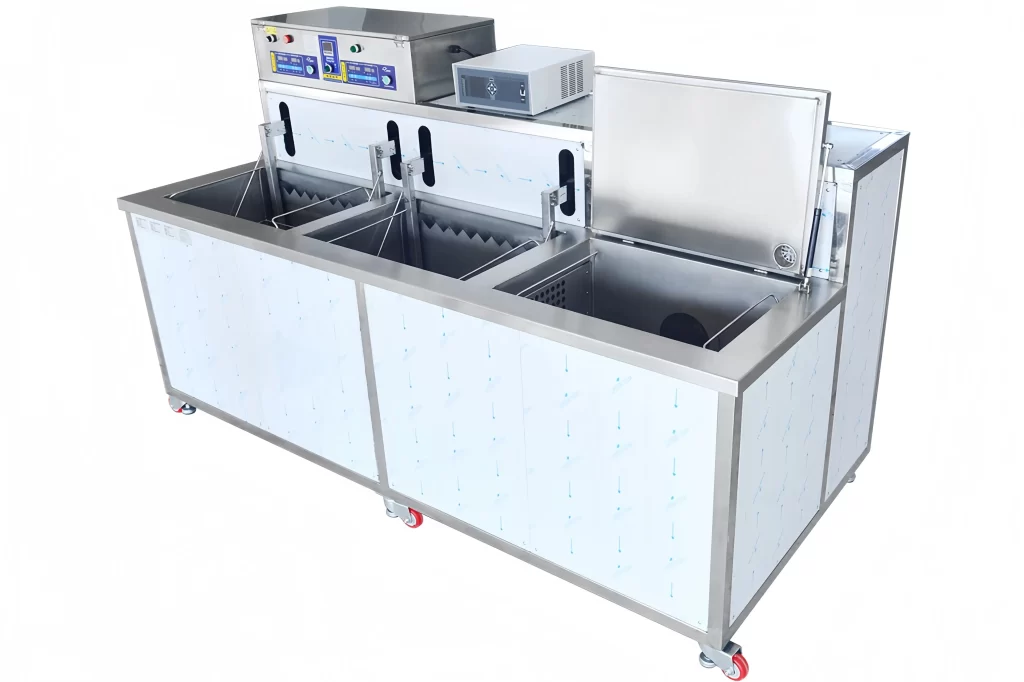
GTKCLEAN incorporates advanced Ultrasonic Generator and transducer technology to deliver these capabilities for demanding industrial applications.
Validating and Controlling Frequency Performance
Selecting an ultrasonic frequency based on material and contamination characteristics provides a starting point, but validation confirms whether that choice actually delivers acceptable results. The process involves controlled cleaning trials with representative parts, followed by cleanliness measurement and surface inspection.
Cleanliness standards vary by industry and application. Aerospace components face different requirements than automotive parts or medical devices. Validation protocols should reflect the specific cleanliness targets and inspection methods relevant to each application.
Ongoing monitoring catches performance drift before it affects product quality. Cavitation intensity can change as transducers age or cleaning solutions degrade. Regular measurement using specialized tools maintains process consistency over time.
Tank design and transducer placement influence how effectively the selected frequency performs across the entire cleaning volume. Poor placement can create uneven cavitation distribution even with optimal frequency selection.
What are the risks of using the wrong ultrasonic frequency for a specific material?
Incorrect frequency selection creates problems at both ends of the spectrum. Too low a frequency for delicate materials causes surface erosion, pitting, or structural fatigue from overly aggressive cavitation. Too high a frequency for heavy contamination results in incomplete cleaning and wasted processing time. Either mistake can lead to rejected parts, rework costs, or field failures from residual contamination or cleaning-induced damage.
Emerging Developments in Ultrasonic Cleaning
Ultrasonic cleaning technology continues advancing in response to tighter cleanliness requirements and sustainability pressures. Artificial intelligence integration represents one significant direction, with systems that analyze cleaning data and adjust frequency and power settings automatically based on measured results.
These adaptive systems can respond to varying contamination levels and part loads without operator intervention, maintaining consistent cleaning quality while optimizing energy consumption.
Sustainability improvements extend beyond energy efficiency to include better solvent recovery and reduced chemical usage. Our Hydrocarbon Solvent Recovery Systems demonstrate this commitment to environmental responsibility in industrial cleaning operations.
Transducer materials and designs continue improving, enabling finer control over cavitation characteristics and broader frequency ranges from single systems. These advances expand what ultrasonic cleaning can accomplish while reducing equipment complexity.
Partner with GTKCLEAN for Optimized Ultrasonic Solutions
Precision ultrasonic cleaning requires equipment designed for specific application requirements. Suzhou Grintek Environmental Technology Co.,Ltd. (GTKCLEAN) brings 28 technical patents and over 20 years of R&D experience to every cleaning challenge. Contact us at [email protected] or +86 17768507147 to discuss how optimized ultrasonic frequency selection can improve your cleaning results and process efficiency.
How does multi-frequency ultrasonic technology enhance cleaning for complex geometries?
Multi-frequency systems combine different frequency ranges to address varied cleaning challenges within complex parts. Lower frequencies around 25-40 kHz generate larger bubbles that reach into large crevices and remove bulk contamination. Higher frequencies between 80-200 kHz produce smaller bubbles that access microscopic features and clean delicate surfaces. Switching or sweeping between frequencies during a single cycle ensures thorough cleaning across all part features without damage to sensitive areas.
What role does cleaning solution chemistry play in optimizing ultrasonic frequency performance?
Cleaning solution chemistry significantly affects cavitation behavior and contaminant removal at any given frequency. Solution type, whether aqueous, solvent-based, acidic, or alkaline, influences bubble formation, stability, and collapse energy. Some formulations enhance cavitation at specific frequencies while others may reduce effectiveness. Proper solution selection creates synergy with frequency choice, maximizing cleaning efficiency while protecting part surfaces from chemical or mechanical damage.
Can ultrasonic frequency optimization lead to energy savings in industrial cleaning operations?
Matching ultrasonic frequency precisely to material and contamination characteristics improves cleaning efficiency, which translates directly to energy savings. Effective cleaning in fewer cycles or shorter times reduces power consumption. Advanced systems with intelligent frequency control adapt to varying loads and contamination levels, avoiding unnecessary energy use when lighter cleaning suffices. These efficiency gains lower operating costs while supporting environmental sustainability goals.
 English
  German
  Spanish
  French
  Russian
  Portuguese