
Picking the Right Parts Washer for Your Manufacturing Line
Getting the cleaning system right matters more than most people realize. The wrong choice shows up fast—rejected parts, bottlenecks, maintenance headaches, costs that creep up quarter after quarter. After working through hundreds of installations across different industries, certain patterns become clear about what actually works and what looks good on paper but falls apart in practice.
How Different Cleaning Technologies Actually Work
Industrial parts cleaning breaks down into a few core approaches, and each one handles specific problems better than others. The trick is matching the technology to what you're actually trying to clean off, and what the parts need to look like afterward.
Ultrasonic cleaning works by sending high-frequency sound waves through liquid. Those waves create tiny bubbles that collapse with enough force to knock contaminants loose from surfaces, including spots you can't reach any other way—blind holes, internal passages, tight corners. For precision work, nothing else comes close. Pre-coating cleaners running ultrapure water with conductivity at or below 0.06 μS/cm prevent water spots and secondary contamination that would ruin the coating process. CNC machined parts come out of these systems with cutting fluids, chips, and burrs gone, and rotary baskets handle the 360° coverage those geometries demand.
Solvent-based systems dissolve organic contamination. Oils, greases, waxes—the stuff that water-based chemistry struggles with. Hydrocarbon solvents work particularly well for degreasing. Multi-tank hydrocarbon systems handle battery housings and stamped components for EV manufacturing, getting into recessed areas and blind holes that would otherwise trap residue. Vacuum ultrasonic cleaning pushes solvent deeper into complex geometries, and vacuum vapor drying leaves parts completely residue-free. Single-station units combine ultrasonic cleaning, vacuum vapor cleaning, and drying in one chamber, working with either hydrocarbon or modified alcohol solvents depending on what the application requires.
Aqueous systems use water-based solutions, sometimes with detergents, and generally create fewer disposal headaches than solvent alternatives. Conveyor systems and inline cleaners handle large-scale container and pallet cleaning with automated pre-wash, rinse, and air drying stages. High-pressure rotary spray units work well for small-batch precision parts that need thorough coverage. These systems adapt to a wide range of industrial cleaning requirements.
| Feature | Ultrasonic Cleaning | Solvent Cleaning | Aqueous Cleaning |
|---|---|---|---|
| Cleaning Medium | Water-based solutions, specialized detergents | Hydrocarbon, modified alcohol solvents | Water-based solutions, alkaline/neutral detergents |
| Contaminants | Particulates, oils, greases, buffing compounds | Oils, greases, waxes, organic residues | Oils, greases, chips, dust, some inorganic soils |
| Precision | Excellent for intricate geometries, blind holes | High for organic residues | Good for general cleaning, less for complex internal |
| Environmental | Generally eco-friendly, reduced chemical waste | Requires careful handling, solvent recovery essential | Environmentally preferred, waste water treatment needed |
| Applications | Medical, aerospace, electronics, precision parts | Automotive, precision machining, stamping | General manufacturing, food, logistics |
For more background on the physics involved, 《What Is Ultrasonic Wave?》 and 《What Is Ultrasonic Cavitation Effect?》 cover the underlying principles.
What Actually Determines Parts Washer Performance
The cleaning technology itself is just the starting point. Several other factors determine whether a system performs well over the long haul or becomes a constant source of problems.
Matching Equipment to Your Specific Requirements
Part material matters first. Some combinations of metals and cleaning chemistry cause corrosion or surface damage that ruins parts. The contamination type matters next—different soils respond to different approaches, and using the wrong chemistry means either incomplete cleaning or wasted effort. Cleanliness standards for downstream processes set the bar for what "clean enough" actually means. And production volume determines whether a system can keep up with demand or becomes a bottleneck.
Throughput requirements drive a lot of decisions. Fastener tunnel cleaners processing 2+ tons per hour make sense for high-volume operations. Energy efficiency affects operating costs and sustainability metrics—inline cleaners with integrated heat recovery systems reduce consumption meaningfully. Maintenance access and component longevity factor into total cost of ownership over the system's life.
Fitting Cleaning Equipment into Production Flow
A parts washer that doesn't integrate smoothly with existing production creates problems that offset whatever cleaning performance it delivers. Material handling, water treatment, and process timing all need to work together.
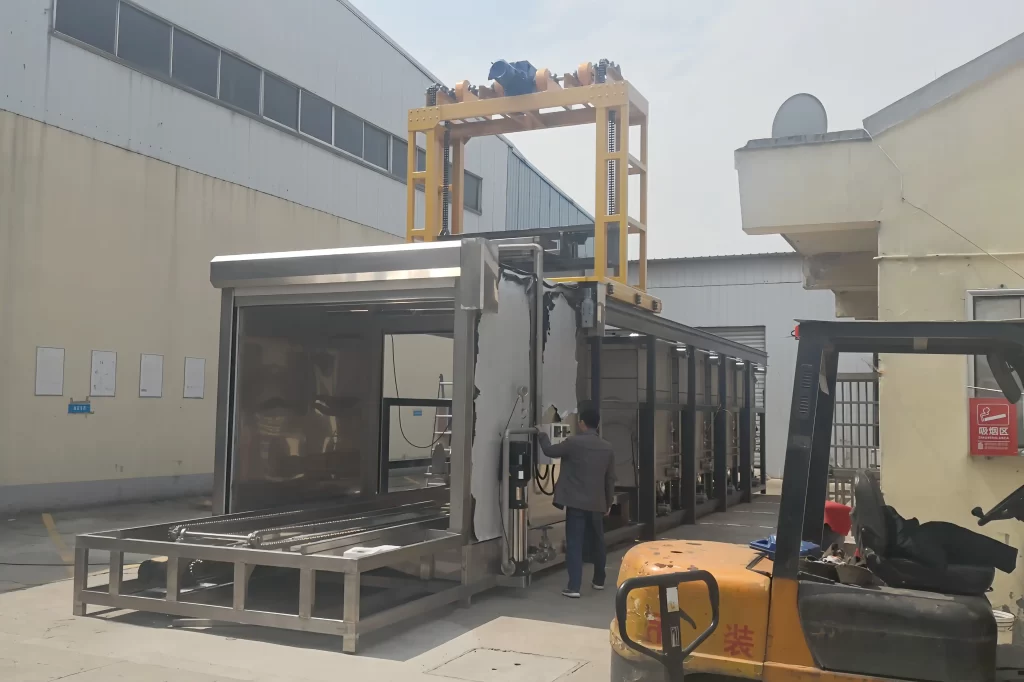
Inline cleaners with continuous conveyor systems move die-cast aluminum shells through multiple cleaning stages without manual intervention. Custom cleaning baskets and robotic loading mechanisms keep parts secure throughout the process while reducing labor requirements. Heavy-duty systems with custom load-bearing baskets and robotic lifting handle workpieces up to 2000 kg for operations dealing with large or heavy components.
Making the Numbers Work Long Term
Advanced cleaning equipment costs more upfront. The question is whether that investment pays back through lower operating costs and better results over time.
The Real Cost Picture
Quality equipment reduces chemical consumption through efficient filtration and recycling. Optimized heating and drying processes lower energy usage. Automation cuts labor costs. Better cleaning extends equipment life downstream by preventing wear and corrosion that leads to premature failures. The total picture looks different from the purchase price alone.
Circulation filtration systems extend cleaning solution life, reducing both detergent and water consumption. Overflow rinsing and circulation systems minimize resource usage. Hydrocarbon solvent systems with distillation-based recovery conserve solvent and reduce waste. These details add up to meaningful cost differences over years of operation.
Where Industrial Cleaning Technology Is Heading
The sector keeps evolving. Higher cleanliness requirements, more automation, tighter sustainability constraints—all of these push development in specific directions.
Smart cleaning systems with advanced sensors and data analytics enable predictive maintenance and performance optimization. Filtration and water treatment systems grow more sophisticated as environmental requirements tighten. New surface preparation equipment addresses increasingly complex materials and stricter specifications. Multi-frequency ultrasonic systems with enhanced cavitation control expand what's possible for precision cleaning applications.
Building Systems for Specific Operations
Generic solutions rarely fit perfectly. Manufacturing operations have specific challenges that require specific answers.
How Technology Choice Affects Your Process
Ultrasonic systems deliver precision that delicate or complex parts require for high-tolerance downstream operations. Solvent systems handle heavy oils and greases effectively, preparing parts for painting or coating. Aqueous systems reduce hazardous waste handling while providing solid general cleaning performance. Each technology influences throughput, quality control, and overall efficiency differently.
Custom-designed equipment addresses application-specific requirements that off-the-shelf systems can't handle. Whether the need is a specialized solvent parts washers for unusual components or a conveyor system for high-volume production, the engineering work determines whether the final system actually solves the problem.
Working with GTKCLEAN
Suzhou Grintek Environmental Technology Co.,Ltd. (GTKCLEAN) brings 20+ years of R&D experience and 28 technical patents to parts washer selection and design. From ultrasonic to solvent to conveyor systems, the expertise covers the full range of industrial cleaning requirements. Contact [email protected] or call +86 17768507147 for consultation on your specific application.
FAQ
What makes GTKCLEAN's ultrasonic cleaning systems stand out for manufacturers?
The systems deliver precision and thoroughness for complex geometries that other approaches can't match. Contaminant removal, cleaning times, and part quality all improve for demanding applications. Two decades of R&D work shows up in industrial efficiency and reliability.
How does GTKCLEAN address environmental compliance in parts washer design?
Sustainable manufacturing drives the design approach. Aqueous and water treatment systems minimize environmental impact through reduced water and chemical consumption, waste treatment facilitation, and compliance with global environmental standards.
Can GTKCLEAN build custom solutions for unusual manufacturing challenges?
Custom automated cleaning equipment is a core capability. Unique solvent washers, specialized conveyor systems, integrated solutions for large-scale operations—the engineering team works from 28 technical patents and extensive field experience to deliver systems that fit specific manufacturing processes.
 English
  German
  Spanish
  French
  Russian
  Portuguese