

What Causes Noise in Ultrasonic Cleaners?
Simply put, cavitation noise forms in the following way: Ultrasonic waves generate acoustic cavitation in water. When cavitation bubbles collapse, they produce fundamental harmonics matching the ultrasonic frequency as well as subharmonics. The superposition of these harmonics creates cavitation noise. Among them, low-frequency subharmonics fall within the audible range of human ears and become the primary source of noise.
The lower the ultrasonic frequency, the more subharmonics become audible, resulting in louder operating noise. High-pitched squealing noise can be eliminated by optimizing the equipment structure, yet inherent cavitation noise cannot be removed — the only exception is placing the cleaner inside an anechoic chamber.
It is essential to understand the working principle of ultrasonic cleaners: multiple high-frequency transducers vibrate to drive resonance of the cleaning solution for cleaning purposes. Poorly designed housings and bases will also trigger structural resonance, generating extra noise. A practical solution is to place the unit on rubber mats and cover the top with soundproof cotton, which will noticeably reduce noise levels.
Acoustic cavitation refers to the process where vast numbers of unstable micro bubbles (approximately 50~500μm in diameter) form in liquid under ultrasonic vibration. These bubbles go through a continuous cycle of generation, rapid expansion and collapse with ultrasonic waves.
The noise generated by ultrasonic cleaners originates directly from acoustic cavitation, known as cavitation noise. It is almost unavoidable whenever the cavitation effect is applied for cleaning, and it always occurs alongside cavitation. To mitigate cavitation noise, it is necessary to study its formation mechanism, so as to develop effective methods to reduce its environmental impact without compromising cleaning performance.
Loud noise is produced when cavitation bubbles burst inside ultrasonic cleaners. Prolonged exposure to such noisy environments is harmful to human health, though the equipment poses few other health risks.
Ultrasonic cleaners are widely adopted across industries, while doubts about their safety still remain. Some people claim the equipment emits harmful radiation that causes long-term health damage. It is advised not to stand directly above the cleaner during operation, as ultrasonic waves propagate upward from the bottom of the tank.
In fact, ultrasonic waves rely on a transmission medium — water is the most commonly used medium in cleaner tanks. Ultrasonic energy attenuates drastically when traveling through air. For this reason, ultrasonic cleaners have negligible adverse effects on the human body overall.
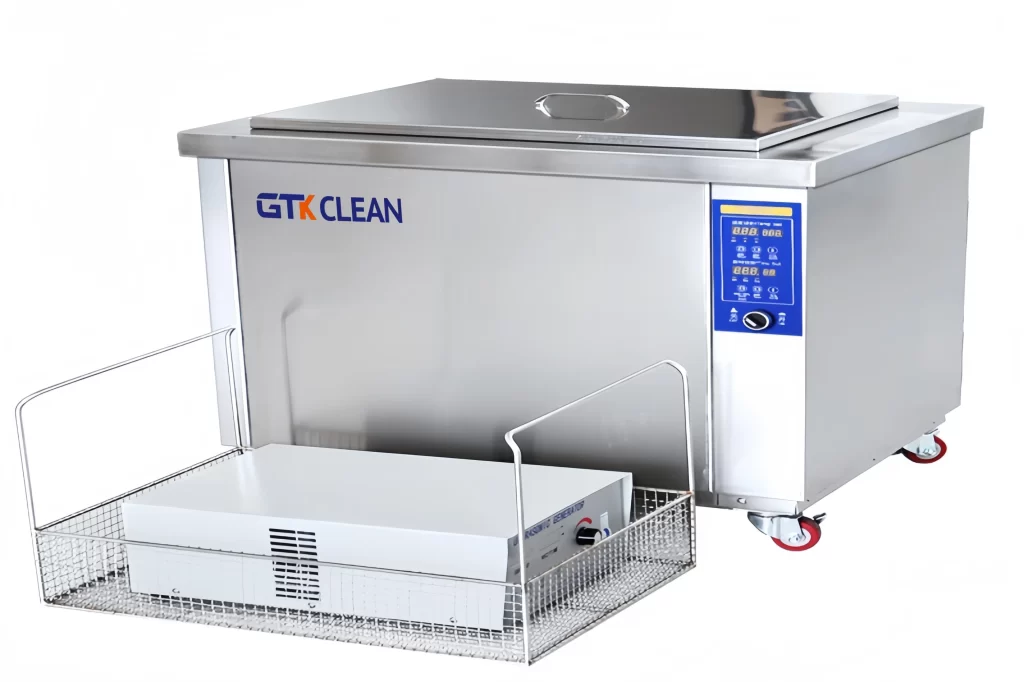
-------Bench Top Ultrasonic Cleaners-------
We appreciate your trust and support. We’re ready to communicate openly and partner with you on all your equipment needs.
Feel free to reach out via email ([email protected]) or WhatsApp (+86 17768507147) to get customized ultrasonic cleaning solutions.
Ultrasonic Cleaner FAQ
Q: How much does an ultrasonic cleaner cost? What is the general budget range?
A: Tabletop ultrasonic cleaners cost several hundred dollars. Manual industrial models are priced at tens of thousands of dollars, while fully automatic production-line units range from hundreds of thousands to over a million dollars. Prices vary greatly depending on equipment configurations and specifications.
Q: How to choose the right frequency for an ultrasonic cleaner?
A: Ultrasonic cleaner frequencies typically range from 28kHz to 120kHz. When using water or water-based cleaning detergents, lower frequencies deliver stronger physical cleaning power via cavitation, with 28kHz to 40kHz being the most common choice.
Q: Are ultrasonic cleaners harmful to human health?
A: Ultrasonic cleaners cause no tangible harm to the human body. Sound waves within 20~20000Hz are audible to human ears; any frequency above 20000Hz is defined as ultrasound, which is divided into low, medium and high frequency bands starting from 20kHz.
Q: Are ultrasonic cleaner and supersonic cleaner the same device?
A: They are exactly the same equipment, only with different naming conventions. The term "supersonic cleaner" is widely used by customers in Taiwan region.
Q: Is an ultrasonic cleaner easy to operate?
A: Extremely user-friendly. Simply add cleaning solution, place items into the tank, power on the device and follow the manufacturer’s operation manual to start the cleaning process.
 English
  German
  Spanish
  French
  Russian
  Portuguese