

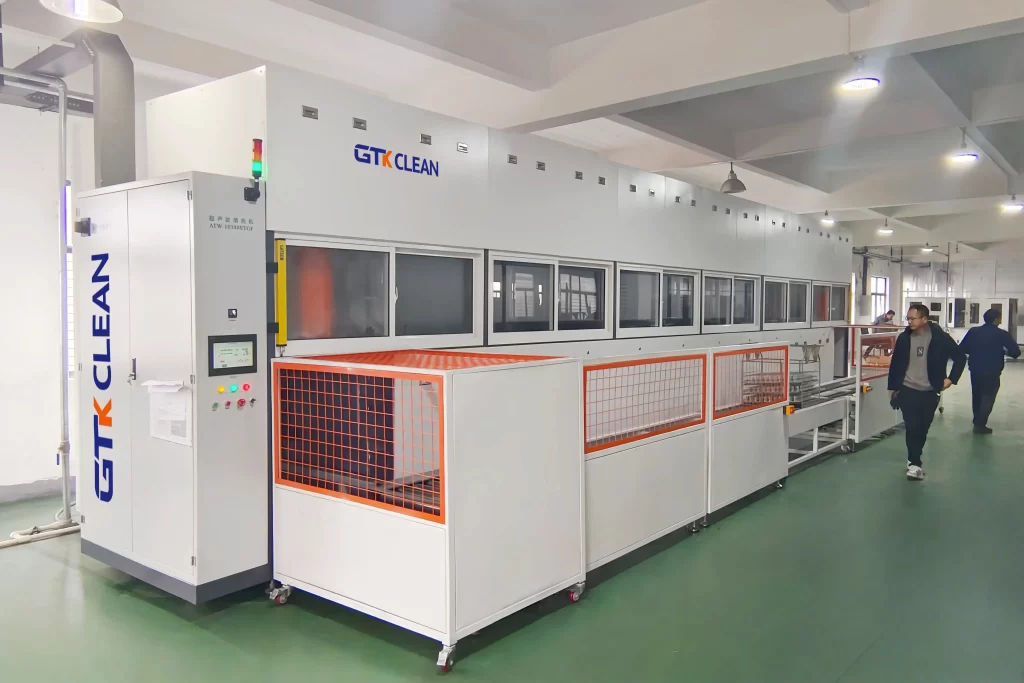
What is the Ultrasonic Cleaning Process for Metal Stamping Parts?
This cleaning machine consists mainly of an ultrasonic generator, transducers, cleaning tanks, a reservoir tank, a continuous tunnel dryer, a circulation filtration system, automatic thermostatic heating system, frame, control panel, and PLC control system.
Application
For cleaning metal stamping parts.
Cleaning Description
This is a semi-automatic cleaning system operated manually. It includes six stainless steel process stations:
rough ultrasonic cleaning tank, fine ultrasonic cleaning tank, spray rinsing tank, ultrasonic rinsing tank, high-pressure air knife station, and a continuous tunnel drying oven.
The operator places parts in a cleaning basket and moves it sequentially through each stage for ultrasonic cleaning, rinsing, and drying. Finished parts are then unloaded manually.
The overall structure is shown in the attached drawings and further descriptions.
Cleaning Process Flow
Manual Loading → Rough Ultrasonic Cleaning → Fine Ultrasonic Cleaning → Spray Rinsing → Ultrasonic Rinsing → High-Pressure Air Blowoff → Hot Air Drying → Manual Unloading
Process Table
| No. | Process | Description | Media | Heating Power | Temperature | Filtration |
|---|---|---|---|---|---|---|
| 1 | Rough Ultrasonic Cleaning | 2400W, 28kHz | Tap water + alkaline cleaner | 6kW + 6kW | RT–55°C | 20μm |
| 2 | Fine Ultrasonic Cleaning | 2400W, 28kHz | Tap water + alkaline cleaner | 6kW + 6kW | RT–55°C | 10μm |
| 3 | Spray Rinsing | Spray rinsing | Overflow DI water + tap water | — | RT | 10μm |
| 4 | Ultrasonic Rinsing | 2400W, 40kHz | Overflow DI water | 6kW | RT–55°C | 5μm |
| 5 | Ultrasonic Rinsing | 2400W, 40kHz | Heated DI water | 6kW + 6kW | RT–85°C | 5μm |
| 6 | High-Pressure Air Blowoff | Compressed air | — | — | RT | — |
| 7 | Hot Air Drying | Circulating hot air | Hot air | 20kW | RT–100°C | — |
Frequently Asked Questions About Ultrasonic Cleaners for Metal Stampings
Q: How do I choose an ultrasonic cleaner?
A: Lower frequencies deliver stronger cavitation and more aggressive cleaning action, which affects parts more intensely.
Q: What quality requirements apply to metal stamping parts?
A: Surfaces must be smooth and free of scratches, dents, indentations, burrs, and any signs of rust.
Q: What processes are involved in stamping metal parts?
A: Typical operations include blanking, bending, drawing, forming, and finishing.
Q: Is a higher ultrasonic frequency always better?
A: No. Lower frequencies are better for heavy oil, grease, and large particles. Higher frequencies are used for delicate, small precision components.
Q: What materials are used for stamping parts?
A: Mainly hot-rolled or cold-rolled (mostly cold-rolled) metal strips and sheets, such as carbon steel, alloy steel, spring steel, galvanized steel, tin-plated steel, stainless steel, copper and copper alloys, aluminum and aluminum alloys, etc.
Q: Can ultrasonic cleaners use only water?
A: It depends.
Small general-purpose units (such as for eyeglasses) often work with plain water.
For heavily oil-contaminated parts, a chemical cleaning agent is required.
 English
  German
  Spanish
  French
  Russian
  Portuguese