

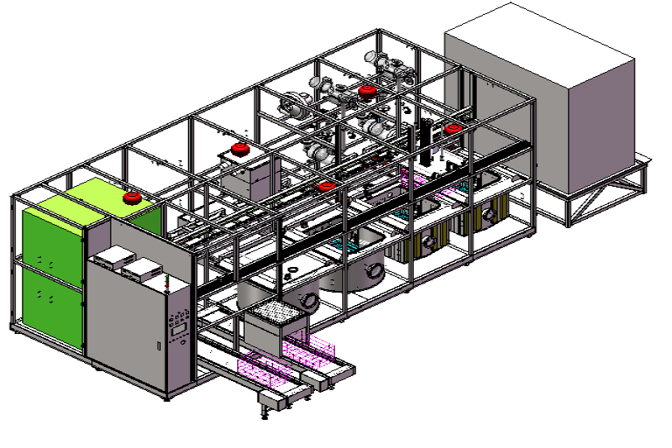
Composition of Hydrocarbon Vacuum Cleaning Machines
A hydrocarbon vacuum cleaning machine consists of the main cleaning and drying unit, ultrasonic system, vacuum degassing system, circulating filtration system, robotic arm system, vacuum drying system, vacuum distillation recovery system, HC concentration monitoring system, automatic fire extinguishing system, and electrical control system.
Working Principle of Vacuum Cleaning
Hydrocarbon cleaning solvents contain a high level of residual gas—8–10 times that of water. High-frequency waves emitted by ultrasonic transducers attenuate when they encounter gas (residual oxygen), which impairs the precision ultrasonic cleaning effect and prevents the ultrasonic cavitation effect from functioning effectively. For this reason, vacuum degassing is essential.
The cleaning process proceeds as follows:
The cleaning basket is lowered into the cleaning tank.
An air cylinder then drives the tank cover to close automatically, and the vacuum degassing system activates to evacuate all air from the tank. Under vacuum conditions, gas trapped in the tiny gaps of the workpieces and gas dissolved in the cleaning solvent can be fully removed.
The ultrasonic system and swing mechanism are then turned on. The swing mechanism drives the cleaning basket to rotate, ensuring the cleaning solvent can fully penetrate and clean the workpieces.
After the preset cleaning duration elapses, the vacuum is released, the tank cover opens, and the cleaning basket moves to the next processing tank.
What Are the Significant Advantages of Hydrocarbon Cleaning Compared to Traditional Cleaning Methods?
(1) Enhanced Environmental Friendliness: Compared to traditional halogenated hydrocarbon solvents (e.g., trichloroethylene, perchloroethylene), hydrocarbon solvents offer lower toxicity, higher flash points (non-flammable and non-explosive), and better biodegradability. They comply with international environmental regulations such as REACH and RoHS, helping enterprises achieve green production and reduce environmental impact.
(2) Optimized Cleaning Efficiency: Leveraging the ultrasonic cavitation effect and uniform coverage of the spray system, hydrocarbon cleaning machines achieve deep cleaning in a short time. They effectively remove micro-contaminants and clean hard-to-reach areas, improving production efficiency and product cleanliness.
(3) Cost-Effective Operation: Hydrocarbon solvents are recyclable—they can be purified and regenerated through distillation, filtration, and other processes, reducing solvent consumption and waste disposal costs with significant long-term economic benefits. Additionally, hydrocarbon cleaning machines feature rational design and easy maintenance, lowering operation and maintenance (O&M) costs.
(4) Strengthened Safety Performance: High-flash-point solvents minimize fire and explosion risks. Combined with advanced safety control systems (e.g., temperature monitoring, pressure protection, emergency shutdown), they ensure production safety and reduce potential safety hazards.
Which Specific Industries and Application Scenarios Are Hydrocarbon Cleaning Machines Suitable For?
Hydrocarbon cleaning machines are widely used in fields such as precision machinery processing, auto parts manufacturing, aerospace, electronic semiconductors, optical component processing, and medical device manufacturing. They are particularly suitable for cleaning precision components with extremely high cleanliness requirements, including precision molds, optical lenses, integrated circuit boards, precision hardware parts, and medical device components.
In auto parts manufacturing, hydrocarbon cleaning machines can effectively remove contaminants such as processing oil, cutting fluid, and rust-preventive oil, ensuring the assembly accuracy and performance of components. In the electronic semiconductor industry, these machines are used to remove residues generated during wafer and chip packaging processes, improving product yield and reliability.
 English
  German
  Spanish
  French
  Russian
  Portuguese