

What Performance Parameters Determine the Quality of an Ultrasonic Cleaner?
Key technical indicators such as loaded aging performance, resonance, impedance and inductive reactance matching are fully calibrated and finalized before factory shipment. Even so, the most important factor is always your actual application and the type of parts you need to clean.
Low ultrasonic frequency works well for rough cleaning tasks where surface finish is not critical. For mesh and porous components, high frequency is strongly recommended, as it reduces intense cavitation impact on workpiece surfaces.
It is also essential to select the right cleaning medium. SUS304 stainless steel is compatible with mild alkaline solutions. However, mild acidic fluids are not suitable; they tend to cause surface oxidation, accelerate tank corrosion and shorten service life.
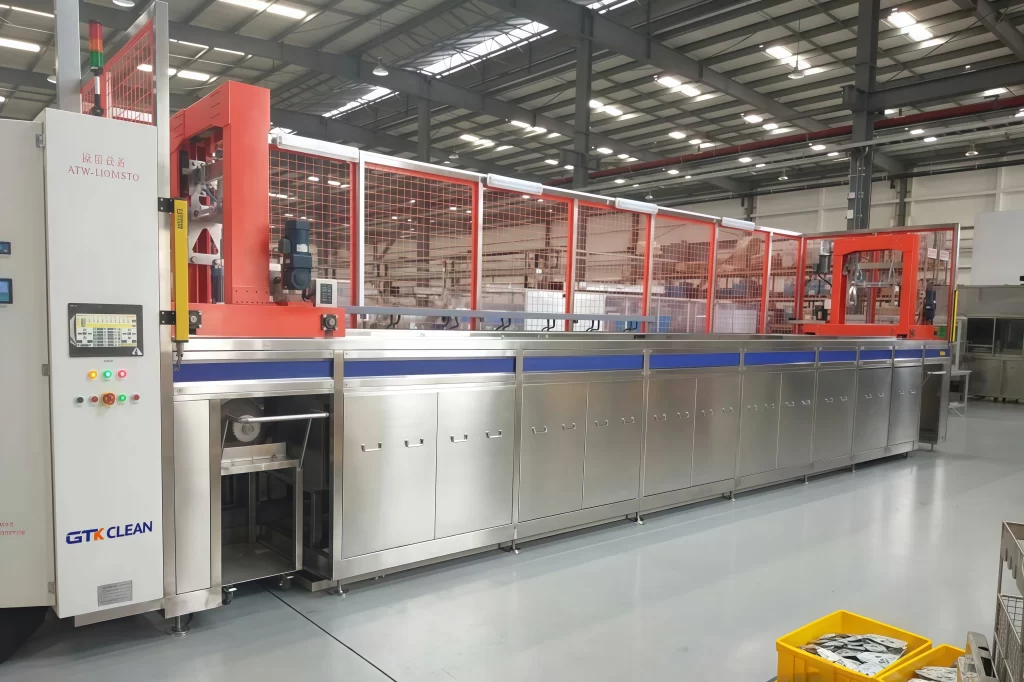
An ultrasonic cleaner mainly consists of the cleaning tank, ultrasonic generator, and ultrasonic transducers, together with professional assembly craftsmanship. The tank should be fabricated and welded from SUS304 or SUS316L stainless steel with thickness of 2.0 mm or above.
Before purchasing an ultrasonic cleaner, perform a full application analysis on your parts:material composition, structural design, production quantity, and the type of contaminants to be removed.These factors determine the proper cleaning method and whether to use water-based detergent or solvent-based fluid. The final cleaning process should always be verified through actual cleaning trials. This ensures you get a well-matched cleaning system, optimized workflow and suitable cleaning chemistry.
Our machines adopt imported core ultrasonic components, delivering strong output, stable performance and long service life.Multi-frequency options and adjustable ultrasonic frequency support both rough cleaning and precision fine cleaning.Since the cleaning power relies entirely on sound wave cavitation, no physical damage is caused to workpieces.
A wide range of machine models is available to complete degreasing, dust removal, rust removal and drying in one continuous process.Eco-friendly solvent cleaning and water-based washing with DI water rinsing fully meet environmental regulations.Cleaning temperature and working time are fully adjustable, allowing customized cleaning cycles.
The whole machine is built with premium stainless steel, offering excellent corrosion resistance and waterproof performance.Ultrasonic energy in water provides fast, thorough and non-destructive cleaning for medical tools, irregular parts, precision components and tiny blind holes that are hard to reach manually.
Modern ultrasonic cleaners and generators are equipped with professional noise reduction design for quieter operation.Transducers are fixed with high-performance specialized adhesive; most industry models now use bolt fastening combined with imported professional bonding glue for maximum durability.
Frequency selection depends entirely on the workpiece.28 KHz is ideal for general materials and applications with ordinary surface requirements.Higher frequencies are recommended for strict cleaning standards and delicate precision parts.
The lower the frequency, the larger the cavitation bubbles generated.When the frequency exceeds 800 KHz, cavitation bubbles almost disappear, minimizing cavitation erosion on delicate surfaces.Ultrasonic cleaning works by the instantaneous high pressure released when cavitation bubbles collapse, stripping contaminants thoroughly from workpiece surfaces.
We appreciate your trust and support. We’re ready to communicate openly and partner with you on all your equipment needs.You may contact us by email ([email protected]) or WhatsApp (+86 17768507147) for custom ultrasonic cleaning solutions.
Ultrasonic Cleaner Q&A
Q: How do I choose the right ultrasonic cleaner?
A: The lower the frequency, the stronger the cleaning impact, and the greater the influence on the workpiece surface.
Q: Which stainless steel grade is best for automotive exhaust pipes?
A: SUS304 and 409 are the common options.SUS304 offers superior corrosion resistance and high temperature resistance up to 650°C.Grade 409 is prone to rust and has much weaker anti-corrosion performance.
Q: For electroplating on stainless steel exhaust pipes, what is the purpose of hot dipping dewaxing as the first process step?
A: Hot dipping dewaxing removes surface contaminants, oil and wax that would compromise electroplating quality. Residues on the surface will result in poor plating appearance and fail finished quality standards.
Q: Is a higher ultrasonic frequency always better?
A: Low frequency suits heavy particles and severe oil contamination. High frequency is designed for tiny precision components requiring fine cleaning.
Q: Are stainless steel exhaust pipes better than ordinary iron ones?
A: Vehicle exhaust runs at high temperature and contains highly corrosive gases such as sulfur dioxide and water vapor, which easily corrode ordinary steel over time.Stainless steel exhaust pipes provide far better corrosion resistance and longer service life, with no increase in operating noise.
Q: Can ultrasonic cleaners work with plain water only?
A: It depends on the usage scenario.Small household units for items such as eyeglasses work well with pure water alone.For heavy oil and greasy dirt, dedicated cleaning detergent is required for proper results.
 English
  German
  Spanish
  French
  Russian
  Portuguese