

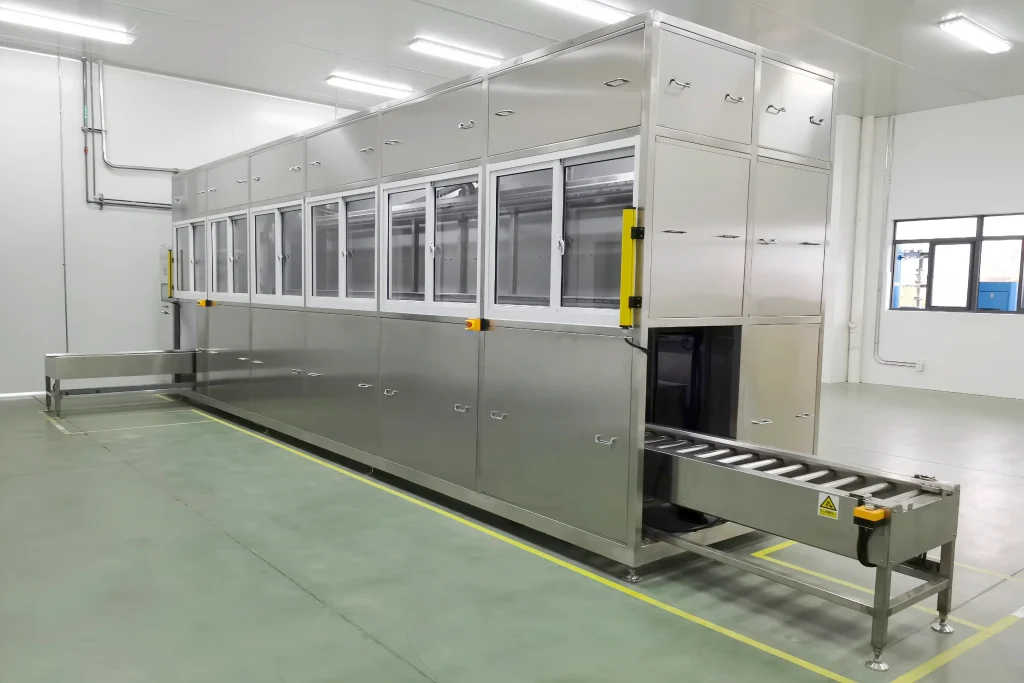
What’s the Difference Between Ultrasonic Cleaners and High-Pressure Spray Cleaners?
Ultrasonic cleaners and high-pressure spray cleaners differ mainly in three aspects:
- Application
- Working principle
- Performance & intended use.
Below we break down each difference in detail to help you clearly understand how these two cleaning systems compare.
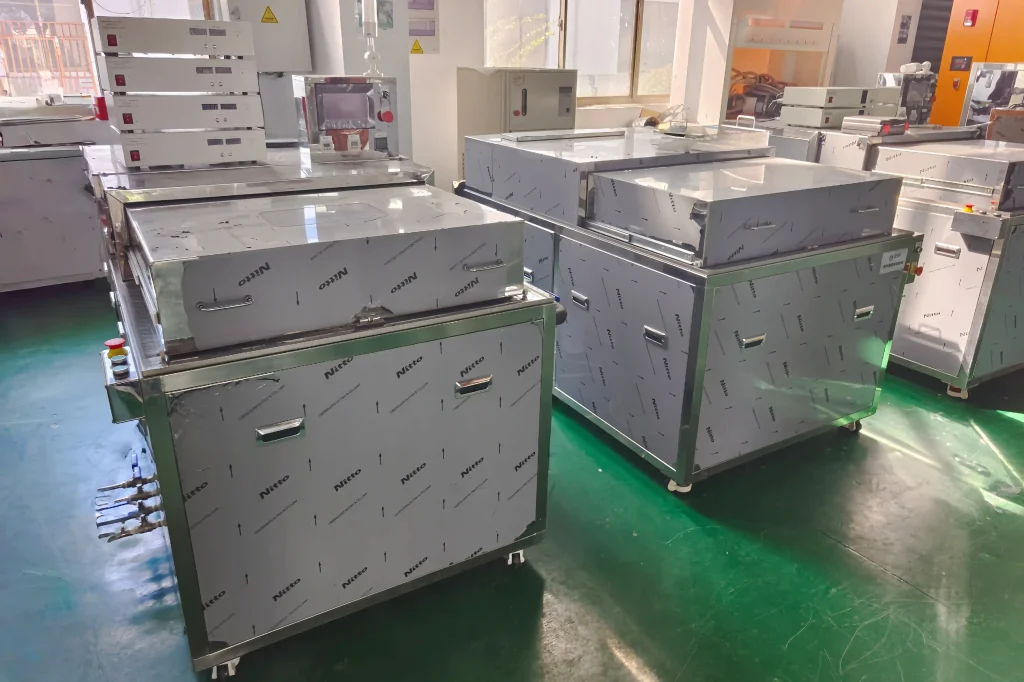
-----Ultrasonice Cleaner-----
1. Application
- Ultrasonic cleaning is widely used in the electrical industry for cleaning machine parts, printed circuit boards, vacuum tube components, silicon wafers, capacitors, and more.
- In the precision industry, it is ideal for instruments, gauges, watch dials and parts, gears, springs, eyeglass frames, and precious metal ornaments.
- For the automotive industry, common applications include cleaning valves, spark plugs, carburetors, fuel pumps, piston rings, and other components.
- In short, ultrasonic cleaning can be used for nearly any small-to-medium part that fits inside the cleaning tank.
By contrast, high-pressure cleaners cover a much broader range of cleaning scenarios. Powered by electric or fuel engines that drive high-pressure pumps, they can be adjusted to different pressure levels for various tasks.They are widely used for cleaning and maintenance in manufacturing facilities and public spaces, including:
- Cleaning mixing equipment, vehicles, and general machinery
- Unclogging pipes and pipelines
- Cleaning drilling rigs, oil pipelines, and internal/external surfaces of oil tanks
- Removing oil, grease, and scale from factory floors and walls
- Washing building exteriors, glass curtain walls, boiler rooms, parking lots, and public areas
- General cleaning of parking areas, plazas, roads, and streets in facility maintenance
- The biggest difference here is that high-pressure cleaners excel at cleaning long underground pipelines, large surfaces, and entire facilities.
2. Working Principle
Ultrasonic cleaners rely on the cavitation effect of ultrasonic waves.High-frequency sound waves create microscopic bubbles in the cleaning liquid, which rapidly form and collapse, generating powerful shockwaves that blast contaminants off part surfaces and deep within crevices. This makes cleaning complex, curved, and tiny parts simple and easily automated.
Since water naturally contains small amounts of air, cleaning performance may be slightly reduced during initial use or after changing the cleaning solution. As air dissipates over time—similar to how “cold water” warms up—cleaning efficiency improves noticeably. The optimal operating temperature for ultrasonic cleaning is 40°C to 60°C.
Many factors affect cleaning results, including frequency, power, water quality, temperature, cleaning time, detergent formulation, solution change intervals, compressed air bubbling quality, ambient air quality, and how parts are positioned and loaded in the tank.
High-pressure spray cleaning works by using a motor-driven high-pressure pump to generate high-velocity water jets.Water flows through a small-diameter nozzle, which accelerates the flow, converting high-pressure, low-speed water into a high-velocity, low-pressure jet. The powerful spray blasts away contaminants from part surfaces.
This system is simple to set up and operate, delivering strong cleaning performance—especially for parts with flat, smooth surfaces. It effectively removes dirt, oil, grease, and rust. Most high-pressure cleaners use a valve-and-pump assembly to control the water jet, making operation smooth and intuitive.
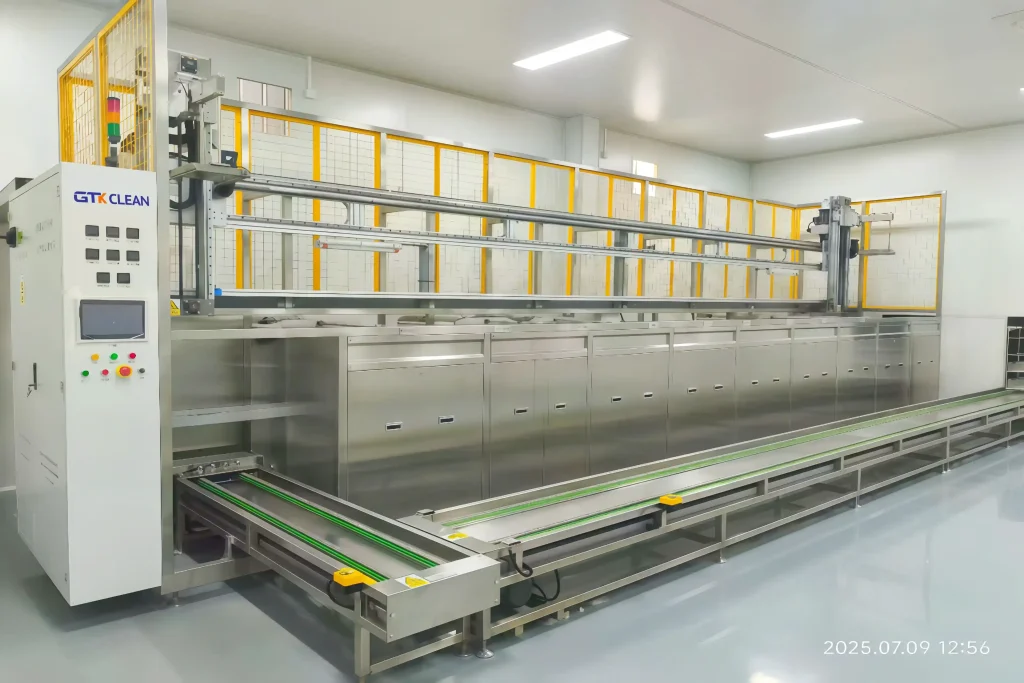
------High-pressure Spray Cleaning-------
3. Performance & Intended Use
Ultrasonic cleaning removes both liquid and solid contaminants from surfaces to achieve a specified cleanliness level.The process involves complex physical and chemical reactions, influenced by contaminant type, adhesion strength, cleaning temperature, pressure, ultrasonic vibration, and mechanical agitation.
Using shockwaves from collapsing microbubbles, ultrasonic cleaners clean both exterior and interior surfaces of parts. For example, ultrasonic dishwashers operate without motors or water pumps, relying only on silent molecular vibration. This results in low noise, lower energy consumption, and water savings.
High-pressure cleaning systems use high-pressure water jet technology.bAny surface or cavity directly reachable by the water jet can be thoroughly cleaned—whether it’s the interior of pipes and tanks, machinery exteriors, tough mineral deposits, or heavy blockages
This method has no special requirements for material, shape, or contaminant type, as long as the jet can reach the target area. It offers high automation, excellent cleaning results, high efficiency, and zero environmental pollution.
In short, both ultrasonic cleaners and high-pressure spray cleaners replace traditional manual cleaning with advanced automated equipment. They improve productivity, reduce labor intensity, promote environmental protection, and are highly suitable for large-scale cleaning operations.
 English
  German
  Spanish
  French
  Russian
  Portuguese