
When a batch of precision automotive parts fails a cleanliness audit, production stops and the quality team scrambles to find the failure point. After twenty years designing industrial cleaning systems for global automotive suppliers, I have seen that the root cause often lies in the gap between cleaning equipment configuration and the applicable standard's requirements. Automotive parts cleaning standards like ISO 16232 and VDA 19 set strict particulate limits and measurement protocols, but translating those numbers into reliable high-volume production is where manufacturers struggle. This article covers the key standards, their testing methods, and most importantly, the equipment design factors that determine whether your line consistently delivers compliant parts.
Understanding Major Automotive Cleaning Standards
The automotive industry relies on a few core standards to define and verify cleanliness of fluid-carrying and safety-critical components. The most widely cited are ISO 16232 and VDA 19, both of which specify extraction, filtration, and microscopic or gravimetric analysis of particulate contaminants. ISO 16232 (Road vehicles: Cleanliness of components of fluid circuits) includes multiple parts covering sample preparation, analysis, and expression of results. VDA Volume 19 (German Association of the Automotive Industry) is similar but often includes additional guidance on blank value determination and reference samples. In practice, most tier-one suppliers must comply with both, as vehicle manufacturers may choose one or the other.
Many engineers also refer to the AIAG CQI-11 (Special Process: Cleaning System Assessment), which focuses not on a specific cleanliness level but on process control and capability. CQI-11 audits evaluate whether a supplier's cleaning process is robust enough to produce consistent results, independent of part type. It encourages documented parameter control, regular contamination checks, and preventive maintenance.
A common misconception is that meeting a standard means hitting a single number. In reality, cleanliness is expressed as a code that combines particle size classes and counts, such as ISO 16232 code A (B) (C) where A, B, C represent numbers of particles larger than 50 µm, 100 µm, and so on. VDA 19 uses a cleanliness code based on maximum allowable mass of residue and/or particle counts by size. Understanding this code is essential before setting cleaning equipment targets. In our projects, we often see specifications calling for VDA 19 Class 12, which translates to a maximum residual dirt mass of approximately 0.4 mg per component for a typical 500 cm² surface area. Achieving this consistently requires not only a powerful cleaning stage but also precise chemical management and filtration to prevent recontamination.
Testing Particulate Contamination in Automotive Parts
To verify compliance with the standards, cleanliness testing is performed on sampled parts. The two most common laboratory methods are gravimetric analysis and microscopic particle counting.
Gravimetric Versus Microscopic Analysis
Gravimetric analysis measures the total mass of residual dirt on a part. The component is flushed with a solvent, the solvent filtered, and the retained particles dried and weighed. It gives a straightforward weight in milligrams but does not differentiate between one large chip and many fine particles. That limitation matters when a standard specifies particle size distribution.
Microscopic analysis follows the same extraction step but the filter membrane is examined under a microscope. Particles are counted and classified into size bins, providing a detailed breakdown. This is the required method when standards call out specific particle counts per size category, as in many high-pressure fuel system specifications. Some laboratories also use optical particle counters that automate the counting process, but they may miss particles that are translucent or irregularly shaped.
| Testing Method | What It Measures | Strengths | Limitations |
|---|---|---|---|
| Gravimetric | Total residual dirt mass (mg) | Simple, fast, low equipment cost | No particle size distribution |
| Microscopic | Particle count by size class | Detailed size data, recognized by all standards | Labour-intensive, requires skilled operator |
| Optical Particle Counting | Automated particle count via light blockage | High throughput, repeatable | May undercount transparent or irregular particles |
Interpreting Cleanliness Codes
Both ISO 16232 and VDA 19 express results as cleanliness codes. ISO 16232 codes like "20/18/14" indicate the number of particles larger than three defined size thresholds (typically 15 µm, 25 µm, 50 µm, but can vary). VDA 19 frequently uses a maximum residual dirt mass per 1000 cm² of component surface area, often combined with a particle size limit. For example, a VDA 19 specification might require no more than 0.3 mg residue per 1000 cm² and no particle larger than 200 µm.
Meeting these codes demands more than a strong ultrasonic bath. The cleaning system must remove the bulk contaminant and then rinse thoroughly enough to leave no residue that could shift the particle count. If your program involves parts with internal cavities that tend to retain cleaning fluid and fine particles, it is worth confirming that your system design includes multi-directional rinsing and proper drying. Reach out to us at [email protected] to discuss your part geometry and cleanliness targets.
How Cleaning Equipment Design Affects Cleanliness Compliance
A cleaning system is not a single machine but a sequence of operations: pre-wash, ultrasonic or solvent cleaning, multiple rinses, and drying. Each stage can add or remove contaminants, and a failure in one can undo the entire effort. I have seen a supplier fail a VDA 19 audit because their single-tank rinse left surfactant residue that later attracted airborne particles, elevating the final particle count beyond the limit.
Impact of Ultrasonic Frequency on Particle Removal
Ultrasonic cavitation generates microscopic bubbles that implode on part surfaces, dislodging particles. The frequency determines bubble size and energy. Lower frequencies (around 20 kHz) create larger, more energetic bubbles suited for breaking off coarse chips and heavy oils. Higher frequencies (40 kHz to 80 kHz) produce smaller bubbles that penetrate fine threads, blind holes, and delicate surfaces. For automotive parts like fuel injector nozzles with sub-millimeter orifices, 40 kHz or higher is often necessary to reach the internal passages without causing erosion.
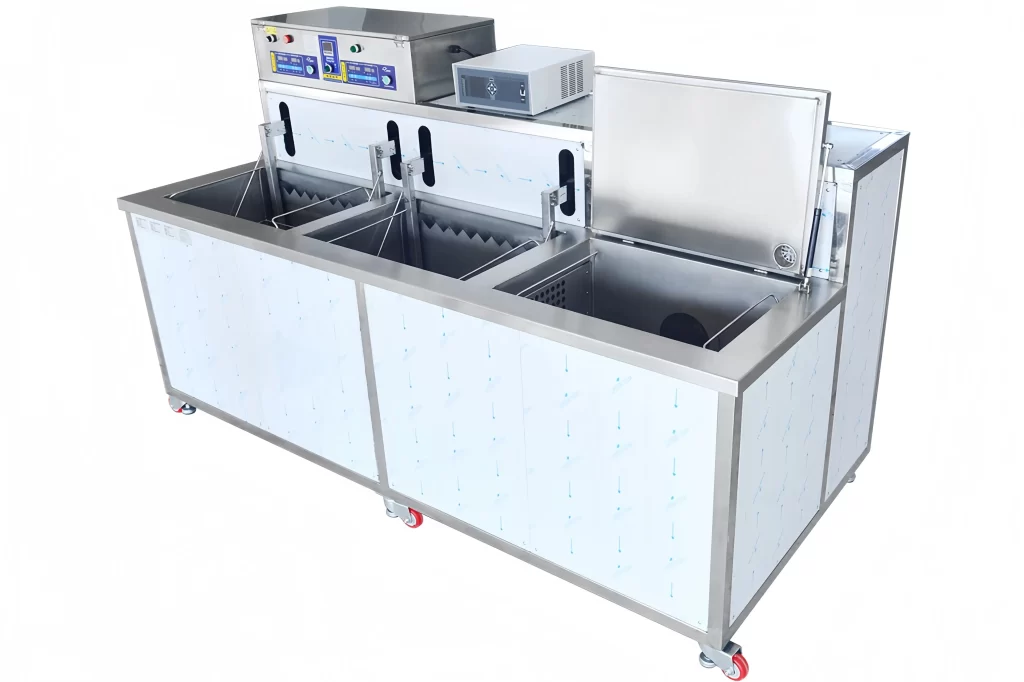
Our company offers ultrasonic vibration plates in four frequencies from 20 kHz to 80 kHz, and in many systems, we combine multiple frequencies in different tanks. This allows the first tank at 20 kHz to remove bulk oil and chips while a later tank at 40 kHz handles fine residue, bringing the part within the target cleanliness code.
The Role of Rinsing and Drying
Most residue after cleaning comes from inadequate rinsing. After ultrasonic degreasing or solvent cleaning, the part carries a thin film of cleaning fluid loaded with suspended particles. If the rinse water is not continuously refreshed and filtered, those particles redeposit on the part as it emerges. This is why multi-stage, cascading rinses with deionized (DI) water are standard for high-cleanliness applications.
In our Pre-PVD coating cleaning systems, we use multiple ultrapure water rinse stages with a final DI water quality of ≤0.06 μS/cm conductivity, alongside circulation filtration. This prevents water spots and ensures that any residual mineral content is too low to leave a visible stain or interfere with coating adhesion. Drying is equally critical: hot air drying can leave droplets, especially in blind holes. Vacuum drying, which boils away residual moisture at low temperature, eliminates that risk. For components with complex internal geometry, combining ultrasonic cleaning with vacuum drying is often the difference between passing and failing a VDA 19 inspection.
Essential Features in Industrial Cleaning Systems for Automotive Parts
When specifying a cleaning system, several design features directly influence cleanliness compliance. The first is automation. Manual or semi-automated systems introduce handling variation that can contaminate cleaned parts. Fully automatic multi-tank ultrasonic systems, with PLC-controlled transfer and recipe management, run repeatable cycles and maintain traceability of process parameters such as temperature, time, and ultrasonic power.
Filtration and fluid management are equally important. Oil skimmers remove floating oil, bag filters trap suspended solids, and circulation pumps keep the cleaning solution clean enough for prolonged use. In high-volume production, this not only extends bath life but ensures that the final rinse stage remains free of contaminants that could compromise the cleanliness code.
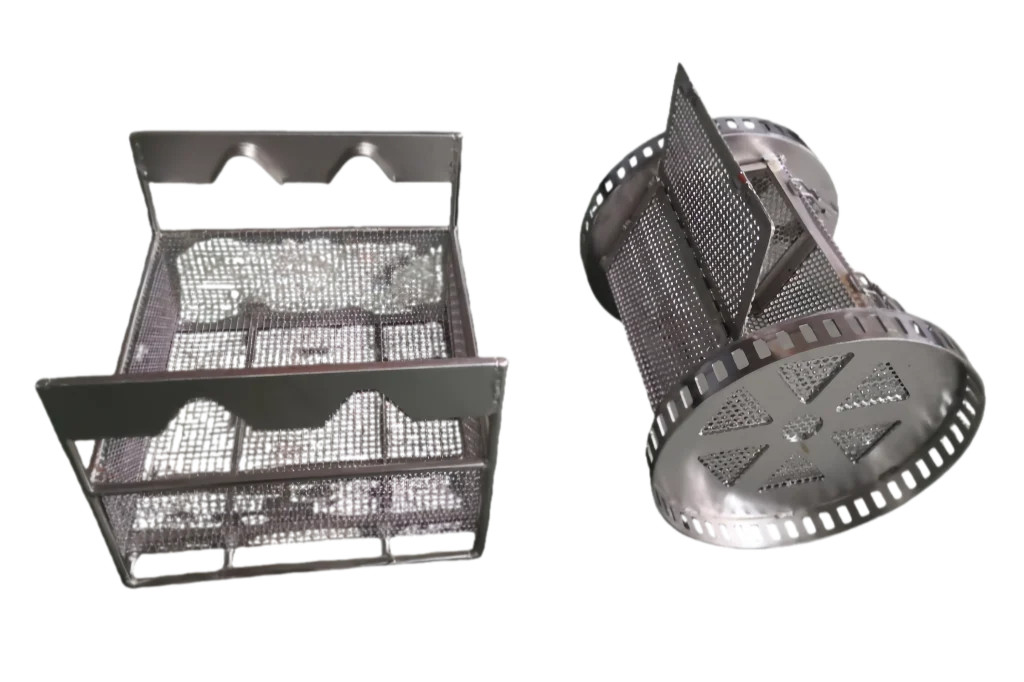
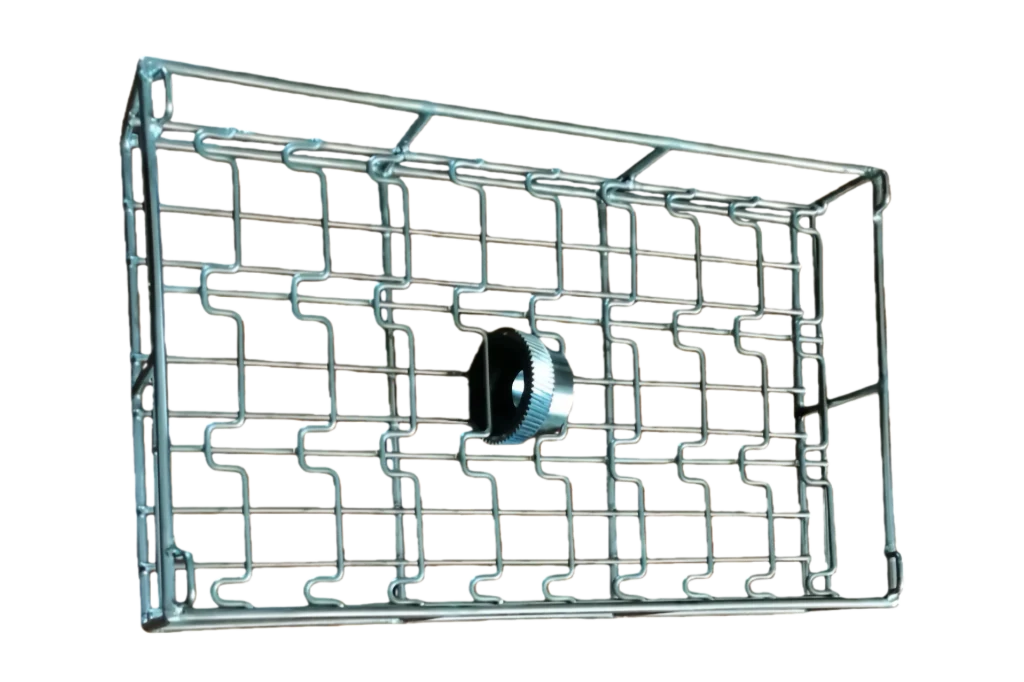
Basket design is often overlooked. A basket must hold parts securely to prevent contact damage and must allow cleaning fluid and rinse water to reach every surface. For parts with blind holes, a rotary basket that rotates during cleaning ensures that liquid drains and cavitation reaches inside cavities. The stainless steel baskets shown above are custom-designed for precision hardware. The material choice also matters: stainless steel resists corrosion and is compatible with both aqueous and solvent chemistries.
Finally, drying technology should match part geometry. Air knives and hot air may suffice for open surfaces, but vacuum drying or infrared drying is needed for complex parts. A system that includes all these elements—automation, filtration, basket engineering, and tailored drying—reduces the risk of failing a cleanliness audit to near zero.
Integrating Cleaning Systems into Production for Consistent Compliance
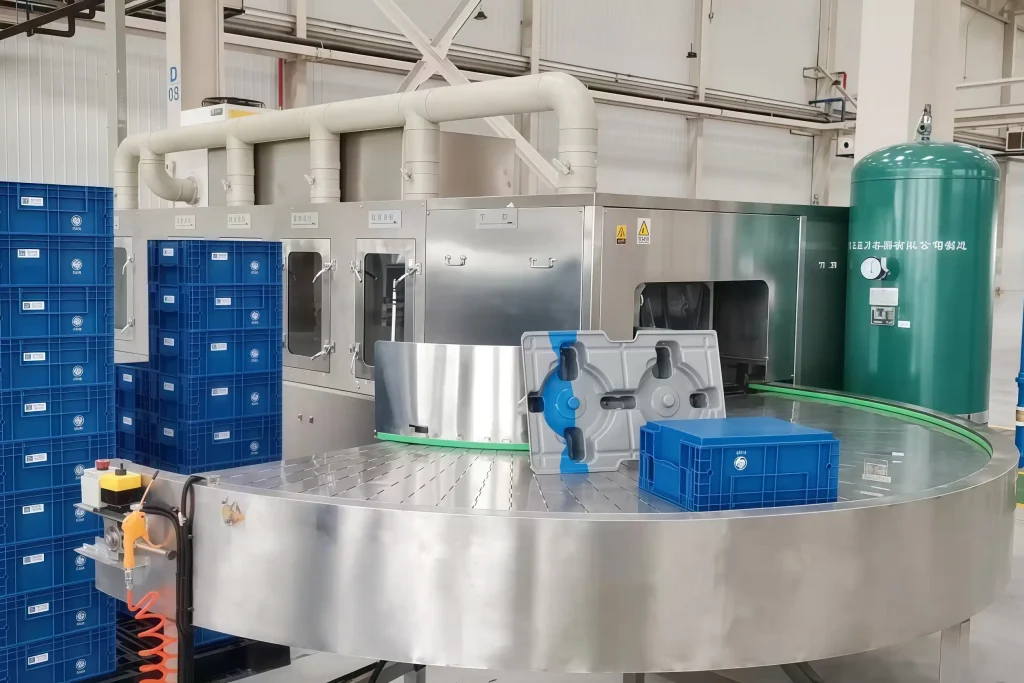
For high-volume automotive manufacturing, standalone batch cleaning creates bottlenecks and adds handling steps that increase contamination risk. Inline cleaning systems, such as conveyor belt or tunnel washers, move parts directly from machining to cleaning and onward to assembly without exposure to ambient dust and moisture. Our CNC Aluminum Shell Inline Cleaner, for example, uses a continuous conveyor with spray degreasing, air-knife drying, hot air drying, and cooling sections, suited for die-cast aluminum parts before coating or assembly.
Process validation and ongoing monitoring seal the compliance loop. After installing a cleaning line, we recommend a gage R&R study on the cleanliness testing method and a process capability study (Cpk) on the key output metric, such as residual dirt mass. A Cpk of 1.33 or higher is typical for safety-critical parts. Daily checks—particle count on a test coupon or a simplified gravimetric test—catch drift before it leads to a full audit failure.
When a new cleanliness specification arrives from an OEM, the most efficient path is to involve the cleaning system supplier early. Engineering a line around the part's geometry, expected contamination type, and required code avoids costly retrofits and reduces the time to process qualification.
Achieving Compliance With a Tailored Cleaning System
Finding the right cleaning system to meet a specific automotive cleanliness standard is not a catalogue exercise. It takes a detailed analysis of your parts, process flow, and quality objectives. At GTKCLEAN, we have twenty years of experience and twenty-eight technical patents in designing and deploying ultrasonic, solvent, and conveyor cleaning systems for automotive suppliers across twenty countries. Whether you face a VDA 19 Class 12 requirement on a new transmission valve body or need to upgrade a legacy line to meet ISO 16232 Level 3, we can configure a system with the right tank count, frequency mix, rinsing architecture, and drying method to hit your target. To start the engineering conversation, share your part drawings and cleanliness specification with us at [email protected] or call +86 17768507147.
Automotive Parts Cleaning Standards: Common Questions
What is the difference between ISO 16232 and VDA 19?
Both specify methods for measuring particulate contamination, but VDA 19 often includes stricter blank value requirements and supplementary guidance for reference samples. In practice, VDA 19 is favoured by German OEMs, while ISO 16232 is more internationally adopted. The cleanliness codes differ slightly: VDA 19 uses residual dirt mass per 1000 cm² of part surface area, whereas ISO 16232 uses particle count per component size threshold. Both aim to ensure functional cleanliness, and many supplier quality manuals accept either standard, but it is essential to verify which your customer requires before designing the process.
Can a single cleaning system meet multiple cleanliness standards?
Yes, if the system is programmable and flexible. A multi-tank ultrasonic cleaner with independent temperature, time, and chemical controls can adjust to achieve different residue limits. However, switching between significantly different contaminant types—cutting oil versus polishing paste—may require separate bath chemicals or thorough purging between cycles. The more critical factor is process validation: running qualification tests for each standard and maintaining documented parameters. A system with recipe-driven automation simplifies this, allowing operators to select the correct program for each part number.
How often should cleanliness testing be performed in production?
It depends on part criticality and customer requirements. For safety-significant components such as fuel system parts, testing every shift or every production lot is common. For less critical brackets or structural parts, periodic sampling per week or even per month may suffice. CQI-11 recommends a risk-based sampling plan tied to process capability (Cpk). As a baseline, daily simplified checks—such as a total mass measurement on a test coupon—combined with a full microscopic analysis once per week, provide a practical and defensible regimen.
What is the most critical factor in choosing a cleaning system to meet a specific standard?
In my experience, the most commonly overlooked factor is not ultrasonic power but the rinsing and drying architecture. Even the most powerful cavitation will leave particles behind if rinse water is contaminated or if drying allows water spots to form. The system must be designed to remove loosened contaminants and prevent their reintroduction. A multi-stage rinse with verified DI water quality and a drying method matched to part geometry is often the deciding factor between passing and failing. To explore a system engineered for your specific cleanliness requirements, share your part specifications with us at [email protected].
If you're interested, check out these related articles:
What Is Ultrasonic Cavitation Effect?
Essential Questions for Industrial Cleaning Equipment Suppliers
Parts Washer Selection: A Manufacturer’s Definitive Guide
How to Ensure Perfect Coating Adhesion Without Water Spots or Stains?
 English
  German
  Spanish
  French
  Russian
  Portuguese