
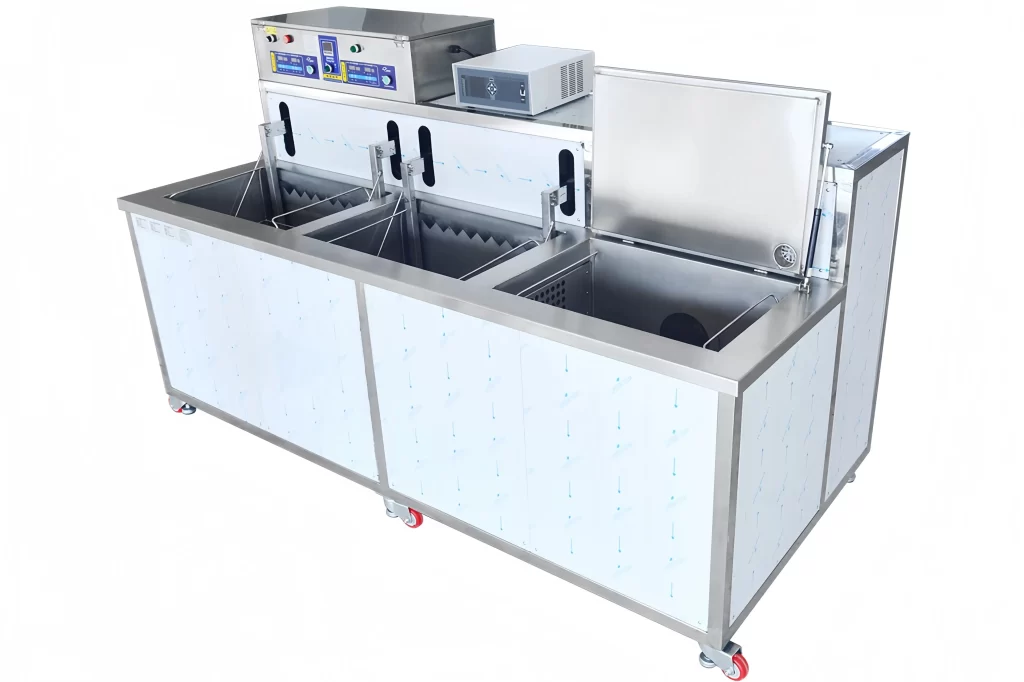
Choosing the right industrial cleaning equipment can make or break throughput and product quality. Production-line ultrasonic cleaning systems pull contaminants from a wide range of parts with repeatable precision. The technology achieves high cleanliness, trims manual labor, and fits smoothly into automated lines. With more than two decades of R&D behind us, we deliver customized solutions that meet diverse industrial demands.
Understanding Production-Line Ultrasonic Cleaning
Here we lay out the core idea of ultrasonic cleaning in a production setting and why it matters for manufacturers aiming for predictable results. You’ll see the basic principles and the clear advantages it holds over traditional cleaning methods.
1. How Ultrasonic Cleaning Technology Works
Ultrasonic cleaning utilizes high-frequency sound waves to create cavitation bubbles in a liquid. These bubbles implode, generating powerful micro-jets that dislodge contaminants from part surfaces. The process effectively cleans intricate geometries, including blind holes and internal cavities. For a deeper understanding of the underlying physics, consider exploring 《What Is the Principle of an Ultrasonic Cleaning Machine?》.
2. Key Benefits for Manufacturing Processes
Ultrasonic cleaning delivers superior cleanliness while cutting back on manual scrubbing. Results stay consistent, which helps reduce product rejection rates. It can also lighten the environmental footprint by using less aggressive chemistries and conserving water through circulation systems.
| Benefit Category | Ultrasonic Cleaning | Traditional Methods (e.g., Spray) |
|---|---|---|
| Cleanliness | Superior, micro-level | Good, surface-level |
| Labor Cost | Low, automated | High, manual intervention |
| Consistency | High | Variable |
| Environment | Eco-friendly options | Often higher chemical use |
3. Common Applications Across Industries
Production-line ultrasonic cleaning is indispensable across various industries. It is used for metals, molds, electronic components, and optical parts. Applications include automotive, medical, aerospace, and electronics manufacturing. We offer Ultrasonic Parts Cleaners tailored for these diverse needs.
Critical Factors for System Selection
This part focuses on the decision points that matter when evaluating and selecting an ultrasonic cleaning system, with an eye on real production constraints and varied plant conditions.
1. Part Geometry and Material Compatibility
The shape, size, and material of parts dictate the optimal cleaning parameters. Complex geometries with deep holes require specific ultrasonic frequencies and cleaning basket designs. Different materials necessitate compatible cleaning agents to prevent damage. We design Custom Ultrasonic Cleaners to accommodate these specific part characteristics.
| Parameter | Influence on System Design |
|---|---|
| Part Geometry | Tank dimensions, basket type (rotary for blind holes) |
| Material Type | Cleaning medium (aqueous, solvent), temperature, frequency |
| Part Weight | Basket strength, lifting mechanism, system structure |
| Contaminant Type | Detergent choice, ultrasonic frequency, cleaning cycle length |
2. Contaminant Type and Cleanliness Standards
Different contaminants, such as oils, greases, chips, or flux, require specific cleaning chemistries and ultrasonic frequencies. Achieving stringent cleanliness levels, like those for medical devices or aerospace components, demands multi-stage processes. Our systems effectively remove even stubborn residues.
3. Production Volume and Throughput Requirements
System capacity and automation levels must match production demands to maintain efficiency. High-volume production lines benefit from fully automated, continuous systems. Conversely, lower volumes might suit batch processing. We provide solutions ranging from Benchtop Ultrasonic Cleaners to fully automated lines.
Types of Production-Line Ultrasonic Systems
This section maps the main configurations of production-line ultrasonic cleaning systems so manufacturers can align design choices with workflow and space constraints.
1. Single-Stage vs Multi-Stage Systems
Single-stage systems offer a compact and cost-effective solution for basic cleaning needs. Multi-stage systems provide full cleaning, rinsing, and drying capabilities for higher cleanliness requirements. These advanced systems integrate multiple processes for superior results.
2. Immersion vs Conveyorized Systems
Immersion systems are ideal for batch processing, where parts are submerged in cleaning tanks. Conveyorized systems, such as Tunnel Cleaning Systems, allow for continuous, high-throughput cleaning by transporting parts through various stages. The choice depends on production scale and workflow.
Implementing and Optimizing Your System
This section offers practical pointers for deploying and running a production-line ultrasonic cleaning system so performance stays high and ROI holds up over time.
1. Installation and Commissioning Best Practices
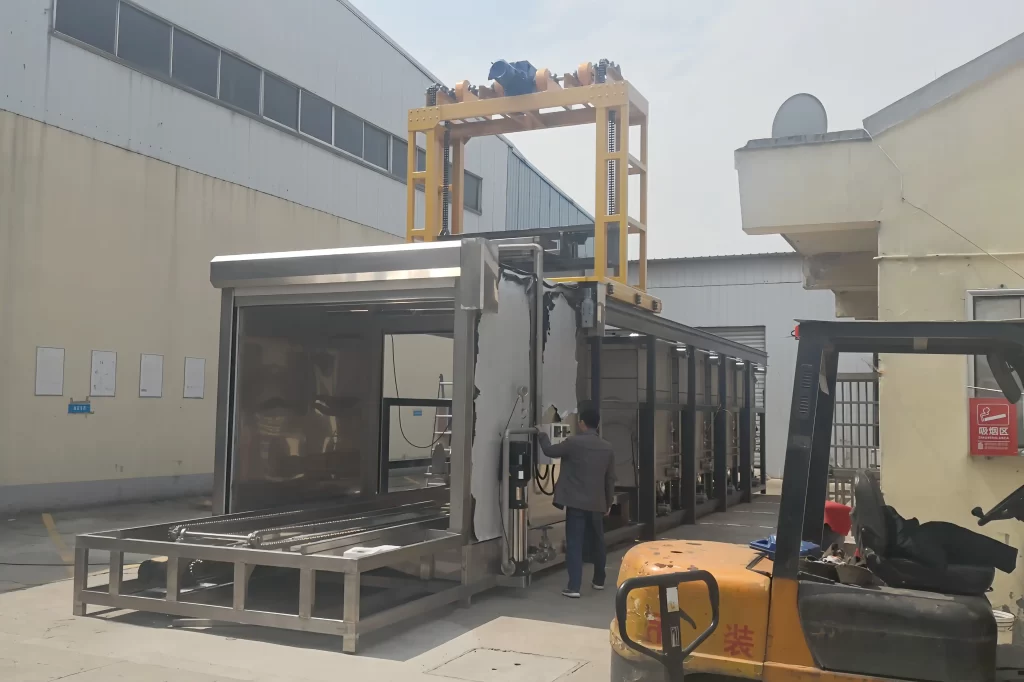
Proper installation ensures optimal system performance and safety. Key steps include preparing the site, connecting utilities, and calibrating the system. Thorough commissioning verifies all functions operate correctly before full production.
2. Maintenance Schedules and Troubleshooting
Regular maintenance keeps uptime high and extends equipment lifespan. This includes routine cleaning, fluid changes, and inspection of critical components. Prompt troubleshooting addresses any issues, preventing costly downtime. We offer detailed maintenance guidelines for all our Ultrasonic Cleaning Systems.
Ready to Enhance Your Production with Advanced Cleaning?
Ready to optimize your production line with a state-of-the-art ultrasonic cleaning system? Contact GTKCLEAN today for a personalized consultation and discover how our 20+ years of expertise and patented technology can deliver superior cleaning performance tailored to your specific needs. Visit our website or call us directly to speak with an expert.
Email: [email protected]
Phone: +86 17768507147
FAQs
1. How do I determine the right ultrasonic frequency for my parts?
The ideal frequency depends on the type of contamination and the delicacy of your parts. Lower frequencies (e.g., 20-40 kHz) provide more aggressive cleaning for robust parts and heavy contaminants, while higher frequencies (e.g., 68-170 kHz) are suitable for delicate parts and fine particulate removal. Our experts can help you determine the optimal frequency.
2. What is the typical ROI for investing in a production-line ultrasonic cleaning system?
The ROI varies based on factors like current cleaning methods, labor costs, rejection rates, and energy consumption. However, businesses often see significant returns through reduced labor, improved product quality, decreased chemical usage, and increased throughput. We can provide a detailed cost-benefit analysis for your specific situation.
3. Can ultrasonic cleaning systems be integrated into existing automated production lines?
Yes, GTKCLEAN specializes in designing comprehensive automated cleaning equipment, including ultrasonic systems that can be seamlessly integrated into existing production lines. We offer customized solutions to ensure compatibility and optimize workflow efficiency.
4. What kind of maintenance is required for these systems?
Regular maintenance includes periodic draining and refilling of cleaning solutions, cleaning of tanks and filters, and checking transducers and heating elements. GTKCLEAN provides detailed maintenance guidelines and support to ensure the longevity and optimal performance of your system.
5. Are there environmental considerations for ultrasonic cleaning?
Modern ultrasonic cleaning systems, especially when paired with water treatment systems, are often more environmentally friendly than traditional methods. They can reduce chemical usage, minimize waste, and improve workplace safety. GTKCLEAN's commitment to environmental technology ensures our systems meet evolving cleanliness requirements responsibly.
 English
  German
  Spanish
  French
  Russian
  Portuguese