

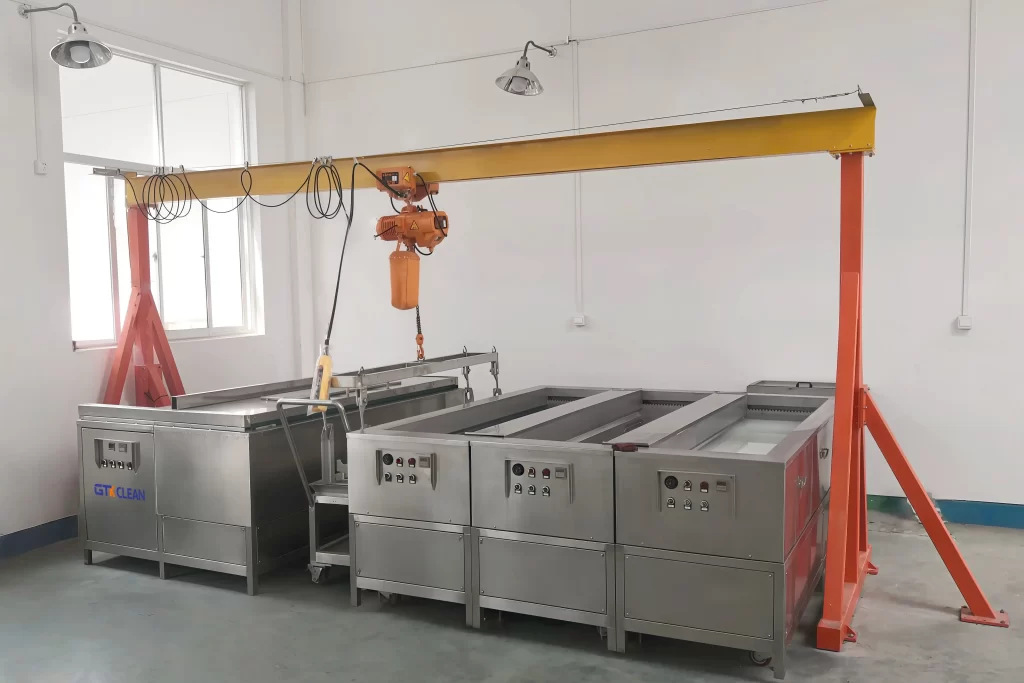
The principle of an ultrasonic cleaning machine lies in high-frequency oscillating signals emitted by an ultrasonic generator. These signals are converted into high-frequency mechanical vibrations by transducers and transmitted to the medium—cleaning solvent. Ultrasonic waves radiate forward in a dense-rarefied pattern through the cleaning fluid, causing the liquid to flow and generate tens of thousands of micro-bubbles with a diameter of 50–500 μm.
These micro-bubbles vibrate under the action of the sound field. They form and grow in the negative pressure zone of the ultrasonic wave’s longitudinal propagation. In the positive pressure zone, when the sound pressure reaches a certain threshold, the bubbles expand rapidly and then collapse abruptly. During collapse, shock waves are generated, creating thousands of atmospheres of pressure around the bubbles. This pressure destroys insoluble contaminants, dispersing them into the cleaning fluid. When solid particles are wrapped in oil and adhere to the workpiece surface, the oil is emulsified and the solid particles detach—achieving the purpose of workpiece purification. In this process, known as the "cavitation effect," bubble collapse can produce instantaneous high temperatures of several hundred degrees Celsius and instantaneous high pressure exceeding 1,000 atmospheres.
Advantages of Ultrasonic Cleaning Machines:
- Excellent cleaning performance with simple operation: The human ear perceives sound waves with a frequency of 20–20,000 Hz; waves above 20,000 Hz are defined as ultrasonic waves. Sound waves propagate longitudinally in a sine wave pattern, generating a large number of micro-bubbles.
- One formation mechanism: Local tensile stress in the liquid creates negative pressure, reducing the pressure to supersaturate the gas originally dissolved in the liquid, which then escapes as micro-bubbles.
- The other mechanism: Strong tensile stress "rips" the liquid into cavities—known as cavitation.
- Superior and consistent cleanliness: Ensures high cleaning standards and uniform cleanliness across all workpieces.
- High efficiency: Accelerates cleaning speed and boosts production efficiency; no manual contact with cleaning fluids, ensuring safety and reliability.
- Thorough cleaning of hard-to-reach areas: Effectively cleans deep holes, fine gaps, and hidden parts of workpieces.
- Non-damaging and cost-saving: No damage to workpiece surfaces; saves solvents, thermal energy, workspace, and labor costs.
 English
  German
  Spanish
  French
  Russian
  Portuguese