
Pre-coating parts cleaning determines whether a coating system performs as designed or fails prematurely. Residue at microscopic levels creates barriers that compromise adhesion, and the consequences show up months or years later as delamination, blistering, or corrosion beneath the film. After two decades of specialized R&D and 28 technical patents in industrial cleaning, we have seen how seemingly minor contamination leads to major product failures. This guide covers the residue types that matter, the cleaning technologies that address them, and the verification methods that confirm results.
Residue Types That Compromise Coating Adhesion
Residues on part surfaces prior to coating are critical factors influencing product quality and durability. These contaminants, often invisible to the naked eye, create barriers between the substrate and the coating material. This interference directly impacts coating adhesion, leading to premature delamination, blistering, and corrosion under film. Understanding the diverse sources and specific impacts of these residues is essential for effective surface preparation.
Common residue types include:
Oils and Greases: These organic films originate from machining, stamping, or handling processes. They prevent coatings from wetting the surface uniformly, creating weak adhesion points. Even a thin film of oil can drastically reduce the surface energy of a part, making it hydrophobic and preventing proper wetting by water-based or solvent-based coatings.
Particulates: Metal chips, dust, and abrasive media from manufacturing operations act as physical barriers. These can also become embedded in the coating, leading to surface defects and reduced wear resistance. If not completely removed, particulate matter creates stress points within the coating layer, initiating cracks and peeling.
Oxides: Naturally occurring or process-induced oxide layers can be loosely adhered or chemically incompatible with coatings. On reactive metals, oxides form unstable interfaces that detach easily under mechanical or thermal stress. The oxide layer itself may bond well to the substrate while bonding poorly to the coating, creating a failure plane.
Salts and Fingerprints: Ionic contaminants and human touch residues attract moisture through osmotic action. Water migrates through the coating toward the salt concentration, creating blisters and localized corrosion beneath the protective layer.
Processing Chemicals: Incomplete rinsing of cleaning agents, rust inhibitors, or other process chemicals leaves films that interfere with coating chemistry and adhesion. These residues may be chemically incompatible with the coating system, preventing proper crosslinking or curing.
Effective surface preparation mitigates these risks by ensuring a clean, active surface that promotes strong chemical and mechanical bonds with the coating. Without meticulous degreasing processes and particulate matter removal, manufacturers face increased rework, warranty claims, and ultimately, a damaged brand reputation. Investing in robust pre-coating cleaning systems significantly improves overall quality control and product reliability.
We have observed that even minor surface contamination can lead to significant issues. Coating delamination, where the coating separates from the substrate, often stems from residual oils or inadequate rinsing. Pinholing or blistering frequently results from trapped gases or particulates. These defects not only compromise aesthetics but also reduce the protective properties of the coating, leading to accelerated corrosion or wear.
| Residue Type | Common Sources | Impact on Coating Performance |
|---|---|---|
| Oils & Greases | Machining, stamping, handling | Poor wetting, reduced adhesion, delamination |
| Particulates | Grinding, deburring, dust | Surface defects, stress points, reduced wear resistance |
| Oxides | Environmental exposure, heat treatment | Unstable interface, poor bonding, delamination |
| Salts & Fingerprints | Handling, process water | Osmotic blistering, localized corrosion, adhesion failure |
| Processing Chemicals | Incomplete rinsing, cleaner residue | Chemical incompatibility, adhesion inhibition, discoloration |
Cleaning Technologies That Achieve Residue-Free Surfaces
Achieving truly residue-free surfaces requires sophisticated cleaning technologies. We leverage advanced systems that go beyond conventional methods, ensuring optimal surface preparation. Each technology operates on distinct principles and offers specific advantages for different materials and residue types.
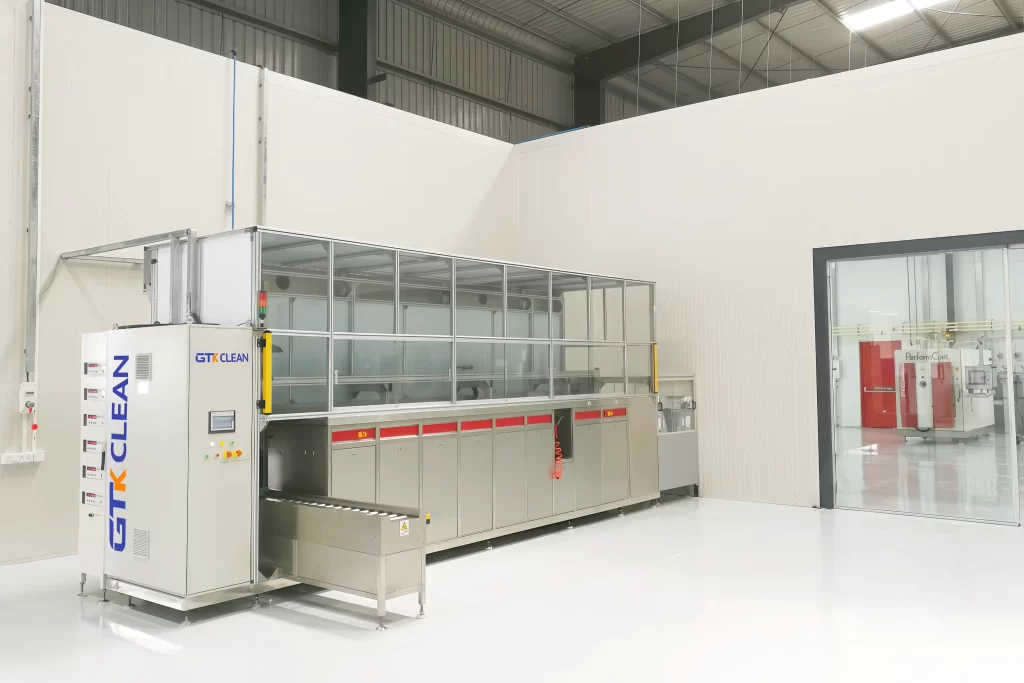
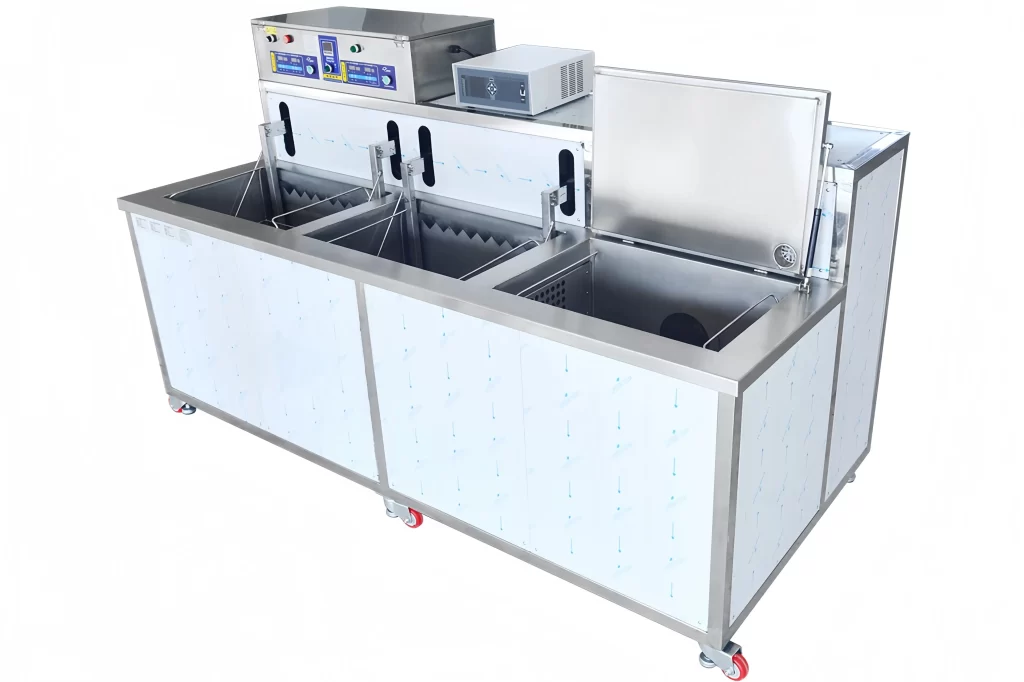
Ultrasonic Cleaning Technology: This method utilizes high-frequency sound waves to create microscopic cavitation bubbles in a liquid. These bubbles implode with tremendous localized force, generating powerful scrubbing action that dislodges contaminants from even intricate geometries and blind holes. Our Pre PVD (Coating) Parts Ultrasonic Cleaners employ multi-stage processes including hydrojet spray, ultrasonic cleaning, multi-stage ultrapure water rinsing, and various drying methods. These systems ensure conductivity ≤ 0.06 μS/cm, preventing secondary contamination. For complex parts, our Rotary Basket Ultrasonic Cleaners provide 360° rotary cleaning, ensuring thorough residue elimination without part collision.
Solvent Cleaning Systems: For specific applications, especially where water-sensitive materials or stubborn organic residues are present, solvent cleaning is highly effective. Our Multi-Tank Hydrocarbon Ultrasonic Cleaners utilize high-purity hydrocarbon solvents. The hydrocarbon molecules have similar polarity to oils and greases, allowing them to dissolve these contaminants rather than simply displacing them. These systems are ideal for degreasing stamped parts and new energy vehicle battery housings, offering precision 360° cleaning for recessed and blind-hole components. They operate at optimized temperatures (40–60°C) for maximum solubility of stamping oils and feature vacuum ultrasonic cleaning for deeper penetration.
Aqueous Cleaning Solutions: These systems use water-based detergents, often combined with heat and mechanical action. Surfactants in the detergent reduce surface tension, allowing the cleaning solution to penetrate beneath contaminant films and lift them from the substrate. Our Ultrasonic Cleaners for CNC Machined Parts integrate high-pressure spray, ultrasonic degreasing, RO water rinse, DI water rinse, and hot air or vacuum drying. This multi-stage approach efficiently removes cutting fluids, chips, burrs, and dust, ensuring high cleanliness for precision-machined components. Similarly, our Ultrasonic Cleaners For Stamping Parts use rough and fine ultrasonic stages with tap/pure/DI water rinsing for thorough contaminant removal.
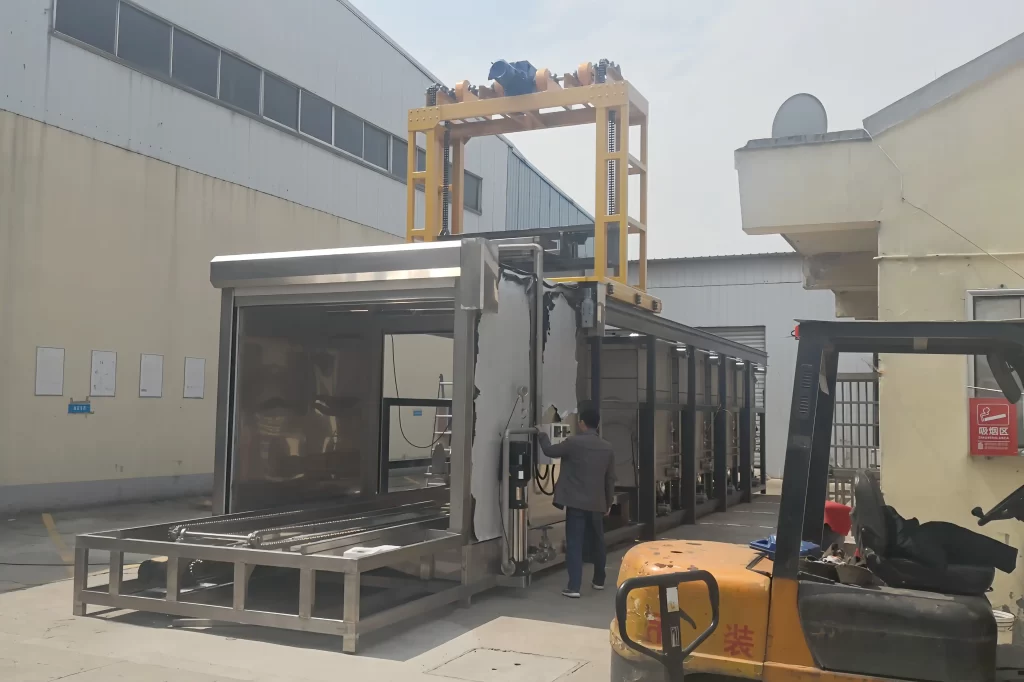
We integrate automated cleaning equipment into our solutions, minimizing manual labor and ensuring consistent quality. This includes fully automatic loading, cleaning, rinsing, and drying processes. Our systems also feature circulation filtration to extend cleaning solution life and reduce consumption of water and detergents.
| Feature | Ultrasonic Cleaning | Solvent Cleaning | Aqueous Cleaning |
|---|---|---|---|
| Mechanism | Cavitation, mechanical scrubbing | Chemical solvency, dissolution | Chemical action, mechanical spray/ultrasonic |
| Residue Types | Particulates, oils, greases, oxides | Oils, greases, waxes, organic films | Oils, greases, particulates, salts, inorganic soils |
| Material Suitability | Most metals, plastics, glass, ceramics | Metals, plastics (solvent-compatible) | Most metals, some plastics (detergent-compatible) |
| Drying Speed | Moderate to fast (with hot air/vacuum) | Very fast (solvent evaporates quickly) | Moderate (requires heat or air knives) |
| Environmental Impact | Low (with proper water treatment) | Requires solvent recovery, emissions control | Low (biodegradable detergents, water treatment) |
| Cost | Moderate (energy, detergent, water treatment) | High (solvent cost, recovery equipment) | Low to moderate (detergent, water, energy) |
How does ultrasonic cleaning compare to solvent cleaning for residue removal?
Ultrasonic cleaning utilizes acoustic cavitation to create microscopic bubbles that implode, generating powerful jets to dislodge contaminants. This mechanical action is highly effective for removing particulates and reaching complex geometries. Solvent cleaning relies on chemical solvency to dissolve organic residues like oils and greases. Ultrasonic cleaning excels with physical contaminants and intricate parts, whereas solvent degreasing is superior for dissolving tough organic films. Often, a combination of both methods offers the most comprehensive residue removal.
For a deeper understanding of the scientific principles behind this technology, consider reading 《What Is the Principle of an Ultrasonic Cleaning Machine?》.
Process Design That Prevents Recontamination
Optimizing pre-coating cleaning processes is critical for achieving flawless results and ensuring coating durability. A well-designed process minimizes defects and maximizes efficiency.
Multi-Stage Cleaning Design: We implement multi-stage cleaning sequences to address various contaminant types progressively. This typically involves initial degreasing, followed by precision cleaning, and then multiple rinsing stages. Our CNC Aluminum Shell Inline Cleaners feature spray degreasing, rinsing, air-knife drying, hot air drying, and cooling. This systematic approach ensures thorough removal of release agents, cutting oils, and surface oxides.
Effective Filtration and Circulation: Continuous filtration systems maintain cleaning fluid purity. This extends the lifespan of the cleaning solutions, reduces chemical consumption, and prevents re-deposition of contaminants onto parts. Our Fastener Tunnel Cleaners incorporate oil-water separation systems that remove over 98% of surface oil, significantly reducing fluid degradation.
Precision Rinsing Techniques: Rinsing is as crucial as cleaning itself. We utilize multi-stage ultrapure water rinsing, often with DI water, to eliminate any residual cleaning agents or dissolved contaminants. Our Pre PVD (Coating) Parts Ultrasonic Cleaners guarantee ultrapure water with conductivity ≤ 0.06 μS/cm. This prevents water spots and secondary contamination, which can compromise coating adhesion.
Optimized Drying Methods: Drying must be complete and residue-free. We employ various drying technologies, including air knives, hot air drying, and vacuum drying, depending on part geometry and material sensitivity. Vacuum drying is particularly effective for parts with deep holes or blind spots, ensuring no moisture is trapped. Trapped moisture can flash to steam during coating application, creating voids and adhesion failures.
Process Control and Monitoring: Advanced control systems, such as Siemens or Mitsubishi PLCs with touchscreen HMIs, enable precise control over temperature, time, and chemical concentrations. Automatic alarms and fault diagnostics ensure consistent performance and prompt issue resolution. This level of automation is crucial for maintaining cleanliness standards.
Corrosion Prevention: For ferrous metals, an optional rust inhibitor can be incorporated into the final rinse or passivation stage. This provides temporary protection against corrosion before coating application.
Regular Equipment Maintenance: Proactive maintenance of cleaning equipment, including tank cleaning, transducer inspection, and filter replacement, is essential. This ensures consistent cleaning efficacy and prolongs the operational life of the system.
By meticulously designing and controlling each step, we ensure optimal process optimization for every application. This comprehensive strategy leads to superior surface preparation and flawless coating results.
What are the best practices for preventing residue buildup in industrial parts cleaning?
Preventing residue buildup involves proactive measures and proper system design. Implement efficient material handling to minimize initial contamination. Regularly monitor and maintain cleaning baths through filtration and chemical analysis to ensure optimal performance. Design cleaning systems with overflow rinsing and closed-loop filtration to prevent re-contamination. Utilize high-quality cleaning baskets that facilitate thorough cleaning and drainage without trapping residues. These practices contribute to consistent cleanliness and reduce the need for extensive rework.
Verification Methods That Confirm Cleanliness
Adherence to stringent cleanliness standards and robust verification methods is paramount in pre-coating parts cleaning. This ensures product quality, reliability, and compliance with industry regulations. As a partner to Global Fortune 500 clients, we understand the critical importance of these measures.
We integrate various quality control protocols and post-cleaning inspection techniques to verify residue absence:
Gravimetric Analysis: This method measures the weight of residual contaminants on a surface. Parts are weighed before and after cleaning, and any weight difference indicates residual matter. This provides a quantitative measure of cleanliness and is particularly useful for tracking process consistency over time.
Surface Tension Tests: Dyne solutions or contact angle measurements assess the surface energy of a part. A high surface energy indicates a clean, wettable surface, crucial for good coating adhesion. Low surface energy suggests residual oils or films that will interfere with coating wetting.
Optical Microscopy and SEM: Microscopic examination allows for visual inspection of surfaces for particulates, stains, or films. Scanning Electron Microscopy provides higher resolution imaging, revealing even sub-micron contaminants that optical methods cannot detect.
Fourier Transform Infrared Spectroscopy: FTIR identifies organic residues by analyzing their molecular absorption of infrared light. This technique is valuable for pinpointing specific types of oils, greases, or polymers left on the surface, helping to identify the contamination source.
Ion Chromatography: This method detects and quantifies ionic contaminants, such as salts, which can lead to corrosion or osmotic blistering under coatings.
Compliance with industry cleanliness standards, such as those from ISO and ASTM, is non-negotiable. These standards provide benchmarks for acceptable levels of surface contamination. ISO 16232 specifies cleanliness requirements for components of fluid power systems, while ASTM F22-02 addresses cleanliness of electronic components.
We also prioritize alignment with environmental regulations in our cleaning processes. Our water treatment systems manage effluent, ensuring responsible discharge and minimizing ecological impact. This commitment to both quality and environmental stewardship provides comprehensive solutions for our clients.
| Standard | Description | Primary Application Areas |
|---|---|---|
| ISO 16232 | Cleanliness of components for fluid power systems | Automotive, hydraulic systems, aerospace |
| ASTM F22-02 | Cleanliness of electronic devices | Electronics manufacturing, medical devices |
| ISO 14644 | Cleanrooms and associated controlled environments | Semiconductor, pharmaceutical, aerospace |
| VDA 19 / ISO 16232 | Technical cleanliness in automotive manufacturing | Automotive components, engine parts |
| AMS 2750 | Pyrometry for heat treatment | Aerospace, defense (indirectly impacts surface quality) |
What are the long-term consequences of inadequate pre-coating cleaning on product quality?
Inadequate pre-coating cleaning leads to severe long-term consequences, primarily impacting product durability and performance. Premature coating delamination exposes the part to environmental degradation, and corrosion under film significantly reduces the product's lifespan. Manufacturing defects stemming from poor surface preparation often lead to increased warranty claims and costly rework, ultimately damaging brand reputation and customer trust.
Partner with GTKCLEAN for Superior Cleaning Solutions
As a globally leading manufacturer with 20+ years of R&D and 28 technical patents, Suzhou Grintek Environmental Technology Co.,Ltd. (GTKCLEAN) offers unparalleled expertise in industrial cleaning. We provide advanced, automated solutions tailored to your specific needs, ensuring ultimate residue elimination and flawless coating performance. Contact us today at [email protected] or +86 17768507147 for a consultation on optimizing your pre-coating parts cleaning processes and achieving superior residue elimination.
What is the most effective method to eliminate residue from complex geometries in pre-coating parts cleaning?
For complex geometries, ultrasonic cleaning technology combined with specialized aqueous cleaning solutions is often the most effective. The cavitation action of ultrasonic waves can reach intricate areas that mechanical or spray cleaning might miss, ensuring thorough residue elimination and optimal surface preparation for coating.
How can I measure the effectiveness of my residue elimination process to ensure coating adhesion?
Measuring effectiveness involves various post-cleaning inspection techniques such as surface tension tests, gravimetric analysis, and optical microscopy. Adhering to specific cleanliness standards and implementing robust quality control protocols are crucial to verify residue-free surfaces and guarantee strong coating adhesion.
Are there environmentally friendly options for eliminating stubborn residue in industrial parts cleaning?
Advancements in aqueous cleaning solutions and solvent cleaning systems have led to more environmentally friendly options. Modern industrial detergents are often biodegradable, and closed-loop solvent cleaning systems minimize emissions. GTKCLEAN also offers water treatment systems to manage effluent, aligning with stringent environmental regulations while ensuring effective residue elimination.
 English
  German
  Spanish
  French
  Russian
  Portuguese