
When a precision manufacturer moves from batch to inline cleaning, the most common mistake is treating the system as a commodity rather than a process that must integrate with part geometry, contaminant load, and downstream finishing. Inline cleaning systems can boost throughput significantly, but only when configured to the parts you actually run. Over two decades of designing these lines, I’ve repeatedly seen three configuration errors produce chronic quality issues: mismatched cleaning method, insufficient rinsing, and undersized drying. Getting these decisions right (not just accepting a standard catalog machine) determines whether your line cleans consistently or generates constant nonconformances.
What Are Inline Cleaning Systems in Precision Manufacturing?
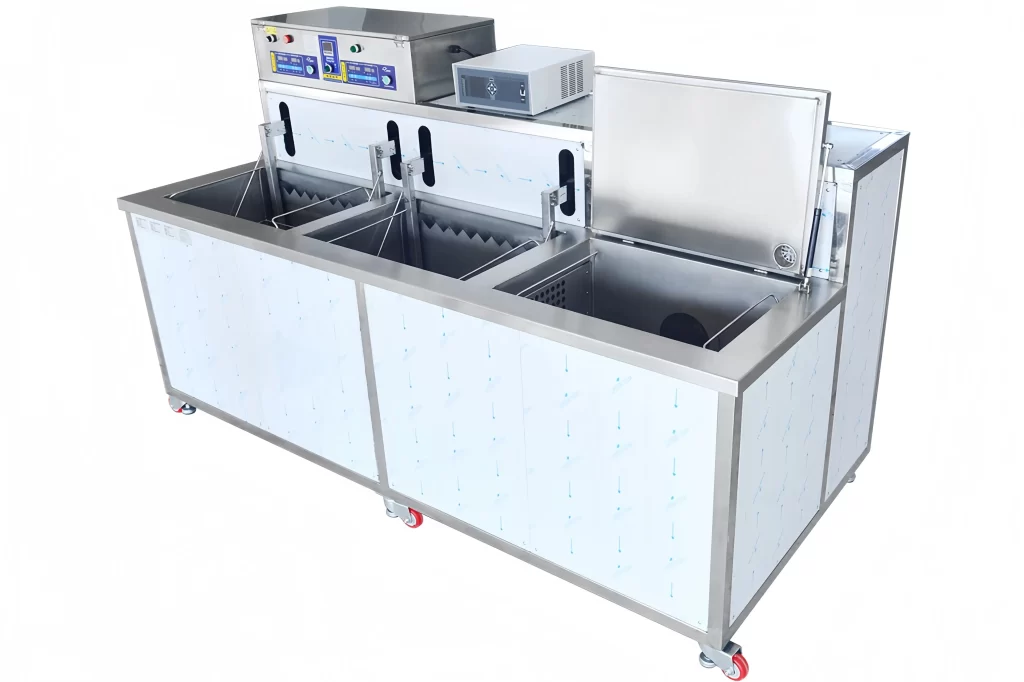
Inline cleaning systems automate the movement of parts through a sequence of wash, rinse, and dry stages using a conveyor. In precision manufacturing, these systems must remove cutting fluids, chips, and surface residues to meet tight cleanliness standards—often particle counts under 100 microns for assemblies or zero-residue specifications for pre-coating applications. I’ve designed lines that handle everything from aluminum die-cast housings to hardened steel fasteners, and the configuration always starts with understanding the specific contaminant and the final cleanliness requirement. A typical system might combine high-pressure spray for gross oil removal with ultrasonic immersion for fine particles, followed by de-ionized water rinses. The conveyor speed, nozzle placement, and drying method are all tuned to the part’s geometry and material. Without this customization, even a well-built system will fail on certain part types.
Aqueous vs Solvent: Which Inline Cleaning System Fits Your Parts?
The choice between aqueous (water-based) and solvent cleaning determines much of your system design. Aqueous systems use heated water with detergents and are well-suited for water-soluble coolants and general soils. They require more rinsing and drying capacity, and the waste stream needs treatment. Solvent cleaning—using hydrocarbons or modified alcohol—excels at removing oily soils, especially from complex geometries with blind holes. Solvents penetrate tight spaces and dry more quickly, often under vacuum, reducing the risk of water spots. For many precision applications, solvent inline systems deliver cleaner results with lower post-process handling.
| Parameter | Aqueous System | Solvent System (Hydrocarbon/Modified Alcohol) |
|---|---|---|
| Cleaning mechanism | Detergent + mechanical action (spray/ultrasonic) | Solvent dissolves oils, often with ultrasonic |
| Part types | Non-sensitive metals, simple geometries | Precision parts, complex shapes, blind holes |
| Drying | Hot air, air knife, more time | Faster, vacuum-assisted, minimal spotting |
| Environmental | Wastewater treatment needed, VOC-free | Solvent recovery system required, VOC emission control |
| Cost | Lower chemical cost, higher water/energy | Higher solvent cost, recovery reduces consumption |
In one project for a client machining aluminum parts with deep pockets, we switched from an aqueous spray line to a hydrocarbon solvent system with vacuum drying after persistent contamination issues. The solvent dissolved the cutting oils completely, eliminating a rework rate that had been above 8%. If your parts have blind holes or internal passages, it is worth evaluating solvent cleaning even if you’ve been using aqueous—the reduction in rejects often justifies the higher consumable cost.
If your program involves parts with deep recesses or stringent residue specifications, confirming the right cleaning medium before finalizing the system design can save months of troubleshooting. Reach out at [email protected] with a sample drawing and we’ll recommend a suitable wash chemistry.
What Key Factors Shape an Inline Cleaning System Configuration?
Beyond chemistry, conveyor speed, temperature, and ultrasonic frequency are all critical. I’ve found that many plants set conveyor speeds based on desired throughput rather than the time needed for adequate cleaning. The result is parts emerging before the cleaning solution has done its work. A better approach is to define the minimum immersion or spray time required for your dirtiest part, then size the line to meet throughput at that speed. Ultrasonic frequency also matters: lower frequencies (20–25 kHz) produce more aggressive cavitation for heavy soils, while higher frequencies (40–80 kHz) are gentler and penetrate small crevices better. For precision parts with fine features, we often use dual-frequency systems that combine a high-power wash at low frequency with a fine rinse at higher frequency.
Temperature control is another underestimated factor—if the rinse water is too cold, it can shock the part and cause flash rust. We typically maintain rinses within 5°C of wash temperature.
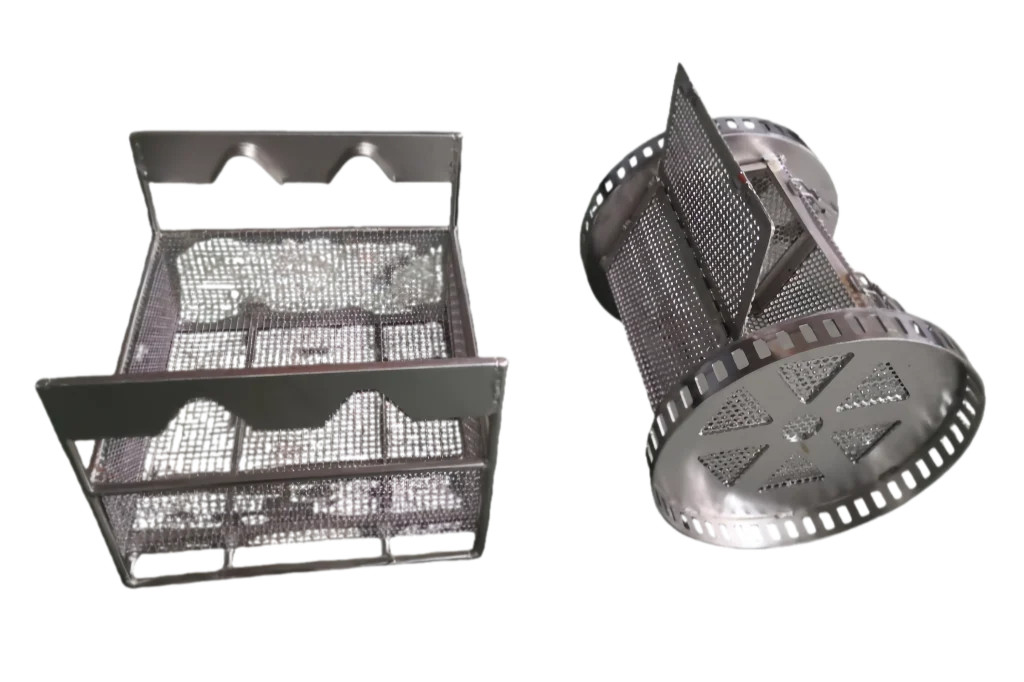
The baskets or fixtures that hold parts are another design element that directly impacts cleaning uniformity. Custom baskets that orient parts to avoid pooling and ensure drainage are often the difference between meeting specification and failing validation. I’ve seen an entire line’s performance improve by 30% after redesigning the baskets to minimize part-on-part shadowing.
How Do You Integrate Inline Cleaning into an Existing Production Line?
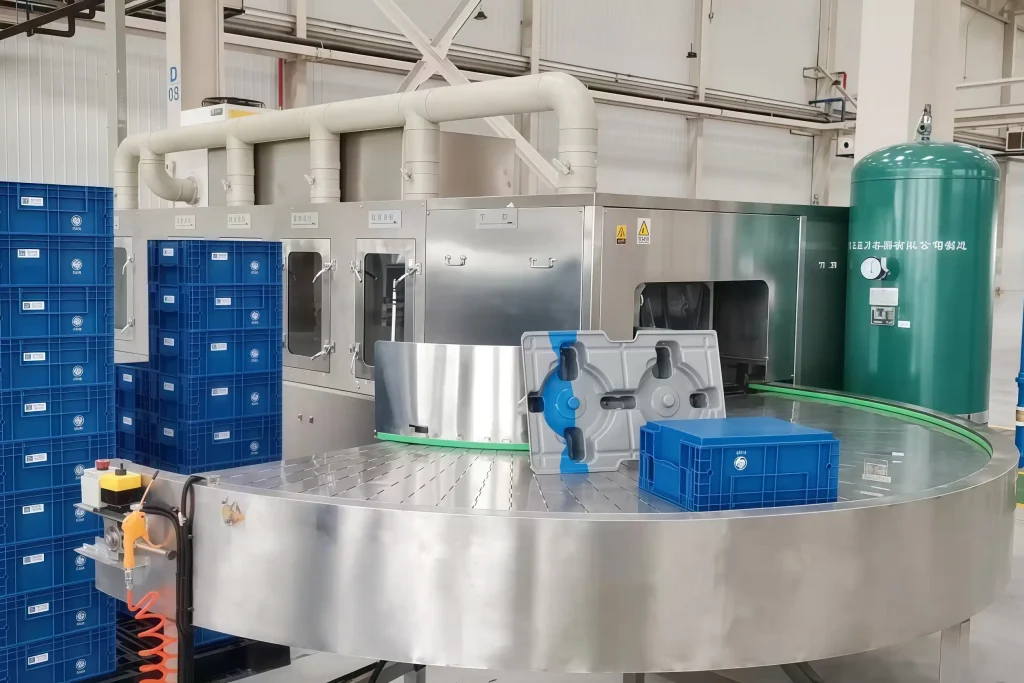
Integration starts with mapping how parts flow from the upstream machine tool or forming press to the cleaning system. You want to minimize manual handling and avoid cross-contamination. For CNC machining cells, we often position the inline cleaner immediately after the machine, with a buffer conveyor that accumulates parts so the machining cycle and cleaning cycle don’t have to be perfectly synchronized. The cleaning system’s loading station should be aligned with the discharge of the previous operation. In one line we built for stamped steel components, parts were fed directly from a progressive stamping press onto a magnetic conveyor that dropped them into the wash station—zero manual handling.
If space is tight, a pass-through tunnel design can be the answer, where parts move straight through on a belt. For larger or heavier components, we use powered roller conveyors and lift stations. The key is to design the interface so that the cleaning system’s uptime matches the production cell’s. When the cleaning system goes down, the whole line stops—reliability becomes a top priority.
We also recommend including a buffer zone with enough capacity to allow 5–10 minutes of cleaning interruptions without stopping upstream production. This avoids the domino effect of a short cleaning stoppage shutting down a machining cell.
How to Validate Your Inline Cleaning Process for Precision Requirements
Validation shouldn’t be an afterthought. For precision manufacturing, you need to prove that the system consistently achieves the required cleanliness level. Standards like ISO 16232 for automotive components or VDA 19 define particle count methods. I typically specify a validation protocol during the design phase: we run a set of intentionally contaminated parts through the system, then measure residues using gravimetric analysis or particle counting. Acceptable limits are agreed with the customer beforehand. For a medical implant manufacturer, we ran multiple test batches with different contaminant loads and part orientations, which confirmed the system met the spec across a range of conditions.
A common mistake is to validate with only perfectly shaped test parts. Real production parts vary—slightly different burrs, tool wear residues, or mixed batches. So we always include a worst-case scenario sample in the validation. If parts have threads or blind holes, we check those areas specifically after cleaning, often using borescopes or extraction tests. Documenting the validation results and the standard operating procedures then transfers to the plant’s quality system. When the line is handed over, the operators know exactly how to maintain the process and what to monitor.
Engineering a System That Fits Your Parts—Not a Catalog
Inline cleaning for precision manufacturing is not a one-size-fits-all proposition. The right system is one that is configured to your specific part geometry, contaminant, throughput, and cleanliness standard. At GTKCLEAN, we design each line around the parts you run—from selecting the wash medium to specifying basket orientation and drying method—so you get consistent results from day one.
To start the process, send us your part drawings, material, target throughput, and cleanliness specification to [email protected], or call +86 17768507147. Based on your specific requirements, we’ll propose a system concept with estimated cycle times and integration points. There is no obligation—just an engineering discussion focused on solving your cleaning challenges.
Common Questions About Inline Cleaning for Precision Parts
What is the minimum production volume for an inline cleaning system?
There is no hard minimum; the system can be built for any throughput. However, inline systems become cost-effective when labor savings and reduced scrap outweigh the capital cost and floor space. For fewer than 500 parts per shift, a semi-automated batch system often yields a better return. We can help you calculate the break-even point if you share your current method and per-part cleaning costs.
Can an inline system clean multiple part types without cross-contamination?
Yes. With PLC-controlled recipes, you can store process parameters for different part numbers—adjusting conveyor speed, wash time, and temperature. Quick-change tooling on conveyors or dedicated baskets allow you to switch between part families quickly. During design, we size the system for the most demanding part, then the recipes scale down for less critical ones. A well-designed system should clean the dirtiest part you run without compromising the throughput of cleaner parts.
Is an inline cleaning system harder to maintain than a batch system?
It depends on the design. An inline system has more moving parts—conveyors, pumps, spray nozzles—but a well-engineered system should require no more maintenance than a batch system. We design with quick-access panels and standard components to minimize downtime. The main difference is that when an inline system goes down, your production line stops, so reliability engineering is critical. We overspec pumps and motors and include redundancy in key circuits. If you’re concerned about uptime, discuss your maintenance team’s capabilities with us before the design is finalized.
How do you keep the cleaning process within spec over time?
Process monitoring is built into modern inline systems. We install conductivity sensors on rinse water, temperature probes on wash tanks, and flow meters on spray nozzles. If a parameter drifts outside limits, the PLC alerts operators or automatically pauses the line. We also recommend a quarterly validation check using test coupons or production parts to verify cleanliness levels haven’t degraded. For critical applications, we can set up automated data logging that integrates with your plant’s quality system. The system should not just clean today—it should stay consistent for years. If you want to see how we incorporate monitoring into a line, send your requirements to [email protected] and we’ll include example process control specifications.
If you're interested, check out these related articles:
Multi-Tank Ultrasonic Cleaning: A Deep Dive into Industrial Configurations
Industrial Cleaning Baskets: Why They Matter for Your Parts Washing Efficiency
How to Choose the Best Ultrasonic Power for an Ultrasonic Cleaning Machine ?
 English
  German
  Spanish
  French
  Russian
  Portuguese