
For operators of diesel-powered generators, marine engines, or heavy trucks, a decline in SCR catalyst activity is never just an instrumentation reading. It means higher NOx emissions, possible non-compliance penalties, and expensive unscheduled downtime. SCR catalyst ultrasonic cleaning systems use controlled cavitation and multi-stage rinsing to remove the soot, ash, and sulfate deposits that choke catalyst channels and poison active sites. When designed correctly, these systems restore NOx conversion efficiency to near-new levels without attacking the underlying titanium dioxide or vanadium-based washcoat. I’ve spent more than two decades designing industrial ultrasonic cleaning equipment, and the single most common path to failure I’ve observed is not insufficient cleaning—it’s cleaning that erodes the catalyst substrate because someone skipped the engineering fundamentals.
How Ultrasonic Cleaning Restores SCR Catalyst Performance
SCR catalysts degrade primarily through physical blockage and chemical poisoning. Exhaust flows through thousands of narrow square channels in a ceramic monolith, and over time, carbonaceous soot, lube oil ash, and ammonium sulfate/bisulfate compounds accumulate on and within the porous washcoat. These deposits block active sites and restrict exhaust flow, increasing backpressure and reducing NOx conversion.
Ultrasonic cleaning addresses this by generating cavitation bubbles in a liquid cleaning medium. When an ultrasonic transducer emits high-frequency sound waves (typically 20–80 kHz), it creates alternating compression and rarefaction cycles in the liquid. During the rarefaction phase, microscopic vapor cavities form and subsequently collapse violently during compression. The collapse produces localized temperatures above 5000°C and pressures exceeding 1000 atmospheres, creating micro-jets that scrub the catalyst surface. In SCR honeycomb structures, these implosions dislodge particulate matter and dissolve soluble contaminants without mechanical abrasion.
The key here is that cavitation works at a microscopic scale, reaching into the catalyst pores where soot and sulfates accumulate. Unlike manual brushing or high-pressure spray, ultrasonic energy penetrates the entire channel length, cleaning the inner walls uniformly. The process does not rely on direct contact; it’s the liquid itself that does the work.
What Components Typically Fail During SCR Operation?
The degradation is not uniform. The front face of the catalyst sees the highest particulate loading, while the rear sections suffer more from ammonium sulfate crystallization because temperatures are lower. In marine applications using high-sulfur fuels, sulfate poisoning can be rapid, sometimes reducing activity by 20–30% within 2,000 operating hours.
How Cavitation Removes Deposits Without Abrasion
The cavitation bubble collapse is confined to the liquid boundary layer; the solid substrate receives only the micro-jet impulse, not direct mechanical impact. This is why ultrasonic cleaning can be used repeatedly without measurable substrate mass loss—provided the frequency and power density are appropriately matched to the catalyst coating hardness.
Designing an Ultrasonic Cleaning System for SCR Catalysts
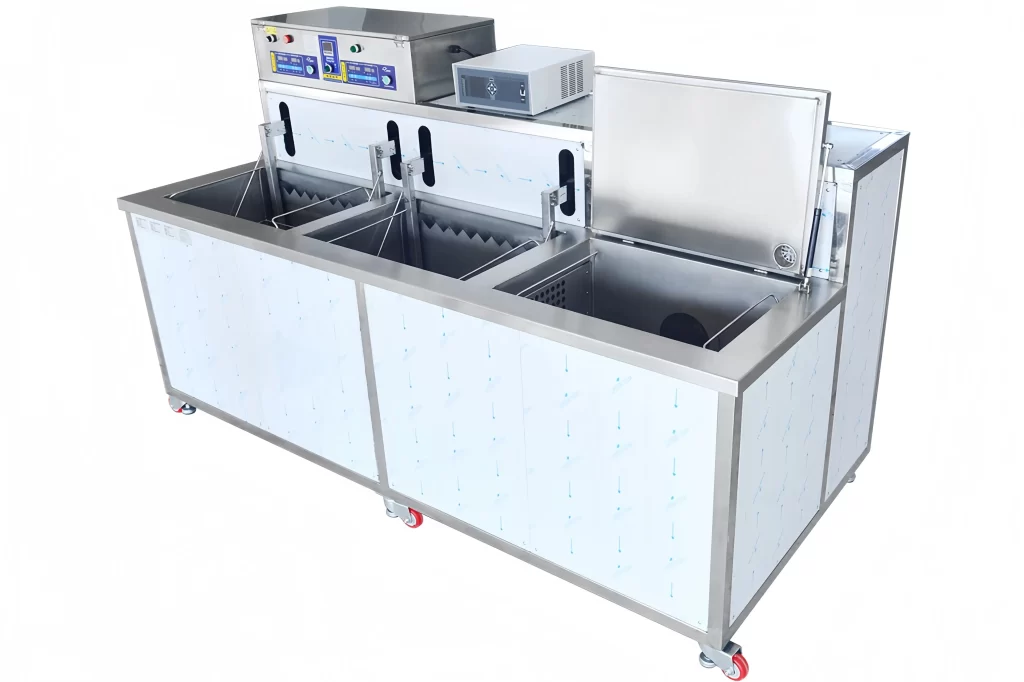
The cleaning system must be engineered around the catalyst module’s dimensions, material, and fouling type. Off-the-shelf benchtop units are not designed for the mass and channel geometry of a full-size SCR catalyst, and attempting to use them will result in uneven cleaning and likely damage.
Tank and Transducer Configuration
For large SCR catalysts—some weighing over 100 kg—we use rectangular tanks with stainless steel construction (SUS304 or 316) and multiple transducer arrays bonded to the tank bottom and sides. The transducer placement is critical to create a uniform sound field across the entire catalyst face. We typically bond 28 kHz or 40 kHz piezoelectric transducers in a staggered pattern to avoid standing waves and hot spots. For catalysts with delicate coatings, we lower the frequency to 40 kHz, which produces gentler cavitation with smaller bubble implosion energy. For robust metal-substrate catalysts, 28 kHz offers more aggressive cleaning.
Multi-Stage Cleaning Process
An effective SCR catalyst cleaning system is not a single tank. It requires a process train that includes:
1. Pre-wash: removal of loose soot and ash using filtered water.
2. Ultrasonic degreasing: high-efficiency detergent solution at 45–60°C, with ultrasonic irradiation for 5–10 minutes per section.
3. RO water rinsing: multiple rinses with reverse-osmosis water to eliminate detergent and dissolved contaminants.
4. Passivation or corrosion protection (optional): for catalysts that will be stored before reinstallation.
5. Drying: warm air or vacuum drying to remove moisture from deep channels without leaving water spots.
Each stage is essential. Skipping the pre-wash shortens the ultrasonic bath life; skipping thorough rinsing leaves surfactant residue that can block pores upon drying.
Water Treatment and Rinsing Systems
The quality of the rinse water directly affects the final cleanliness. We integrate deionized (DI) water systems with conductivity monitoring, typically aiming for ≤5 μS/cm. This prevents mineral deposits from forming inside the catalyst channels after drying. Recirculation filtration with 5-micron bag filters extends the cleaning solution life and reduces waste.
Critical Parameters for Effective SCR Catalyst Cleaning
If three variables are set incorrectly, even a well-built system will damage the catalyst or fail to clean it adequately. Those are frequency, power density, and chemistry.
Choosing the Right Frequency
| Frequency | Type | Cavitation Bubble Size | Best For |
|---|---|---|---|
| 20–25 kHz | Low-frequency | Large, energetic | Heavy soot, robust metal-substrate catalysts |
| 28–30 kHz | Mid-frequency | Moderate | Standard ceramic-substrate catalysts with moderate fouling |
| 40 kHz | High-frequency | Smaller, gentler | Delicate washcoats, vanadia-based catalysts, repeated cleaning |
| 68–80 kHz | Very high-frequency | Micro-cavitation | Precision cleaning of catalyst micro-pores, final rinse degassing |
For most SCR catalyst cleaning applications, we recommend 40 kHz as the starting point. It provides adequate cleaning energy while minimizing the risk of washcoat erosion. In our own designs, we offer adjustable generators so operators can switch between 28 kHz and 40 kHz depending on the catalyst condition assessed during inspection.
Power Density and Temperature Control
Power density (watts per liter) must be matched to the tank volume and part load. For SCR catalysts with ceramic substrates, we typically use 10–20 W/L. Higher power densities can accelerate cleaning but risk substrate damage if not carefully controlled. The cleaning solution temperature is maintained at 45–65°C; this improves detergent activity and reduces cavitation threshold, making the process more efficient. Overly high temperatures degas the liquid and reduce cavitation intensity.
Cleaning Solution Compatibility
The cleaning chemistry must dissolve ammonium sulfate compounds and break down carbonaceous deposits without attacking the catalyst washcoat or the cordierite substrate. We generally use alkaline detergents with surfactants and chelating agents, pH 10–12. Solvents like hydrocarbon or modified alcohol are not typically used for SCR catalyst cleaning because they don't address water-soluble salts and pose fire risks. However, for heavy oil fouling, a solvent pre-wash might be considered separately.
Integrating Ultrasonic Cleaning into SCR Maintenance Operations
Online vs. Offline Cleaning
SCR catalyst cleaning is almost always an offline process—the catalyst module is removed from the exhaust system and transported to a cleaning facility. Some research explores in-situ cleaning using ultrasonic transducers mounted directly on the catalyst housing, but those methods are not yet proven for production environments. Currently, offline cleaning with a dedicated system offers the most reliable outcome.
Automation and Loading Systems
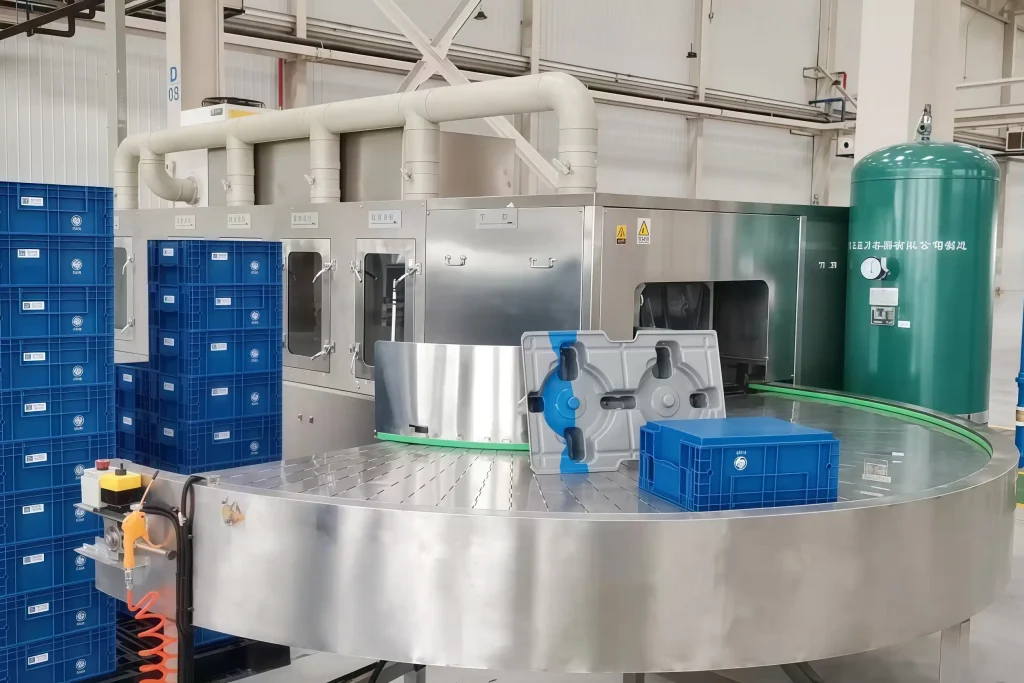
For large-scale maintenance providers, we build automated washing lines with robotic arms that load and unload catalyst modules. The process is fully PLC-controlled (Siemens or Mitsubishi), with recipe storage for different catalyst models. A typical cycle for a 150 kg SCR catalyst includes 10 minutes of pre-wash, 12 minutes of ultrasonic cleaning, three 3-minute rinses, and 15 minutes of hot air drying. Total cycle time is around 45–50 minutes.
Wastewater Management
The cleaning process generates wastewater loaded with heavy metals, sulfates, and oils. Regulations in most regions require treatment before discharge. We integrate low-temperature evaporation systems or chemical precipitation units to concentrate solids for disposal and recycle water, achieving near-zero liquid discharge in many installations. The oil-water separator captures floating hydrocarbons for proper disposal.
Evaluating System ROI and Selecting a Reliable Supplier
Cost of Ownership vs. Replacement
A new large SCR catalyst for a marine engine can cost USD 20,000–60,000 or more. Cleaning, including logistics, typically costs 10–20% of replacement. With proper process control, cleaning can be repeated multiple times, extending catalyst life by 3–5 years. Thus, the payback period for a cleaning system investment is often less than two years, even for moderate fleet sizes.
However, not all cleaning services are equal. I’ve seen third-party shops using generic hydrocarbon ultrasonic cleaners meant for machined parts, unaware that the solvents leave residues that actually accelerate sulfate formation. A system designed specifically for SCR catalysts with water-based chemistry and thorough rinsing is non-negotiable.
Supplier Qualification Checklist
When evaluating ultrasonic cleaning equipment for SCR catalysts, look for:
- Proven installations in the SCR remanufacturing sector, preferably with references.
- Capability to provide a complete process: pre-wash, ultrasonic, multi-stage rinsing, and forced drying.
- Water treatment integration, including DI water and wastewater handling.
- Custom engineering to fit your catalyst models, not just off-the-shelf tanks.
- After-sales support with remote diagnostics and spare parts availability.
- Certifications: ISO 9001 at minimum; CE marking for European operations.
Move Forward with an Engineered SCR Catalyst Cleaning System
If your fleet is experiencing rising NOx emissions, increased backpressure, or compliance thresholds that are getting harder to meet, the underlying cause is often catalyst fouling rather than catalyst age. The right cleaning system can restore performance and avoid a full replacement—but only if the system is designed for SCR substrates, not repurposed from general parts washing. GTKCLEAN engineers each SCR cleaning system from the ground up, matching tank dimensions, transducer arrays, rinse water quality, and drying method to your specific catalyst models. Send your catalyst specifications and typical throughput to [email protected] or call +86 17768507147, and we will provide a system recommendation based on your operating conditions and expected cleaning volume.
Common Questions About SCR Catalyst Ultrasonic Cleaning
How often should an SCR catalyst be ultrasonic cleaned?
The answer depends on fuel sulfur content, exhaust temperature, and engine load profile. In marine engines burning 0.5% sulfur fuel, we generally recommend inspection at 8,000–12,000 operating hours. If activity has dropped more than 15%, cleaning is warranted. For land-based power plants using ultralow-sulfur diesel, the interval may extend to 24,000 hours.
Can ultrasonic cleaning damage the catalyst substrate?
No. In our experience, properly designed 40 kHz systems show no measurable substrate erosion even after 10 cleaning cycles. Damage occurs when operators use excessive power or incorrect chemistry that attacks the washcoat binder. The cavitation energy is absorbed by the liquid boundary layer, not the solid, so the key is staying within the recommended frequency and power density range for the specific catalyst coating.
Are cleaning and regeneration the same thing?
The terms are often confused, but they are not interchangeable. Cleaning removes physical contaminants (soot, ash, salts) that block active sites. Regeneration implies a thermal or chemical treatment to restore the catalytic metal dispersion, which ultrasonic cleaning does not do. For most SCR catalysts deactivated by fouling, ultrasonic cleaning suffices to restore performance without any supplementary regeneration step.
How do I know if my cleaning process is working?
We look at NOx conversion efficiency before and after cleaning. The most reliable indicator is a before/after measurement on a test bench under controlled flow and temperature conditions. A well-cleaned catalyst should return to within 90% of its original conversion efficiency. We also recommend borescope inspection of channel interiors and washcoat analysis via XRF to confirm deposit removal.
Should I purchase my own cleaning system or use a third-party service?
The decision hinges on annual catalyst volume and in-house maintenance capability. If you process fewer than 20–30 large catalysts per year, a service provider with dedicated SCR cleaning equipment is more economical. If you have a fleet of 50+ large engines or operate as a catalyst remanufacturer, an in-house system pays back quickly. In either case, verify that the equipment is specifically designed for SCR catalysts, not repurposed general-purpose washers. If you need help assessing your specific requirements, share your catalyst specifications and typical throughput with us at [email protected], and we will confirm whether an in-house system or a service arrangement makes the most financial sense for your operation.
If you're interested, check out these related articles:
Industrial Cleaning Baskets: Why They Matter for Your Parts Washing Efficiency
Justify Ultrasonic Cleaning Equipment Investment: A Strategic ROI Guide
 English
  German
  Spanish
  French
  Russian
  Portuguese