
When electronic assemblies fail due to contamination, the root cause is often inadequate cleaning, not component defects. Ultrasonic cleaning for electronics can remove flux residues, particulates, and films that conventional washing leaves behind, but only when the system is engineered for the specific demands of electronic components. Controlling frequency, power density, and chemistry while integrating proper rinsing and drying directly determines whether the process improves reliability or introduces new failure modes. I’ve seen production lines where switching from manual solvent wiping to an automated ultrasonic system with deionized water rinsing raised first-pass yield by over 15%, simply because contamination that was invisible under shop lighting finally got removed. This article examines the system‑level parameters—from transducer selection to contamination control—that make the difference.
How Does Ultrasonic Cleaning Work for Electronics?
In an industrial cleaner, piezoelectric transducers bonded to the tank floor vibrate at ultrasonic frequencies, generating pressure waves in the liquid. These waves create microscopic vacuum bubbles that collapse violently near solid surfaces—a mechanism known as cavitation. As the bubbles implode, they dislodge flux, solder balls, dust, and thin films from component leads, under chip capacitors, and inside plated through‑holes.
For electronics, the cleaning energy must be controlled precisely because too much cavitation can erode bond wires or crack ceramic chip packages. The key parameter is frequency. Lower frequencies, around 20 to 40 kHz, produce larger, more energetic bubbles suited for heavy contamination on robust substrates. Most electronics applications perform better at 40 to 80 kHz, where cavitation intensity is moderate and less likely to damage fine‑pitch assemblies. For advanced packages like flip‑chip or MEMS devices, megasonic cleaning operating above 100 kHz delivers gentle particle removal without mechanical stress. Power density, typically measured in watts per liter of tank volume, also matters—higher density accelerates cleaning but demands careful fixture design to avoid “hot spots” that concentrate ultrasonic energy on a single board.
What Frequency Is Safest for Electronic Assemblies?
There is no single safest frequency; the right choice depends on the component mix. High‑voltage power modules with heavy‑gauge copper lead frames can tolerate 40 kHz without damage. A mixed‑technology SMT board with 0201 passives and fine‑pitch QFPs will be safer at 68 to 80 kHz. For wafer‑level packages or fragile sensors, megasonic rinsing at 200 to 400 kHz is the norm. The mistake I see most often is selecting a 28‑kHz system because it cleans fast, then discovering lifted components after the first few batches. Validate the frequency on sample assemblies before committing to a full system.
Which Cleaning Chemistry Is Compatible with Electronics?
Chemistry matters as much as ultrasonics, and the wrong choice can corrode exposed copper, dissolve component markings, or leave conductive residues. For most electronics, aqueous cleaning with a mild alkaline detergent is the workhorse. The detergent saponifies rosin‑based fluxes and emulsifies oils, while the ultrasonic action provides mechanical release. The critical follow‑up is rinsing: without a thorough deionized water rinse, ionic contamination from the detergent itself can remain on the board. A final rinse resistivity above 10 MΩ·cm is typical for commercial electronics; for high‑reliability aerospace or medical devices, 18 MΩ·cm is the target.
Solvent cleaning, historically using CFCs, has shifted toward modified alcohols and hydrocarbon‑based solvents in sealed vacuum systems. These offer excellent drying performance and are compatible with water‑sensitive components, but the equipment is more complex and requires solvent recovery systems to manage cost and environmental compliance. For a standard PCB assembly line, aqueous cleaning usually wins on operating cost and simplicity.
Is Ultrasonic Cleaning Safe for PCB Assemblies?
Yes, when frequency, chemistry, and rinse‑drying are matched to the board. Start with a process qualification: run a few boards and inspect under magnification for lifted pads, cracked MLCCs, or wire bond deformation. Confirm ionic cleanliness with a resistivity of solvent extract test per IPC‑TM‑650. If your design includes water‑soluble flux, aqueous ultrasonic cleaning is often the most effective way to meet those cleanliness standards without the fire hazard of solvent‑based manual benches.
How Do You Choose Between Benchtop and Inline Systems?
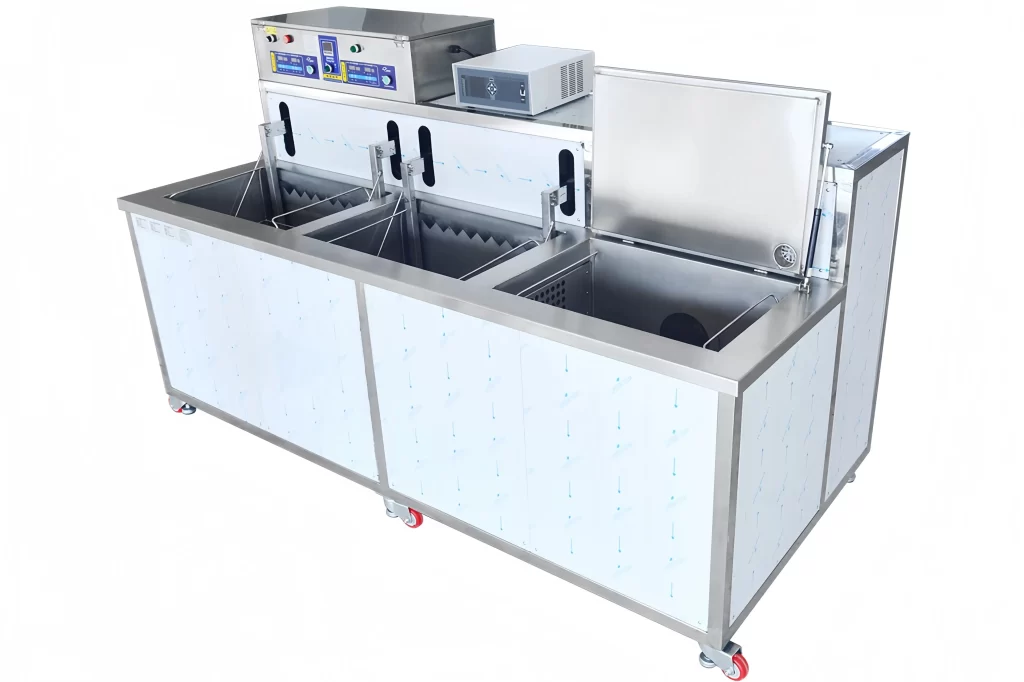
The selection turns on production volume, board size, and line integration. Benchtop ultrasonic cleaners, ranging from 30 L to 180 L, work well for prototype cleaning, repair stations, and small‑batch production. They are manual load‑unload and typically combine ultrasonic wash with a static rinse and warm air drying. Their limitation is consistency: the operator controls dwell time, and drying quality depends on how carefully parts are blown off.
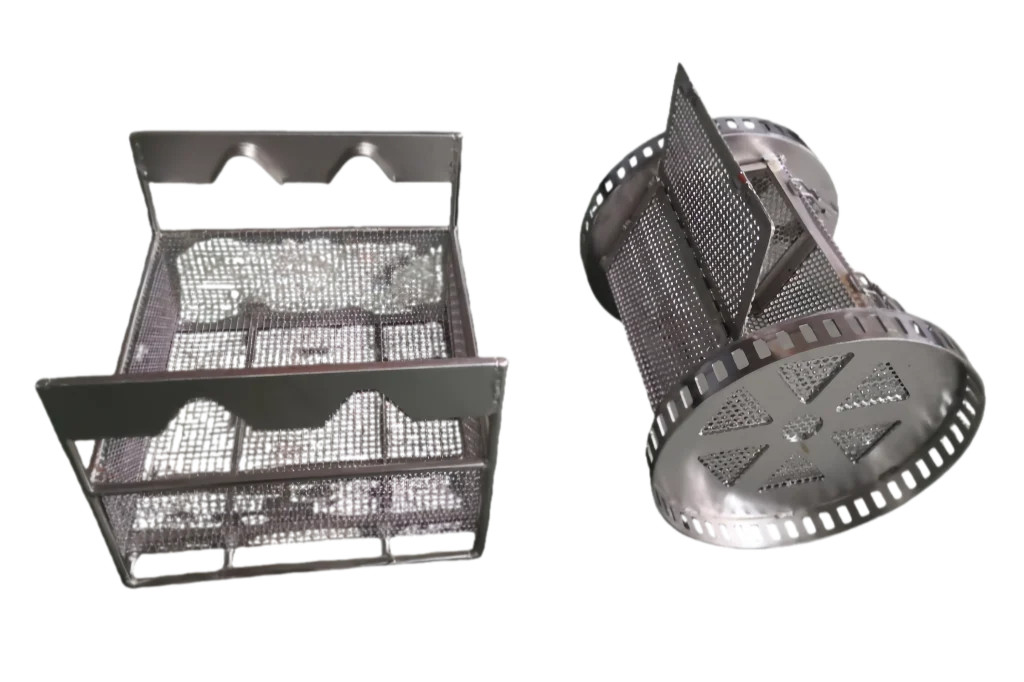
Once production rises above about 50 boards per shift, a semi‑automated multi‑tank system becomes practical. These use a diagonal basket lift or robotic transfer to move parts through a sequence of ultrasonic wash, cascade rinses, and hot air or vacuum drying. The environment stays sealed, solvent‑based options can include vacuum distillation for solvent recovery, and the process runs on a PLC with stored recipes. For high‑volume SMT lines where cleaning must keep pace with pick‑and‑place placement, inline conveyorized systems integrate directly after reflow. Inline systems spray wash and ultrasonic immersion sections along a belt, followed by air knife and hot air drying, feeding cleaned boards directly to the next operation.
| System Type | Typical Volume | Integration | Cleaning Quality Control |
|---|---|---|---|
| Benchtop | Up to ~50 boards/day | Manual off‑line | Operator‑dependent |
| Multi‑tank batch | 50–500 boards/day | Standalone | PLC‑controlled, consistent |
| Inline conveyor | 500+ boards/day | In‑line with SMT | Fully automated, repeatable |
What Makes an Ultrasonic Cleaning System Production‑Ready?
A production‑ready system means more than a tank with transducers. It requires engineered fluid management that keeps the cleaning solution clean and the rinse water pure, plus drying that leaves no water spots. Here are the elements that define a reliable electronics cleaning system.
Multi‑tank architecture. Separating wash, primary rinse, and final rinse prevents cross‑contamination. In a single‑tank system, detergent residue inevitably redeposits during draining. A three‑ or four‑tank configuration—ultrasonic wash, deionized water rinse, second deionized rinse, drying—dramatically improves final ionic cleanliness. Inline systems add a chemical isolation zone between wash and rinse sections.
Sustainable filtration and water treatment. A circulating pump with bag or cartridge filters (10 µm down to 1 µm) captures dislodged particles and extends bath life. For rinse stages, a closed‑loop deionized water system with mixed‑bed resin cartridges or reverse osmosis maintains resistivity automatically. This keeps rinse water quality stable across multiple shifts and cuts water consumption compared to single‑pass flow.
Drying without recontamination. Electronics cannot simply be blown off with compressed shop air—it introduces oil aerosols and static. Production systems use heated filtered air knives, high‑volume hot air circulation, or vacuum drying chambers that pull moisture from under BGAs and inside connector housings. A well‑designed system will dry a dense board to a residual moisture level below 10 µg/cm², confirmed by a humidity sensor at the exit.
Process control and traceability. A PLC with touchscreen HMI stores recipes that lock in ultrasonic power, temperature, dwell time, and rinse flow rates. This eliminates operator variability and creates a data log for quality audit. Remote access allows engineers to adjust programs and diagnose faults without being on the factory floor.
How to Validate Cleanliness After Ultrasonic Cleaning?
The standard method is resistivity of solvent extract (ROSE) following IPC‑TM‑650. A quick‑check alternative is a direct resistivity measurement of the final rinse tank, which gives real‑time feedback. For high‑reliability products, automated optical inspection after cleaning can catch visible residues, but a periodic ionic contamination test is still required to catch invisible films that affect conformal coating adhesion.
If your cleaning process targets aerospace or medical electronics where cleanliness specifications are audit‑level, it is worth confirming the system design against those requirements early. Send us your cleanliness specification and we will confirm whether the tank configuration and rinse stages can meet it consistently.
How to Justify the Investment in Automated Ultrasonic Cleaning
The business case builds on three hard numbers: labor reduction, yield improvement, and rework avoidance. A manual cleaning bench typically requires one full‑time operator per shift per line. Replacing that with a multi‑tank system frees the operator for higher‑value tasks while processing more boards per hour. In our experience deploying automated systems for electronics manufacturers, labor costs for the cleaning step drop by 60–80%.
The larger gain comes from yield. Contamination that escapes cleaning becomes a failure in final test, costing rework time and scrapped assemblies. One customer producing motor controllers reduced field returns by 22% after moving to an ultrasonic inline system with DI water rinse—the root cause was residual flux causing dendritic growth on high‑impedance nodes. Those failures had never been attributed to cleaning because the visual inspection couldn’t detect the ionic contamination.
A third factor is line speed. An automated system processes a board every five to seven minutes with no drying bottle‑neck, whereas manual cleaning often cycles in 12–15 minutes including drying wait time. The throughput increase alone can pay back the equipment cost within 12–18 months when operating two or more shifts.
Common Questions About Ultrasonic Cleaning for Electronics
Can ultrasonic cleaning damage sensitive components?
Yes, if frequency, power, or exposure time are not controlled. 28 kHz high‑power ultrasonics can fatigue aluminum wire bonds and crack MLCCs. But 68–80 kHz at moderate power density, with parts properly fixtured, services millions of boards without damage. Always run a pilot batch and inspect for mechanical defects before scaling up.
What is the difference between ultrasonic and megasonic cleaning?
Ultrasonic cleaning uses frequencies from 20 to 80 kHz, producing cavitation across the whole tank. Megasonic cleaning operates above 100 kHz, often at 200–400 kHz, generating a pressure wave that pushes particles off surfaces without violent bubble collapse. Megasonic is preferred for wafer cleaning and ultra‑fine particle removal, while ultrasonic is the standard for PCB‑level flux removal.
Do I need a deionized water rinse after ultrasonic cleaning?
If you used a detergent, yes. Tap water contains dissolved minerals and salts that dry onto the board as conductive residues. A final rinse with deionized water (resistivity ≥1 MΩ·cm for commercial electronics, higher for high‑reliability) removes those ions and lowers the ionic contamination level to trace amounts. Skipping this step guarantees that a cleanliness test will fail.
How often should the cleaning solution be changed?
In a well‑filtered system with continuous circulation, a detergent‑based bath lasts two to four weeks of continuous operation. When the bath becomes visibly cloudy or the cleaning time extends beyond 20% of the baseline, it’s time to change. Automated systems can include a pH or conductivity probe to trigger a maintenance alert.
Is ultrasonic cleaning effective for lead‑free flux residues?
Yes—lead‑free fluxes often polymerize at higher reflow temperatures, leaving hard, tenacious residues. Ultrasonic cavitation combined with a mild alkaline detergent readily breaks these into a fine slurry that rinses away. In fact, many electronics manufacturers adopted ultrasonic cleaning specifically because manual cleaning could not remove lead‑free flux residues reliably. If your boards carry no‑clean flux but still need cleaning for conformal coating or wire bonding, share your flux type and board size; we can confirm the right detergent and rinse sequence. Contact us at [email protected] or call +86 17768507147.
If you're interested, check out these related articles:
Industrial Ultrasonic Cleaning Systems: Diverse Applications Guide
Automated Versus Manual Cleaning Investment Comparison for Industry
How to Choose Between Aqueous and Solvent Cleaning Systems
 English
  German
  Spanish
  French
  Russian
  Portuguese