

Cleaning parts with blind holes, narrow threads, and deep recesses has always been the real test of an ultrasonic system. Ultrasonic cleaning solutions for complex geometry parts go beyond simple immersion; they require tuned frequency, proper fixture design, and a drying method that actually works on internal cavities. After two decades designing automated cleaning systems, I know the difference between a clean part and a rejected batch often comes down to how you handle the liquid trapped in a blind hole.
The Cleaning Challenge of Complex Geometry Parts
Generic ultrasonic cleaners do not meet the specification for complex geometry parts. A blind hole, threaded hole, or narrow slot traps air and debris, shielding contamination from the cavitation that cleans open surfaces. Even when the cleaning solution reaches the contamination, removing the spent chemistry becomes the next problem. Heavily recessed features hold chips, cutting fluids, and polishing compounds. If the part is destined for PVD, electroplating, or painting, those residues directly cause adhesion failure. I have watched coating lines reject entire batches because a single blind hole still held a trace of stamping oil after surface preparation. Wetting the part is not enough; the system must force cleaning media into every internal recess and, just as critically, find a way to get it out again, taking the contamination with it.
How Ultrasonic Cavitation Accesses Deep Features
The physics of cavitation in confined spaces differs from what happens in an open tank. Inside a blind hole, the ultrasonic wave reflects off side walls and the bottom, creating pressure nodes that can either amplify or cancel the cleaning effect. Some internal surfaces see intense cavitation while others see none. Frequency selection becomes the first important decision. Low frequencies around 20–28 kHz generate large, energetic bubbles that travel further into recesses and deliver higher impact force. High frequencies in the 60–80 kHz range produce smaller, gentler bubbles that form a more uniform cavitation field inside narrow gaps. A system with dual or variable frequency works better for geometrically complex parts; broad-spectrum cavitation addresses both large open areas and fine threads or cross-holes. Power density matters too. A transducer located directly beneath a deep blind hole produces stronger cavitation there than a side-mounted plate. Part orientation in the tank must align the internal axis with the ultrasonic beam for maximum penetration. Simply placing the part in a standard basket and hoping cavitation finds its way is not a reliable strategy.
Key Process Parameters for Complex Part Cleaning
Chemistry selection is as important as ultrasonic parameters. The cleaning solution must be compatible with the workpiece material and low in surface tension to wet into recesses. Aqueous detergents with surfactants can be effective, but for stubborn oil-based contamination in deep holes, a high-purity hydrocarbon solvent in a vacuum ultrasonic system may be needed. Temperature control adds another dimension. Warmer solutions reduce viscosity and improve penetration into small openings, but too high and cavitation intensity drops. I typically specify 45–65 °C for detergent-based processes and 40–60 °C for hydrocarbon solvents in vacuum systems, adjusted for the specific soil load.
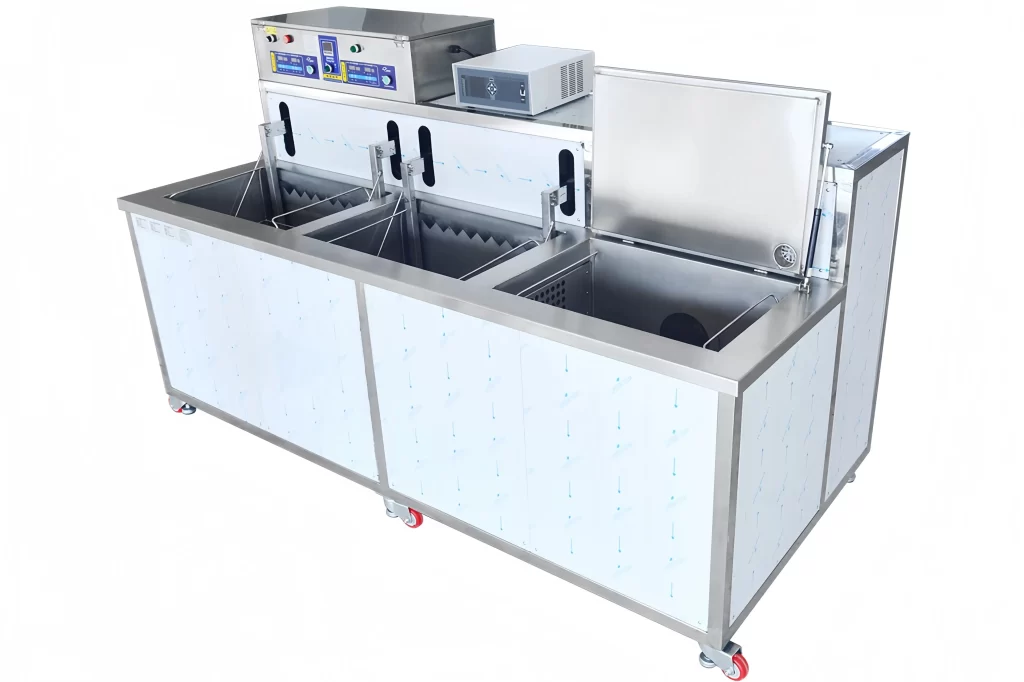
Mechanical action beyond cavitation also contributes. A rotating basket reorients the part continuously, exposing each blind hole to fresh cleaning solution and relocating it in the cavitation field. The same basket later helps draining.
| Part Feature | Recommended Frequency | Basket Type | Drying Method |
|---|---|---|---|
| Deep blind holes (>5× diameter) | 20–28 kHz + rotation | Rotary basket | Vacuum drying |
| Fine threads (M2–M6) | 40–80 kHz | Static with precise orientation | Compressed air knife then hot air |
| Cross-drilled passages | Dual frequency (28+40 kHz) | Custom fixture with rotation | Vacuum or blow-off + hot air |
| Large internal cavities with narrow openings | 20–28 kHz | Rotary or tilt-fixture | Hot air with extended cycle |
If your production involves parts with deep blind holes or cross-drilled passages, verifying basket compatibility and drying requirements before finalizing your BOM saves rework later. Send your part drawings and target cycle time to [email protected] for a specific recommendation.
Basket and Fixture Design for Blind Holes and Threads
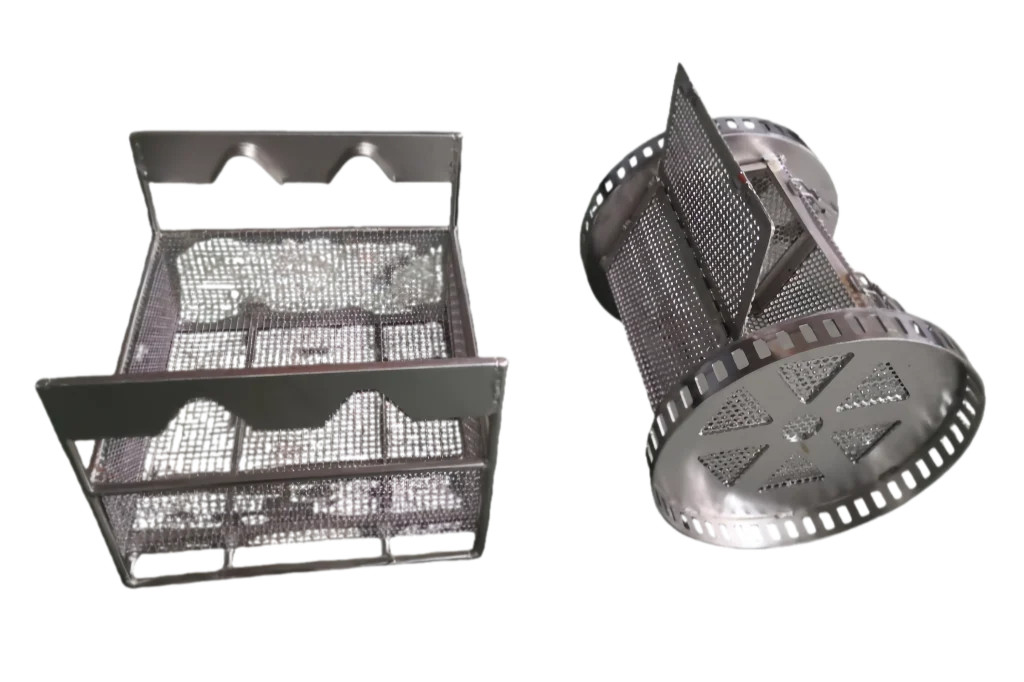
Standard wire baskets hold parts, but they do not solve the orientation and drainage problem. For a part with a deep blind hole, the basket must orient that hole so the ultrasonic beam aligns with its axis and later, so the liquid drains out rather than pooling. Rotary baskets compound the benefit. A 360° continuous rotation during cleaning ensures that every time the part passes through the ultrasonic field, the cavitation reaches the blind hole from a slightly different angle. In the rinsing and drying stages, rotation flings out trapped liquid. GTKCLEAN's rotary basket systems have been applied to automotive and bearing components where residual oil in blind holes is a known reject cause. Custom fixtures, often machined from stainless steel or engineering plastic, are worth the investment for production lines. They hold the part in exactly the position that maximizes ultrasonic penetration and aids drainage. I have worked on projects where a customer switched from a generic flat basket to a custom tilt-fixture, and the improvement in blind-hole cleanliness was immediate, cutting rework by more than half. The fixture also protects the part from contact damage, which matters for high-value aerospace or medical components.
Drying Strategies for Complex Parts After Cleaning
Drying is where many complex-geometry cleaning processes fall apart. A blind hole can carry cleaning solution through the rinse stage and out into the drying zone, leaving a water spot, a rust bloom, or a residue ring that compromises the part. Blow-off drying with compressed air knives works well for open surfaces but struggles with deep recesses; the air stream may not displace fluid at the bottom of a long blind hole. Hot air drying evaporates the liquid, but if the part is thick or the hole narrow, it can take too long. Vacuum drying changes the physics. Lowering the pressure inside the chamber causes any trapped liquid to boil at a temperature below its normal boiling point, and the vapor is then pulled out. This method reaches every surface uniformly, including those air cannot access. I recommend vacuum drying for parts where water or solvent retention is a risk. It adds a station but eliminates the hidden cost of re-inspection and rework.
Validating Cleanliness in Internal Passages
You cannot inspect what you cannot see. A visual check under white light confirms that external surfaces are clean, but it tells you nothing about the bottom of a blind hole 50 mm deep. For critical applications, standards such as ISO 16232 apply. A solvent flush of the blind hole followed by membrane filtration and microscopic analysis quantifies the residual particle load. In less critical applications, a borescope lets an inspector look inside and verify the hole is free of debris and water. The clean part requirement must be written into the process specification from the start. If you specify the cleaning machine but not the validation method, you end up with a system that cannot be proven to clean. I encourage engineers to define acceptance criteria for internal cleanliness before selecting equipment; the machine design, the basket, and the drying method then follow directly from that requirement.
Common Questions About Cleaning Complex Geometry Parts
Does a single ultrasonic frequency clean all the features of a complex part?
A single frequency can be sufficient if all internal features share similar dimensions and the contamination type is uniform. In most production scenarios, however, a complex part contains a mix of open surfaces, fine threads, and blind holes that respond differently. A single low frequency may clean the open areas but leave threads underprocessed; a single high frequency may not reach the bottom of a deep recess. A system with switchable or dual-frequency capability lets you design one process that addresses the range of geometries without repositioning the part.
When is a custom basket truly necessary for complex parts?
Many buyers assume a standard basket will work, and sometimes it does. If your part has a single deep blind hole that can be aligned with the ultrasonic beam in a stock basket, a custom fixture may not pay off. If the part must be processed in high volumes with consistent orientation, or if it contains multiple recesses at different angles, a custom basket repays its cost quickly through reduced rework. The decision should be based on a trial run. Test the part in a standard basket first, then decide whether the added consistency of a custom fixture is warranted.
What causes water spots or corrosion after cleaning complex parts?
In nearly every case, trapped rinse water is the root cause. A small quantity of liquid left at the bottom of a blind hole evaporates slowly, concentrating dissolved salts and forming a spot or corrosion site. Compressed air blow-off and hot air drying are not always enough to reach deep recesses. Vacuum drying removes this risk by boiling trapped liquid under reduced pressure and pulling the vapor out completely. If you are seeing recurring quality issues on internal features, check whether the drying stage can actually reach the deepest cavity in the part. If you are unsure, share your requirements and we will confirm which drying method fits your configuration, [email protected] or +86 17768507147.
If you're interested, check out these related articles:
How to Select the Frequency for Ultrasonic Cleaning Equipment ?
Ultrasonic Cleaning systems for Pre PVD (Coating) Parts
 English
  German
  Spanish
  French
  Russian
  Portuguese