
Ultrasonic cleaning system integration is not a catalog exercise. Over two decades of designing automated cleaning lines, I've seen integration projects fail because the engineering of part transfer, process timing, and system configuration was treated as an afterthought. The machine itself may clean perfectly in the lab, but once placed on a production line running at 200 parts per hour, it creates a bottleneck. This article addresses the engineering decisions that determine whether an ultrasonic cleaning system integrates seamlessly or becomes a recurring source of line stoppages.
The Engineering Demands of Ultrasonic Cleaning Integration
Connecting an ultrasonic cleaner to a production line means more than bolting a conveyor belt to the machine's inlet and outlet. The cleaning system must become a fully synchronized part of the overall manufacturing rhythm. Takt time, the maximum time allowed to produce a part to meet demand, governs everything. If your upstream operation delivers a part every 18 seconds, the cleaning station cannot take 25 seconds without creating buffer inventory or stopping the line. I've encountered this mismatch on several projects. One automotive supplier was running a high-pressure die-casting cell at a 22-second cycle. They selected a conveyor-based ultrasonic degreaser with a 30-second cleaning time, assuming they could just run two units in parallel. But the part orientation and transfer mechanism made paralleling impractical, and they ended up with a costly redesign.
Beyond timing, the control system integration is another engineering focal point. Modern ultrasonic cleaning lines from companies like GTKCLEAN use Siemens or Mitsubishi PLCs with industrial communication protocols (Ethernet/IP, Profinet, or Modbus TCP) that can talk directly to a factory's SCADA or MES. This allows the cleaning station to automatically adjust cycle parameters based on the part code called up by the line's central controller and log cleanliness data for traceability. Retrofitting this level of integration into an older line requires careful electrical and software engineering, but it is the difference between a "black box" cleaning station and a truly integrated process step.
Selecting the Right System Configuration
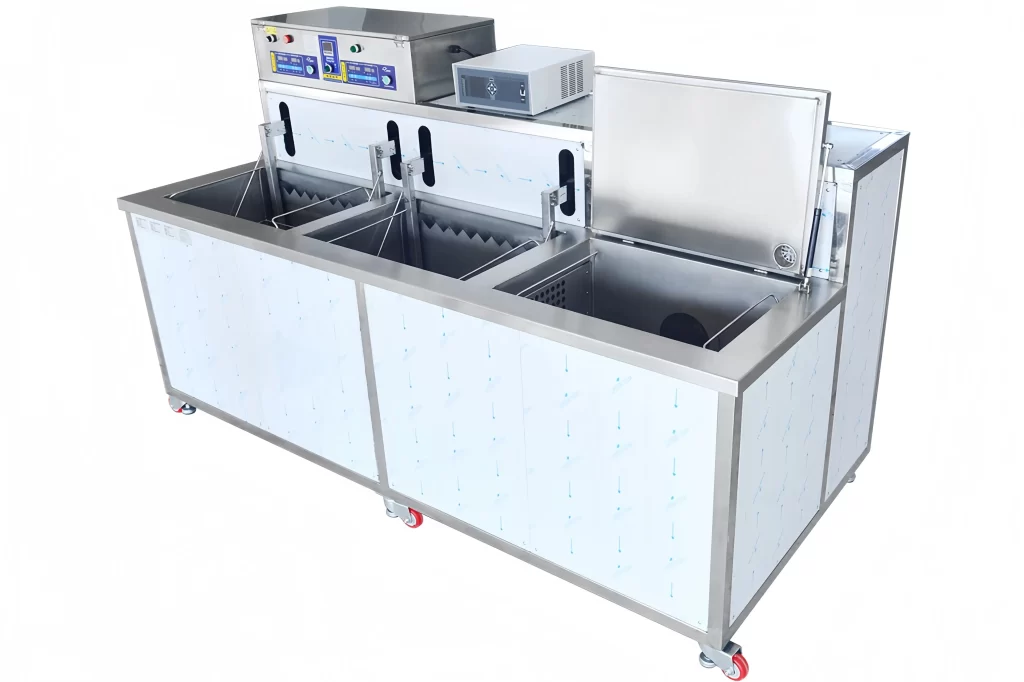
The first decision, and often the most consequential, is the mechanical layout of the cleaning line. The table below outlines the most common configurations and their typical application envelope.
| System Type | Part Handling Method | Typical Throughput | Best For |
|---|---|---|---|
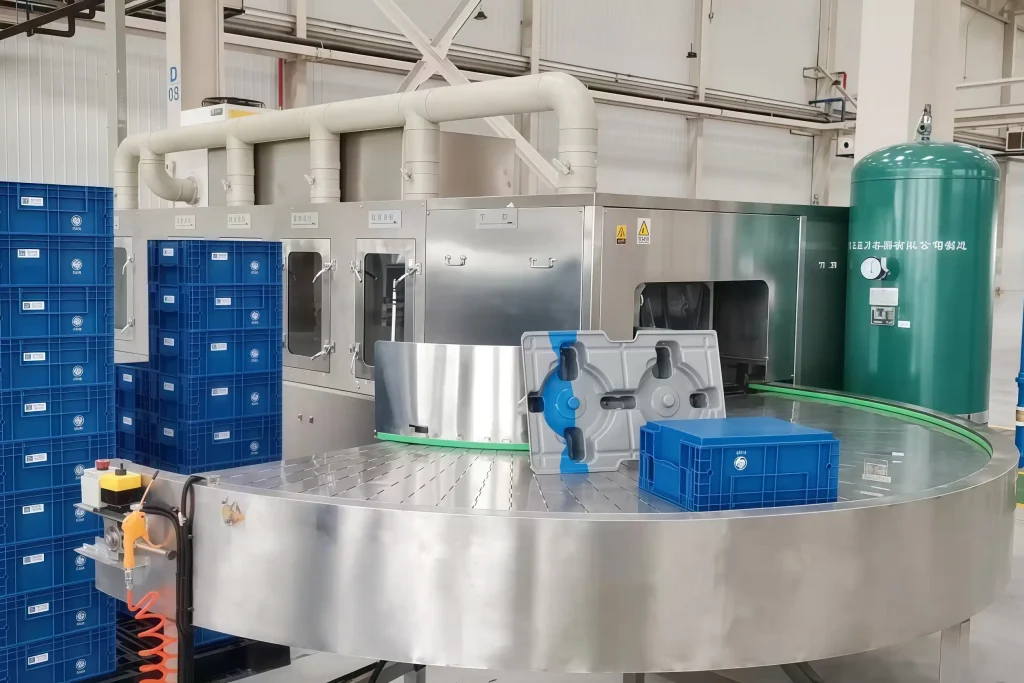
| Inline conveyor | Continuous belt or chain | 200–2000 parts per hour | Flat or regularly shaped parts with consistent orientation |
| Tunnel washer | Mesh belt or roller conveyor | 500–5000 parts per hour | Mass-produced fasteners, small stamped components |
| Pass-through robotic | Gantry or articulated arm | 50–200 parts per hour | Large, heavy, or complex parts requiring specific orientation |
| Multi-tank rotary | Rotary basket (360° rotation) | 10–100 baskets per hour | Parts with blind holes or internal cavities |
In my experience, the throughput figures in product literature often assume ideal conditions—simple part geometry, single detergent, and no drying complications. Real-world throughput can drop by 30% or more once you account for part loading/unloading, maintenance access, and occasional stoppages. For example, GTKCLEAN's CNC aluminum shell inline cleaner handles die-cast automotive parts with a conveyor width of 1000 mm and adjustable speed up to 0.8 m/min. That translates to a theoretical capacity of around 120 shells per hour, but in an actual line with manual loading and periodic air-knife inspections, we've seen stable rates closer to 85–90 per hour. Understanding this gap is essential when matching a cleaning system to your line's target output.
If your production line involves multiple part families with different cleanliness requirements, the configuration exercise becomes more involved. In such cases, a multi-tank system with bypass lanes or a robotic pass-through unit that can call up different cleaning recipes offers the flexibility to avoid tooling changeovers that halt the line.
Synchronizing Process Timing with Production Line Speed
Making the cleaning cycle match the upstream and downstream pace is where most integration projects need the most detailed engineering. The total cleaning cycle time includes fill/drain, ultrasonic energy application, rinse stages, drying, and part transfer. If your production line runs at a steady 10 parts per minute, then the cleaning system must complete its work inside a 6-second-per-part window (including transfer overhead). For reference, a typical aqueous multi-stage ultrasonic degreaser with a hot-air drying stage needs 5–8 minutes per batch. So batch processing must be sized to accumulate enough parts in a basket or on a conveyor to achieve the required throughput without creating excessive buffer waiting time.
A useful calculation: determine the maximum basket load (by part geometry and weight), divide the cleaning cycle time by the basket capacity, and compare to your production line's parts-per-minute requirement. If the cleaning system throughput is too low, you either need a larger basket, a parallel second module, or a reduction in cleaning time—which may compromise cleanliness. I've often advised clients to build in a 15–20% throughput margin when specifying the cleaning line, to accommodate minor line speed increases without future capital expenditure.
The transfer mechanism between the line and the cleaning station also consumes time. A robotic pick-and-place arm may need 3–5 seconds per part, while a direct conveyor-to-conveyor handoff can be nearly immediate if the part orientation is maintained. The choice between these approaches depends on your tolerance for cumulative cycle time and the fragility of your parts.
Part Handling and Transfer: Preventing Line Downtime
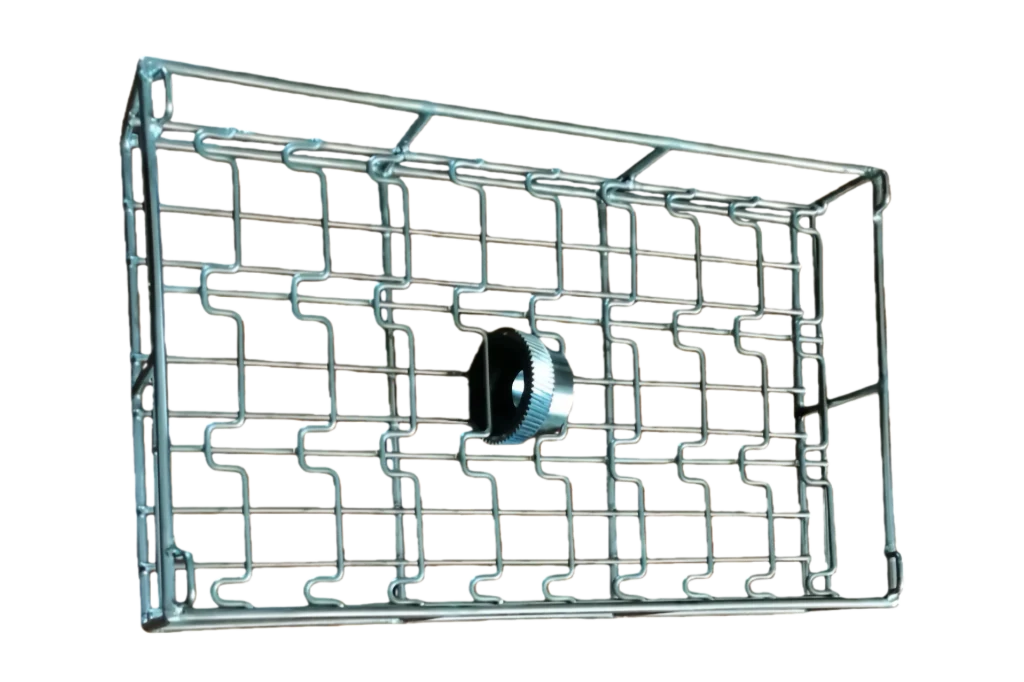
Workpiece handling is the silent failure mode in many integration projects. A standard wire-mesh basket works well for symmetrical parts that self-orient under gravity. But parts with blind holes, threads, or complex internal cavities need custom fixturing to ensure the ultrasonic cavitation reaches every surface and that the part does not trap liquid during draining. If your production line handles a family of parts with different geometries, the cleaning system's part holding must accommodate them without manual changeover—otherwise every product switch becomes a line stoppage.
GTKCLEAN's industry washing baskets are designed with this in mind: stainless steel construction tailored to workpiece shape, weight, and cleaning requirements. For parts with deep blind holes, a rotary basket that turns 360° during the cleaning and drying phases pushes trapped air out and allows complete fluid exchange. On one project involving automotive oil pump housings, we found that a static basket left 20% of parts with residual machining chips in the blind drilling. Switching to a rotary basket with dedicated holding nests eliminated the issue entirely, cutting rework rates to below 0.5%. The upfront cost of custom fixturing is modest relative to the cost of line downtime or field returns due to contamination.
Automated loading and unloading systems also reduce the operator dependence that causes throughput variability. For high-volume lines, robotic loading integrated with the line's part-present sensors ensures that no empty baskets are sent through the cleaning cycle, saving energy and detergent while keeping the line rhythm consistent.
Cost and Performance Validation in Integration Projects
The financial analysis for an integrated ultrasonic cleaning system must extend beyond the equipment purchase price. Key cost drivers include the cost of custom part handling fixtures, any required modifications to existing conveyors or guarding, the engineering time for PLC integration, and the recurring costs of detergent, water, and energy. I've found that a thorough Total Cost of Ownership (TCO) analysis, factoring in reduced rework, scrap, and labor savings, typically returns a payback of 12–18 months for an automated cleaning line replacing manual or semi-automatic processes.
A formal Factory Acceptance Test (FAT) and Site Acceptance Test (SAT) are non-negotiable steps in an integration project. The FAT validates that the cleaning system meets cleanliness specifications using your actual parts and detergent, at the specified throughput, before the machine leaves the factory. The SAT verifies that, once installed and connected to your production line's controls, the same performance is reproducible. I always recommend including a joint commissioning period of at least one week during which your production and engineering teams work alongside the cleaning system supplier's technicians to optimize parameters under real line conditions. This period almost always reveals subtle integration details—an accumulation of chips at a transfer point, a mist that affects an adjacent station—that are far cheaper to address during commissioning than after full production ramp-up.
When you begin planning an ultrasonic cleaning integration, involving the system design engineer in early-stage line layout decisions avoids many of these late-cycle issues. Sending part CAD data, production rate targets, and cleanliness requirements to a manufacturer with deep engineering capability sets the project on a solid footing. Reach our engineering team at [email protected] or call +86 17768507147 to discuss your specific line integration challenges.
Common Questions About Ultrasonic Cleaning Integration
How do I integrate ultrasonic cleaning into an existing production line without stopping production?
The most effective approach is to design the cleaning station as a parallel or bypass loop that can be connected to the main conveyor via a divert gate. During initial installation, parts are temporarily cleaned offline. Once the cleaning system is commissioned and validated, the diverter is activated to route parts through the new cleaning line. This strategy requires careful planning of conveyor elevation changes and part transfer mechanisms but keeps the main line running. I've used this method on several retrofits, and while it adds engineering cost upfront, the avoided production downtime usually justifies it within the first few months of operation.
What is the difference between inline and tunnel ultrasonic washing systems?
An inline system typically uses a belt or chain conveyor that carries individual parts or small batches through the washing stages. A tunnel system employs a continuous mesh belt that moves products through a fully enclosed tunnel housing, with spray bars and ultrasonic immersion zones within. Tunnel washers are generally better suited for high-volume, small-parts cleaning where containment of mist and heat is critical. Inline systems offer more flexibility for mixed-part production where part orientation needs to change between stages. The choice depends on part geometry, throughput, and factory floor layout.
How do you handle parts with blind holes or complex geometries in an automated line?
Parts with blind holes trap air and contaminate the liquid, blocking ultrasonic cavitation. The solution is to incorporate a rotating basket or part-specific fixturing that tilts the part during immersion to allow air to escape. In some cases, we add a vacuum evacuation step before ultrasonic processing to pull air from internal cavities. The fixturing design must also ensure that liquid drains completely during the drying phase, preventing water spots and corrosion. Our experience with automotive and aerospace components shows that this level of attention to part handling is the difference between a 95% first-pass yield and 99.8%.
What is the typical ROI for integrating automated ultrasonic cleaning?
The payback period varies by application, but most automated ultrasonic cleaning integrations show a return within 12–18 months. Savings come from three main sources: reduced manual labor, lower rework and scrap rates due to consistent cleaning, and decreased chemical and water usage through automated dosing and filtration. In one comparison, a manual ultrasonic bench operation required three operators per shift and yielded a 7% rework rate, while an automated inline system needed one operator to oversee two lines and cut rework to under 1%. Your specific ROI depends on your production volume and current cleanliness costs—sharing those numbers with our team leads to a detailed projection.
What are the most common integration mistakes?
I see three recurring failures. First, underestimating the transfer time between the production line and cleaning station, which slows the overall line pace. Second, using a standard basket without validating it with actual parts, leading to part damage or incomplete cleaning. Third, ignoring the factory's electrical and network infrastructure, which causes integration delays during commissioning. The best way to avoid these mistakes is to involve the cleaning system engineer during the early stages of line layout design, not after the conveyors are already installed. If you have a new line or retrofit under consideration, send your line specifications and part data to [email protected] to start the engineering conversation before the project is locked in.
If you're interested, check out these related articles:
Automated Cleaning Equipment: A Beginner’s Industrial Guide
Budgeting for Industrial Cleaning Equipment Upgrades A Strategic Guide
Why Coating Manufacturers Choose GTKCLEAN Pre-Coating Cleaning Equipment
 English
  German
  Spanish
  French
  Russian
  Portuguese